Runes & Symbols
Viking Symbols and Their Meaning
Viking symbols and their meaning explained: Mjölnir, Valknut, Vegvísir and more - what's actually confirmed by archaeology and what came centuries later.

Contents
- Mjölnir: The Hammer People Actually Wore
- The Valknut: Three Triangles, Plenty of Questions
- The Vegvísir: The “Viking Compass” That Wasn’t
- Ægishjálmur: The “Helm of Terror”
- Yggdrasil and the Web of Wyrd
- Odin’s Marks: Gungnir, Ravens, and the Triquetra
- Runes as Their Own Category of Symbol
- How the Mix-Up Happened in the First Place
- What Actually Comes From Graves and Rune Stones
- A Nod Toward Ragnarök and the End
- The Bottom Line: Two Traditions, One Shared Legacy
Few topics get scrambled online quite as thoroughly as Viking symbols and their meaning. Walk into any tattoo studio and you’ll find Mjölnir hanging next to a Valknut next to some symbol someone half-remembers from a fantasy novel, all labeled with equal confidence as “ancient Viking signs.” Some of them genuinely are Viking Age artifacts, pulled from graves, carved into rune stones, dated to the 9th or 10th century. Others come from Icelandic magic books written when the Viking Age had already been over for two hundred years. Anyone who takes these symbols seriously should know the difference, not to spoil the fun, but because the real history is more interesting than the myth anyway.
Mjölnir: The Hammer People Actually Wore
Start with the symbol that has the strongest evidence behind it. Mjölnir, Thor’s hammer, was demonstrably worn as jewelry during the Viking Age, and in real numbers. Archaeologists have recovered hundreds of hammer-shaped pendants in silver, bronze, and iron, scattered across Scandinavia, England, and even Russia along the Rus trade routes. The best-known find comes from Skåne in southern Sweden: a 10th-century silver pendant bearing a runic inscription that most likely reads “hammer.”
The timing is what makes it interesting. Mjölnir pendants seem to spike in popularity precisely as Christianity gains ground across Scandinavia, from the 9th into the 11th century. Some historians read that as a deliberate statement, a pagan counterpart to the Christian cross, which starts turning up in graves during the same period. In the Prose Edda, compiled around 1220 by the Icelandic scholar Snorri Sturluson, Mjölnir is described as a weapon that never misses its target and can split mountains, forged by the dwarf brothers Brokkr and Eitri, its handle left too short thanks to one of Loki’s tricks. For the full story behind the hammer’s owner, see our piece on Norse gods.
The Valknut: Three Triangles, Plenty of Questions
The Valknut, three interlocking triangles, appears on several Viking Age rune stones and grave finds, most famously on the Stora Hammars I stone on Gotland and in carved scenes tied to funerary ritual. The name itself is modern, built from Old Norse valr (“the slain”) and knut (“knot”). What the Vikings themselves actually called the symbol, we simply don’t know.
What it meant is still an open question in scholarship. The most common reading links the Valknut to Odin and the cult of the dead: some researchers see it as a marker for warriors slain in battle and welcomed into Valhalla, while others connect it to shamanic binding or trance states associated with Odin’s power to paralyze or “bind” fighters in combat. The motif also shows up in textile finds, notably in the famous Oseberg ship burial. Very little here is settled fact, but that very uncertainty is part of why the Valknut remains one of the most debated symbols in all of Norse iconography.
The Vegvísir: The “Viking Compass” That Wasn’t
This is where a lot of online guides get sloppy. The Vegvísir (“way-finder”), a round symbol with eight staff-like arms radiating outward, gets marketed constantly as an ancient Viking navigation talisman. It isn’t. The Vegvísir comes from the Icelandic Galdrabók, a collection of magical staves (galdrastafir) compiled in the 17th century, a good 600 years after the Viking Age had ended.
That doesn’t make the symbol worthless or uninteresting; quite the opposite. Icelandic folk magic of the 16th and 17th centuries is a fascinating chapter of Norse cultural history in its own right, with its own visual language and its own charms that were never meant to fade away. The manuscript describes the Vegvísir as a sign meant to keep its bearer from losing their way in storms or on unfamiliar paths, a charming idea, but one from the early modern period, not from Viking sailors who crossed the North Atlantic in a Viking longship, navigating by sun position, bird flight, and wave patterns rather than magical staves drawn on vellum.
Ægishjálmur: The “Helm of Terror”
Much the same applies to the Ægishjálmur, the “helm of terror” or “helm of awe,” a symbol built from eight trident-like arms radiating from a central point. This one, too, is known chiefly from early modern Icelandic magic books, again from the Galdrabók tradition. The name itself, however, really is older: in the Fáfnismál, a poem in the Poetic Edda, the dragon Fáfnir boasts that he carries the “Ægishjálm” over all creatures and that none dare stand against him.
Here’s the catch: the Fáfnismál never describes a concrete graphic form. The eight-armed symbol sold today as the Ægishjálmur is a later addition from the Icelandic galdrastafir tradition, which grafted a new image onto an old name. It’s a neat example of how a genuine Viking Age word and a symbol invented centuries later fused into what looks, at a glance, like a single ancient unit.
Yggdrasil and the Web of Wyrd
Yggdrasil, the immense world tree connecting all nine realms of Norse cosmology, isn’t really a graphic symbol at all in the strict sense but a mythological structure, described in the Völuspá and in Snorri’s Prose Edda. Even so, it’s routinely rendered as a tree motif and used in jewelry and tattoos, usually with stylized roots reaching into the underworld and branches climbing toward the sky. Readers who want the mythology in full can find it in our article on Yggdrasil, the World Tree.
The so-called Web of Wyrd (“net of fate”), a grid formed from nine crossing lines, tends to get mentioned in the same breath as the Norns, the three fate-weaving women who sit at Yggdrasil’s roots. Here too, the honest answer is that there’s no archaeological evidence for this specific grid pattern from the Viking Age. The link some modern interpretations draw between the Web of Wyrd and the Elder Futhark runes is a later invention, not a documented Viking Age tradition.
Odin’s Marks: Gungnir, Ravens, and the Triquetra
Odin himself is written into several symbols. His spear Gungnir, also forged by dwarves and described in the Prose Edda, never misses its mark, a weapon whose image appears on picture stones like the famous Ardre VIII stone on Gotland, where an eight-legged horse (presumably Sleipnir) and a spear-bearing figure are both carved. Odin’s two ravens, Huginn and Muninn (“thought” and “memory”), fly out over the world each day according to the Völuspá and Snorri’s account, returning to tell Odin what they’ve seen, a motif echoed in the famous raven banner, which several Anglo-Saxon chronicles report Viking armies carrying into England during the 9th and 10th centuries, including in the wake of the Lindisfarne raid.
The Triquetra, a three-cornered knot formed from three interlocking arcs, gets marketed as “Odin’s horns” or a purely Norse symbol, but it genuinely turns up in both pre-Christian Celtic contexts AND Viking Age Norse ones, including on rune stones and even on coins minted in York, Viking-era Jórvík. Its precise meaning in a Norse setting remains unclear; it seems to have been used in parallel by multiple cultures, each attaching its own significance to it.
Runes as Their Own Category of Symbol
Worth remembering here: individual runes themselves were understood as symbols carrying their own power, not merely as letters. Readers who want to understand how the Elder Futhark is structured, and why runes like Fehu or Ansuz carry layered meanings beyond their sound value, will find a full introduction in our article on the Elder Futhark runes. It’s enough to note here that runic inscriptions bearing protective formulas or curses show the line between writing and symbolic magic was already blurry within the Viking Age itself, long before Icelandic galdrastafir carried that tradition forward into the late medieval and early modern periods.
There’s no contradiction in a symbol from the 17th century still being “authentically Norse.” The error isn’t in the symbol itself, it’s in the claim that it came straight from Ragnar Lothbrok or his contemporaries.
How the Mix-Up Happened in the First Place
Why do symbols from such wildly different centuries all get filed under the same “Viking symbol” label today? Part of the answer lies in Iceland’s unusual cultural continuity. Settled by Norwegians in the 9th century, Iceland remained linguistically and culturally conservative for centuries afterward. The galdrastafir of the 16th and 17th centuries weren’t invented in a vacuum; they emerged from a society that still spoke a language close to Old Norse and still knew the old sagas by heart, which makes the later blending with genuine Viking Age imagery understandable, if not historically accurate.
The rest of the answer is simple marketing, dating back to the 19th-century Viking revival and amplified by two decades of television and pop culture: “Viking” sells better as a label than “early modern Icelandic folk magic,” even where the latter would be the more accurate description.
What Actually Comes From Graves and Rune Stones
Weighing the evidence gives a fairly clear picture. From the Viking Age itself, backed by archaeological or written evidence from the 8th through 11th centuries:
- Mjölnir - hundreds of pendant finds, runic inscriptions
- Valknut - picture stones, grave finds, textile finds from Oseberg
- Gungnir and Odin’s ravens - picture stones, Snorri’s Prose Edda, Anglo-Saxon chronicles
- Elder and Younger Futhark runes - thousands of inscriptions on stone, wood, and bone
From later centuries, mostly the Icelandic magical tradition of the 15th through 17th centuries:
- Vegvísir - Galdrabók, 17th century
- Ægishjálmur in its current graphic form - galdrastafir tradition, though the name itself is older
- Web of Wyrd - no documented historical origin before the 20th century
None of this is a reason to avoid the later symbols. It’s a reason to be honest when explaining them, especially since the real history, with its gaps, reinterpretations, and centuries-long threads of tradition, is more compelling than any smoothed-over legend could be.
A Nod Toward Ragnarök and the End
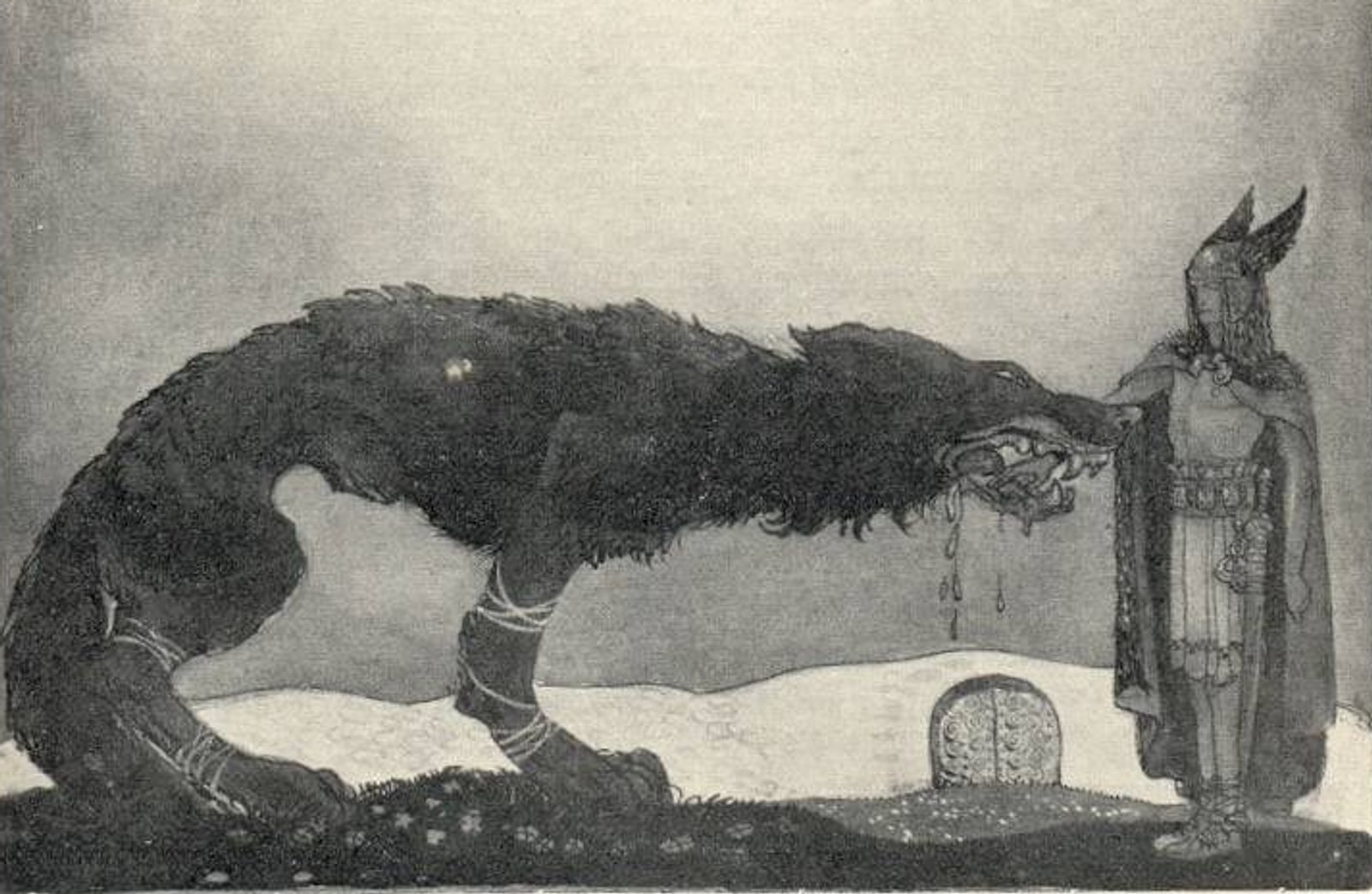
Many of these symbols are tightly bound up with the Norse sense of fate and doom: Odin’s ravens bringing word of coming destruction, the Valknut marking death in battle, Mjölnir as the gods’ last line of defense in the final battle. Readers who want the larger story these symbols belong to should turn to our article on Ragnarök, the twilight of the gods, the framing narrative that gives the whole Norse symbolic world its meaning.
The Bottom Line: Two Traditions, One Shared Legacy
In the end, one simple but important point remains: you can’t understand Viking symbols and their meaning without accounting for time. Some of these signs really did lie in the graves of men and women who lived in the 9th century. Others weren’t created until the Viking Age was already history, in an Icelandic society that preserved that past, reinterpreted it, and charged it with its own brand of magic. Both traditions deserve respect, just not the same timestamp.