Warriors & Battles
The Raid on Lindisfarne: The Day the Viking Age Began
In 793 AD, Norsemen sacked the monastery of Lindisfarne. Why this raid shook all of Europe and is remembered as the dawn of the Viking Age.

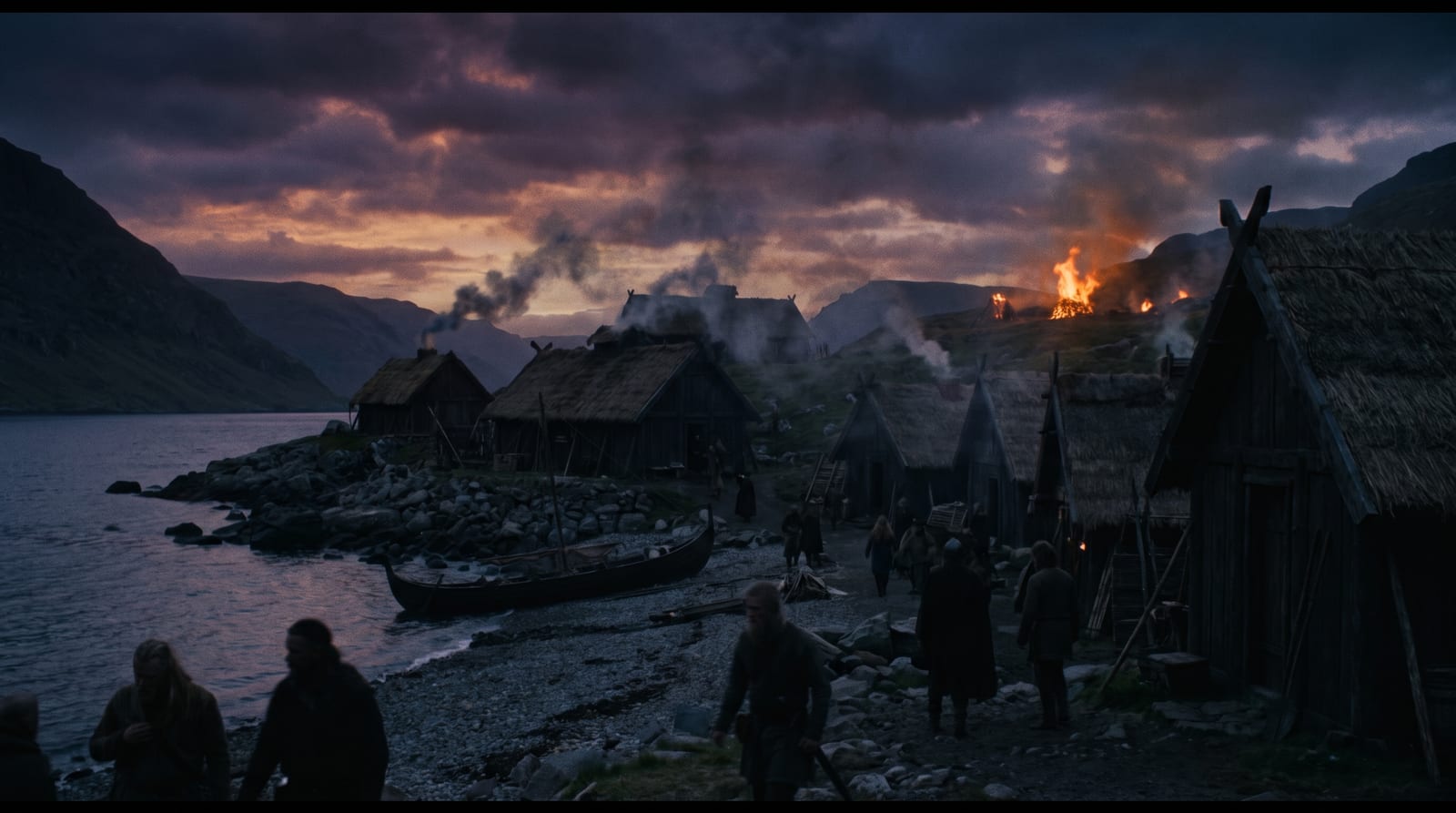
Some days announce the arrival of a whole era. The 8th of June, 793, was one of them-though no one on that small island off the coast of Northumbria could have guessed it that morning.
Lindisfarne was no ordinary place. Its monastery was reckoned one of the holiest in all of England, a centre of learning where monks pored over precious manuscripts and guarded sacred relics. It lay open to the sea, undefended-for who, after all, would dare to attack a house of God?
The men who emerged from the mist that morning had simply never asked the question.
What Happened That Morning
The sources are thin, and that is part of the problem: almost everything we know comes from the victims and their contemporaries, not from the attackers. The Anglo-Saxon Chronicle records, in sparse but shaken words, “dire portents”-whirlwinds, lightning, and reportedly even fiery dragons streaking across the sky.
What followed was real enough. The Norsemen plundered the church, killed some of the monks, drowned others in the sea, and carried off the youngest as slaves. The precious treasures of the church-gathered over generations-vanished into their ships.
“Never before has such terror appeared in Britain as we have now suffered from a pagan race.”
So wrote the scholar Alcuin of York, who was serving at the court of Charlemagne at the time. In his letters you sense less the cool detachment of a chronicler than the raw disbelief of a man whose entire view of the world has just begun to crack.
Why This Raid Changed Everything
There had been raids before. What set Lindisfarne apart was not so much the brutality as its symbolic power. A holy place, believed untouchable, had been desecrated in a single morning. For Christian Europe this was not merely a military blow but a spiritual one.
And it was only the beginning. In the years that followed, more monasteries met the same fate-Jarrow, Iona, and dozens more strung along the coasts. The Norsemen had discovered a weakness: rich, poorly defended targets, all reachable by sea.
Historians still argue over why Scandinavian expansion should have begun precisely then. The usual explanations run as follows:
- Overpopulation and a shortage of land in Scandinavia
- A technological edge in the shape of the superior longship
- Political pressure from the centralisation of power back home
- Or, quite simply, the knowledge that there was plunder to be had in the south
In all likelihood it was a mixture of all of these. No single event explains a movement that would shape three centuries.
The Legacy of Lindisfarne
Today a priory stands on Lindisfarne once more-a ruin from a later age, the silent witness of an island that has won back its peace. The famous Lindisfarne stone, carved with warriors brandishing raised weapons, is often linked with the raid.
What endures is the memory of a turning point. In the history books, 793 marks the beginning of the Viking Age-those roughly 250 years in which Norsemen traded, settled, founded kingdoms, and yes, also plundered, from Newfoundland to Baghdad.
It began with mist over a small island. And with men who did not stop to ask the wrong question.