Mythology
Tyr: The One-Handed Norse God of Law and War
Tyr, the Norse god of law and war: why he put his right hand into Fenrir's jaws, what the t-rune really meant, and how his name once simply meant god.
Contents
Of all the Aesir, Tyr has the thinnest surviving story and the hardest single scene. The Norse god of law and war appears rarely in the sources, and when he does, usually in one image: a hand laid between a wolf’s teeth so that a contract can be concluded, a contract every other god present already intends to break. Knowing Tyr through that hand alone means knowing the essential part of him. It also means missing the ancient sky god behind the one-handed Aesir, whose name once meant nothing more specific than “god”, and who had been pushed aside in the north long before the Eddas were written down.
The evidence is lopsided. Snorri Sturluson gives him a handful of lines in the Prose Edda, the Poetic Edda gives him two appearances, and both contradict Snorri on one basic point. In return, Tyr has what most Norse gods lack: traces outside literature. A Roman-era altar, place names, two rune poems that remember him differently, and a weekday half of Europe still names after him.
What the Sources Say About Tyr, the Norse God of Law
In Gylfaginning, Snorri is brief but exact. Tyr is the boldest and most courageous of the gods, he has great power over victory in battle, and brave men do well to call on him. Snorri adds that he is wise, and backs both claims with two words that were part of everyday speech: a very brave man was called tyhraustr, “Tyr-bold”, a very clever one tyspakr, “Tyr-wise”. A god whose name turns into ordinary adjectives was not a marginal figure.
Then comes the line that sets up everything else. Tyr, Snorri writes, is not called a reconciler of men. That is a definition of jurisdiction, not a throwaway remark. He is not the god who smooths quarrels over; he is the god in whose presence quarrels are conducted by rule. Norse law was not a state of harmony. It was a procedure in which violence remained an admissible answer.
In Skaldskaparmal, Snorri’s handbook for poets, the approved ways to name him are listed: the one-handed god, the feeder of the wolf, the god of battles, the son of Odin. That is the whole inventory. No hall, no named wife, no cycle of adventures. For the god who named Tuesday that is remarkably little, and the gap is the most interesting thing about him.
The Binding of Fenrir: A Legal Case With Teeth
The one full narrative sits in Gylfaginning, and it reads like litigation. The gods had raised Fenrir, Loki’s wolf son, inside Asgard on the theory that they could watch him there, and only Tyr was willing to walk up and feed him. When the animal grew faster than expected and the prophecies sharpened, the gods decided to bind him.
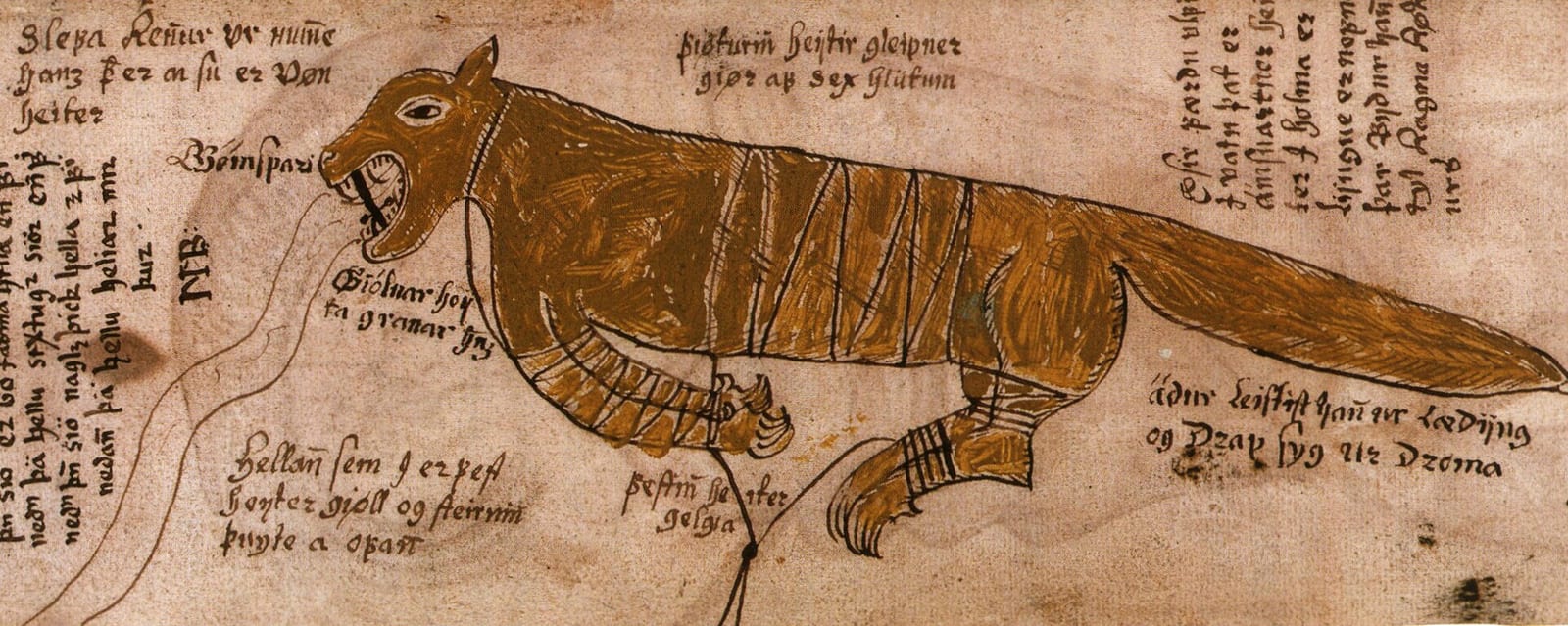
Twice they tried it openly. The fetter Laeding burst at the wolf’s first stretch, and Dromi, twice as strong, went the same way. Snorri records that both became proverbs for anyone who forces their way out of a tight spot. The gods had now proved to Fenrir, twice, that he was stronger than their best work.
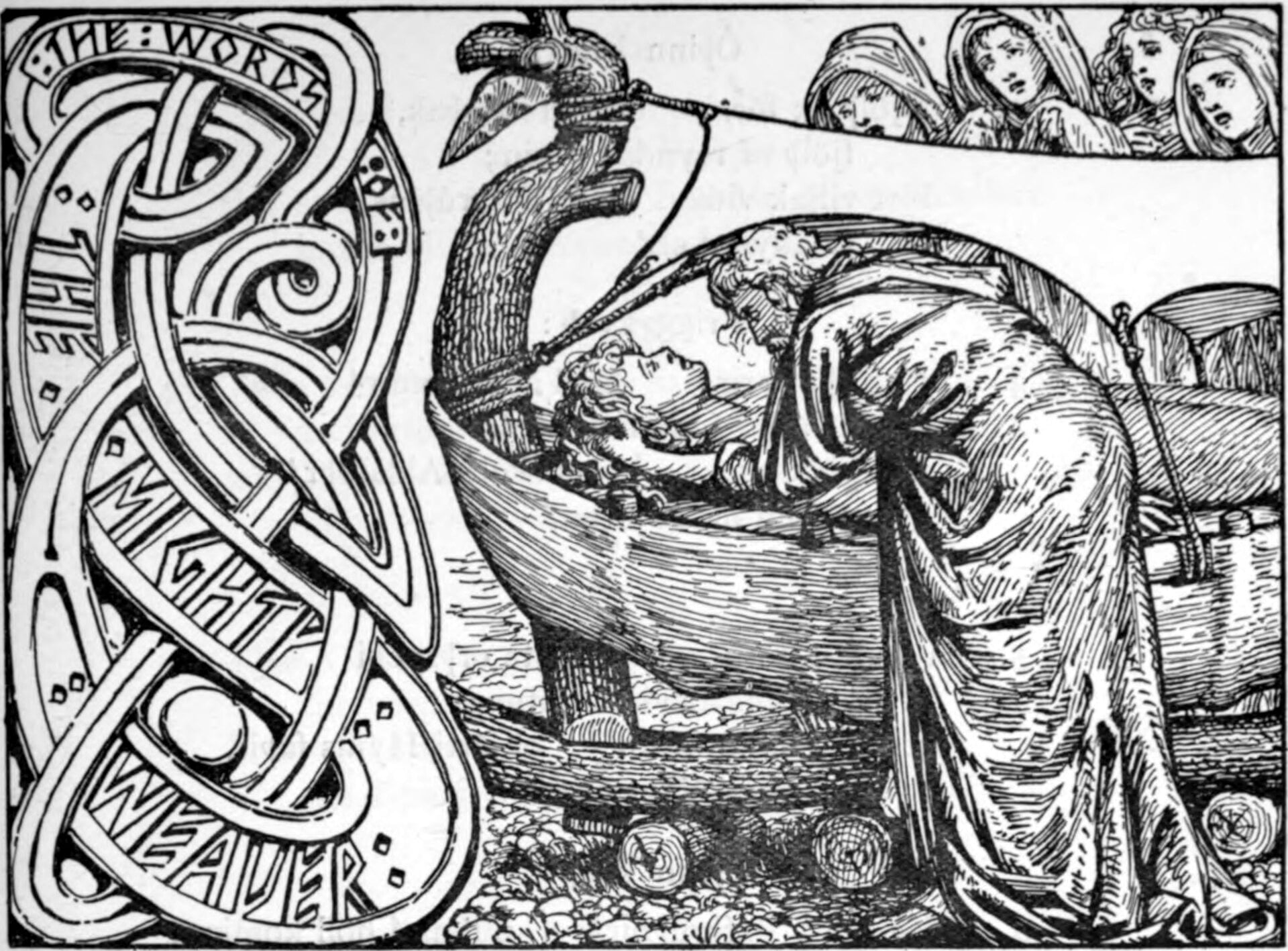
So Odin sent the messenger Skirnir down to the dwarfs of Svartalfheim, and they made Gleipnir: a ribbon as soft as silk, spun from six things that do not exist. The sound of a cat’s footfall, a woman’s beard, the roots of a mountain, the sinews of a bear, the breath of a fish, the spittle of a bird. Snorri adds an explanation that shows how seriously medieval storytellers took their own internal logic: those six things are missing from the world today because they were used up back then.
On the island of Lyngvi in the lake Amsvartnir, the gods invited the wolf to a test of strength. Fenrir was not stupid. He saw a ribbon too flimsy for glory and too smooth to be honest, so he set a condition, and it was legally sound: if the band was made with trickery, one of the gods should lay a hand in his mouth as a pledge. Nobody moved. Everyone understood the demand was fair, and that the pledge would never be honoured.
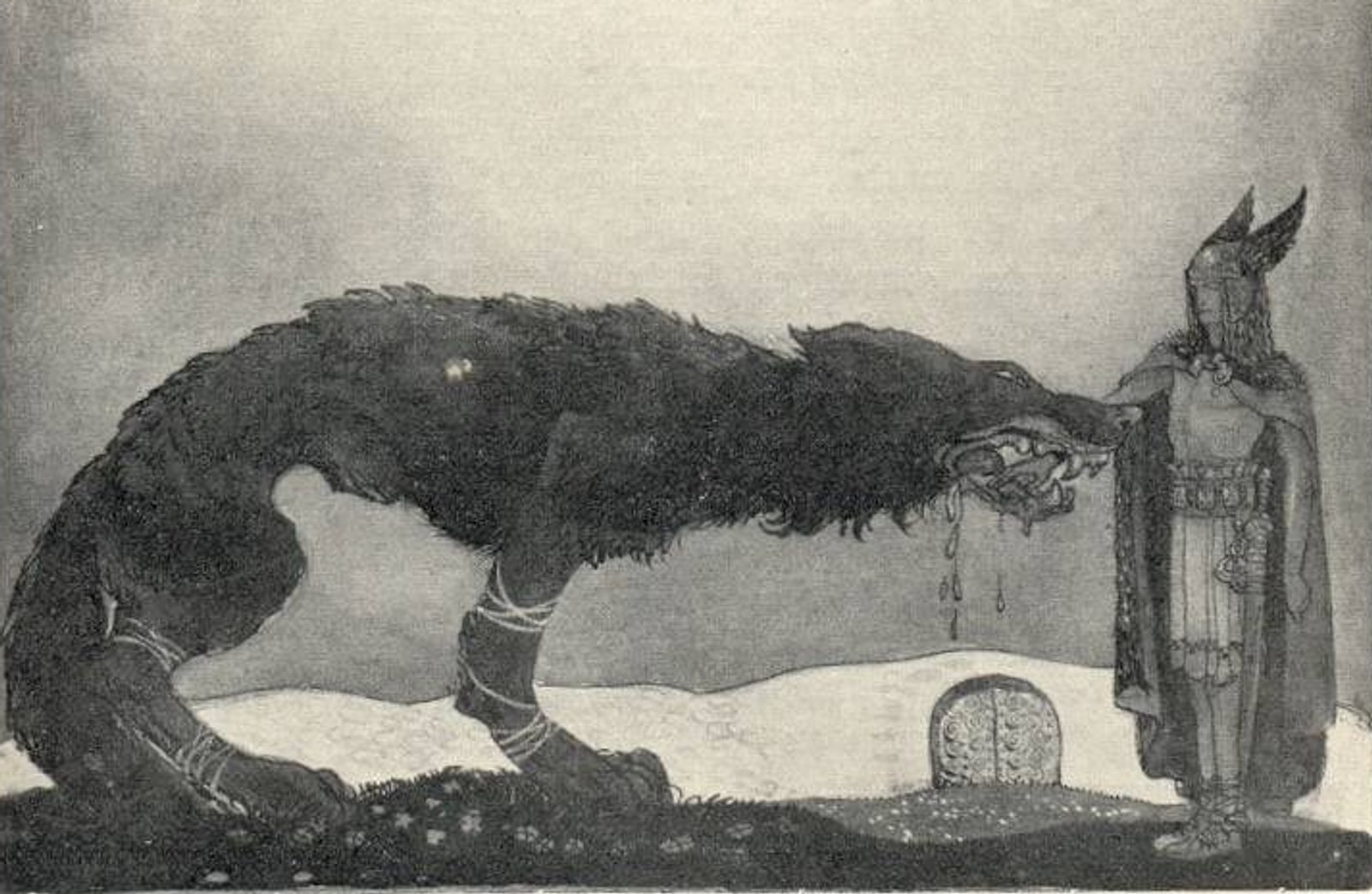
Tyr held out his right hand.
The wolf let himself be tied, then strained, and the harder he fought the tighter Gleipnir held. The gods laughed, Snorri says. All of them except Tyr, who lost his hand. Fenrir bit it off at the ulflidr, the “wolf joint”, which is simply the Old Norse word for the wrist. The language carried the story.
Put Tyr on while you read the rest:
The bound wolf was dragged off by the chain Gelgja, run through the stone Gjoll and made fast to the rock Thviti. When Fenrir snapped at them, they drove a sword into his jaws, hilt in the lower jaw, point in the palate. From his drooling, Snorri says, runs the river Van. There he lies until Ragnarok.
Son of Odin, or Son of a Giant?
Snorri calls Tyr a son of Odin. Hymiskvida in the Poetic Edda does nothing of the kind. There, Thor and Tyr travel together to the giant Hymir to collect the enormous cauldron in which ale is to be brewed for the gods, and Tyr says outright that Hymir is his father. His grandmother in that poem has nine hundred heads; his mother is bright and gold-adorned and slips her son the ale in secret.
There is no tidy way around the contradiction. Two regional traditions may have run in parallel; Snorri may have filed Tyr into Odin’s family because his systematising prose demanded a family tree; or the word tyr in older verse was read as the general noun for “god” and only later attached to one person. Anyone who tells you the question is settled has gone past the sources.
A Name That Used to Mean “God”
Linguistically, Tyr is the oldest Norse god we can reach. Old Norse Tyr goes back to the reconstructed Proto-Germanic Tiwaz and from there to the Indo-European root dyeus, the bright daytime sky. The same root sits inside Greek Zeus, Latin Jupiter and deus, and Sanskrit Dyaus Pitar. Etymologically, Tyr is the Norse Zeus.
Within Old Norse itself, tyr became the ordinary word for a god, the plural tivar meaning simply “the gods”. And which god carries that syllable most often in his by-names? Odin. Hangatyr, god of the hanged. Sigtyr, god of victory. Farmatyr, god of cargoes. The old sky god’s name became a title his successor wore: a change of throne recorded in vocabulary.
The Romans did what they always did and matched the Germanic war god to their Mars. Dies Martis became Old Norse Tysdagr, Old English Tiwesdaeg, English Tuesday, Danish tirsdag. German took a side road and built Dienstag on Thingsus, the god of the Thing, the legal assembly. Which is exactly the point of him.
What Survives Outside the Eddas
This is where Tyr gets solid, because he is one of the few Norse gods with a trail outside Icelandic manuscripts.
| Evidence | Date | What it shows |
|---|---|---|
| Altar to “Mars Thingsus”, Housesteads on Hadrian’s Wall | 3rd century AD | Frisian troops tie the war god directly to the Thing |
| Place name Tisso, Zealand, Denmark | Viking Age | ”Tyr’s lake”; a magnate site with weapon offerings, excavated by the National Museum of Denmark |
| Danish names such as Tislund and Tiset | Viking Age | A Tyr cult concentrated in Denmark, almost absent in Iceland |
| Norwegian and Icelandic rune poems | 13th to 15th century | Both open the t-rune with “Tyr er einhendr ass”, the one-handed god |
| Old English Rune Poem | manuscript, 10th century | Calls Tir a star that keeps faith with princes and never leaves its course |
| Gylfaginning, Hymiskvida, Lokasenna | 13th century, older verse behind them | The whole narrative tradition: three appearances, three roles |
The distance between the two rune poems is the most revealing line in that table. In Scandinavia the t-rune is the god with the missing hand. In England it is a dependable star above the night mist. One rune, two different memories of the same name.
Sigrdrifumal adds a practical instruction: cut victory runes into the sword hilt and name Tyr twice while doing it. It is one of the rare Eddic stanzas that reads like an operating manual.
One modern footnote belongs here: the t-rune was taken up in the twentieth century by the SS as a badge for its officer schools, and still works as a far-right marker in parts of Europe. That has nothing to do with the Viking Age.
Ragnarok and the Last Argument
In Lokasenna, the flyting in which Loki insults every god in the hall by turn, Tyr gets his share. Loki tells him he was never able to make peace between two men, and reminds him about the hand. Tyr answers dryly that he lost a hand while Loki lost the wolf, and neither came out well. Loki then claims Tyr’s wife bore him a son. That wife appears nowhere else. A hole in the record, not a mystery.
For Ragnarok, Snorri gives a clean assignment: Tyr fights Garm, the hound chained before the cave Gnipahellir, and the two kill each other. The Voluspa mentions Garm repeatedly but never names his opponent, and several scholars suspect Garm is a doublet of Fenrir. If so, Snorri’s pairing is not inherited tradition but an extremely good narrative decision: the god who handed the wolf his hand dies at the teeth of a wolfhound.
Our Reading: A God of Law Who Commits Perjury
Georges Dumezil placed Tyr beside Odin in his trifunctional model: Odin rules by magic and frenzy, Tyr by contract and law, a pair matching Varuna and Mitra in India. He compared the Roman Mucius Scaevola holding his right hand in the fire: the ruler pays with the limb that swears oaths and holds the sword.
Our reading pushes further, and it is less flattering. Tyr’s hand is not proof of courage. It is collateral on a lie. The gods knew they would never untie Fenrir when they accepted his condition, which makes the agreement a planned fraud from the first word, and the god responsible for oaths and procedure is the one who notarises it and pays for it. In the whole scene, the wolf is the only party who keeps his side of the deal.
That fits what we know about Norse legal thinking from the Thing assembly: law was not a moral condition but a process with a price attached. The Edda is not telling a hero story here. It is describing an order that holds only because somebody is willing to be personally liable for breaking it. That Tyr then nearly vanishes from the myths is the logical next chapter. A god whose authority rests on his word has little left to say after a night like that.
Myth versus fact, briefly sorted:
- Myth: Tyr was the chief god until Odin deposed him. Fact: His name does descend from the Indo-European sky god, and Odin does wear it as a by-name. The name history is documented; the deposition is not. No source tells that story.
- Myth: Tyr is a pure war god. Fact: Snorri calls him brave and wise in the same breath, and the Housesteads altar links him to the legal assembly. War and law are one portfolio.
- Myth: He gave up the hand for the common good. Fact: He posted it as security for a promise that was broken on purpose. In substance that is perjury, not sacrifice.
- Myth: The t-rune was a Viking victory emblem. Fact: The rune poems tie the rune to the god, but its use as a standalone badge is a twentieth-century invention.
Tyr offers less story than Thor or Loki and more structure. He is the point at which the Norse gods admit that order does not come from virtue. It comes from a bill, and someone has to settle it.
Image: John Bauer (1911), public domain, via Wikimedia Commons