Runes & Symbols
Mjölnir: Thor's Hammer as a Protective Symbol
Mjölnir as a protective symbol: what finds like the Skåne hammer reveal about amulets, dual pagan-Christian casting molds, and the symbol's modern comeback.

Contents
We’ve already told the story of Thor’s hammer itself, its forging by the dwarves Brokkr and Eitri and its heroics against giants, in a dedicated article. This piece deliberately takes a different angle: not the myth itself, but the physical traces it left behind in the real world of the Viking Age. But Mjölnir is more than a mythological weapon - it’s one of the most frequently excavated religious symbols of the entire Viking Age. Thousands of small hammer pendants have been dug up in graves, settlements, and hoards from Iceland to Russia, and precisely because they were so ordinary, they tell a story that reaches well beyond myth: the story of a symbol people actually wore around their necks, in an age of religious upheaval where wearing a particular pendant could itself be a political statement.
More Than a Weapon: What Mjölnir Meant in Myth
In Snorri Sturluson’s Prose Edda, Mjölnir is described as Asgard’s strongest protection, forged by the dwarves Brokkr and Eitri (also called Sindri) as part of a wager with Loki. Its one flaw, a handle that’s slightly too short, came about because Loki, disguised as a fly, sabotaged the forging process. Despite that flaw, no giant and no instrument of destruction could withstand Mjölnir’s force, and Thor used it not only in battle but to consecrate things - at weddings and funerals, for instance, where the hammer was swung over the deceased or the bridal couple. That dual role, weapon and blessing at once, is exactly why Mjölnir translated so naturally into a wearable pendant: putting one on meant claiming Thor’s protection in everyday life, not just in combat.
Among the Norse gods, Thor was the one closest to ordinary people. Unlike Odin, whose worship is often associated with kings, warriors, and the aristocracy, Thor was seen as the god of farmers, sailors, and craftsmen, a practical protector against giants, bad weather, and everyday misfortune. That broad social reach of his worship helps explain why his symbol turns up so much more often in the graves of ordinary people than symbols clearly tied to Odin, and why Mjölnir pendants are scattered across nearly the entire Viking-age settlement area, from Ireland to the Volga.
The Hammer as Jewelry: What Archaeology Actually Found
More than a thousand Mjölnir pendants are known today from Viking-age find contexts, made of silver, bronze, iron, amber, and occasionally even gold. What surprises many people: not all of them look like the stylized, symmetrical T-shaped hammer familiar from modern jewelry. The earliest examples, from the 8th and 9th centuries, are often plainer and look almost like simple toolmaker’s hammers, while the ornately decorated form with animal-head patterns and interlace only became standard in the 10th century - precisely as Christianity was gaining ground across Scandinavia. That timing is no coincidence; archaeologists increasingly see it as a direct consequence.
The geographic distribution of finds is telling too: an unusually large share of Mjölnir pendants come from women’s graves, often worn as part of a multi-strand necklace alongside beads, keys, and other jewelry, which cuts firmly against the popular modern assumption that the hammer was primarily a symbol of warrior masculinity. Gotland and parts of Sweden show particularly high find densities, which some researchers read as a sign that these regions resisted Christianity longer and more decisively than, say, Denmark under Harald Bluetooth, while skeletal finds from Birka and other trading sites show Mjölnir pendants frequently buried alongside imported goods from across the entire Viking-age trade network, evidence of just how tightly religious and economic identity were bound together.
The Skåne Find: A Hammer With Its Own Inscription
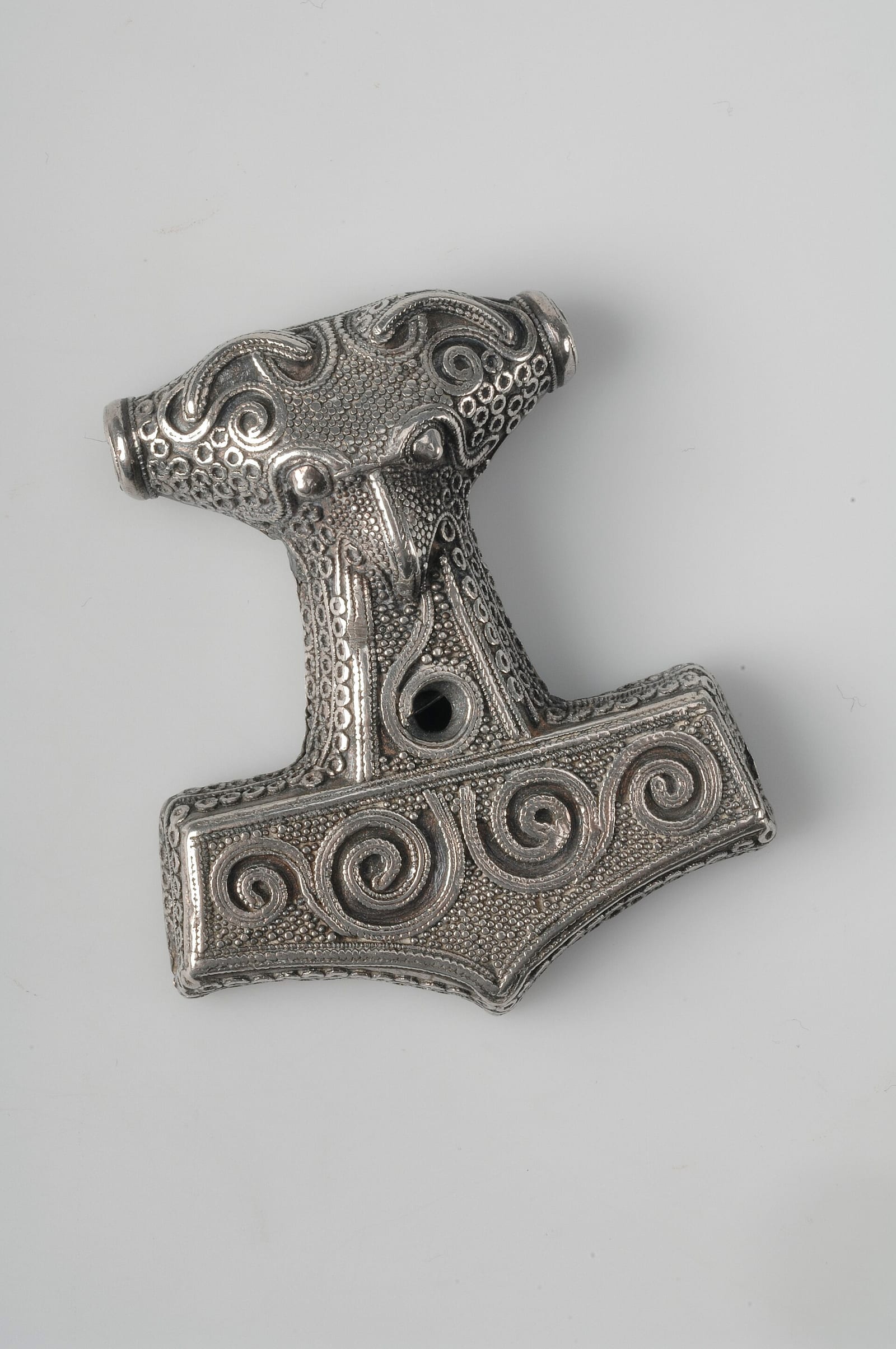
One of the most remarkable individual finds comes from Erikstorp in Skåne, Sweden, where a 10th-century Mjölnir pendant unearthed in 2014 carries a rare feature: a scratched runic inscription that translates roughly to “this is a hammer.” However mundane that message sounds, it makes the find extraordinary, because it proves unambiguously that Viking-age people consciously identified and named the symbol as a hammer, rather than simply wearing it as an abstract decorative motif. A similarly significant find, the Läby hammer from Uppland, additionally shows fine grooves that some researchers interpret as a stylized face, eyes and beard, suggesting that some craftsmen deliberately gave the hammer anthropomorphic features, possibly as a direct nod to Thor himself.
The manufacturing technique itself is also revealing about how these amulets were valued. Many examples were made using elaborate lost-wax casting, in which a wax model was embedded in clay, the wax then melted out, and the resulting cavity filled with molten metal, a technique requiring genuine craft skill that kept the pendants from being cheap mass-produced trinkets. Silver and gold examples, often further decorated with filigree or granulation work, were likely reserved for wealthier owners, while simpler iron or bronze versions were apparently affordable for people of more modest means too, showing that the desire for Thor’s protection cut across every social tier of Viking-age society.
| Find | Location | Notable Feature |
|---|---|---|
| Erikstorp hammer | Skåne, Sweden | Runic inscription “this is a hammer” |
| Läby hammer | Uppland, Sweden | Possible facial features |
| Trendgården mold | Jutland, Denmark | Cross and hammer castable from the same mold |
| Bråtenmyra hoard | Norway | Several hammer pendants with runes and tools |
Taken together, this pattern of finds shows just how regionally varied the worship of Thor was across Scandinavia, and how strongly local workshops seem to have developed their own preferences in shape, material, and ornament, rather than following a single, identical standard pattern everywhere.
Hammer and Cross: Casting Molds From the Conversion Era
Perhaps the most revealing find for understanding Mjölnir as a political symbol is the famous Trendgården mold from Denmark. This small soapstone casting mold has two cavities: one for a Mjölnir pendant, one for a Christian cross. A single craftsman could cast either pagan or Christian jewelry from the same metal, apparently for the same customers in the same workshop. This find offers some of the most direct archaeological evidence that the line between “pagan” and “Christian” was far more fluid during the conversion period than later church sources suggest, and that many Scandinavians wore religious symbols pragmatically rather than dogmatically, choosing whichever protection they needed, or whichever community they wanted to signal belonging to, at a given moment.
This observation matches a broader pattern archaeologists have documented at numerous 10th-century Scandinavian sites: graves from this transitional period repeatedly show combinations that look contradictory by modern standards, such as Mjölnir pendants buried alongside Christian crosses in the same burial, or grave goods that suggest both pagan ritual and seemingly Christian burial customs at once. Historians describe this as a genuine transitional religion, a phase in which old and new religious practice coexisted side by side for a generation or two before Christianity finally established itself as the official, state-enforced faith.
Why Mjölnir Pendants Are Everywhere Again Today
Since the 1990s, the Mjölnir pendant has enjoyed a remarkable revival, worn first by followers of modern heathen faiths like Ásatrú, who explicitly invoke the old Norse gods and treat the hammer as an authentic profession of faith, much like a cross in Christianity. Popular culture later picked up the symbol as well, amplified by films, TV series, and video games that brought Norse mythology to a global audience.
Interestingly, this modern revival is especially visible in Scandinavia itself: both Norway and Iceland now officially recognize Ásatrú, or Ásatrúarfélagið, as a registered religious community, with the right to perform its own naming, wedding, and funeral ceremonies. In recent years, Reykjavík even saw the construction of a dedicated Ásatrú temple, the first of its kind in over a thousand years, a symbol of how a once-suppressed faith has re-established itself in the present day, often marked by the very same Mjölnir pendant that Viking-age craftsmen once cast.
A Symbol Between Faith, Fashion, and Misuse
That popularity has a darker side, too. Over the past few decades, far-right groups have tried to appropriate Mjölnir and similar Norse symbols and load them with racist ideology, a distortion that fits neither the archaeological record nor the mythological sources. Serious Ásatrú communities and historians explicitly reject this appropriation, pointing out that the actual archaeological record, from Erikstorp to Trendgården, paints a picture of religious diversity and pragmatic coexistence that lends itself to no form of exclusion or ethnic purity ideology whatsoever. It’s worth looking closely at context here: in the overwhelming majority of cases, someone wearing a Mjölnir pendant today is simply following the same thousand-year-old tradition as the craftsmen of Trendgården and Erikstorp - a desire for protection, belonging, and a visible connection to something larger than themselves. Readers wanting to understand the runic script behind these finds can find an introduction in our article on the Elder Futhark. In the end, Mjölnir remains exactly what it was over a thousand years ago: not merely a piece of jewelry, but a mark its wearers chose deliberately, to show where their loyalty lay, a continuity running from Erikstorp to today’s jewelry shops that hardly any other Viking-age symbol can claim quite so unbroken.