Daily Life & Culture
The Longship: How a Boat-Building Idea Changed the World
The Viking longship was the Norsemen's defining technology. Why it mastered rivers, seas, and the open ocean alike-and reshaped an entire age.

Contents
You cannot tell the story of the Vikings without talking about their ships. Everything the Norsemen became famous and feared for-the raids, the trade, the settling of Iceland, the voyages to America-would simply have been impossible without the longship.
It was their defining technology. The iPhone of its day, if you like.
The Secret Lies in the Hull
What made the longship so special is not something you notice at first glance. The trick lies in the construction, in what is known as clinker building.
Here the planks of the hull are not set edge to edge but laid overlapping-like roof shingles-and riveted to one another. The result is a hull that is not rigid but flexible. It gives a little in the waves rather than fighting against them.
That flexibility was the key. It made the ship faster, lighter, and astonishingly seaworthy, without breaking apart in heavy seas.
Shallow Enough for Rivers, Strong Enough for the Sea
The second stroke of genius: longships had a very shallow draught. A fully laden ship often needed less than a metre of water beneath its keel.
That sounds like a technical footnote, but its consequences were enormous. It meant the Norsemen could:
- sail far inland, up rivers deep into Europe and Russia
- land on almost any shallow beach, with no need of a harbour
- even haul their ships overland when required, from one river to the next
An enemy could never feel safe. Wherever there was water-even a narrow river-the longships could appear. This strategic mobility left the cumbersome ships of other peoples far behind.
Sail and Oar-The Best of Both Worlds
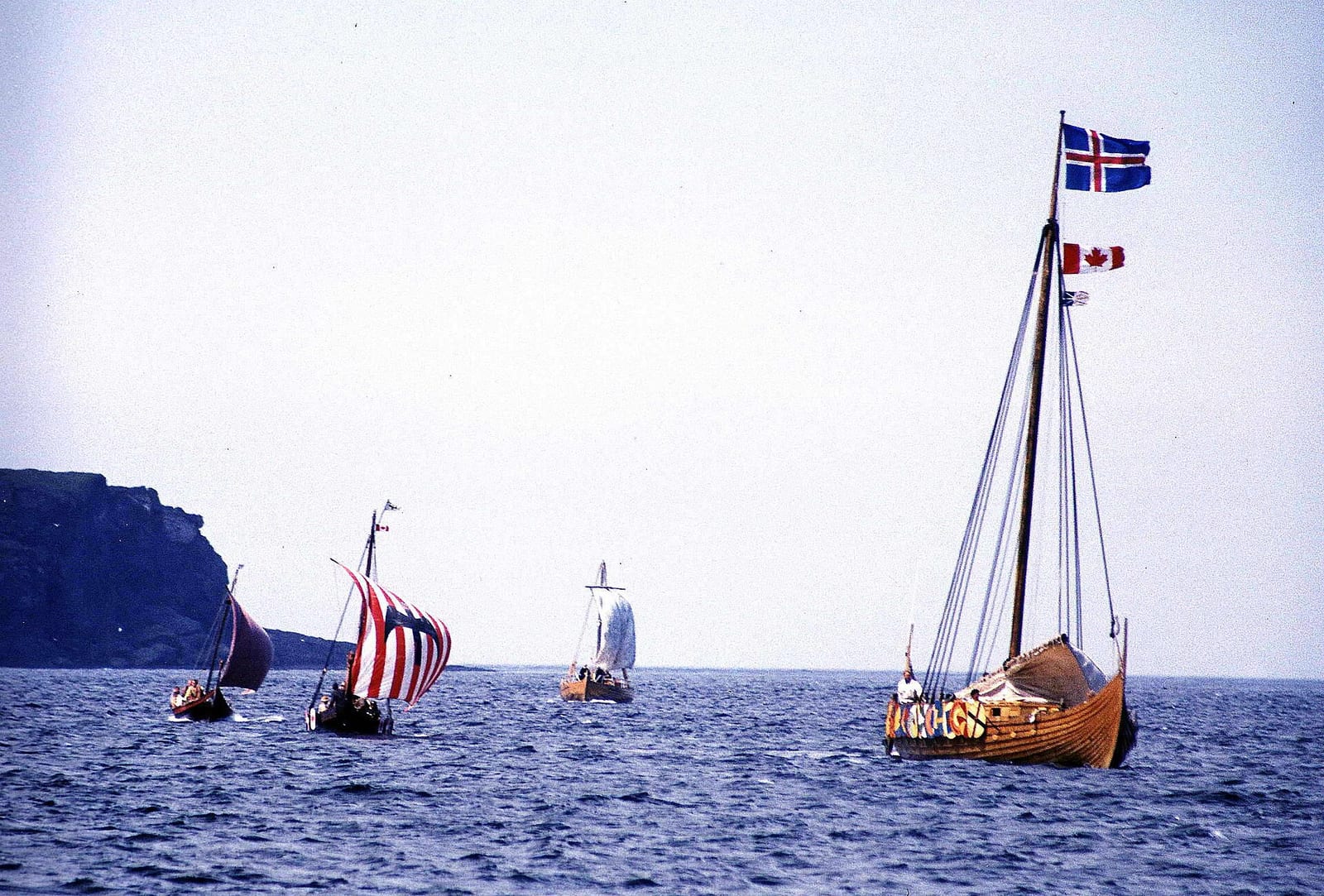
Longships were driven two ways. On the open sea a large, often red-and-white striped square sail carried them along at remarkable speeds-estimates put it at over 15 knots in a good wind.
When the breeze dropped, or the way led up a river, the crew reached for the oars. Every man aboard was both rower and warrior. There was no separate crew-travelling, rowing, and fighting all lay in the same hands.
A longship was not a vehicle that carried warriors somewhere. It was a part of the warrior band itself.
More Than a Single Type of Ship
We often speak loosely of “the longship,” but the Norsemen drew finer distinctions. For war they built sleek, fast ships such as the drakkar (“dragon ship”), often with a carved animal head at the prow, meant to intimidate enemies and drive off evil spirits.
For trade, by contrast, they used the knarr-shorter, broader, deeper, with plenty of hold for goods, livestock, and the provisions of an emigrant family. It was a knarr, not a dragon ship, that carried the settlers to Iceland and Greenland.
What the Finds Tell Us
Most of what we know we owe to the chance of preservation. Two finds in particular are legendary: the Oseberg ship and the Gokstad ship, both buried in Norway as grave goods and, because of that, preserved in the earth for more than a thousand years.
When the Gokstad ship was reconstructed and sailed across the Atlantic, the replica proved beyond doubt what the originals had been capable of: in 1893 it crossed the ocean to America without trouble.
It was the practical confirmation of what the sagas had always claimed. These ships could reach the world-and that is exactly what they did.