Mythology
Yggdrasil: The World Tree and the Nine Realms
Yggdrasil, the world tree of Norse mythology: what Völuspá and Grímnismál really say about the nine realms, the three roots and wells, Ratatoskr and Níðhöggr.

Contents
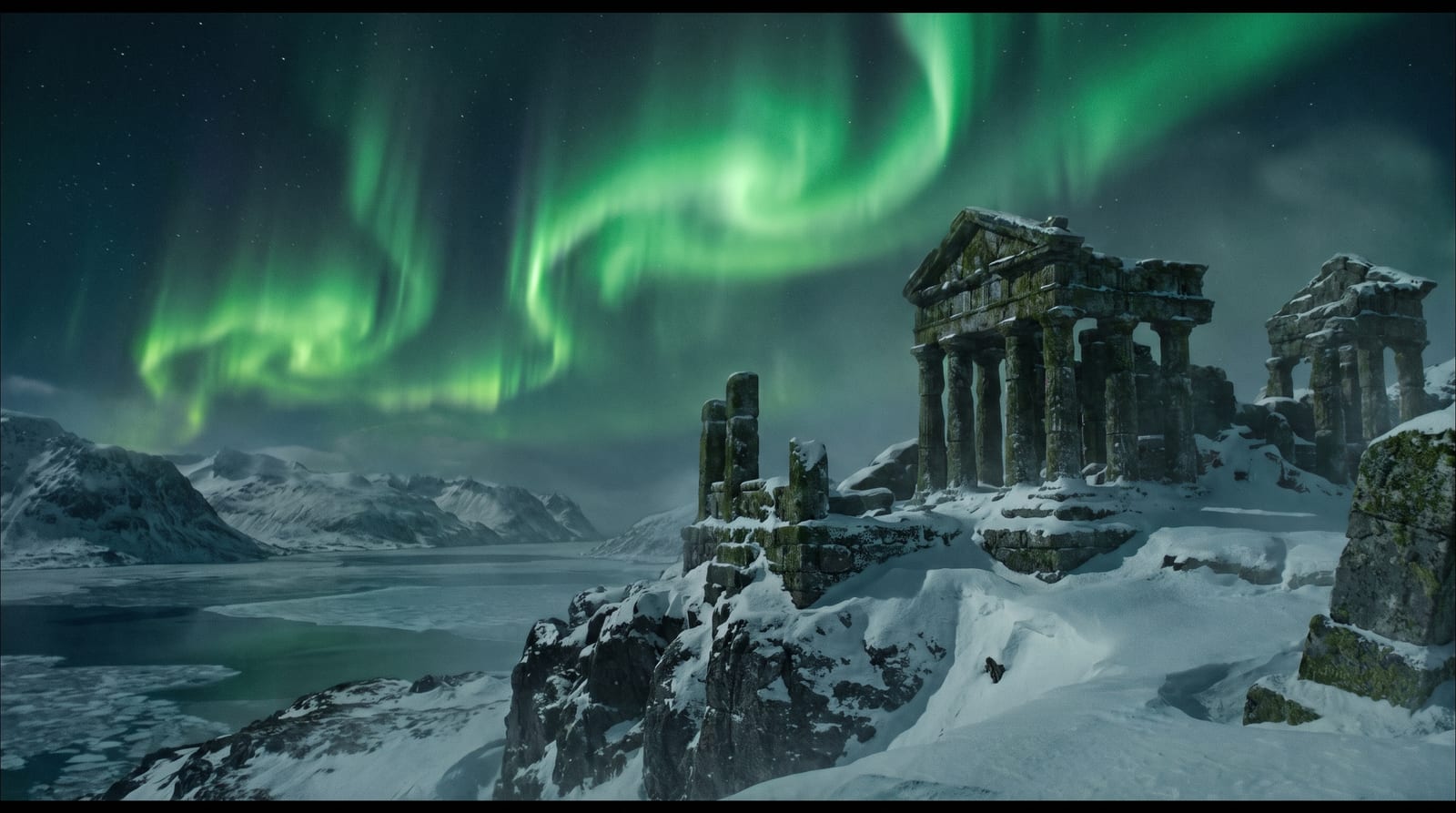
Imagine a tree so vast that gods hold court beneath it, that an eagle is enthroned in its crown and a dragon gnaws at its roots. Yggdrasil, the world tree of Norse mythology, is exactly that: an immense, evergreen ash that grows through every region of the cosmos and holds it all together. No place in the Norse imagination matters more-and few are more often misunderstood.
For Yggdrasil is no pretty backdrop. The tree lives, and it suffers. It is grazed, gnawed, rotting along one flank. The Vikings did not picture the universe as a perfect order but as an organism that must be tended against decay every single day. That thought alone makes the tree worth our attention.
How We Know About the World Tree Yggdrasil
Like almost everything we know of Norse mythology, the image of Yggdrasil comes from a handful of Icelandic texts of the 13th century. Three stand out:
- The Völuspá (“The Seeress’s Prophecy”), the great opening poem of the Poetic Edda, in which a seeress reveals to Odin the history of the world from creation to its downfall.
- The Grímnismál (“The Sayings of Grímnir”), also from the Poetic Edda: Odin, captured and pinned between two fires, pours out the structure of the cosmos in a kind of ecstatic torrent of knowledge-including the most detailed description of the tree we possess.
- The Prose Edda of the scholar Snorri Sturluson (around 1220), who in the Gylfaginning assembled the scattered verses into an ordered picture of the world.
The Völuspá places the tree at the beginning of everything. The seeress remembers nine worlds and the “mighty measuring tree” beneath the earth-before it had even grown. And she describes it in lines that rank among the most beautiful the Edda has to offer:
“An ash I know, its name is Yggdrasil, a tall tree, sprinkled with white water. From it comes the dew that falls in the valleys. Evergreen it stands above the well of Urd.” - Völuspá, stanza 19 (paraphrased)
Pause on one word: evergreen. In a world of long winters and short summers, a tree that never goes bare was the most powerful possible image of permanence. The real ash loses its leaves-the mythical one never does.
Three Roots, Three Wells
The Grímnismál names three roots that support the tree, anchoring it in three very different spheres: one reaches to Hel, the realm of the dead, one to the frost giants, one to humankind. Snorri arranges the picture somewhat differently-in his version the roots run to the gods, to the giants, and down into icy Niflheim. Such contradictions are not an accident of transmission but the normal state of affairs: these myths were told aloud, across centuries, and nobody ever drew an authorised map of the cosmos.
More exciting than the exact geography is what lies at the roots. For there collects the most precious thing this mythology knows: knowledge and fate, bound to three wells.
- The Well of Urd (Urðarbrunnr), where the gods gather in council each day. Here dwell the Norns-Urd, Verdandi and Skuld-who lay down the fate of every being. They draw water and white clay from the well and pour it over the tree, day after day, so that it will not wither.
- Mímir’s Well (Mímisbrunnr) among the giants, in which wisdom and understanding lie hidden. For a single drink from it, Odin gave up an eye-we told that story in our overview of the Norse gods.
- Hvergelmir in Niflheim, the seething primal spring from which all rivers flow-and beneath which the dragon Níðhöggr has his lair.
Note the twist: of all beings, it is the gods who do not own fate. It rests with the Norns, at the foot of the tree, and not even Odin can shake it. The order of the world hangs, quite literally, on the watering can of three women.
The Nine Realms in the Branches
Yggdrasil carries and connects the nine realms-but anyone expecting a tidy list in the sources will be disappointed. The Völuspá gives the number, yet nowhere counts the worlds off. The list in common use today is a reconstruction from scattered mentions:
- Asgard - the world of the Aesir
- Vanaheim - home of the Vanir
- Alfheim - realm of the light elves
- Midgard - the world of humans
- Jötunheim - land of the giants
- Svartalfheim (or Nidavellir) - the world of the dwarves
- Muspelheim - the fire world in the south
- Niflheim - the world of mist and ice in the north
- Helheim - the realm of the dead
Did the Vikings themselves mean exactly these nine? Uncertain. What is certain is that nine was their sacred number: nine worlds, nine nights Odin hung upon the tree, nine paces Thor staggers at Ragnarök. Wherever the nine appears in Norse mythology, pay attention-it almost always marks a threshold between worlds.
Life in the Tree: the Eagle, Ratatoskr and Níðhöggr
The Grímnismál populates the tree with a veritable bestiary, and every one of these creatures earns its place.
In the crown sits a nameless eagle, and between its eyes perches the hawk Veðrfölnir-an image that generations of scholars have puzzled over. At the roots gnaws Níðhöggr, the “Malice-Striker”, a dragon who elsewhere sucks the corpses of oath-breakers and murderers. And between the two, tirelessly, the squirrel Ratatoskr races up and down the trunk-a messenger carrying the eagle’s insults downward and the dragon’s abuse back up.
You are allowed to find that funny; the Norse probably did too. But the image has a false bottom: even at the heart of the cosmos there is no peace, only an endless, petty quarrel-and the medium of that quarrel is the message itself. A squirrel as the embodiment of rumour’s power: one could almost believe the Edda foresaw social media.
Add to this four stags-Dáinn, Dvalinn, Duneyrr and Duraþrór-which browse the tree’s foliage. The Grímnismál draws a bitter balance from all this: the ash Yggdrasil endures more hardship than men can know-the stag bites above, the trunk rots at its side, Níðhöggr tears from below. The world tree is a permanent construction site. In this view, the existence of the world is not a condition. It is a daily achievement.
Odin’s Gallows: What the Name Yggdrasil Means
And the name itself? Yggdrasil literally means something like “the steed of Yggr”-and Yggr, “the Terrible One”, is a byname of Odin. Odin’s horse: that is how the skalds, in grim circumlocution, referred to the gallows, for the hanged man “rides” the tree from which he hangs.
With that, perhaps the darkest door of the entire mythology swings open. In the Hávamál, Odin himself tells how he hung for nine nights on the windswept tree, wounded by his own spear, “given to Odin, myself to myself”-without bread, without the drinking horn. At the end of this self-torture he screams and seizes the runes, the very essence of magical knowledge. Most scholars agree that this “windswept tree” is Yggdrasil.
The world tree, then, is also Odin’s place of sacrifice. Cosmic axis and gallows in one-life and death in the same trunk. There are few images in the history of religion that strike with such force.
Yggdrasil at Ragnarök - and After
What happens to the tree when the world ends? The Völuspá gives an astonishing answer: when Ragnarök breaks loose, when Heimdall sounds his horn and the wolf’s fetters snap, the old ash trembles-it groans and shakes. But nowhere does it say that the tree falls.
Quite the opposite. The Vafþrúðnismál, another of the Edda’s wisdom poems, reveals that one human couple survives the burning of the world: Líf and Lífþrasir, “Life” and “the one who strives after life”, hidden in “Hoddmímir’s wood”-by the most widespread interpretation, nothing other than the world tree itself. They feed on the morning dew, and from them grows the new humankind when the green earth rises once more from the sea.
The tree that carried the old world thus shelters the seed of the new. Downfall, yes-but no ending. If one were permitted a single sentence about the Norse view of existence, it might well be that one.
Why the World Tree Will Not Let Us Go
Sacred trees in the North were no mere poetry. In the 11th century, Adam of Bremen described a huge evergreen tree at the temple of Uppsala, and the Saxons venerated a world pillar, the Irminsul, until Charlemagne had it felled. Yggdrasil is the literary summit of a very real devotion-people actually stood before such trees, sacrificed, hoped.
Perhaps that is why the image still works on us today. A cosmos as a tree: everything connected, everything dependent on everything else, nothing able to survive without care-and in the middle of it all, a squirrel sowing discord. Frankly, we know of no model of the universe that says so much about cohesion and fragility with so few images. The Norns water the tree every single day. It would not be the worst idea to follow their example-each of us tending whatever has been entrusted to us.
Image: YvesSch (CC BY-SA 3.0), via Wikimedia Commons