Mythology
The Norse Gods: Odin, Thor, Freyja and the Powers of Asgard
Who were the Norse gods really? A clear guide to Odin, Thor, Freyja and Loki, the war between Aesir and Vanir, and the nine realms of Yggdrasil.

Contents
Say the words Norse gods today, and most people picture a bearded giant with a hammer or a one-eyed wanderer in a broad hat. Yet behind those familiar images lies one of the richest and most contradictory pantheons ever imagined. The Norse gods were not all-powerful, not immortal, and certainly not flawless. They quarrelled, deceived, loved and feared—and they knew that in the end even they would die.
That, more than anything, is what makes them so compelling. But let us take it in order.
How We Know About the Norse Gods at All
Before we look closely at Odin and his kin, an honest question is worth asking: where does our knowledge actually come from?
The answer is more sobering than many assume. The Vikings themselves wrote their myths down only rarely—theirs was a deeply oral culture. Most of what we tell today was recorded after the Viking Age, in the Christian Iceland of the 13th century.
Two sources stand out:
- The Poetic Edda, a collection of anonymous Old Norse poems preserved chiefly in the Codex Regius.
- The Prose Edda, a handbook for poets written by the Icelandic scholar and politician Snorri Sturluson around 1220.
Snorri was a Christian, and it shows. He arranged, smoothed and interpreted the old stories—sometimes with a certain ironic distance. So we are not looking straight into the minds of the Vikings, but rather through the window of a later scholar. That is worth keeping in mind.
Aesir versus Vanir – Two Families of Gods
Here is a point that surprises many: the Norse gods were not a single team. There were two families.
The Aesir (Old Norse Æsir) are the gods we usually mean—Odin, Thor, Frigg, Tyr. They stand for war, kingship, sky and order. Their home is Asgard.
The Vanir, by contrast, were older gods of fertility and prosperity, tied to harvest, sea and wealth. Among them are Njord, Freyr and the famous Freyja.
The Edda tells that the two families once fought a bitter war—the very first war in the world. It ended not in victory but in a truce and an exchange of hostages. That is how Njord, Freyr and Freyja came to Asgard and were honoured there as Aesir in their own right. Some scholars read this as a faded memory of two real cults meeting and merging. It cannot be proven, but it is a lovely idea.
Odin – the God Who Wanted to Know More
Odin is no cosy father of the gods. He is enigmatic, unsettling, driven.
As the Allfather he rules Asgard, yet his true obsession is knowledge. For a single draught from Mimir’s well of wisdom he sacrificed an eye. To win the runes he hung for nine nights on the world tree, wounded by his own spear—a sacrifice of himself to himself, as the Hávamál of the Poetic Edda describes it.
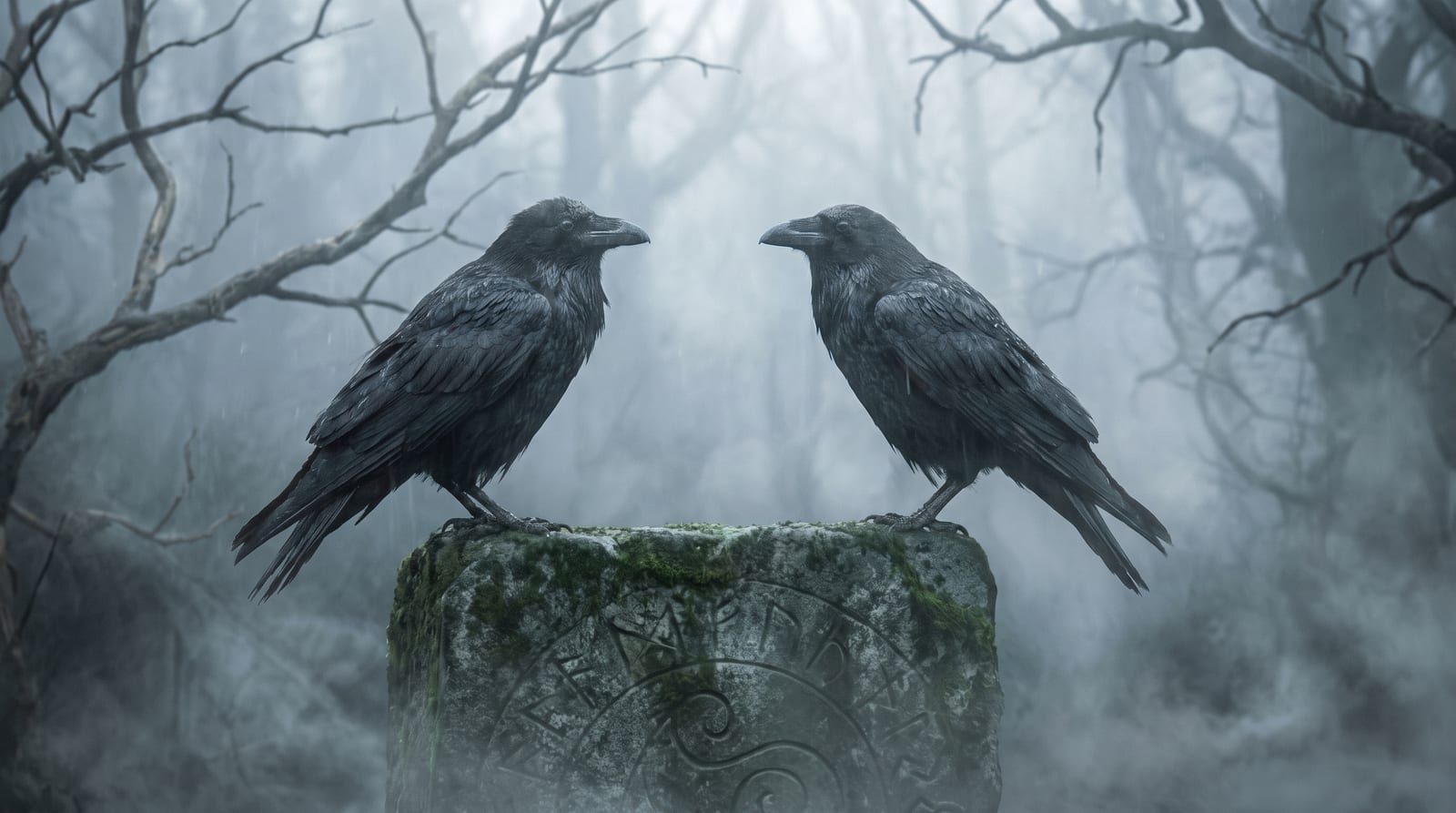
Two ravens, Huginn (“thought”) and Muninn (“memory”), fly across the world each day and whisper to him what they have seen. In his hall Valhalla he gathers the fallen warriors, the Einherjar, for one final battle.
Why would the wisest of all gods raise an army? Because he knows what is coming. But that is the story of Ragnarök—a tale of its own.
Thor – the Protector with the Hammer
If Odin is the king of thinkers, then Thor is the hero of the people. And in truth it was Thor, not Odin, whom ordinary farmers and seafarers revered most. The many Thor’s-hammer amulets found across Scandinavia say as much.
Thor is the god of thunder, strength and protection. His hammer Mjölnir returns to his hand after every throw and is the mightiest weapon of the gods. With it he holds the giants (Jötnar) in check, the eternal enemies of order.
Snorri tells wonderful stories about him—how Thor must dress as a bride to recover his stolen hammer, or how he is challenged to drain a drinking horn secretly connected to the world ocean. Thor is powerful but not always clever, and that is exactly what makes him human.
Odin ruled over kings, but Thor belonged to the people—to the farmer in the storm and the sailor in a heavy sea.
Freyja and Loki – Desire and Chaos
No account of the Norse gods is complete without these two.
Freyja is perhaps the most powerful goddess of the pantheon. She stands for love, beauty and fertility—but do not underestimate her. She rides in a chariot drawn by cats, owns the shimmering necklace Brísingamen, and commands seiðr, a form of sorcery that even Odin learned from her. She is a goddess of death, too: half the slain go to Valhalla to Odin, the other half to Freyja’s hall Fólkvangr. That detail is rarely told, but it says a great deal about her rank.
Loki, by contrast, is the disruptor every good drama needs. Strictly speaking he is not one of the Aesir but the son of a giant, whom Odin took as a blood brother. Loki is witty, clever and utterly unreliable. Sometimes he rescues the gods from a tight spot; sometimes he lands them in it first. He is a shape-shifter, the father of monsters—the wolf Fenrir, the world serpent Jörmungandr and the death goddess Hel—and in the end the traitor who sets the catastrophe in motion.
The Lesser Gods It Is Easy to Forget
Between the great names stand a few figures who appear more rarely in the sources but reveal a great deal about how the Norsemen thought.
There is Tyr, the god of war and—more interesting still—of law and the oath. Snorri tells how Tyr laid his hand in the jaws of the wolf Fenrir so that the gods could bind the beast. He knew he would lose the hand, and did it anyway. For a people to whom the oath was sacred, that was the highest virtue of all.
Heimdall, for his part, keeps watch at the edge of Asgard over the rainbow bridge Bifröst. He needs less sleep than a bird, sees as well by night as by day, and can hear the grass grow. At Ragnarok he will blow his horn Gjallarhorn and call the gods to the final battle.
And finally Frigg, Odin’s wife and queen of the Aesir. She knows the fate of every being but never speaks it—a quiet, tragic knowledge she shares with her husband. When her son Balder is doomed to die, she extracts an oath from every thing in the world to do him no harm. Everything except the mistletoe. You can guess how that story ends.
Yggdrasil and the Nine Realms
Above all of this—or better, running through all of it—grows the world tree Yggdrasil, an immense ash that binds the whole cosmos together.
Within its branches and roots lie the nine realms of Norse mythology. Their exact arrangement is surprisingly unclear in the sources, but the traditional list runs:
- Asgard – the world of the Aesir
- Vanaheim – home of the Vanir
- Alfheim – realm of the light elves
- Midgard – the world of humans
- Jötunheim – land of the giants
- Svartalfheim (or Nidavellir) – the world of the dwarves
- Muspelheim – the fire world in the south
- Niflheim – the world of mist and ice in the north
- Helheim – the realm of the dead
At the foot of the tree sit the Norns, three fate-women who weave the destiny of every being. An eagle perches in the crown, the dragon Nidhögg gnaws at the roots, and the squirrel Ratatöskr carries insults between them. It is a living, breathing image of the universe—not an empty firmament, but a tree full of strife and life.
Why These Gods Still Move Us
What remains once you set the old names aside? A surprising amount.
The Norse gods feel so alive because they think like mortals. They hoard knowledge because time is short. They fight even though they know they will lose. In a world accustomed to an eternal, all-knowing God, this is a radically different notion: gods who are as bound to fate as the humans below them.
Perhaps that is their real secret. Odin, Thor and Freyja are not distant idols but mirrors. They reveal a worldview in which courage does not mean knowing you will win—it means acting anyway.
And it is precisely this, the end of all things, that the next great story of the North sets out to tell: Ragnarök.