Recipes
Fish the Viking Way: Smoking, Salting, Fermenting
How Vikings preserved fish by smoking, salting and fermenting: real finds from Hedeby and Birka, Iceland's sur method, and a recipe for smoked salmon flatbread.

Contents
No craft mattered more for survival in the North than knowing how to make fish last. A household that could smoke, salt, or ferment enough fish in the autumn had a real chance of making it through winter, and a crew that packed enough dried or salted fish had a real chance of surviving the weeks-long crossing to Iceland or Greenland. This Viking smoked fish recipe shows the tasty end result of that centuries-old preservation craft: smoked salmon on crisp flatbread, topped with onion and fresh dill, ready in about fifteen minutes. Before we get to the pan, though, it is worth looking at the actual craft behind it, because that history is the more interesting half of this story.
Smoking, Salting, and Fermenting: Viking Fish Preservation
Archaeological finds from the great trading towns of the Viking Age show just how central fish was to the Norse diet. At Hedeby (Haithabu), the most important trading settlement on the border between Denmark and what is now northern Germany, excavators uncovered thousands of fish bones from the 9th and 10th centuries: herring, cod, eel, and salmon, often in quantities that suggest deliberate processing for trade rather than only local, day-to-day eating. At Birka, the great trading town in what is now Sweden, fish bones are likewise among the most common food remains recovered. Together, these two sites paint a picture of an economy in which fish was not just eaten, but preserved, transported, and traded on a considerable scale.
The picture gets even sharper thanks to the excavations at Coppergate, in Viking-Age York (Jorvik). The latrine and midden deposits there are a goldmine for archaeologists: in the waterlogged, oxygen-poor layers, organic remains survived remarkably well, including huge numbers of fish bones from herring, cod, eel, and salmon. The sheer volume and variety of the finds shows that fish was a genuine staple food in a Viking-Age trading town, eaten across every level of society, from ordinary craftworkers to wealthy merchants.
It is also worth noting how the balance shifts between freshwater and saltwater fish depending on how close a site sits to the coast. Inland settlements often show a higher share of freshwater species from rivers and lakes, while trading hubs like Hedeby and Birka show a markedly higher proportion of herring and other sea fish, a clear sign of organized fishing and long-distance trade.
Exactly how the fish was preserved is harder to pin down archaeologically, since smoke and salt leave few direct traces in the soil. But experimental archaeology, historical comparisons, and the well-documented rural fishing traditions of Scandinavia into the modern era let us reconstruct the process fairly well. Smoking over smoldering, often damp wood draws moisture out of the fish while killing off bacteria, and the smoke compounds themselves have a mild preservative effect. Salting, whether as a dry rub or as a brine, likewise pulls water from the flesh and makes it inhospitable to spoilage bacteria. The two methods could be combined: salt first, then smoke, for the longest possible shelf life.
For the longest voyages, though, a third method mattered even more: plain air-drying, with no salt at all. Lean fish like cod, dried this way, became a forerunner of what Norway today calls klippfisk, or stockfish: air-dried cod that, stored properly, kept for months, weighed almost nothing, and packed an enormous amount of nutrition into a small space. Those qualities made dried fish the ideal travel ration. Aboard a longship, every kilogram counted, and provisions that could neither spoil nor add much weight were as vital for a raiding expedition as they were for the settlers sailing to Iceland and Greenland.
Fermentation and Iceland’s Sur Method
Alongside smoking and salting, the people of the North knew a third, much quieter preservation method: fermentation. It is best documented in Iceland, where medieval sources describe a technique that became known as súrsun: foods, including fish, were packed in slightly soured whey and kept there for months at a time. The lactic acid in the whey created an environment where spoilage bacteria struggled to survive, while the food itself slowly took on a distinctive, sharply sour flavor. These sour-preserved foods, called súrmatur in modern Icelandic, are still part of Icelandic cuisine today and are traditionally served around the midwinter feast of Þorrablót.
One distinction deserves to be made carefully here. Scandinavia’s most famous fermented fish, Swedish surströmming (fermented Baltic herring, sold in tins), is only documented in writing from considerably later centuries, and it should not be presented uncritically as a direct Viking-Age practice. What can be said with more confidence is this: the underlying technique of preserving fish and other foods through controlled fermentation, rather than through heat or salt alone, has deep roots in Norse food culture, and Iceland’s sur method shows that this principle was already in practical use by the medieval period. Whether it existed in exactly this form as early as the 9th and 10th centuries cannot be proven with certainty, given the lack of clear sources from that early window, but it fits comfortably into a broader picture of people in the North using every available method to bridge short harvest seasons and long, hard winters.
Here is how the three techniques compare:
| Method | How it works | Typical use |
|---|---|---|
| Smoking | Smoke and heat draw out moisture, smoke compounds help preserve | Salmon, herring, lasting weeks to months |
| Salting | Salt draws water from the flesh, inhibits spoilage bacteria | Cod, herring, often combined with drying or smoking |
| Fermenting | Lactic acid or soured whey create a bacteria-hostile environment | Iceland’s sur method, forerunner of later traditions like surstromming |
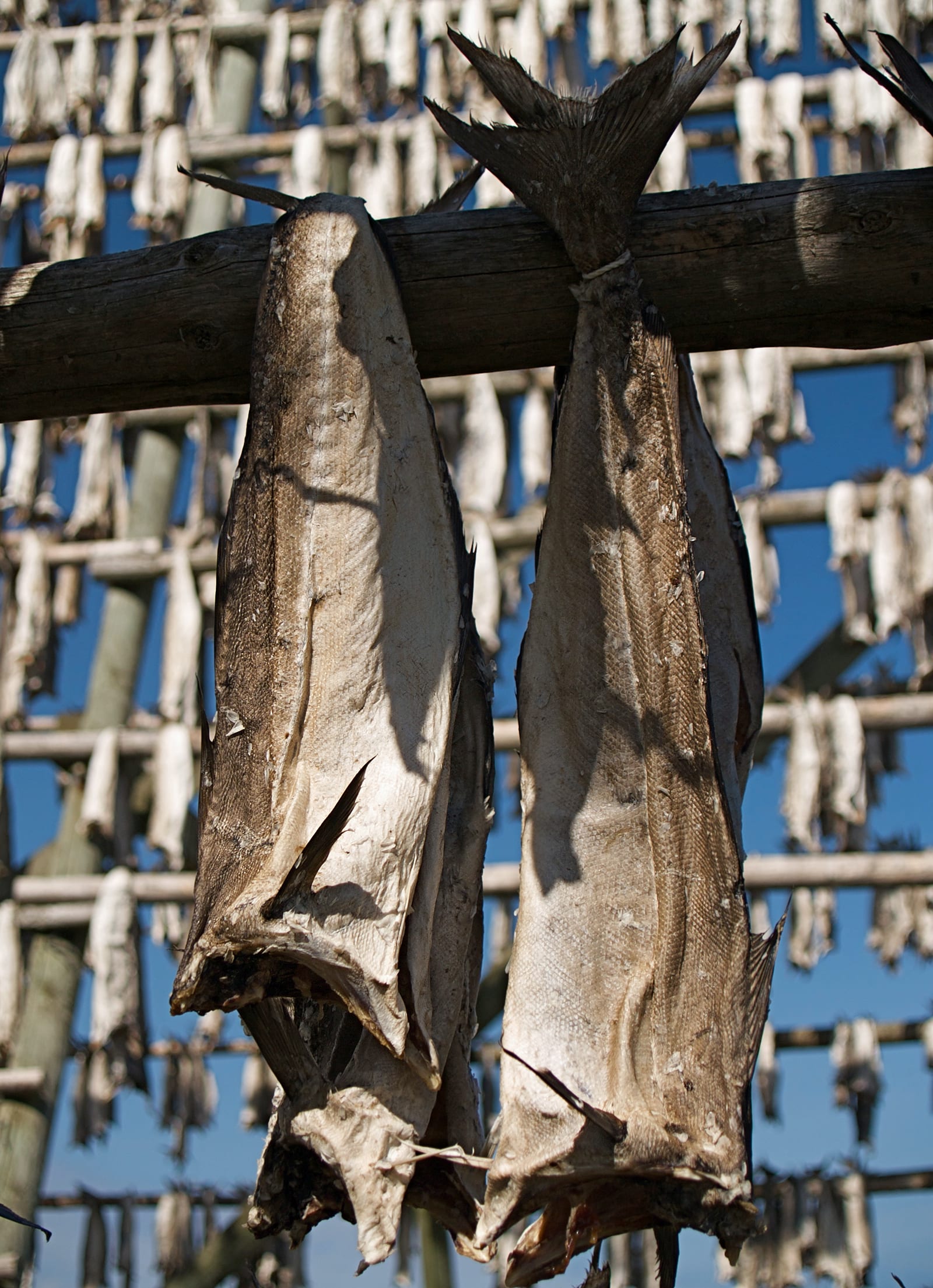
Image source: Jörg Hempel (CC BY-SA 2.0 de), via Wikimedia Commons
This is what air-dried stockfish looks like, made in a similar way along the Norwegian coast since the Viking Age: whole cod, hung head-down on wooden racks, exposed to the wind and the cold, dry air of the North until the flesh turned firm and essentially unspoilable.
Ingredients
For 2 flatbreads:
- 7 oz (200 g) smoked salmon
- 2 rustic, thin flatbreads
- 1 onion, finely sliced
- 1 bunch fresh dill
- Coarse sea salt or rock salt
Instructions
- Warm the flatbread. Warm the flatbreads briefly in a pan or over an open fire until slightly crispy.
- Slice the salmon. Slice the smoked salmon into thin strips.
- Top the flatbread. Top the flatbread with the salmon, sliced onion, and chopped dill.
- Season and serve. Sprinkle with coarse salt and serve immediately.
Tips & Variations
- Add acidity: A squeeze of lemon juice or a dollop of skyr pairs beautifully with smoked salmon and adds welcome freshness.
- Swap the herb: Chives or a little fresh chervil work well instead of dill, for a slightly different flavor.
- Mellow the onion: If raw onion feels too sharp, soak the slices briefly in cold water or a splash of vinegar to soften the bite.
- Serve as an appetizer: Cut the flatbreads into strips and serve as bite-sized pieces, perfect for a Viking-style spread with several courses.
- Smoke it yourself: If you have the time and a smoker, cold-smoking your own salmon takes this recipe even closer to the original.
- A study in contrast: Where this recipe leans on raw, smoked texture, our honey-mustard salmon shows the other side of Viking fish cookery: warm from the oven, with a crisp, sweet-and-sharp crust. Both recipes start from the same fish, but come from completely different preservation and cooking traditions.
If this preservation craft has piqued your curiosity, this recipe is just one taste of our collection. The cookbook “Viking Feast” holds 141 recipes from the Norse kitchen, from flatbread to feast-day dishes to fish prepared every possible way. Get the cookbook
Smoking, salting, fermenting: three simple principles that kept the North alive for centuries, long before anyone had a refrigerator. Anyone enjoying a piece of smoked salmon on freshly warmed flatbread today is, in a very real sense, holding the end result of one of the Viking Age’s most important survival techniques.