Recipes
Hot-Smoked Trout: The Basic Viking Method
How to hot-smoke trout step by step: a juniper brine, dry alder chips, exact temperatures and times, plus the Norse craft that stands behind the method.
Contents
Hot-smoking a trout asks for surprisingly little: salt, water, patience, and a fire that gives off more smoke than heat. That is why this basic method is so reliable. It needs no specialist gear, works in a smoker and a kettle grill alike, and ends with a golden, juicy fish whose flavour comes straight out of the Norse pantry. First, though, why the North smoked at all, and which parts of the popular story hold up.
Why the North Smoked
The Viking Age had no refrigeration and, more importantly, no cheap salt. In Scandinavia salt had to be won the hard way, mostly by boiling seawater down or burning salt-rich coastal plants. A household that landed a good catch could not simply bury it in salt the way a Mediterranean one could. Smoke was the alternative, and it cost nothing but firewood and time.
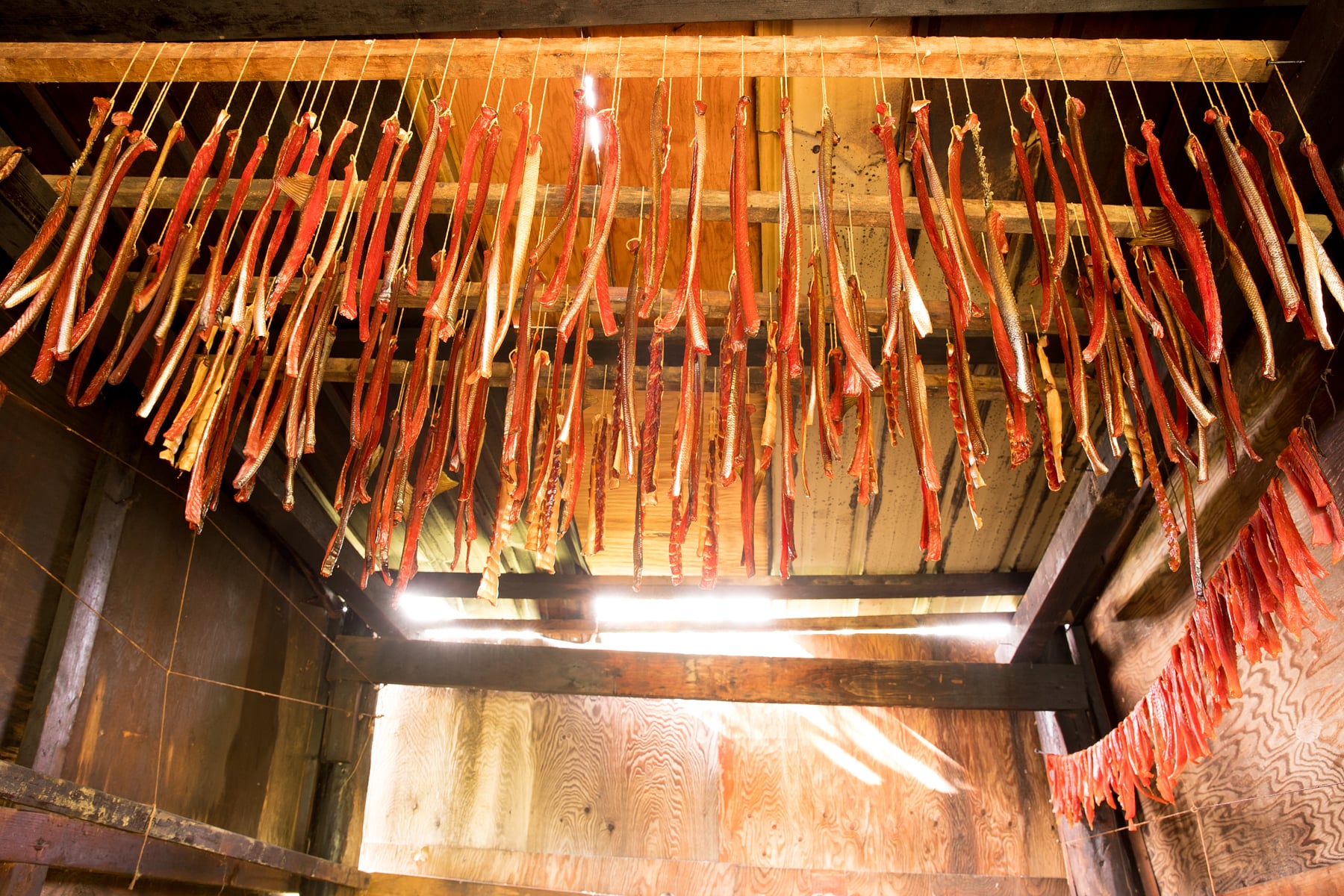
It did not even require a dedicated building. In a Norse dwelling the fire burned in the middle of the room almost without pause, and the smoke left not through a chimney but under the roof. The space above the hearth was therefore permanently warm, dry and full of smoke, which is precisely what fish needs in order to keep. Anything hanging up there was preserved as a by-product, without anyone lifting a finger. The Old Norse word eldhús, literally fire-house, names that room with the hearth, and in doing so describes the first smoking chamber of the North.
One honest caveat belongs here. Smoke leaves almost nothing behind in the soil, and no 9th-century smoking chamber has ever been excavated and identified as such with any certainty. What we say about the process rests on hearths inside longhouses, on unbroken rural practice in Scandinavia into modern times, and on experimental archaeology. Solid footing, but reconstruction rather than an excavation report.
Cold Smoke or Hot Smoke: Two Different Foods
Temperature decides everything. The same smoke, at two different heats, produces two entirely different foods.
| Cold smoking | Hot smoking | |
|---|---|---|
| Temperature | 60 to 77°F (15 to 25°C) | 160 to 195°F (70 to 90°C) |
| Time | 12 hours to several days | 1 to 2 hours |
| Result | firm, sliceable, raw in texture | tender, cooked through, juicy |
| Keeps for | weeks to months | a few days, chilled |
| Difficulty | high, needs cool weather | low, hard to ruin |
Historically, cold smoking was the real preservation method: it pulls water out of the flesh over days while the smoke compounds protect the surface. In a modern kitchen it is the thankless option, demanding consistently cool ambient temperatures, constant attention and a fair amount of practice.
So this recipe uses hot smoking. It works in July as reliably as in January, and it delivers what most people picture when they think of Northern smoked fish: bronzed skin, moist flesh, a smoke note that flatters rather than overwhelms. Our take after several rounds of testing: if you have never smoked anything before, start hot and start with trout. Cold-smoked salmon is the better party trick, but the failure rate is high and you learn less from each attempt.
Wood Is Not a Detail
The rule that matters most: it should smoulder, never flame. Open flame gives you heat and soot but very little of the thin blue smoke you actually want. The opposite extreme does as much damage. Wet or freshly cut wood never settles into a proper smoulder, because it has to boil off its water first, and the thick white smoke it throws out meanwhile leaves an acrid, ashy film on the fish.
That is why this method calls for dry chips. The widespread tip to soak them first comes from grilling practice and serves one purpose: it stops chips from bursting into flame when they sit straight on hot coals. If you are running indirect heat and watching the temperature anyway, you do not need that detour, and you spare yourself the steamy white smoke of the first few minutes.
Three woods have earned their place in Northern smokehouses:
- Alder is the Scandinavian standard. It burns gently, tastes mildly sweet, and suits every fish you are likely to put in front of it.
- Beech is stronger and colours the skin darker. Reach for it when you want something assertive.
- Juniper is not a base wood but a finishing touch. A few dry sprigs or a handful of berries on the coals add the resinous, almost peppery note that defines traditional Nordic smoking. For how wide that repertoire really was, see our guide to herbs and spices in the Viking kitchen.
Avoid conifers such as spruce and pine. Their resin settles as a bitter film and the fish tastes of turpentine rather than woodland.
Myth Versus Fact
A few claims about smoking circulate widely, some historical and some thoroughly modern. All deserve a closer look.
| Claim | Where it actually stands |
|---|---|
| Vikings smoked fish over open flame | Misleading. Smoke comes from smouldering wood. Over flame you are grilling, not smoking. |
| Smoked fish was the standard sea provision | Only half true. For long voyages air-dried stockfish was better: lighter, drier, longer lasting. |
| Viking smokehouses have been excavated | Not established. Hearths yes, securely identified smoking chambers no. |
| Smoked fish keeps all winter | Depends on the method. Cold-smoked yes, hot-smoked no: that fish is cooked and lasts only a few days chilled. |
| Smoking chips have to be soaked first | Modern grilling advice, not Northern craft. Wet wood steams before it smoulders. |
The Timeline
Smoking is not a weeknight project, but the hands-on time is short. The rest is waiting.
- Day 1, evening: mix the brine, submerge the fish. About 20 minutes of work.
- Day 2, morning: rinse and pat dry. 10 minutes.
- Day 2, then: air-dry 1 to 2 hours until the skin turns matt and tacky.
- Day 2, midday: fire up the smoker or grill. 30 minutes.
- Day 2, after that: smoke for 60 to 90 minutes, then rest briefly.
Ingredients
Serves 4:
- 4 whole trout, cleaned, about 10 oz (300 g) each
- 3 quarts (3 l) cold water
- 6 oz (180 g) coarse sea salt
- 1 tbsp honey
- 2 tsp juniper berries, lightly crushed
- 2 bay leaves
- A handful of dill stalks
- 2 generous handfuls of dry alder or beech smoking chips
- 1 small dry juniper sprig
Instructions
- Mix the brine. Dissolve the salt and honey completely in the cold water. Add the juniper berries, bay leaves and dill stalks.
- Brine the fish. Submerge the trout fully, cover, and refrigerate for 8 to 12 hours. Longer, and the fish turns salty rather than seasoned.
- Rinse and dry. Rinse briefly under cold water, pat dry, then leave uncovered in a cool draught for 1 to 2 hours until the skin looks matt and feels slightly tacky. The smoke clings to that surface.
- Set up the fire. Bring the smoker or kettle grill to 160 to 195°F (70 to 90°C) using indirect heat. Set the dry chips and the juniper sprig beside the coals rather than straight on top of them, so they smoulder steadily instead of catching fire.
- Smoke. Hang the trout or lay them on the grate and smoke for 60 to 90 minutes. Keep the lid shut and the temperature as steady as you can.
- Check for doneness. The fish is ready when the dorsal fin pulls free easily and the flesh along the backbone is opaque. If you use a thermometer, look for 145°F (63°C) at the thickest point.
- Rest and serve. Rest for 10 minutes and serve warm with boiled potatoes, cucumber and plenty of dill.
Fun fact: The matt, faintly tacky layer that forms on the skin while the fish air-dries has a name: the pellicle. It is why the drying step decides more about flavour than the smoking time does. On damp skin the smoke rolls off almost uselessly; on the pellicle it sticks.
Tips & Variations
- Other fish: Mackerel, char and herring behave identically. Mackerel is fattier and often needs 10 minutes less.
- Fillets instead of whole fish: Skin-on salmon fillets need only 4 to 6 hours in the brine and roughly 45 minutes of smoke.
- Herbs in the brine: A few sprigs of thyme or mugwort add an earthy note against the juniper.
- No smoker? In a kettle grill, bank the coals to one side, set a pan of water beside them, and put the fish on the cool side. The dry chips go in a perforated foil tray at the edge of the coals.
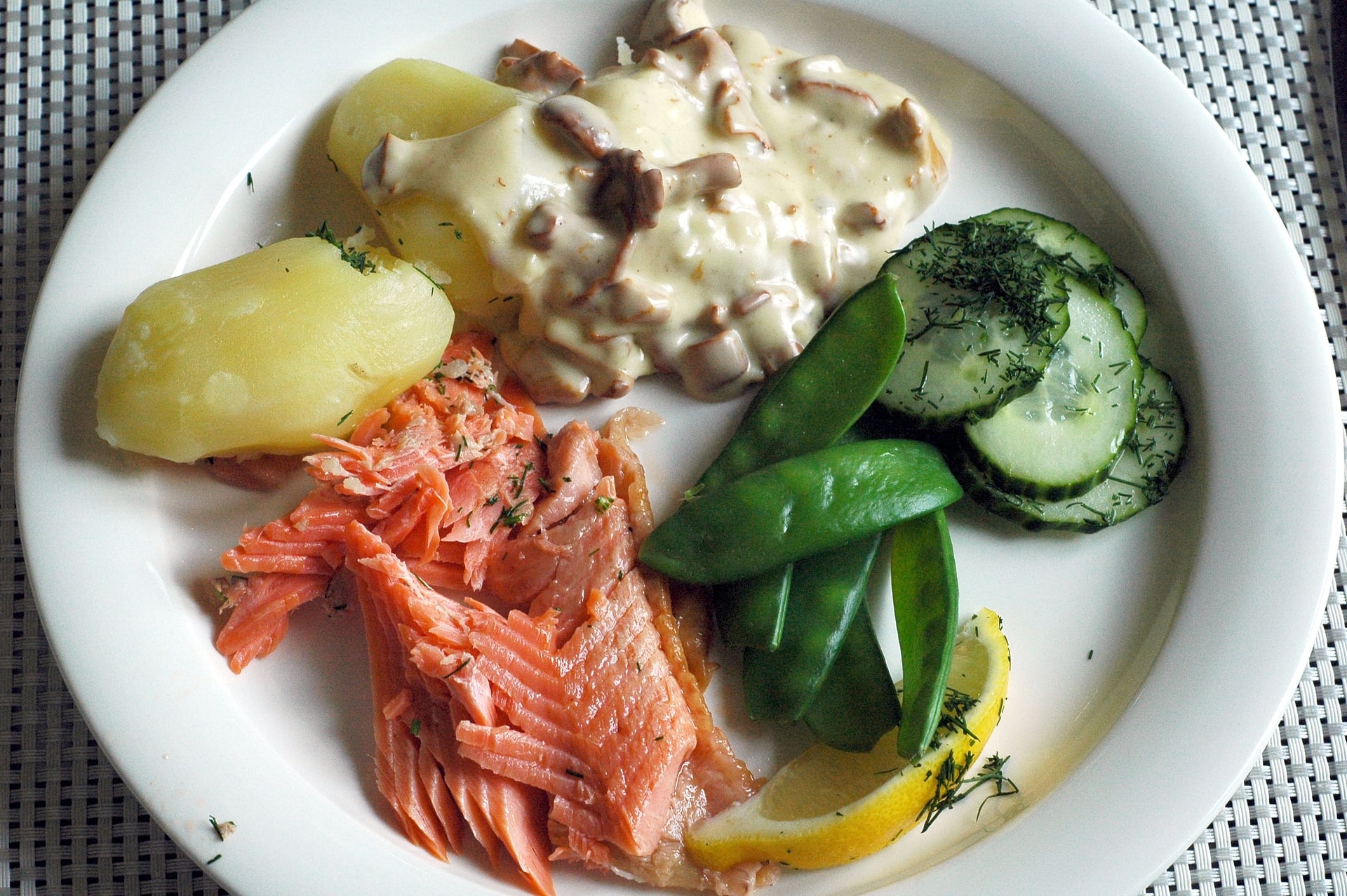
- As a warm main course: Flake the fish coarsely and plate it with boiled potatoes, cucumber slices with dill, snap peas and a creamy mushroom sauce. That is exactly what the photo above shows, made with hot-smoked salmon rather than trout.
- Storage: Hot-smoked fish keeps 3 to 4 days refrigerated. Flaked, it is excellent scattered over the dishes in our guide to the Viking diet.
- Leftovers: Flake the cold fish, fold it through skyr with dill and a squeeze of lemon, and you have a spread for flatbread.
If this craft appeals to you, the recipe is one of 141 in our cookbook Viking Feast, which brings together the fish, breads, stews and feast dishes of the Norse kitchen. See the cookbook
Smoking is one of the most honest techniques in cooking. There is no batter to hide behind, nothing to rescue a fish that was handled carelessly. Just salt, smoke, time, and a result that tastes exactly as good as the care you put in.
Image credits: Jpatokal (CC BY-SA 4.0) and USFWSAlaska (Public domain), via Wikimedia Commons