Mythology
Odin: The Allfather and God of Wisdom
Odin, the Norse Allfather: why he gave up an eye for wisdom, hung nine nights on the world tree, and what his ravens Huginn and Muninn truly represent.

Contents
A one-eyed wanderer in a broad-brimmed hat, two ravens perched on his shoulders, a spear in hand: this is how most of us picture Odin, the Allfather of Norse mythology. But that image only skims the surface of one of the strangest gods ever conceived. Odin is not simply the king of the gods. He is a god who was willing to maim himself, sacrifice himself, and torment himself - all for the sake of knowledge.
We already gave Odin a brief introduction in our overview of the Norse gods. Here we dig into what actually drove him: his missing eye, his self-crucifixion on the world tree, his ravens, his many names - and the question of why a god who knows the future still marches straight into his own destruction.
How We Know About Odin
Almost everything we know about Odin comes from two Icelandic sources of the 13th century: the Poetic Edda, a collection of anonymous poems preserved in the Codex Regius, and the Prose Edda of the Icelandic scholar Snorri Sturluson, composed around 1220.
Central to Odin is the Hávamál (“The Sayings of the High One”), a poem of the Poetic Edda that reads partly as a collection of life-wisdom and partly as a first-person account from Odin himself. Alongside it stands the Grímnismál, in which a captured and tortured Odin pours out his knowledge of the cosmos, and the Völuspá, in which a seeress reveals to him the entire future of the world, down to its end. Snorri’s Gylfaginning weaves these and other fragments into one coherent picture.
The Eye in Mímir’s Well
The first great sacrifice story about Odin centers on a single eye. At the foot of the world tree Yggdrasil, the Edda tells us, lies Mímir’s Well, in which wisdom and understanding lie hidden - we already mentioned it in our article on Yggdrasil. Mímir, the well’s guardian, drinks from it daily and is, as a result, immeasurably wise.
Odin wants to drink from it too. But Mímir demands a price: an eye. Odin does not hesitate long, and casts it into the water. Snorri reports the episode almost matter-of-factly - yet the weight of the gesture remains. The most powerful of all gods is willing to permanently give up part of his body, part of how he perceives the world, simply to become wiser. The one-eyed appearance in which Odin turns up in practically every later depiction is therefore no minor detail - it is visible proof of his defining trait: an unbounded thirst for knowledge.
The Völuspá returns to this image as well: the seeress recalls that Odin’s eye still lies hidden in Mímir’s well, and hints that Mímir will still be drinking from that knowledge even as Ragnarök unfolds and the world burns. The lost eye, then, is not a one-time sacrifice confined to the past - it remains a pledge left in the well until the end of time, a constant, visible price Odin pays for his knowledge.
Nine Nights on the Tree: The Rune Self-Sacrifice
The second sacrifice story is even more radical, recorded in Hávamál, stanza 138. Odin speaks there himself, in the first person:
Paraphrased from the Hávamál: “I know that I hung on the windswept tree nine full nights, wounded by a spear and given to Odin, myself sacrificed to myself, on that tree of which no one knows from which root it springs.”
Without bread, without a drinking horn, wounded by his own spear, Odin hangs himself upon the world tree - by the prevailing scholarly view, Yggdrasil itself. For nine nights he stares down into the depths, until at the height of his agony he cries out and seizes the runes, the magical writing system that stores knowledge and channels sorcery.
What matters most in this scene is its paradox: Odin sacrifices himself to himself. No other god demands the offering; no other power forces it. It is an act of pure self-overcoming, undertaken to reach knowledge accessible to no one else. Many scholars of religion see in it one of the most striking images of shamanic initiation anywhere in European mythology - a god who dies in order to be reborn, emerging with powers he did not possess before.
Huginn, Muninn, Geri, and Freki: Odin’s Animals
Odin does not rule from Asgard alone. Each day he sends out two ravens, Huginn (“Thought”) and Muninn (“Memory”), across the nine worlds. At evening they return and whisper into his ear everything they have seen and heard. In the Grímnismál, Odin himself confesses a worry that surprises many readers: he fears more for Muninn’s safe return than for Huginn’s - memory, as the passage is usually read, is more fragile than thought alone.
At his feet lie two wolves, Geri and Freki (both names roughly mean “the ravenous one”), whom he feeds from his own plate. Odin himself, Snorri tells us, needs no solid food at all - wine alone serves him as both meat and drink. Taken together, the ravens, the wolves, and the eight-legged wonder-steed Sleipnir, once born of Loki, paint the picture of a god who rules across boundaries: across sky and earth, across thought and memory, across life and death.
Gungnir, Valhalla, and the Einherjar
Odin’s spear Gungnir, forged by the same sons of the dwarf Ivaldi who also built Freyr’s ship Skidbladnir, never misses whatever target it is aimed at, according to Snorri. When Odin hurls it over an army, he consecrates the fighters to death - a practice that Viking-age warriors reportedly imitated in ritual, throwing a spear over the enemy’s ranks before battle began.
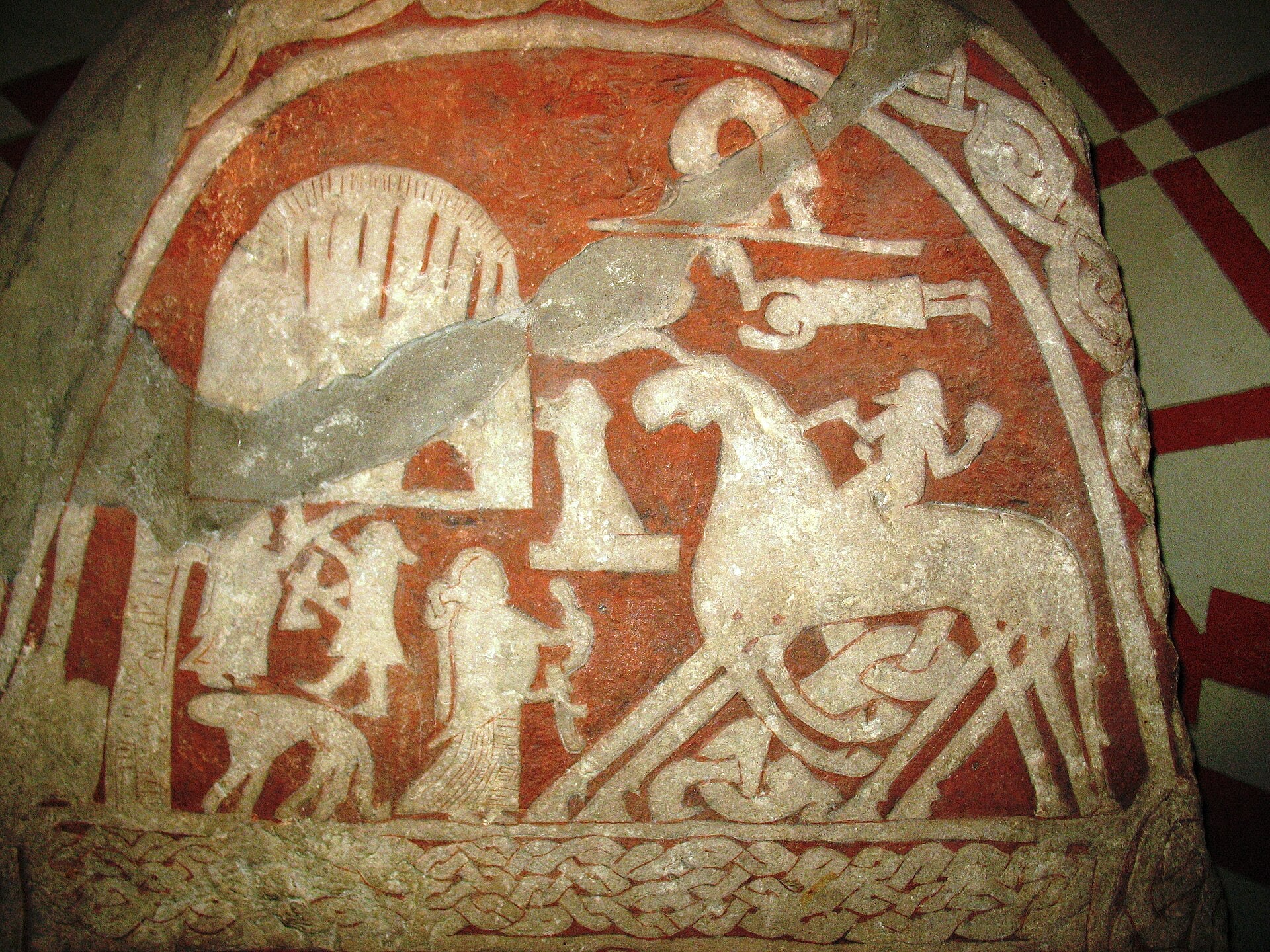
In his hall Valhalla (“hall of the slain”), Odin gathers the einherjar, warriors fallen in battle, chosen and escorted there by the valkyries. There they fight one another daily, die, and rise again each evening for the feast - a kind of eternal training. The reason is not kindness but calculation: Odin is building an army for the final battle, because he already knows, as the Völuspá reveals, how the world will end. At Ragnarök, he himself will ride at the head of the einherjar into battle - and be swallowed by the wolf Fenrir.
Worth noting here is that Valhalla is not the only afterlife reserved for fallen warriors. As we touched on in our overview of the Norse gods, Odin shares the fallen with the goddess Freyja: half go to Valhalla, the other half to Freyja’s hall, Fólkvangr. Snorri never explains the principle behind this division, but the mere existence of two claimants for the bravest of the dead says a great deal about how highly the Norse world prized an honorable death in battle.
The Mead of Poetry: How Odin Stole Verse Itself
One of the strangest stories about Odin explains how the art of poetry entered the world at all. According to Snorri’s account in the Skáldskaparmál, the mead of poetry was brewed from the blood of Kvasir, the wisest being who ever lived, whom the dwarves murdered. The mead later came into the possession of the giant Suttungr, who had his daughter Gunnlöð guard it deep inside a mountain.
Odin, under a false name, drilled his way through the rock, transformed himself into a snake to slip through the hole, and spent three nights with Gunnlöð to persuade her to part with the mead. In the end he drank the entire stock in three colossal gulps, turned himself into an eagle, and fled back to Asgard - narrowly pursued by Suttungr, likewise in eagle form. Ever since, the mead of poetry has been regarded as the source of all poetic skill and eloquence, a gift that Odin - acquired none too honorably - has shared with humankind ever since.
Odin’s Many Names
Few gods in Norse mythology carry as many bynames as Odin - the Prose Edda lists well over a hundred. Allfather (Alföðr) underscores his role as the origin of the gods’ lineage, Yggr (“the Terrible One”) is even embedded in the name Yggdrasil, Herjan (“War-Lord”) points to his role directing battles, and Sigföðr (“Father of Victories”) to his power over triumph and defeat. This sheer multiplicity of names is no accident - it reflects the sheer breadth of his domains: Odin is simultaneously a war god, a death god, a god of wisdom, of poetry, and of magic.
Part of this magical side is seiðr, a form of sorcery traditionally regarded as feminine and beneath a warrior’s dignity - Loki mocks Odin for exactly this in the famous flyting poem Lokasenna. That Odin refused to let this stop him shows, once again, that knowledge and power mattered more to him than social standing. According to legend, Odin learned this art from none other than Freyja herself, the Vanir goddess said to be the first among the Aesir to master seiðr - a small detail that reveals just how porous the boundary between the two divine families really was.
Why Odin Still Fascinates Us
What remains of this figure once the bynames and trappings are set aside? A god who knows he will die, and who nonetheless spends every day gathering more knowledge, recruiting every warrior into his hall, studying every rune - as if enough preparation might yet avert the inevitable. It cannot, and Odin knows that too. Right there lies the quiet tragedy of his character.
Odin is not a god one trusts easily - he deceives, manipulates, switches sides whenever it serves his purpose. But he is also the only god willing to sacrifice himself in order to understand what is coming. Perhaps that is why his image - the hat, the spear, a raven on the shoulder - still will not let us go: it is the image of a seeker who knows he will never know enough, and keeps searching anyway.
Image: Wikimedia Commons (CC BY 4.0), via Wikimedia Commons