Mythology
Valkyries: Odin's Shield-Maidens and the Choosers of the Slain
Who were the Valkyries really? A clear guide to Odin's battle-maidens, the choosers of the slain, Valhalla and the Einherjar, and named figures like Brynhildr.
Contents
Say the word Valkyries today, and a certain image usually appears: golden-helmed riders on winged horses, spears raised, while Wagner’s music thunders in the background. It is a magnificent picture-and a deeply misleading one. The Valkyries of the old sources were not romantic warriors in shining armour. They were something far stranger and more unsettling: spirits who decided life and death before the first sword was even drawn.
Anyone who wants to understand the Valkyries truly has to forget that postcard version first. So let us begin at the beginning.
What Are the Valkyries, Really?
The Old Norse word valkyrja means, quite literally, “chooser of the slain”-from valr (the battle-dead) and kjósa (to choose). The name alone gives away their purpose. The Valkyries do not decide who fights; they decide who dies. They ride across the battlefield and single out those destined to fall, escorting them to Odin’s hall.
That is an enormous idea of power. Pause on it for a moment: not the enemy’s blade, not luck or skill, seals a warrior’s fate, but the gaze of a supernatural woman who already knows, before the battle begins, who will not be coming home. In a warrior culture such as the Norse one, this was among the most disquieting-and most consoling-notions imaginable.
The earliest evidence paints a grim picture. In some sources the Valkyries are not lovely maidens at all but ravenous death-spirits, kin to the ravens that circle above the corpses. They belong to the same world as the Norns, the three fate-women at the foot of Yggdrasil who, within the wider family of the Norse gods, watch over all becoming and passing away. Where the Norns weave life, the Valkyries, it seems, weave death.
The “Choosers of the Slain”
No text makes this darker side as vivid as the Darraðarljóð, the “Song of the Spear,” preserved in the Icelandic Njáls saga. In it a band of Valkyries sits at a ghastly loom. The warp is human entrails, the weights are severed heads, the shuttle a real sword. And as they weave, they sing of the outcome of a battle they themselves are deciding.
We weave, we weave the web of the spear, / as the banner of the brave warrior presses onward.
This is no gentle guardian goddess. This is war itself in female form-cold and pitiless. Anyone who thinks Norse mythology is merely heroic pathos should sit with this image for a while.
And yet there is a strange honour buried in that choosing. To be selected by a Valkyrie meant to be worthy-worthy of admission to Valhalla. Death on the battlefield was not, for the Norse warrior, an ending but a promotion. The Valkyrie was at once executioner and messenger of a higher destiny.
Odin, Valhalla and the Einherjar
Here is where Odin enters. For the Valkyries do not act on a whim of their own-they are servants of the Allfather.
Odin gathers the fallen for one cold, calculating reason: he is preparing for Ragnarök, the last battle in which the gods will fall. For that he needs an army. The chosen dead, the Einherjar (“those who fight alone,” or “the lone champions”), dwell in Valhalla, the vast hall with its 540 doors and a roof made of golden shields.
And what do they do there? Snorri Sturluson describes it in the Prose Edda with almost macabre delight: every day the Einherjar ride out to fight and slaughter one another. Every evening they all rise again, whole and unharmed, and feast together. They eat the ever-renewing flesh of the boar Sæhrímnir and drink the mead that flows from the udder of the goat Heiðrún.
And who serves that mead? The Valkyries. Snorri names them here-Hrist and Mist, Skeggjöld and Hildr, Þrúðr and Göndul among others-carrying the drinking horns to the Einherjar. So two roles fuse into one: the chooser of the slain by day becomes the cup-bearer by night. You could read that as a contradiction. I read it as a logic: the one who leads you into death also receives you afterward.
Famous Valkyries: Brynhildr, Sigrún and Göndul
Alongside the nameless death-spirits, the poetry gives us individual Valkyries who almost become human-with names, wills and fates of their own.
The most famous is undoubtedly Brynhildr (also Brünhild). Her story, told in the Poetic Edda and the Völsunga saga, is one of the great tragedies of the North. Brynhildr was a Valkyrie who defied Odin’s command: in battle she let the wrong king win. As punishment, Odin pricked her with the sleep-thorn and banished her to a ring of fire, trapped in slumber until a fearless hero should wake her. That hero was Sigurd, the dragon-slayer. What follows is a chain of love, betrayal and revenge that echoes all the way into the German Nibelungenlied.
What is remarkable about Brynhildr is her disobedience. A Valkyrie who stands against Odin and loses her supernatural nature for it-that is a deeply human motif. She is no longer merely an instrument of fate but an agent in her own right.
Something similar is true of Sigrún in the Helgi lays. She falls in love with the hero Helgi Hundingsbani, defies her father’s will, and follows her beloved even beyond death. When Helgi is killed, she seeks him out in his burial mound-a scene of eerie tenderness in which love and death become indistinguishable.
And then there is Göndul, whose name appears in several sources and may mean something like “wand-wielder” or “the wolf-like one.” She turns up in the Hákonarmál, the praise-poem for the fallen king Hákon the Good. There Göndul rides out with a companion to bring the Christian-baptised king to Valhalla all the same-a subtle sign of how thoroughly the pagan and the Christian had already begun to blend in that age.
From Battle-Spirit to Shield-Maiden
How did the grisly loom-spirit become the shining rider of our imagination? This transformation is one of the most interesting developments in all of Norse mythology.
In the oldest layers, Valkyries are bodiless, demonic powers-closer to carrion-eaters than to princesses. But the younger the sources grow, the more human they become. In the heroic poetry of the High Middle Ages they increasingly merge with the image of the shield-maiden, the mortal warrior woman of flesh and blood. Brynhildr stands precisely on that threshold: half supernatural being, half tragic woman.
One may suspect that Christian scribes had a hand in this. A death-spirit with a bloody trade fit awkwardly into a world that people were beginning to smooth and reorder. The beautiful, noble maiden, by contrast, was easier to tell-and easier to bear.
The final great stage came only in the 19th century. Romanticism, the Nordic national movement, and above all Richard Wagner’s Ring of the Nibelung created the Valkyrie we now carry in our heads: heroic, operatic, complete with a winged helmet (which never historically existed). It is a powerful vision, no question. But it tells us far more about the 19th century than about the Vikings.
What the Sources Actually Say
Here it is worth asking the same honest question one must ask of every Norse myth: how do we actually know this?
As so often, nearly everything comes from the Christian Iceland of the 13th century. The Poetic Edda provides the oldest testimony-poems such as the Völuspá, in which a seeress watches the Valkyries ride to battle, or the Grímnismál, which lists their names. The Prose Edda of Snorri Sturluson arranges and interprets it all, as was his way. To these we can add skaldic verse and sagas like Njáls saga with its terrible loom-song.
Not one of these sources was written by a believing pagan. So we always see the Valkyries through a double window: centuries later, from a Christian pen, filtered through the literary fashions of the time. That does not mean it is all invention-the archaeological record includes female figurines holding a drinking horn or a sword that scholars connect with Valkyries. But it counsels caution. We possess not a single word that a Viking woman of the 9th century might have said about the Valkyries.
What the Finds Tell Us
Fortunately, texts are not the only trace. The soil of Scandinavia has preserved images older than any surviving manuscript-and one of them is remarkable.
In 2012 a metal-detectorist working a field near Hårby, on the Danish island of Funen, turned up a tiny figure of silver-gilt, 3.4 centimetres tall. It shows a woman in a long gown, holding a sword in one hand and a shield in the other-an armed woman rendered fully in the round, dated to around 800 AD, the very start of the Viking Age. Scholars widely interpret the Hårby figurine as a valkyrie, and it is something rare: one of the very few three-dimensional depictions of such a figure known at all. Before this find, Valkyries were almost always flat-an incised line, a relief, a word on a page. Here, suddenly, one stood solid in the palm of a hand.
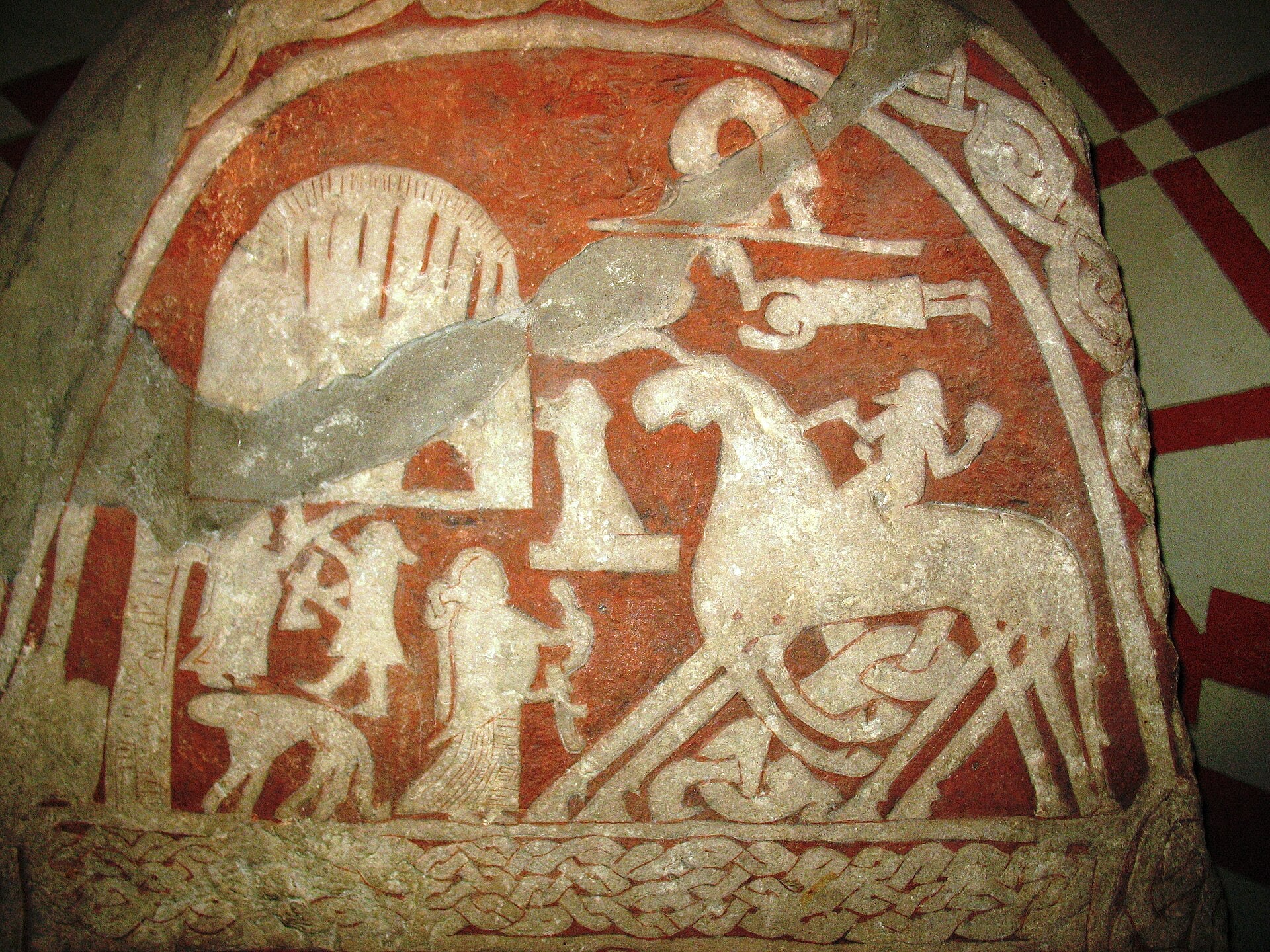
Nor is it alone. On the Gotland picture stones, those upright limestone monuments, a motif recurs again and again: a woman holding out a drinking horn to an arriving rider. Many researchers read her as a valkyrie welcoming the fallen hero into Valhalla-the very reception scene Snorri describes. Whether the Vikings truly meant it that way cannot be proven. But when text and stone and silver all show the same picture, it gives one pause.
Why the Valkyries Still Fascinate Us
So what remains once you take off the winged helmet?
Something ancient and unsettling. The Valkyries embody a truth every warrior culture must face: death in battle is not random but chosen. By attributing that choice to supernatural women, the Norsemen gave the horror a meaning. The fallen warrior was not simply dead-he was chosen.
Perhaps that is their lasting power. The Valkyrie is comfort and terror at once, messenger and executioner, fate in female form. She is a reminder that the Norse world never prettified death but looked it in the face-and even found a way to honour it.
And where do the Valkyries lead their chosen? To Valhalla, into Odin’s golden hall, where the final battle already waits. But that is another story.