Mythology
Valhalla: The Hall of the Fallen Warriors
Valhalla norse mythology explained: what Grímnismál and the Prose Edda really say about the 540 doors, the einherjar, and why Valhalla was only one afterlife.

Contents
Few places in Norse mythology are as famous as Valhalla - and few are so thoroughly misunderstood. In video games and films, Valhalla is often reduced to “the place Vikings go when they die.” That’s only partly true. Valhalla was a very specific, very strange place with a very concrete purpose - and it was nowhere near the only destination for the dead in the Norse cosmos.
So what do the actual sources say about Valhalla norse mythology, once you strip away the pop-culture gloss? Let’s look closer.
What “Valhöll” Literally Means
The Old Norse name Valhöll combines valr (those slain in battle) and höll (hall). Literally, then: the “hall of the slain.” The name itself tells you this isn’t a generic afterlife for everyone - it’s a place with a very narrow admissions policy: warriors who died in combat.
That’s a crucial distinction from the later, romanticized notion of “Valhalla as the Viking heaven.” Valhalla wasn’t a reward for having lived a good life in general. It was a standing reserve of manpower.
Grímnismál: 540 Doors, a Roof of Shields
The fullest description of the hall itself comes from Grímnismál (“The Sayings of Grímnir”) in the Poetic Edda. There, a captured Odin - seated between two fires under the alias Grímnir - reveals the structure of the cosmos to a young man named Agnar in a kind of feverish outpouring of knowledge, and somewhere in the middle of it sits one of the most memorable descriptions of a building in all of Old Norse literature.
Paraphrased from Grímnismál: Five hundred and forty doors does Valhalla hold, and forty more besides - from each of them eight hundred warriors will march out together when they go to war against the wolf.
The hall’s roof, the poem tells us, is made of golden shields, held up by spears for rafters, and the benches are strewn with breastplates. It’s an architecture built entirely out of war gear - a building that looks as though it had been assembled straight from the battlefield. Picture it literally: not gold for gold’s own sake, but weapons and armor arranged as construction material. The hall doesn’t just contain war. It is war, cast into architecture.
That number - 540 doors, each releasing 800 warriors at once - isn’t poetic flourish. It tallies precisely the force Odin will lead against the wolf Fenrir on the day of Ragnarök: 432,000 einherjar. Valhalla, strictly speaking, isn’t a resting place in any ordinary sense. It’s a barracks with an expiration date.
It’s also worth noting where Grímnismál places Valhalla: in Glaðsheimr, “the home of gladness,” a district within Asgard itself. Snorri Sturluson picks up this detail in his Prose Edda and adds further touches the poem only implies - a wolf hangs before the western door, an eagle hovers above the roof. Even the smallest embellishments follow the same pattern: Valhalla is saturated with the symbols of war, right down to its façade.
Where This Knowledge Comes From
As with almost all of Norse mythology, what we know about Valhalla doesn’t come from the Vikings themselves but from a handful of Icelandic texts written down generations after the Viking Age had officially ended. Grímnismál belongs to the Poetic Edda, preserved in the 13th-century Icelandic Codex Regius, though likely older in oral form. Snorri Sturluson’s Prose Edda, composed around 1220, organizes and expands these older verses into a connected narrative - with due caution, since Snorri was a Christian writing at a real distance, in time and worldview, from what he described.
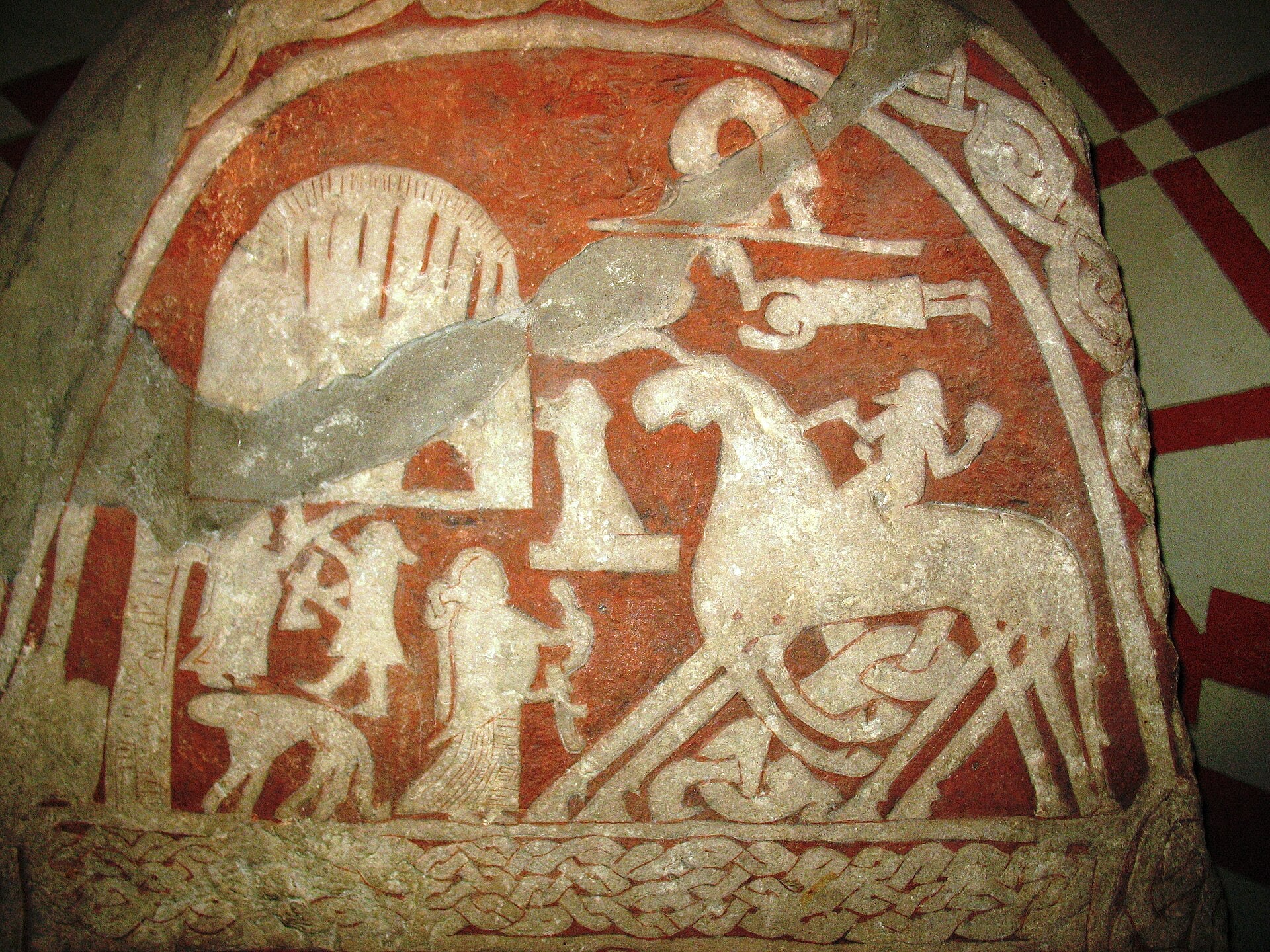
Alongside the literary record sits the archaeological one. On Gotland’s picture stones, and in grave finds containing weapons, shield bosses, and drinking vessels, scholars see hints that the idea of an afterlife war-hall wasn’t a pure 13th-century invention but reached back into older, pre-Christian belief. None of this proves the details - but poetry, prose, and grave goods together form a picture that hangs together remarkably well.
Odin and the Choosing of the Slain
Who actually decides who makes it into Valhalla? Here Odin himself enters the picture, alongside the Valkyries - those “choosers of the slain” who ride across the battlefield deciding who will die and who will be escorted to Valhalla. Their story, their names, and their role as the hall’s cup-bearers we’ve told in full in our article on the Valkyries - here it’s enough to note that Valhalla is unthinkable without them. Odin doesn’t make the selection alone; he depends on his messengers, riding through the chaos of battle and deciding, with a glance, whose time has come.
Why does the Allfather go to all this trouble? The answer lies in his wisdom - and his fear. Odin knows, through prophecy, that Ragnarök is coming, and that the gods will face a vast army of giants, monsters, and the dead of Helheim. So for as long as he can, he gathers the bravest of the fallen and arms them in Valhalla for that single day.
The Einherjar’s Daily Routine: Fighting, Dying, Feasting
So what do the einherjar (“those who fight alone”) actually do all day in this enormous hall, long before Ragnarök even begins? Snorri Sturluson describes it in his Prose Edda with an almost comic matter-of-factness that popular retellings rarely follow through to its full logic.
Every morning the einherjar rise, arm themselves completely, and ride out of the hall to fight one another. It’s no symbolic tournament - they genuinely cut each other down with real weapons until the field is littered with corpses. And then, right on schedule each evening, everyone gets back up, unharmed, as if nothing happened, rides back into the hall, and joins a shared feast.
The feast centers on the meat of the boar Sæhrímnir, slaughtered and cooked fresh every day and fully regrown by morning, so there’s always enough for everyone again. To drink, there’s mead flowing from the udder of the goat Heiðrún, who grazes on the hall’s roof and feeds on the leaves of a tree called Læraðr. Both are served by the Valkyries, who shift seamlessly between choosing the slain by day and pouring drinks by night.
This daily cycle of combat, death, resurrection, and feasting is more than entertainment for bored dead men. It is training. The einherjar rehearse, every single day, for the one battle that actually counts - the one after which there will be no getting up again in the evening.
It’s worth noticing how closely this mirrors the real social world of the Vikings, only pushed into the supernatural. A retainer (Old Norse drótt) served his lord in exchange for shelter, weapons, and a place at his feasting table - exactly the pattern repeated in Valhalla, except the lord here is Odin and the pay is endless mead and regenerating boar meat. Valhalla is, in a sense, the idealized, exaggerated version of a real retinue relationship, the kind actually lived out in the halls of Viking-age chieftains. Archaeological excavations of large hall buildings, such as the one at Lejre on Zealand, reveal exactly the combination of feasting hall and weapons store that Grímnismál describes.
Even the daily deaths aren’t incidental. Snorri makes a point of noting that every warrior who falls in the practice combat returns each evening just as whole as before. It’s a world without permanent loss, but also without real rest - a state that is neither peace nor endless war, but something closer to permanent readiness.
What Valhalla Was Actually For
This makes the real purpose of Valhalla clear, and it differs fundamentally from any Christian-influenced notion of heaven. Valhalla is not a place of eternal rest, not a reward for a virtuous life, not relief from the world’s burdens. It is a rearmament facility.
The einherjar’s entire existence points toward a single future event: the day Heimdall sounds his horn, the monsters break free of their bonds, and Odin rides at the head of his assembled army into the last battle. Valhalla exists only because Ragnarök is coming. Without the prophecy of the world’s end, there would be no reason to gather warriors in the first place - we tell the full story of that final battle, in which Odin himself falls, in our article on Ragnarök.
It’s a remarkably sober, almost military-logistical idea for a mythology to hold: even the afterlife of the bravest warriors serves, first and foremost, a strategic function.
Not Everyone Went to Valhalla
And here lies perhaps the most important correction to the popular image: Valhalla was not the only destination for the dead, not even for those who died in battle. The sources are unusually clear on this, even though pop culture almost always leaves this nuance out.
Snorri reports in the Prose Edda that the slain are actually divided between two hosts: Odin receives one half for Valhalla, but the other half goes to the goddess Freyja and her hall Fólkvangr (“field of the host,” or “people’s field”). No source explains exactly why the division works the way it does - but the mere existence of Fólkvangr thoroughly dismantles the idea that Valhalla was some kind of monopoly Odin held over the war-dead.
And even that covers only a fraction of all the dead. The overwhelming majority of people - those who died of illness, old age, or accident rather than in battle - went to neither Valhalla nor Fólkvangr, but to the far less glamorous Helheim, realm of the death-goddess Hel, one of Loki’s children. Helheim wasn’t a place of punishment in the Christian sense, but it wasn’t a place of glory either - more a neutral, rather grey continuation of existence in the shadows. The vast majority of the Norse dead, men and women alike, ended up there, not in a gold-roofed hall of warriors.
This threefold cosmology of the afterlife - Valhalla for some of the battle-dead, Fólkvangr for the rest of them, Helheim for nearly everyone else - shows just how much the idea of a single “Viking paradise” distorts the actual complexity of the sources.
Why Valhalla Still Resonates
What’s left once you set the pop-culture shine aside? A picture of surprising internal logic. Valhalla isn’t a reward; it’s a function within a mythology that knows, from the very start, that it’s heading toward an ending. The hall with its 540 doors, the roof made of shields, the endlessly regenerating boar, the warriors dying and rising again every single day - none of it makes sense except as what it actually is: preparation for the one battle that matters.
Perhaps that’s the source of its lasting pull. Valhalla promises no eternity of stillness, but an eternity of readiness - combat, death, resurrection, feast, and the next morning starting all over again. It is an afterlife that never truly rests, because the world it sprang from never really rested either.
Image: Pöllö (CC BY 3.0), via Wikimedia Commons