Mythology
How to Get to Valhalla: The Real Rules of the Norse Afterlife
How to get to Valhalla, according to the Eddas, Snorri and the oldest skaldic poems: who was chosen, who decided, and where everyone else actually went.
Contents
Sooner or later, anyone who reads about Norse mythology runs into the same question: how to get to Valhalla. The popular answer takes about four seconds. Die in battle, a valkyrie collects you, the doors open. It is not wrong, exactly. It is just far too tidy for the material it claims to summarise.
The Old Norse sources never set out admission rules the way a monastery sets out a rule of life. What survives is a scatter of verses, one systematising thirteenth-century handbook, two royal funeral poems and a handful of saga anecdotes that pull in slightly different directions. Put them side by side and you get something far stranger than a checklist. You get a selection process in which the candidate has almost no say at all.
How to Get to Valhalla: The Short Answer
The shortest defensible answer is that nobody gets into Valhalla. People are taken there.
The hall’s Old Norse name, Valhöll, means “hall of the slain”. The same first element sits inside valkyrja, “chooser of the slain”. Neither word describes an arrival. Both describe a choice made by somebody else, and the ones doing the choosing are the valkyries, riding the field while the fighting is still going on. Odin carries the byname Valföðr, father of the slain, and Snorri Sturluson states plainly that every man who falls in battle becomes his adopted son.
So the one condition that genuinely appears across the sources is a manner of death: killed in combat. Not a virtuous life, not generous sacrifice, not piety, not even courage in general. The sources are oddly uninterested in what kind of person you were. They care about how you died, because Odin is not rewarding goodness. He is recruiting.
That shift in logic is worth sitting with. A Christian heaven answers the question “did you deserve this?” Valhalla answers a blunter one: “can you still fight?”
What the Sources Actually Require
The fullest picture of the building comes from Grímnismál in the Poetic Edda, with its 540 doors, its roof of shields and its rafters of spears. We covered the architecture and the daily routine of the einherjar in our piece on Valhalla, the hall of the fallen warriors. On the question of admission, though, that poem is almost silent. It describes the house, not the doorway.
For something closer to a rule you have to go to Snorri Sturluson’s Gylfaginning, written around 1220. There the division is explicit: those who fall in battle go to Odin and are called einherjar, while those who die of sickness or old age go to Hel. Snorri even uses the technical vocabulary, sóttdauðr and ellidauðr, “sickness-dead” and “age-dead”. It is the clearest statement of entry criteria we possess, and it was written by a Christian Icelander two centuries after the conversion.
The oldest surviving texts are a different kind of thing entirely. They are commissioned poems about named dead men. Eiríksmál, composed around 954 for Eirik Bloodaxe at the request of his widow Gunnhild, shows Odin ordering the benches strewn and sending Bragi and Sigmundr out to meet the arriving king. Asked why he took victory from so good a warrior, Odin answers that the grey wolf is watching the seats of the gods.
Paraphrased from Eiríksmál: the grey wolf stares at the dwellings of the gods, and so the king is needed.
Hákonarmál, composed around 961 by the skald Eyvindr skáldaspillir, does the same job for Hákon the Good, and it contains the single most awkward fact in this whole discussion. Hákon was a baptised Christian king. The valkyries Göndul and Skögul take him to Valhalla anyway. If there were ever a doctrinal test at the door, the oldest poem about an arrival did not know about it.
Listen to Valhalla while you read on, the same idea set to music:
Myth Versus Source: Five Stubborn Assumptions
The gap between what gets repeated about Valhalla and what the texts contain is wide enough to drive a longship through. Five examples:
| Common assumption | What the sources say |
|---|---|
| All Vikings went to Valhalla | Only some of those killed in battle; everyone else went elsewhere |
| It was the reward for a brave life | No text makes conduct in life a condition, only the manner of death |
| Odin does the choosing on his own | Grímnismál gives half of the slain to Freyja |
| Women were barred from entry | No source states this either way; the texts simply do not address it |
| Dying in bed meant permanent exclusion | Ynglinga saga preserves the spear-marking as a workaround |
The fourth line deserves more care than it usually gets. There is no Old Norse passage that denies women entry to Valhalla, and none that confirms it. The poems speak of warriors and leave the rest unsaid. Anyone filling that silence in either direction is interpreting, and honest writing about the period says so instead of inventing an answer.
Valhalla Was Never the Only Destination
The biggest error buried inside the question is the assumption that Valhalla was the Norse afterlife. It was one option among several, and statistically the least likely.
| Destination | Ruler | Who went there |
|---|---|---|
| Valhalla | Odin | A portion of those killed in battle |
| Fólkvangr | Freyja | Per Grímnismál, the other half of the slain |
| Helheim | Hel | Everyone who died of sickness or old age |
| The sea | Rán | The drowned, implied in kennings and sagas |
| The burial mound | nobody | Continued existence near the farm, well attested archaeologically |
How the slain were divided between Odin and Freyja, and why the overwhelming majority of the dead ended up with Hel, we worked through in Valhalla, the hall of the fallen warriors. For the admission question only one consequence of that matters: dying in battle does not by itself land you in Odin’s hall, because even the battle-dead get split.
The more interesting rows are the bottom two, which almost never make the list. Rán, wife of the sea-giant Ægir, draws the drowned into her net; the sagas and skaldic kennings gesture at this rather than spelling it out, but for a seafaring culture it was the death permanently in view. And one destination needed no deity at all: the solid conviction that the dead simply carried on in the burial mound, within sight of the farm, occasionally troublesome. The saga tradition of restless draugr assumes precisely that. Ask how to reach Valhalla and you are asking about the rarest of five options.
Straw Death and the Spear Mark
If dying in combat was the criterion, what happened to the ageing warrior who could see a sickbed coming? Old Norse has a word for that fate: strádauðr, straw death, the death on the bedding straw. It was not a neutral description. It was a verdict.
Snorri’s Ynglinga saga, the opening section of Heimskringla, preserves a remarkable loophole. When Odin, there rationalised into a human king in Sweden, dies of illness, he has himself marked with a spear point and dedicated to himself before death. The same saga reports that Njörðr was marked in the same way. Snorri also records the belief that a man arrived in Valhalla with whatever wealth had burned on his pyre.
Whether anyone actually performed this ritual, or whether Snorri reconstructed a custom out of older poetry, cannot be settled from the evidence we have. What is clear is the symbolic logic. The spear is Odin’s weapon, and a spear wound marks ownership. In Gautreks saga, Starkad kills King Víkar with precisely that gesture and the words that he now gives him to Odin. In Hávamál, Odin describes hanging nine nights on the windswept tree, wounded by a spear, given to himself. Across all three texts the message is identical: this dead man belongs to Odin.
My own reading is that the spear mark tells us less about ritual practice than about anxiety. A culture only invents a workaround for a rule it takes seriously, and only takes a rule seriously when it fears being caught on the wrong side of it.
What Stones and Graves Suggest
Texts are one kind of evidence. The ground is another. Archaeology cannot prove an admission rule, but it can show that the idea of a warrior hall after death is older than any surviving manuscript.
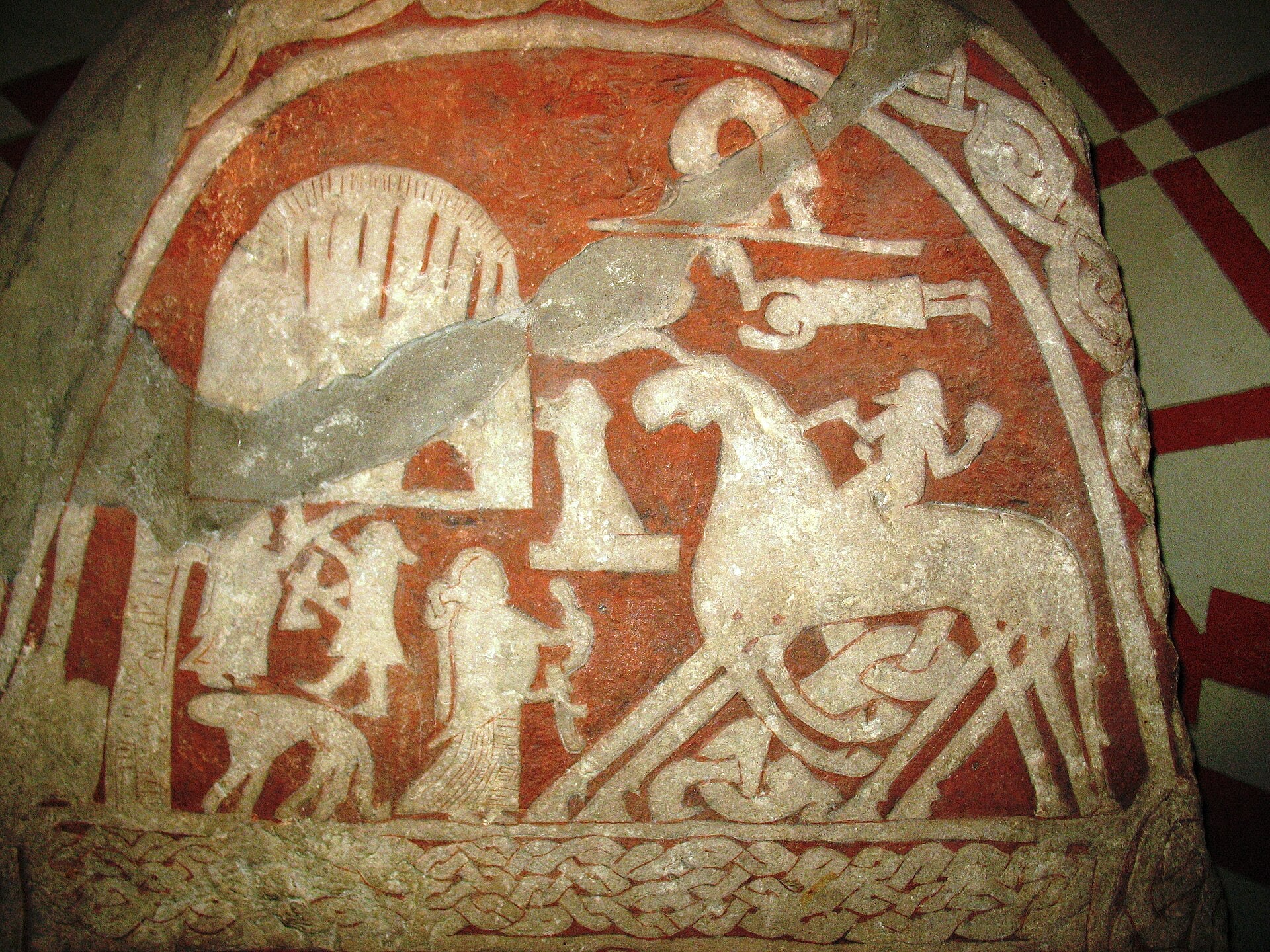
- The Gotland picture stone from Tjängvide, in Alskog parish and now in the Historiska museet in Stockholm, shows a rider on an eight-legged horse approaching a female figure who holds out a drinking horn. The stone is dated to the eighth or ninth century, which puts that welcome scene centuries before Snorri wrote a word.
- In 2012 a detectorist at Hårby on the Danish island of Funen found a gilded silver figure 3.4 centimetres tall: a woman carrying a sword and shield, dated to around 800. The identification as a valkyrie is an interpretation rather than a certainty, but it is the standard one.
- Weapon graves containing swords, shield bosses and drinking vessels, such as the chamber graves at Birka in Sweden, show a burial practice in which fighting gear and feasting equipment travel together. That is the same pairing the poetry describes.
None of this is proof. Taken together, though, stone, grave and verse line up unusually well. Someone carving a welcome-with-a-drinking-horn into limestone around the year 800 clearly had a notion of what waited after the last fight.
Our Assessment: A Hall Built for Lords
Here is where it is worth stepping past summary and saying something. Look at who the oldest Valhalla texts were written for. Eiríksmál and Hákonarmál are not folk poetry. They are commissioned works about two dead kings, paid for by a widow and a royal court. The hall they describe receives named rulers with a formal reception committee, not anonymous farmhands with spears.
That points to a conclusion a good deal of scholarship shares: in its earliest recoverable form, Valhalla looks less like a promise to every Northman than like the ideology of a warrior aristocracy. A jarl binding followers to himself could offer no better prospect than the continuation of that same relationship in Odin’s hall, with better mead and no final defeat until the last day. Read this way, the absence of any moral test stops being puzzling. Retinues were never recruited on virtue. They were recruited on usefulness and loyalty.
Which means the clean rule everybody quotes today owes less to the Viking Age than to Snorri, who tidied contradictory material two centuries later, and to the nineteenth century, which turned his tidying into a Viking heaven. Asking how to get to Valhalla is, in the end, asking about a system that never existed in that form.
So the honest answer is an uncomfortable one. You die fighting, and even then the decision is not yours. A valkyrie chooses, Odin takes one half, Freyja takes the other, and the overwhelming majority of the Norse dead never saw the inside of the hall at all.
Perhaps that is exactly where the appeal lies. Valhalla was not a heaven you could earn. It was a posting you could be called up for. Less comforting than the postcard version, and a much better fit for a world that already knew how its story ended.
Image: Berig (CC BY-SA 4.0), via Wikimedia Commons