Recipes
Viking Stew Recipe: Skause, the Cauldron Stew from the Longhouse
A hearty Viking stew recipe: cauldron stew (skause) with root vegetables, barley and meat, cooked the longhouse way - with an easy slow cooker option.

Contents
Picture a longhouse in winter: snow whipping past outside, inside one long room full of people, animals in the byre, smoke drifting under the roof. And in the middle, hanging from a chain above the open hearth, the iron cauldron quietly bubbling away. What simmered inside was the daily dish of the North: a hearty stew of root vegetables, barley, and whatever farm, forest, and sea happened to provide.
In the living history scene, this dish has come to be known as skause - linguistically related to Norwegian “lapskaus” and the old sailors’ dish “lobscouse”. What the Vikings themselves called their cauldron stew, we do not know. But we know fairly precisely what went into it, and that is exactly what this recipe is built on: authentic ingredient logic, modern measurements, foolproof on any stove.
One Pot for Everyone
The hearth was the heart of every Norse house, and the cauldron was its most important tool. Archaeologists find it in two versions: as a riveted iron cauldron that hung from a chain or tripod over the flames, and as a pot carved from soapstone, which holds heat for a long time and was quarried almost industrially from the rock faces of Norway. Both tell the same story: cooking was done slowly, in a single large vessel, for many people at once.
This way of cooking had its own logic. Fresh meat was mostly an autumn affair, when the slaughtering was done - for the rest of the year, salted or smoked meat, dried fish, bacon, and bones went into the pot, along with whatever garden and storage pit could offer: onions, leeks, cabbage, turnips, peas, beans, and again and again barley, which made the stew creamy and filling. Seasoning came from salt, wild herbs like caraway, mugwort, and dill, and whatever grew along the paths. This was never a dish with a fixed recipe - more a principle: everything good into one pot, add time, done.
That is exactly why the cauldron stew fits our own era so well. It is the opposite of fast food, yet it takes almost no work. And it tastes even better on the second day than on the first - something the people around the longhouse fire knew well, which is why the cauldron rarely went completely empty.
From the Cauldron to the Bowl
Serving happened straight from the cauldron: a ladle carried the stew into bowls of turned wood or soapstone, of the kind preserved in waterlogged sites like the harbor of Hedeby. Forks played no part in everyday life - people ate with spoons, and the spoon was personal property. Many carried their own spoon of wood or horn on their belt, much as we carry our keys today. On the side: flatbread for dipping, and a vessel of ale, since thin barley ale was the everyday drink of the North for everyone, not least because it kept better than well water.
Meals, by the way, usually happened only twice a day, in the late morning and in the evening, whenever the work in field and fjord allowed. Here the stew had a priceless advantage: it waited patiently over the embers until everyone had gathered in the hall - and whoever came late still got something warm.
Ingredients
For 4 to 6 servings:
- 600 g (1.3 lbs) lamb or pork shoulder, cut into large cubes (beef works too)
- 2 tbsp clarified butter or oil for browning
- 2 onions, roughly diced
- 1 leek, sliced into rings
- 3 carrots, in thick slices
- 1/2 rutabaga (swede) or 2 parsnips, diced (about 300 g / 10 oz)
- 1/4 head of white cabbage, in strips
- 100 g (1/2 cup) pearl barley
- 1.5 liters (6 cups) water or meat stock
- 2 tsp salt, freshly ground pepper
- 1 tsp whole caraway seeds and a bunch of fresh dill or parsley
- Optional: 100 g (3.5 oz) smoked bacon for that smoky open-fire note
Instructions
- Brown the meat. Heat the clarified butter in a large, heavy pot (ideally cast iron) and brown the meat cubes in batches until well colored on all sides. If using bacon, brown it along with the meat.
- Add the onions. Add the onions to the meat and cook until translucent. Together with the browned bits at the bottom, they form the flavor base.
- Deglaze. Pour in the water or stock, add salt and caraway, and bring everything to a boil once. Then reduce the heat right down.
- Let it braise. Cover and simmer gently for about 60 minutes, until the meat starts to turn tender. No rolling boil - the cauldron over the embers only ever simmered softly too.
- Add barley and root vegetables. Add the pearl barley, carrots, rutabaga or parsnips, and leek to the pot. Simmer for another 30 to 40 minutes, until the barley is soft and lightly thickens the stew.
- Cabbage last. Add the cabbage strips and simmer for a final 15 minutes - this keeps it from going grey and mushy.
- Season. Taste and adjust with salt and pepper. Too thick? Add a splash of water. Too thin? Simmer uncovered for a few minutes.
- Serve. Scatter the chopped dill or parsley over the steaming stew only once it is in the bowl. Fresh flatbread on the side is perfect.
Tips & Variations
- Slow cooking tip: This stew loves time. In a slow cooker it takes 6 to 8 hours on low (add vegetables and barley halfway through); in the oven, about 3 hours at 140 degrees Celsius (285 F). The slower, the closer to the original over the embers.
- With fish: On the coast, fish often went into the cauldron instead of meat. Replace the meat with 600 g of firm fish (cod, pollock) and add it only for the last 15 minutes.
- Vegetarian: Skip the meat, double the barley, and use a strong vegetable stock. A spoonful of butter at the end brings the needed richness.
- Smoky flavor: Without an open fire, smoked bacon or a piece of smoked fish carries the longhouse aroma onto the plate.
- Make it ahead: Like every good stew, skause tastes even rounder reheated the next day.
By the way, this recipe is just a taste: our cookbook “Viking Feast” holds 141 recipes from the Norse kitchen - from more cauldron dishes and feast-day roasts to bread and mead. See the cookbook
| Into the Viking cauldron | Only reached Europe after 1500 |
|---|---|
| rutabaga, turnip, parsnip | potato |
| cabbage, leek, onion | tomato |
| peas, beans (old varieties) | bell pepper and chili |
| barley and oats | corn |
Fun fact: Potatoes, tomatoes, and peppers only came to Europe from the Americas centuries after the Viking Age. An “authentic” Viking stew with potatoes is about as historical as a longship with an outboard motor - delicious, but a different era.
The Dish That Carried the North
From the farms of Iceland to the trading towns of the Baltic: the cauldron stew was the quiet fuel of the Viking Age. It warmed farmers after a day in the fields just as it warmed the men returning from long voyages on the longship, and at feasts in honor of the Norse gods, the sacrificial cauldron hung over that same fire. When the scent of onions, caraway, and braised meat drifts through your kitchen, you are closer to that everyday world than any museum can take you.
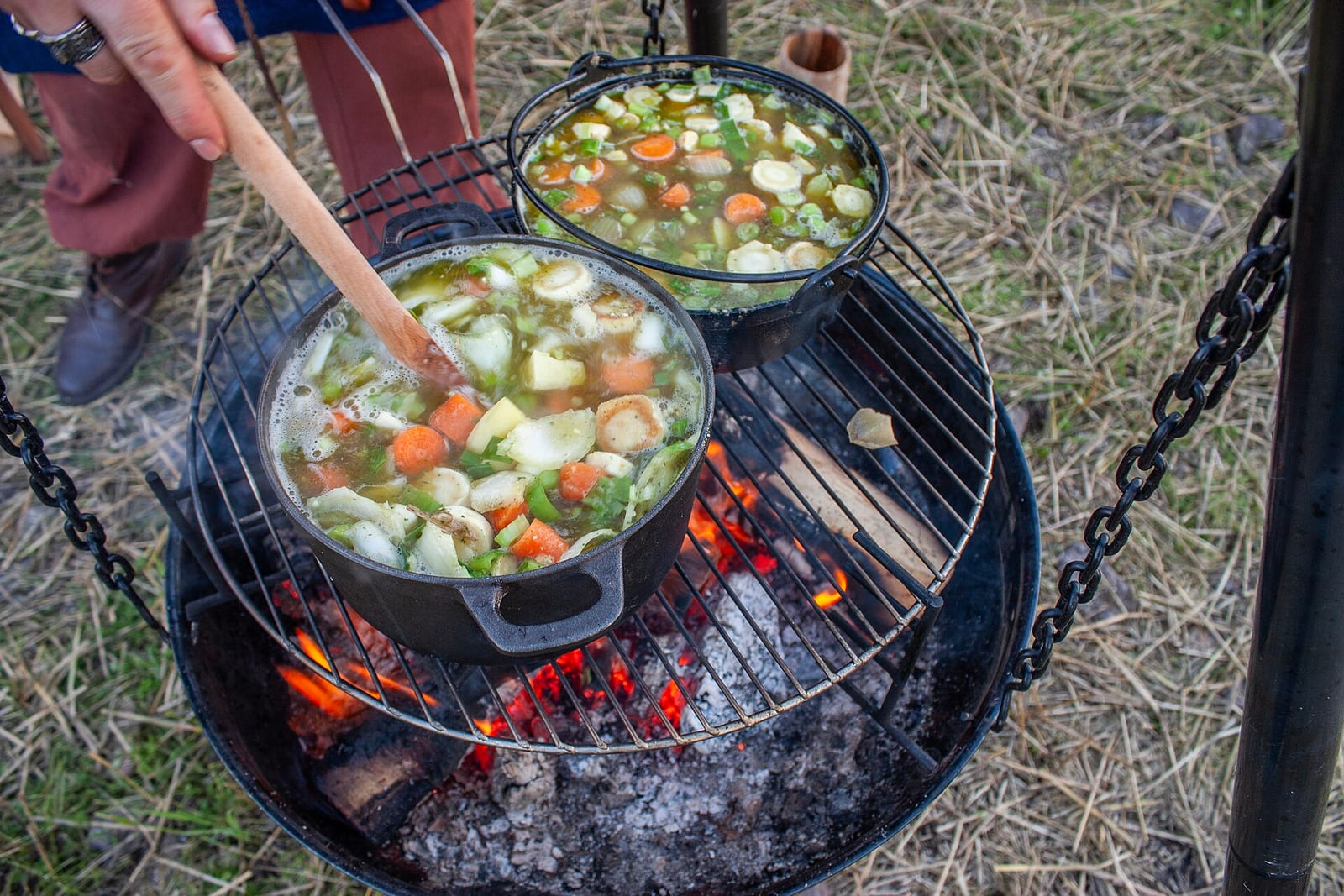
Image: Monica Ferreira Ask (CC BY-SA 4.0), via Wikimedia Commons