Warriors & Battles
Viking Shield Construction: Materials, Build and the Shield Wall
Viking shield construction explained: which wood, which boss, what weight, and what the Gokstad and Trelleborg finds really tell us about the shield wall.
Contents
- Viking shield construction: thin boards, not heavy planking
- Which wood did the shieldwrights actually use?
- The shield boss: iron over the fist
- Edging, leather and paint: the details films forget
- The shield wall: what the sources actually say
- Myth against fact
- What the Viking shield says about the men who carried it
No piece of Viking Age kit gets drawn more often or understood less than the round shield. Look closely at Viking shield construction and you will not find a heavy slab of planking bound in an iron rim. You will find something surprisingly light, almost fragile: a disc of thin boards, an iron dome over the fist, a rawhide edge and a single wooden grip running behind the centre. That build is not a detail. It decides how fighting actually worked in the tenth century.
It also explains why, out of tens of thousands of shields, almost nothing survives but rusted metal. Wood rots, leather perishes, paint dissolves. What sits in museum cases is usually the iron core of an object that was ninety percent organic. Which makes the handful of sites where soil, water or burial conditions preserved a whole shield board unusually valuable.
Viking shield construction: thin boards, not heavy planking
The standard Viking Age shield was a circular disc of several narrow boards laid edge to edge. They were not tongued, not jointed, not set into a frame. A round hole sat at the centre, covered from the front by a hemispherical iron shield boss fixed with rivets. Behind that hole, running across the opening, was a wooden grip the hand closed around. The shield therefore hung from one point in front of the fist rather than being strapped to the forearm the way a later medieval cavalry shield was.
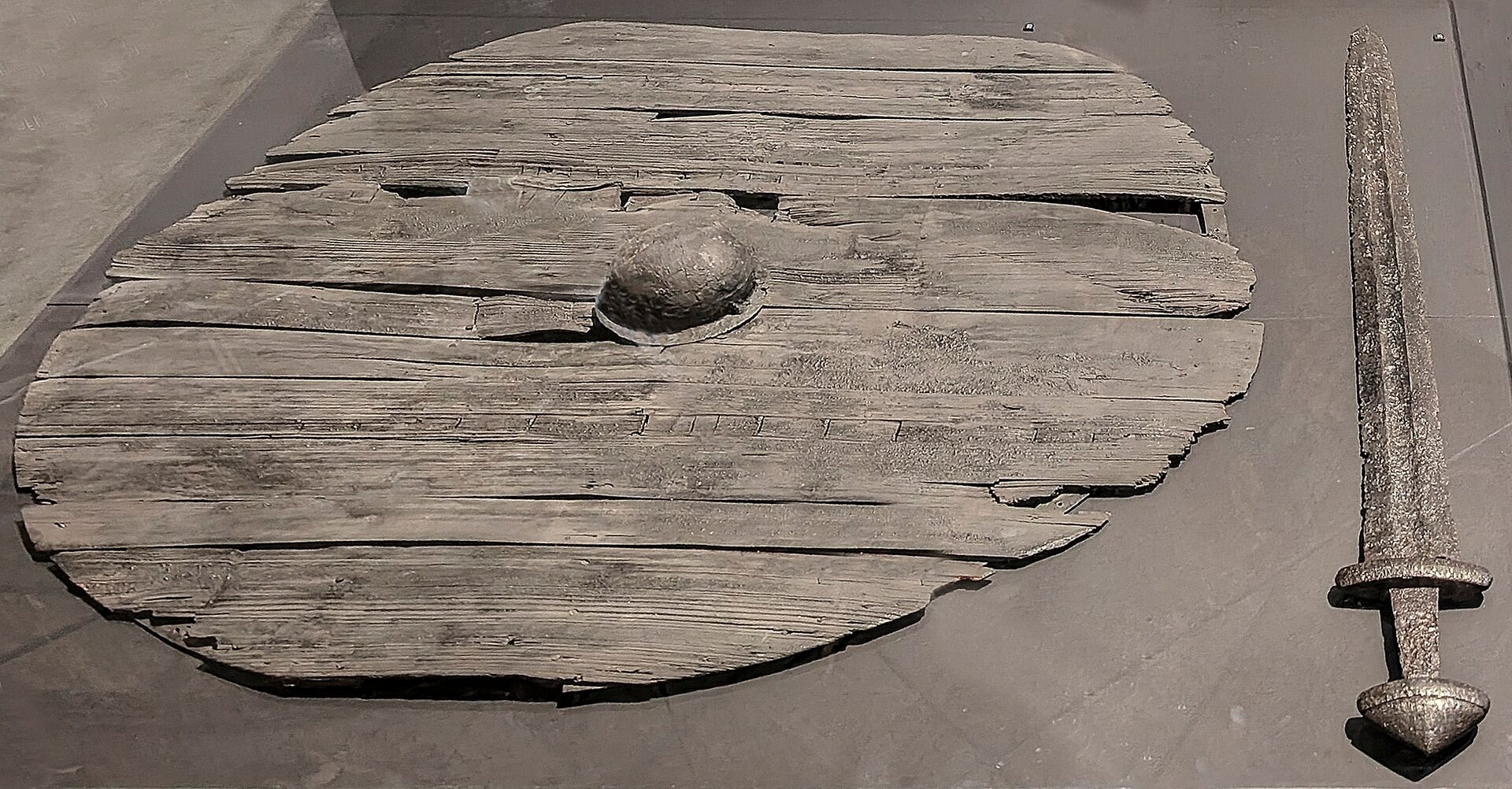
The measurements catch most people off guard. The shields from the Gokstad ship burial in Vestfold, Norway, are roughly 94 centimetres across but built from boards only about seven millimetres thick. The near complete example recovered in 2008 at the Danish ring fortress of Trelleborg is smaller still, around 80 centimetres wide and about six millimetres thick. Reconstructions built to those figures come in near three kilograms, sometimes less, depending on the edging. That is lighter than most replicas sold at modern festivals.
Thin does not mean cheap. A thin board does not stop a blow dead, it yields, splinters in a controlled way and drags on the blade instead of locking it. A heavy shield would have slowed every arm movement, which is precisely how a man dies in a press of axes and spears. Viking shieldwrights were not cutting corners. They were optimising.
Which wood did the shieldwrights actually use?
Here poetry and archaeology pull apart in a rather lovely way. Skaldic verse likes to call a shield lind, the linden, and linden genuinely is excellent shield timber: light, tough, slow to split catastrophically. The surviving boards tell a different story. The Gokstad shields are conifer. The Trelleborg disc was identified by the Danish National Museum as fir. Fragments from the harbour deposits at Hedeby point in the same direction, with the occasional hardwood exception.
The dullest explanation is probably the right one. People used what grew nearby and split cleanly: spruce, pine or fir across Norway and Jutland, and whatever was seasoned and to hand elsewhere. The poetic linden shield belongs in the same box as the hero’s golden sword, an image rather than an inventory. If you want the rest of the warrior’s kit in context, our piece on Viking weapons covers the axe, the sword and the much underrated spear.
Put on Járn ok þrumr while you read on:
The shield boss: iron over the fist
The shield boss is the part that outlives everything else. In Scandinavian graves, including the many warrior burials at Birka on the island of Björkö, it is often the only proof the dead man owned a shield at all: a corroded iron dome with nothing but soil around it.
As engineering it is the neatest idea in the whole design. Because the hand sits dead centre and would otherwise be completely exposed, an iron cap arches over it, drawn through the board by four to six rivets. Those same rivets hold the grip on the reverse. So the boss is not only armour for the knuckles, it is the structural anchor that keeps a set of loose parallel boards behaving as one object.
It was offensive equipment too. A shove with the boss puts an opponent off balance, and its hard curve makes an incoming edge skid rather than bite. Because boss profiles shift across the Viking Age, from lower, broad brimmed forms towards taller and more pointed ones, archaeologists can date a burial from the iron alone when every scrap of wood has gone.
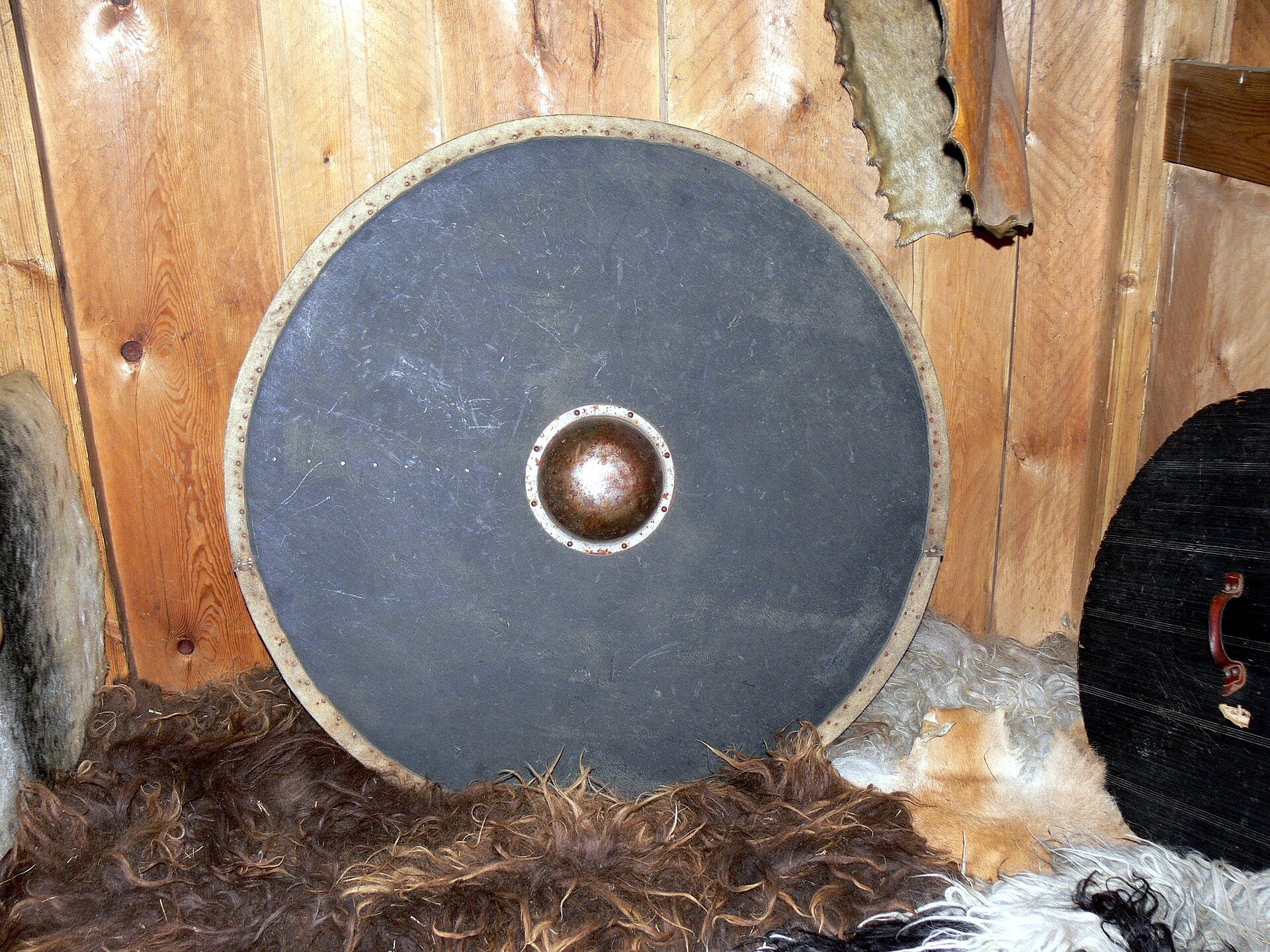 Image credit: Wolfgang Sauber (CC BY-SA 3.0), via Wikimedia Commons
Edging, leather and paint: the details films forget
The weak point of a disc made from boards laid side by side is the rim. One axe blow on the edge and the whole thing opens like a split log. So the rim was bound: with rawhide applied wet and shrunk tight as it dried, with stitched leather, or with small iron clamps that keep turning up individually in graves. The continuous metal ring beloved of prop departments has no real archaeological support.
More contested is whether the face was covered with leather or hide across its whole surface. The Danish archaeologist Rolf Warming has argued in his work on Viking Age shields that such a facing was the rule rather than the exception, since it binds thin boards together and sharply reduces splintering. Experiments with reconstructions support the idea, though unambiguous organic traces remain rare. This is where the evidence stops and interpretation starts.
Paint, on the other hand, is certain. The Gokstad shields were painted alternately yellow and black and hung along the hull in that order. Shield boards with surviving pigment came out of the Viking grave at Ballateare on the Isle of Man. And skaldic poetry has an entire genre built on the subject: Bragi Boddason’s Ragnarsdrápa and Þjóðólfr of Hvinir’s Haustlöng describe mythological scenes supposedly painted across a gifted shield. A fine shield was a picture surface and a status object as much as a defence.
| Find | Place | What it reveals about the build |
|---|---|---|
| Gokstad shields | Vestfold, Norway | 64 shields along the hull, about 94 cm wide, roughly 7 mm thick, painted yellow and black |
| Trelleborg shield | Zealand, Denmark | near complete disc, about 80 cm wide, roughly 6 mm thick, fir |
| Ballateare | Isle of Man | shield boards from a warrior grave with surviving traces of paint |
| Birka graves | Uppland, Sweden | many iron bosses without wood, the backbone of boss typology |
| Hedeby harbour | Schleswig | waterlogged wood fragments confirming the plank built disc |
The shield wall: what the sources actually say
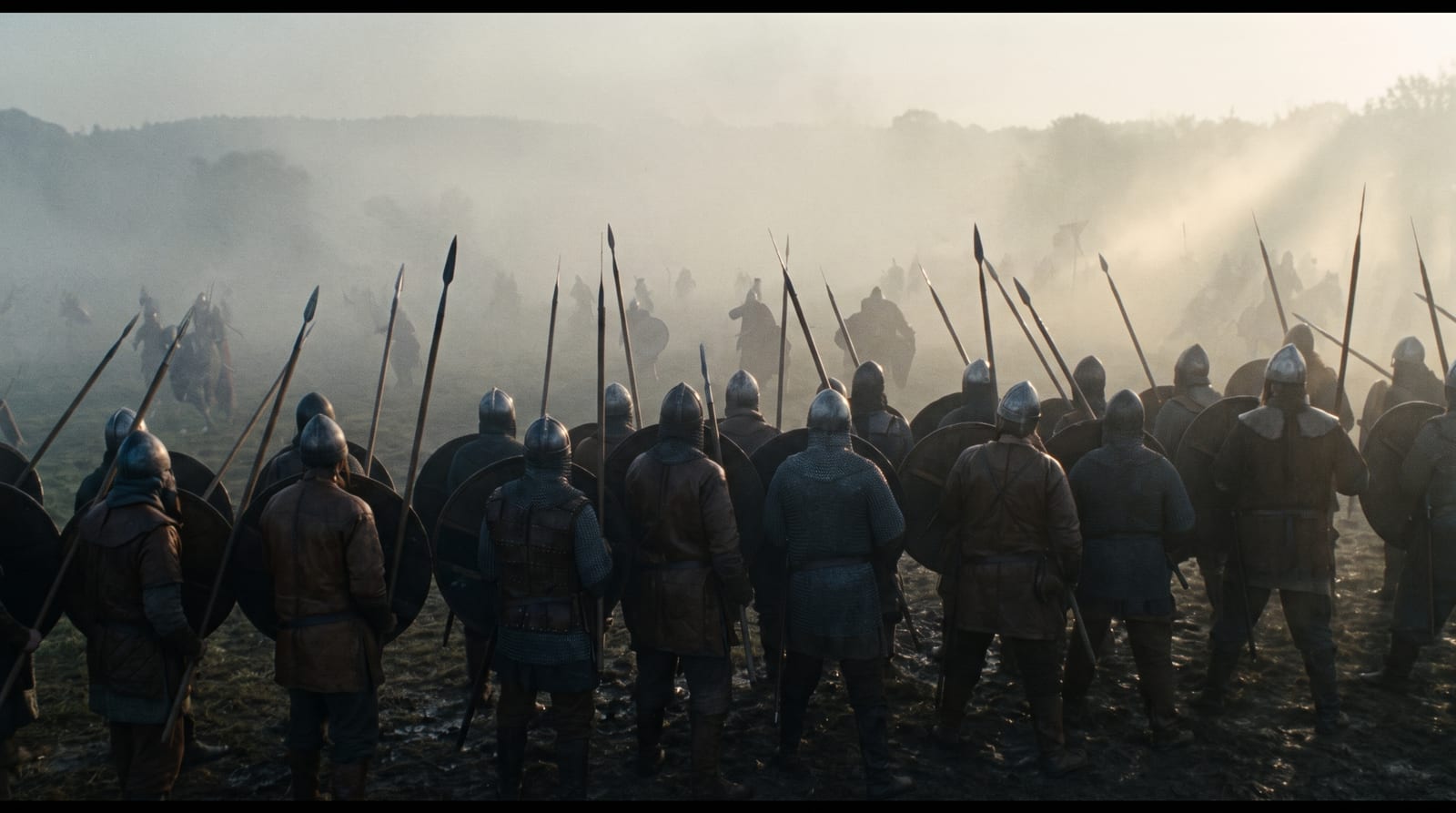
The Old Norse word skjaldborg, literally shield fort, turns up regularly in sagas and skaldic verse, and its Old English counterpart bordweal appears in the poem on the Battle of Maldon in 991. The formation existed, and contemporaries thought it worth a word of its own. Snorri Sturluson describes a shield wall closing around a king more than once in Heimskringla, including in his account of Stamford Bridge in 1066.
What no source tells us is how tightly it stood. The familiar picture, shields overlapping like roof tiles until the line becomes a solid wall, owes more to Roman imagery and to cinema than to anything Norse. The shield itself argues against it. A disc suspended from a single centre grip can be tilted, rotated and punched forward, but it is awkward to clamp rigidly against the man beside you. Six millimetres of fir is not masonry. It is a tool that wants to move.
Our editorial read is this: the Viking shield wall was most likely a dense, disciplined line rather than an interlocked block, with every fighter working his own shield actively while covering his neighbour’s flank. That fits the material, it fits the spears that dominate the graves, and it fits accounts in which shield walls open, shift and close again. A truly locked wall would simply have been too rigid to do any of that.
Myth against fact
- Myth: Viking shields were heavy planks bound in iron. Fact: boards of six to ten millimetres, with an edge usually of rawhide or leather.
- Myth: every shield was an individual work of art. Fact: the Gokstad shields follow a plain two colour scheme, and elaborate painted shields were elite gifts.
- Myth: the shield was strapped to the forearm. Fact: it was carried by a cross grip in the fist, protected by the boss.
- Myth: shields on the hull were battle armour for the gunwale. Fact: the Gokstad arrangement is now read mainly as display and stowage, not a fighting position.
- Myth: berserkers biting their shield rims is a modern invention. Fact: Snorri writes exactly that in Ynglinga saga, though whether anyone ever did it is another question.
What the Viking shield says about the men who carried it
Viking shield construction is a lesson in how material, craft and fighting style lock together. A disc of split boards, a piece of rawhide and a handful of rivets cost almost nothing, took days rather than weeks to make and counted as expendable after a hard battle. That is exactly why nearly every able bodied man could own one, while a sword was worth a small farm.
If you want to see where that same workshop logic leads at a larger scale, our article on the Gokstad ship picks up the story: the same burial, the same craft tradition, the same sober arithmetic of wood, iron and experience. The round shield was never a showpiece. That is precisely what makes it the most honest object the Viking Age left behind.
Hero image credit: Paul Hermans (CC BY-SA 4.0), via Wikimedia Commons