History
The Gokstad Ship: The Viking Ship That Conquered the Atlantic
The Gokstad ship: unearthed in Norway in 1880, the grave of a mysterious chieftain with wounds from violence, and a 1893 replica that crossed the Atlantic.
Contents
- The Discovery Beneath the King’s Mound
- The Measurements and Craftsmanship of a Masterpiece
- The Chieftain With the Mysterious Wound
- Three Small Boats and a Blueprint for Archaeology Itself
- Animals for the Final Journey
- 1893: Proof on the Open Atlantic
- Where the Original Stands Today
- Gokstad Compared: Not Every Viking Ship Was Built Alike
- A Ship That Proved More Than Any Other
In February 1880, two farm boys near Sandefjord in Norway started digging into a large burial mound the locals had called the “King’s Mound” for generations. What they found changed our picture of the Viking Age for good: a nearly intact, 23-meter oak ship built for a man whose identity remains a mystery to this day. The Gokstad ship isn’t just one of the best-preserved Viking ships ever found - in 1893, a faithful replica of it also proved, quite literally, what these ships were capable of, by crossing the North Atlantic.
The Discovery Beneath the King’s Mound
The burial mound at the Gokstad farm had sat undisturbed for centuries beneath a thick layer of blue clay that kept oxygen largely out, preserving the wood from decay. When antiquarian Nicolay Nicolaysen took charge of the excavation in the spring of 1880, it quickly became clear that something extraordinary lay beneath the surface. By that same summer, the ship had been fully uncovered - a remarkably fast excavation for the era, and a carefully documented one at that.
Dendrochronological analysis dates the ship’s timber to around 890 AD, while the burial itself likely took place around 900 to 905 AD. The ship had therefore already seen several years of use before it was buried - wear marks on the hull and repairs to several planks confirm it genuinely sailed the seas rather than being built solely for the grave.
The Measurements and Craftsmanship of a Masterpiece
At 23.24 meters long and 5.20 meters wide, the Gokstad ship ranks among the larger surviving Viking ships. It was built entirely of oak using the classic clinker technique, in which overlapping planks give the whole hull remarkable flexibility - the same principle that defines the famous longship. Unlike the more ceremonial Oseberg ship, the Gokstad find was a genuine ocean-going sailing vessel: sturdily built, with a deep keel that gave it markedly better handling on the open sea.
Aboard, archaeologists found 64 round shields, painted alternately black and yellow and mounted in pairs along the gunwale - an imposing, intimidating sight for anyone who encountered the ship at sea. The grave also contained three smaller boats, a sled, tent frames, cooking equipment, and a gaming board, apparently meant to serve the deceased on his journey into the afterlife.
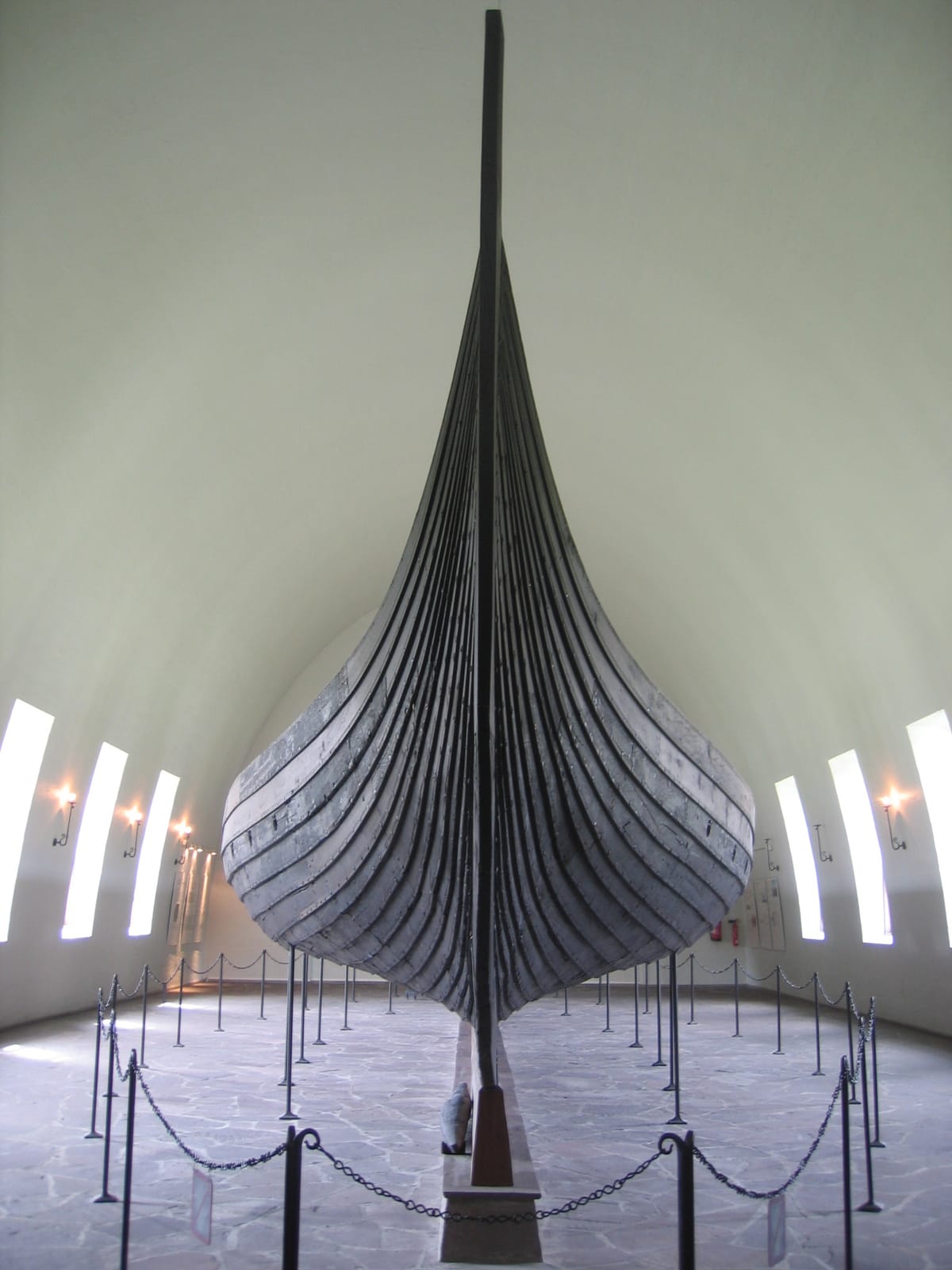 Image credit: Karamell (CC BY-SA 2.5), via Wikimedia Commons
The Chieftain With the Mysterious Wound
At the center of the burial chamber lay the skeleton of a man who was likely between 40 and 60 years old at the time of his death - a fairly advanced age for the Viking era, suggesting a certain degree of wealth and status. Osteological examination of his bones reveals clear signs of deep, severe cuts, including one to the shinbone, likely inflicted by a weapon. Whether these wounds actually caused his death or dated from an earlier fight can’t be conclusively determined from the bones alone.
Exactly who was buried in the Gokstad ship remains one of Norse archaeology’s open questions - a man of high rank, violently wounded, whose name history never recorded.
Norwegian saga tradition has linked various names to the grave, including the semi-legendary king Olaf Geirstadalf, associated in later sources with the Vestfold region. This identification can’t be proven, however - the sagas in question were written down centuries after the events they describe and are treated as historical sources only with considerable caution. What archaeology can say with confidence is far more modest: a man of high status, powerfully built, bearing serious combat wounds, buried with extraordinary effort.
It’s also worth noting that the grave was already looted in antiquity, likely within just a few generations of the burial. Valuable metal objects such as weapons and jewelry are almost entirely absent, which historians read as a sign that the looters knew exactly where and what to look for - possibly even descendants or former retainers of the man buried there.
Three Small Boats and a Blueprint for Archaeology Itself
Alongside the large ship, excavators found three noticeably smaller boats of varying size, likely used as tenders for going ashore, fishing, or ferrying people and goods between the ship and land. Two of these boats survive in such good condition that they allow detailed comparisons of different building techniques within the same shipyard - a rare stroke of luck that shows Viking Age shipyards apparently built not just one ship model, but an entire range of boat types for different purposes.
The Gokstad excavation is also considered something of a founding moment for modern Norse ship archaeology. Nicolaysen’s methodical approach - numbering every plank, documenting its exact position, and reconstructing the entire hull piece by piece afterward - later became the standard procedure for virtually every subsequent Viking ship excavation, including the more famous Oseberg find two decades later. Without this early methodical care, a great deal of what we now know about Viking Age shipbuilding would simply have been lost.
Animals for the Final Journey
Alongside the deceased, archaeologists found the remains of twelve horses, six dogs, and a peacock - an exceptionally exotic bird for the Viking Age, underscoring the far-reaching trade connections the buried man must have had. Such animal offerings were part of the burial ritual, likely meant to serve the deceased on his journey into the afterlife or to demonstrate his status even in death. Similar, if less extensive, animal offerings are known from other significant Viking Age ship burials as well.
Listen to Víkingr while you read on, an epic album that captures the sheer force of this seafaring nation:
1893: Proof on the Open Atlantic
Perhaps the most striking chapter in the Gokstad ship’s story didn’t happen during the Viking Age at all, but in 1893. For the World’s Columbian Exposition in Chicago, Norwegian captain Magnus Andersen had a faithful replica built, simply named “Viking.” With a crew of twelve, the ship sailed from Bergen across the North Atlantic straight to America - a roughly four-week voyage undertaken deliberately without modern navigation aids, to prove once and for all that the Viking ship design was truly seaworthy.
The voyage was a resounding success. The “Viking” weathered rough storms on the open ocean and reached New York faster than many contemporaries thought possible - a striking practical demonstration that Vikings really could cross the Atlantic safely with their ships, long before Columbus was even born. The replica still exists today and stands on display at an open-air site in Geneva, Illinois.
Where the Original Stands Today
The original ship has been on display since the 1930s at the Viking Ship Museum (Vikingskipshuset) on the Bygdøy peninsula in Oslo, alongside the Oseberg ship and other major Viking Age finds. The museum is currently undergoing a major renovation into the new “Museum of the Viking Age,” intended to provide more modern conservation conditions for these fragile, centuries-old ships.
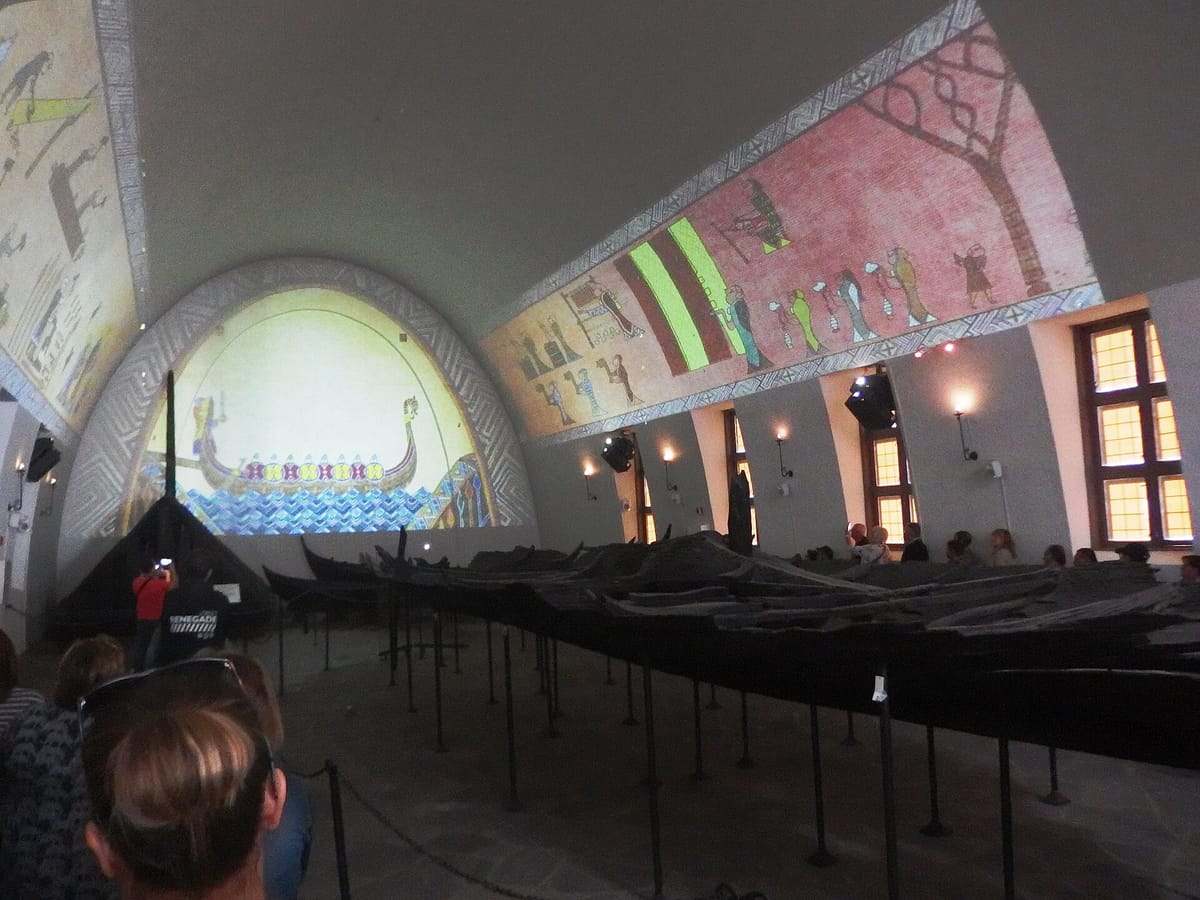 Image credit: Palickap (CC BY-SA 4.0), via Wikimedia Commons
Gokstad Compared: Not Every Viking Ship Was Built Alike
A look at other major Norwegian ship finds shows just how differently Viking ships were built depending on their purpose:
| Ship | Discovered | Length | Built (approx.) | Primary Purpose |
|---|---|---|---|---|
| Gokstad | 1880, Sandefjord | 23.24 m | c. 890 AD | Ocean-going sailing ship, burial ship |
| Oseberg | 1904, Tønsberg | 21.58 m | c. 820 AD | Ceremonial, calm waters |
| Tune | 1867, Rolvsøy | c. 20 m (fragmentary) | c. 900 AD | Likely a war/burial ship |
The comparison makes clear why the Gokstad find mattered so much for the question of Viking seaworthiness: its deeper keel and sturdier construction set it noticeably apart from the more fragile, fjord-built Oseberg ship. Those very design differences are exactly what the “Viking” confirmed in practice on the Atlantic in 1893.
A Ship That Proved More Than Any Other
What makes the Gokstad ship so remarkable is the rare combination of archaeological quality and practical proof. While many Viking ship finds mostly raise questions, the 1893 replica answered one of the central questions in Viking scholarship with wind, water, and a four-week Atlantic crossing: yes, these ships really could conquer the open ocean. If you want to see what ships like this one could do when used as weapons of attack rather than as grave goods, check out our article on the raid on Lindisfarne.
Our take: precisely because the grave was looted and the man buried inside remains nameless, the Gokstad find shows just how much can still be learned about the Viking Age purely from shipbuilding, burial ritual, and experimental archaeology - even without ever answering the one question everyone really wants answered: who was actually lying there.