Warriors & Battles
Ulfberht Sword: The High-Tech Blade of the Viking Age
The Ulfberht sword explained: why around 170 blades marked +VLFBERH+T count as tenth-century high tech, and what the metallurgy actually proves about them.
Contents
- What actually makes a sword an Ulfberht sword
- Reading the inscription: +VLFBERH+T and the trouble with the crosses
- A steel that should not have existed in Europe
- Following the trail east, and the objection from Hannover
- Counterfeits in the tenth century
- Contraband: how Frankish kings tried to stop the export
- What the Ulfberht sword really leaves us
Few objects from the Viking Age force materials science, long-distance trade and something close to early trademark law into the same awkward conversation. An Ulfberht sword is not identified by its shape, its hilt or where it was found, but by eight characters someone hammered into the glowing blade: +VLFBERH+T. Around 170 such blades are known today, pulled out of Norwegian graves, out of the river Weser, out of Polish lakes and out of cemeteries along the Volga. They span the ninth to the eleventh century, and some of them are made from a steel that, according to everything we know about the furnaces of the period, simply could not be produced in Europe at the time. That gap between the evidence and the expectation has kept the group in the research literature for more than a century.
What actually makes a sword an Ulfberht sword
First the part that gets confused most often: Ulfberht is not a type of sword. It is a signature on a blade, and only on the blade.
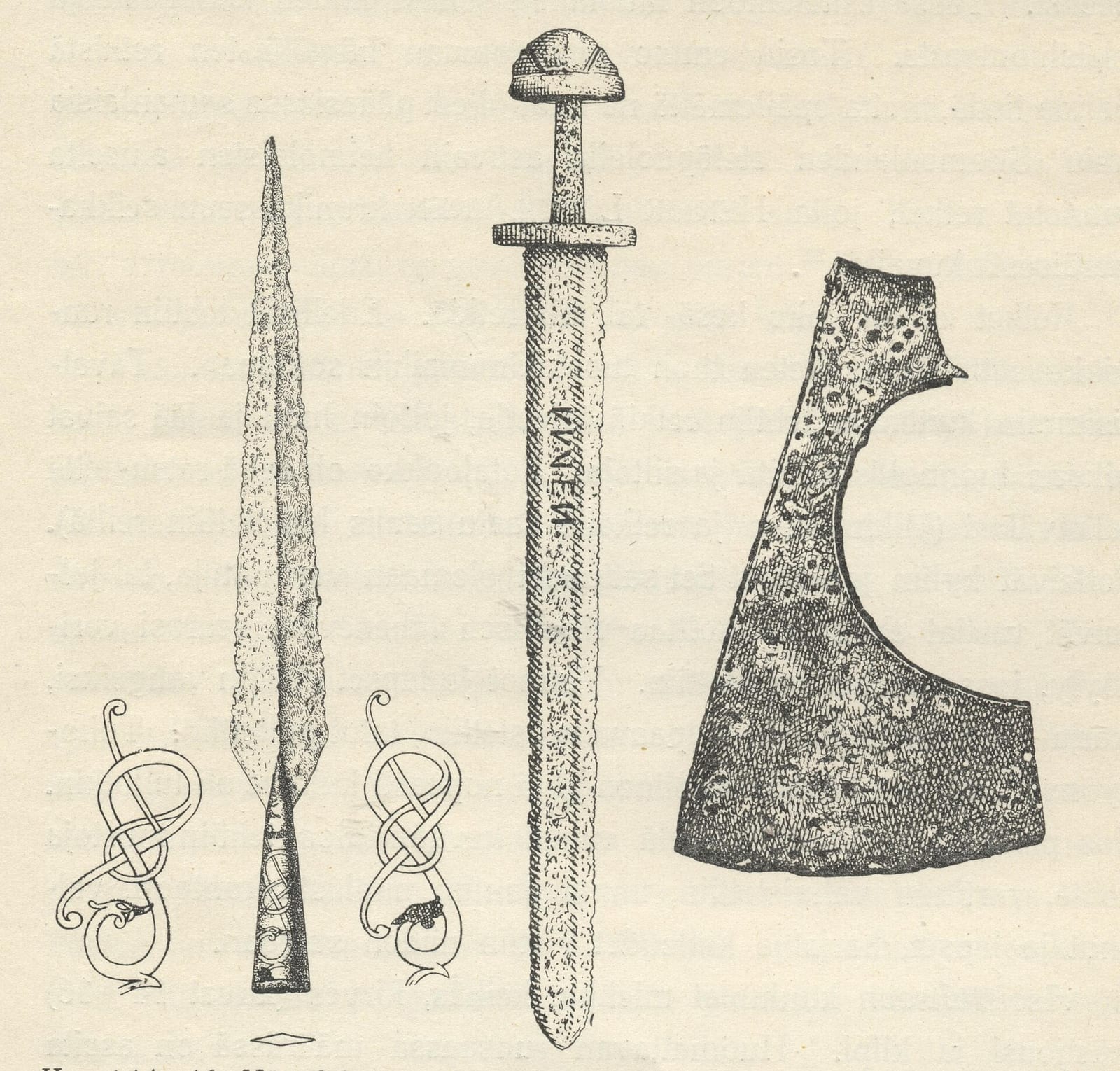
The weapons themselves look like other swords of their generation. Double-edged, usually around 90 centimetres long, with a broad fuller running down the centre that saves weight without killing the stiffness. The hilts, by contrast, are all over the place. In the typology the Norwegian archaeologist Jan Petersen published in 1919 for the Viking swords of Norway, Ulfberht finds turn up across several different hilt forms. That sounds like a footnote. It is actually the key to the whole phenomenon.
It means blade and hilt did not come from the same workshop. The blade was the traded commodity; the hilt was fitted locally, often decades later, in whatever style the region favoured. A buyer was paying for steel. Everything else he had made at home. Why that made a finished sword so expensive, and why swords appear far less often in graves than axes or spears, is something we unpack in our overview of Viking weapons.
The name itself is continental Germanic rather than Norse, built from the elements for wolf and bright, like dozens of Frankish names of the period. The fact that the inscription appears across roughly two centuries argues strongly against a single smith. A workshop or a family in Frankish territory, passing the name down the way a later business passes down a company name, fits the evidence far better.
Reading the inscription: +VLFBERH+T and the trouble with the crosses
The letters are not scratched on and not stamped in. They sit inside the metal.
The smith chiselled the characters into the still-warm blade as grooves, laid thin iron or steel wires into them, usually twisted ones, forge-welded them to the body of the blade and then ground the whole surface flat. After polishing or a light etch the letters stood out bright against a darker ground. It is the same thinking behind the silver inlay on parade weapons, minus the precious metal, and applied to the part of the weapon that actually takes the load in a fight.
+VLFBERH+T
One peculiarity has drawn more attention than anything else. On some blades the second cross sits between the H and the T; on others it comes after the T, giving +VLFBERHT+. The British metallurgist Alan Williams, for many years at the Wallace Collection in London, is the researcher who connected that small difference to something much larger: blades with the cross tucked inside the name belong strikingly often to the group with the exceptional steel, while blades with the cross at the end mostly do not. A spelling quirk thereby turns into a test of authenticity.
It should not be treated as a rule that settles every case. The number of blades subjected to chemical analysis is small, corrosion has eaten into many inscriptions, and more than one reading is really an interpretation. What survives scrutiny is a strong tendency, not a law.
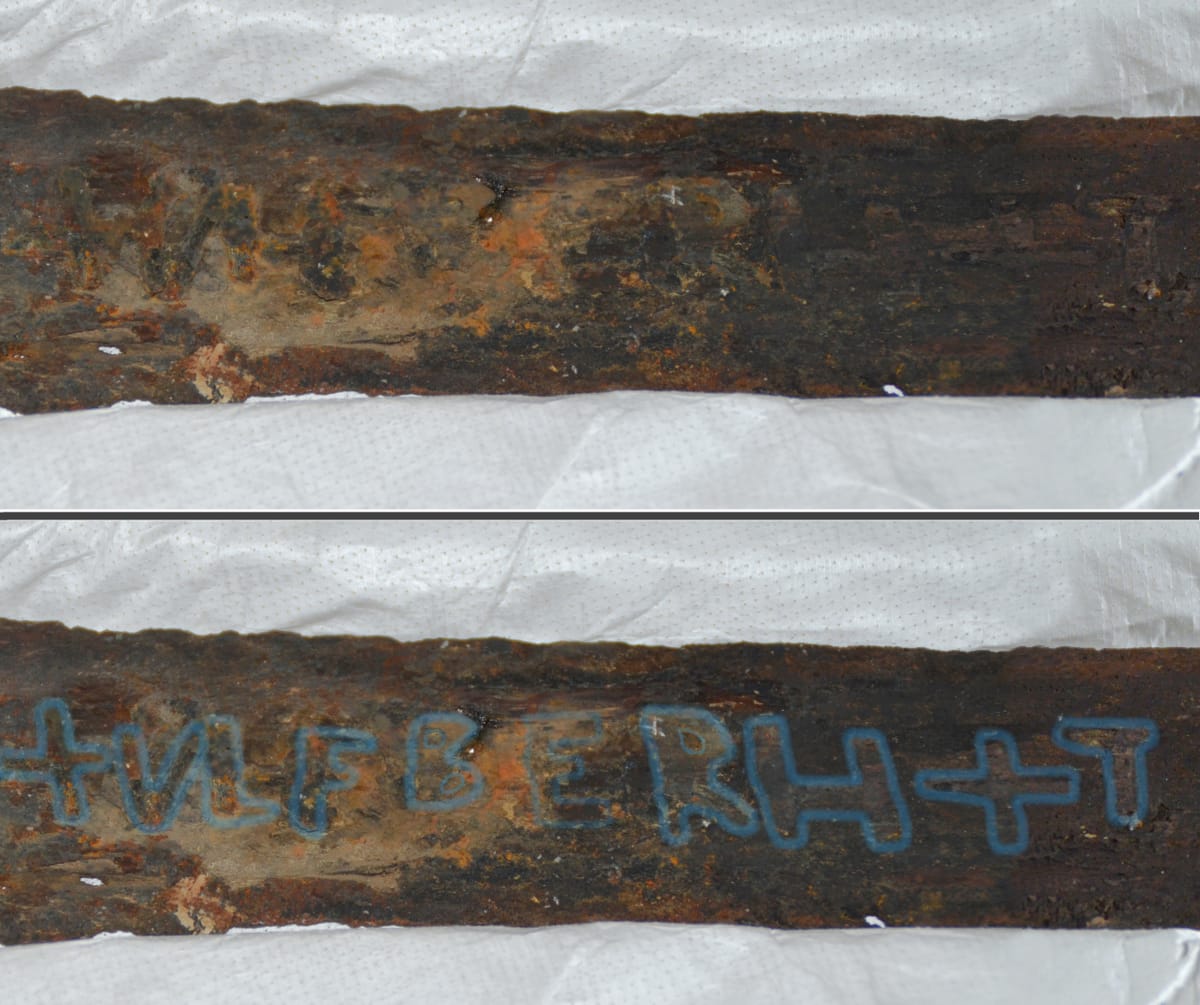
Image source: Axel Hindemith (CC BY 3.0), via Wikimedia Commons
Put on Járn ok þrumr while you read on:
A steel that should not have existed in Europe
To see why specialists sit up when they look at some of these blades, you need to know how iron was made in early medieval Europe.
Smiths north and west of the Alps worked with the bloomery. Ore was reduced at temperatures too low to melt the iron, leaving a spongy mass shot through with slag that had to be consolidated, folded and drawn out again and again. Carbon content was not something you controlled; it was something you got. One stretch of the bar came out too soft, the next too brittle. The answer to that problem is pattern welding: bars of differing hardness are forge-welded together, twisted, and the resulting blade spreads its weaknesses along its whole length. The famous patterns were a by-product of the technique long before anyone treated them as decoration.
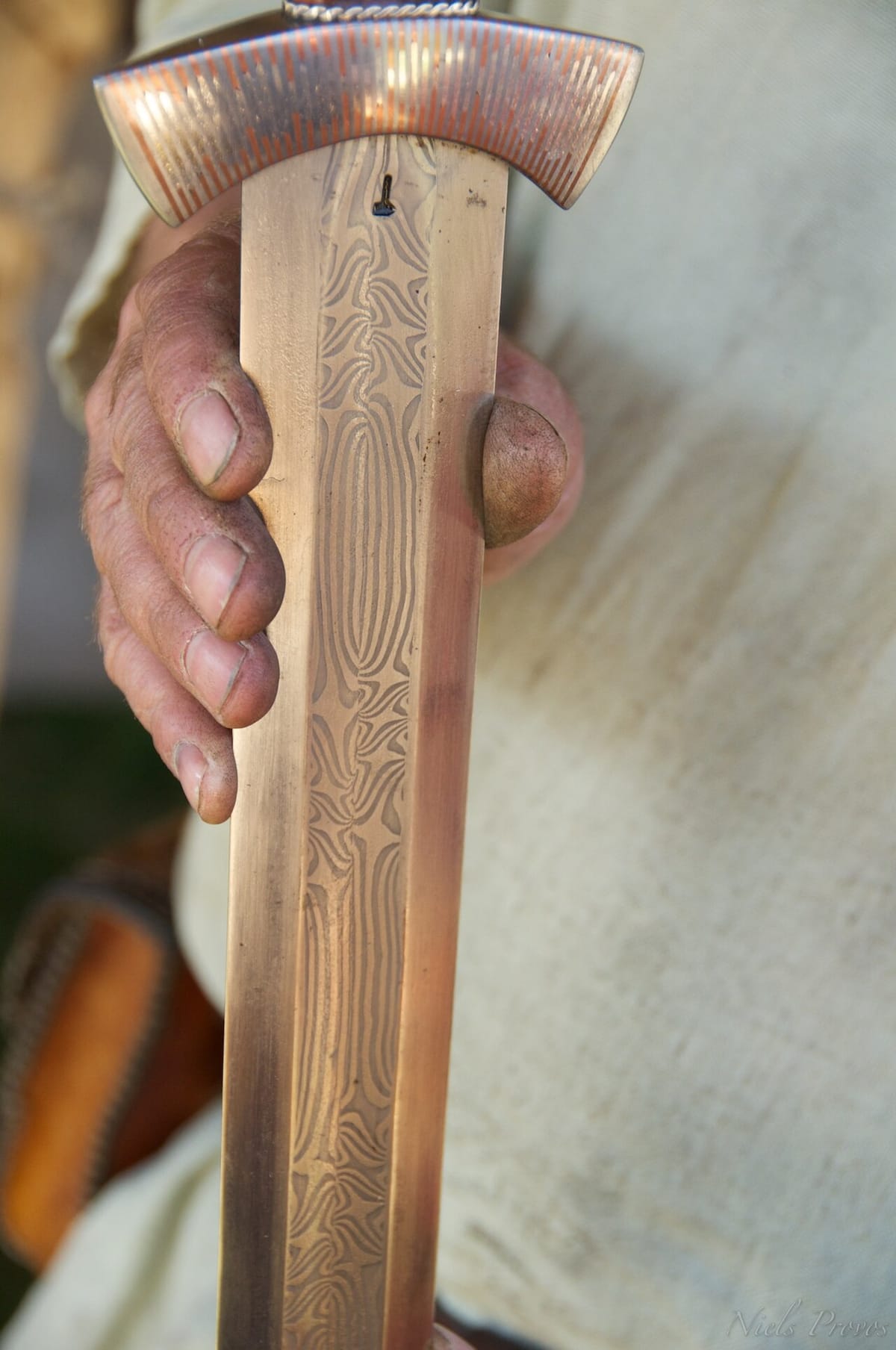
Image source: Niels Provos (CC BY-SA 4.0), via Wikimedia Commons, blade by Ejvind Nørgård
This is exactly where the best Ulfberht blades break the pattern, in both senses. They are not pattern-welded. They consist of a largely uniform, high-carbon steel, roughly one per cent carbon, with remarkably few slag inclusions. Material like that only forms if the metal was fully molten, and European iron did not become fully molten until the blast furnace arrived centuries later. In the crucible process long mastered in Central Asia, Persia and India it was perfectly achievable: ore, a carbon source and a flux were sealed in a vessel and heated until everything fused into one homogeneous ingot.
A blade made from that material genuinely outperforms an ordinary bloomery blade. It is harder, it holds an edge longer, it can be forged slimmer and still resists breaking. None of that is supernatural. It is simply a better starting material.
Following the trail east, and the objection from Hannover
If the material came from the east, there has to be a road. There is one, and the archaeology for it is solid.
Running down the Russian river systems, the Volga route tied Scandinavia to the realm of the Volga Bulgars and, across the Caspian, to the Islamic world. What came back was above all silver: hundreds of thousands of Arabic dirhams lie in northern European hoards, nowhere more densely than on Gotland. That ingots of crucible steel travelled west along the same channels is a reasonable inference, not a proven fact. Just how dense that network was is the subject of our piece on the Viking trade routes.
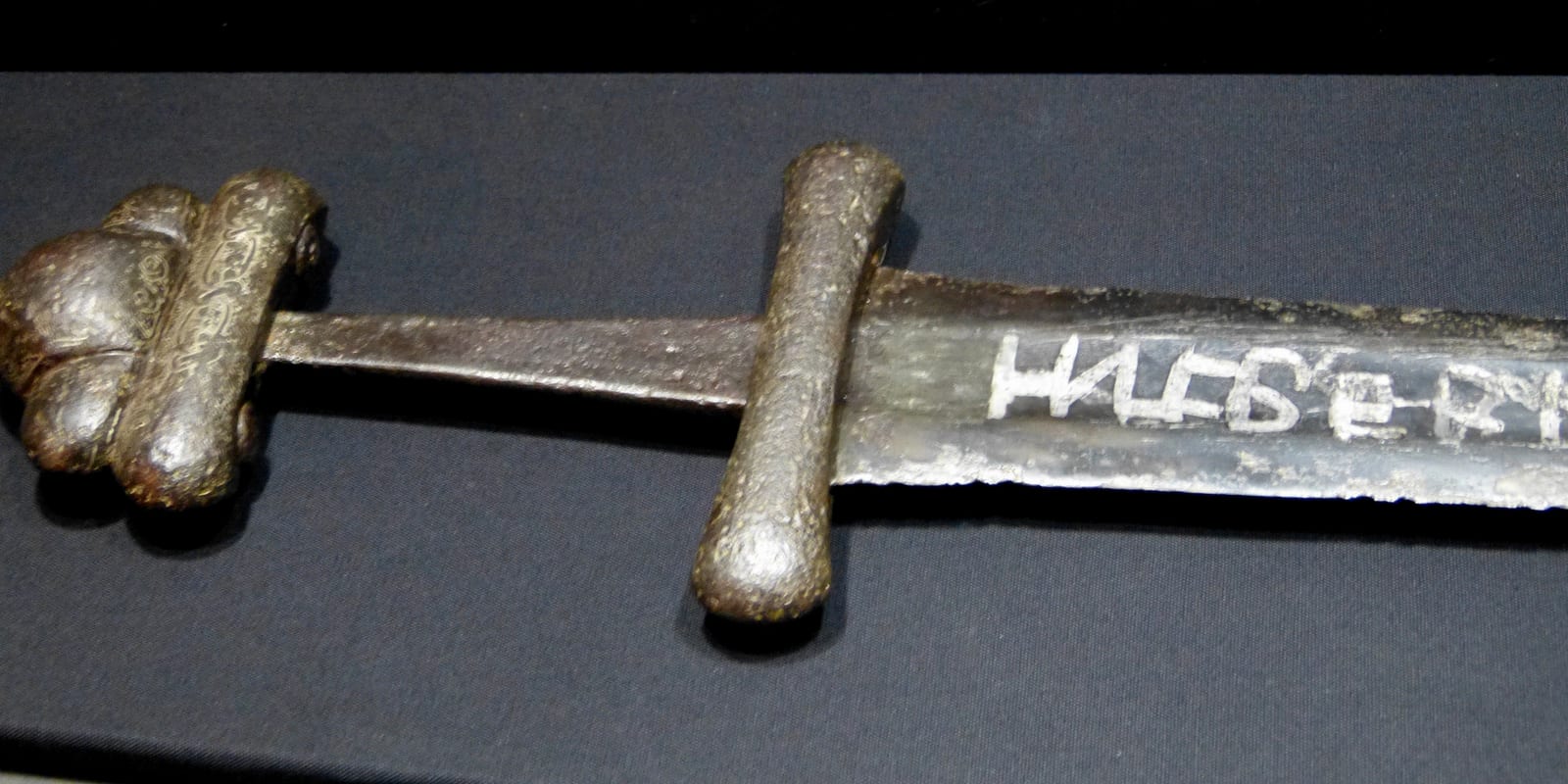
One find makes the connection unusually vivid. The Historical Museum in Kazan holds an Ulfberht blade, one of several recovered in Volga Bulgar territory: a Frankish branded blade thousands of kilometres east of where it was made, in the very region the raw material may have come from.
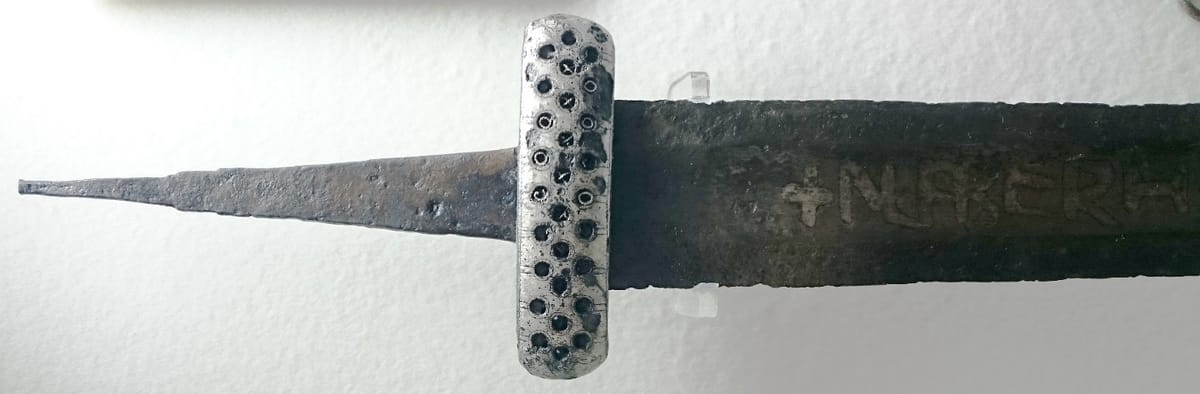
Image source: Dbachmann (CC BY-SA 4.0), via Wikimedia Commons
There is, however, a serious objection to the purely eastern story. The chemist Robert Lehmann of Leibniz University Hannover examined the sword from the Weser near Großenwieden and concluded from trace elements and lead isotopes that the metal had a central European origin, with indications pointing to ore from the Taunus hills. For that particular blade, the analysis argues against any journey from Central Asia.
The two findings do not cancel each other out, and this is the editorial judgement we think the evidence supports: a mark that runs for more than two hundred years is not a production run. It is a name under which material of varying quality was worked at different times, sometimes imported, sometimes local. Anyone who wants to close the question of origin with a single answer is mistaking a workshop stamp for a recipe.
Counterfeits in the tenth century
The most recognisably human part of this story is the fakes.
Alongside the high-grade blades sits a substantial group carrying the same inscription on thoroughly ordinary metal: welded-up iron, a soft core, erratic carbon content. On some of them the letters are reversed, misplaced or unevenly spaced, which is hardly surprising if the smith could not read. The name on its own was evidently enough to sell a sword. It is one of the earliest tangible cases of product piracy in Europe, and it says more about the workshop’s reputation than any praise in a saga ever could.
| Common claim | What the evidence supports |
|---|---|
| Ulfberht was one master smith | The inscription spans roughly two centuries, far beyond any working life |
| Every Ulfberht blade is top quality | Only part of the analysed sample shows the superior steel; the rest is ordinary work with a famous name |
| The swords were Viking-made | Name and technique point to Frankish territory; they reached the north by trade and plunder |
| The steel was a lost secret | Crucible steel was well known in the east; Europe lacked the furnace technology, not the idea |
| The inscription was magical | It sits where a brand name sits today, which is precisely why it was copied |
Contraband: how Frankish kings tried to stop the export
The Frankish authorities were well aware that weapons of this quality were going north, and they tried to shut the trade down.
Capitularies issued under Charlemagne already forbade selling weapons and mail beyond the borders of the empire. Charles the Bald restated the ban in the Edict of Pîtres in 864, aiming it explicitly at the Northmen, who by then were operating deep inside Frankish territory. When a prohibition has to be issued repeatedly, it is usually a sign that it was not working.
The distribution map confirms it emphatically. Norway, where the custom of burying weapons with the dead was especially strong, accounts for the densest concentration of Ulfberht finds anywhere. What was banned was smuggled, taken as plunder or handed on as tribute.
Some well-known examples and where they are kept:
| Find spot or region | Where it is held | Why it matters |
|---|---|---|
| Old Rhine near Friesenheimer Insel, Mannheim | Germanisches Nationalmuseum, Nuremberg | Recovered in 1960, a ninth-century blade with a clearly legible inscription |
| River Weser near Großenwieden, Lower Saxony | Lower Saxony, scientifically analysed | Basis of the analysis pointing to ore from the Taunus |
| Schwedt, Brandenburg | Museum für Vor- und Frühgeschichte, Berlin | Tenth-century blade, repeatedly shown in exhibitions |
| Territory of the Volga Bulgars | Historical Museum, Kazan | Evidence of how far east these blades travelled |
| Norway, various grave finds | Norwegian museum collections | The largest coherent group of finds anywhere |
What the Ulfberht sword really leaves us
Popular culture has turned these blades into something close to a magic sword, and the documentaries of the last decade have been enthusiastic accomplices. That is a shame, because the sober version is the better story.
An Ulfberht sword proves that in the ninth and tenth centuries a workshop name held its value across two hundred years and thousands of kilometres. It proves that material, technique and reputation were already three separate things that could be bought, copied and lost separately. And it proves that the Viking Age was never a sealed Nordic world but a network in which Frankish steel, Arabic silver and possibly Central Asian ingots ended up in the same graves.
What we do not know remains enormous. No workshop has been located, no furnace, no shipping list, not one name of a buyer. We have a signature, a few dozen analysed blades and a distribution map. For an object that has appeared in every standard work on the Viking Age for over a century, that is remarkably little. It may be exactly why the subject refuses to settle.
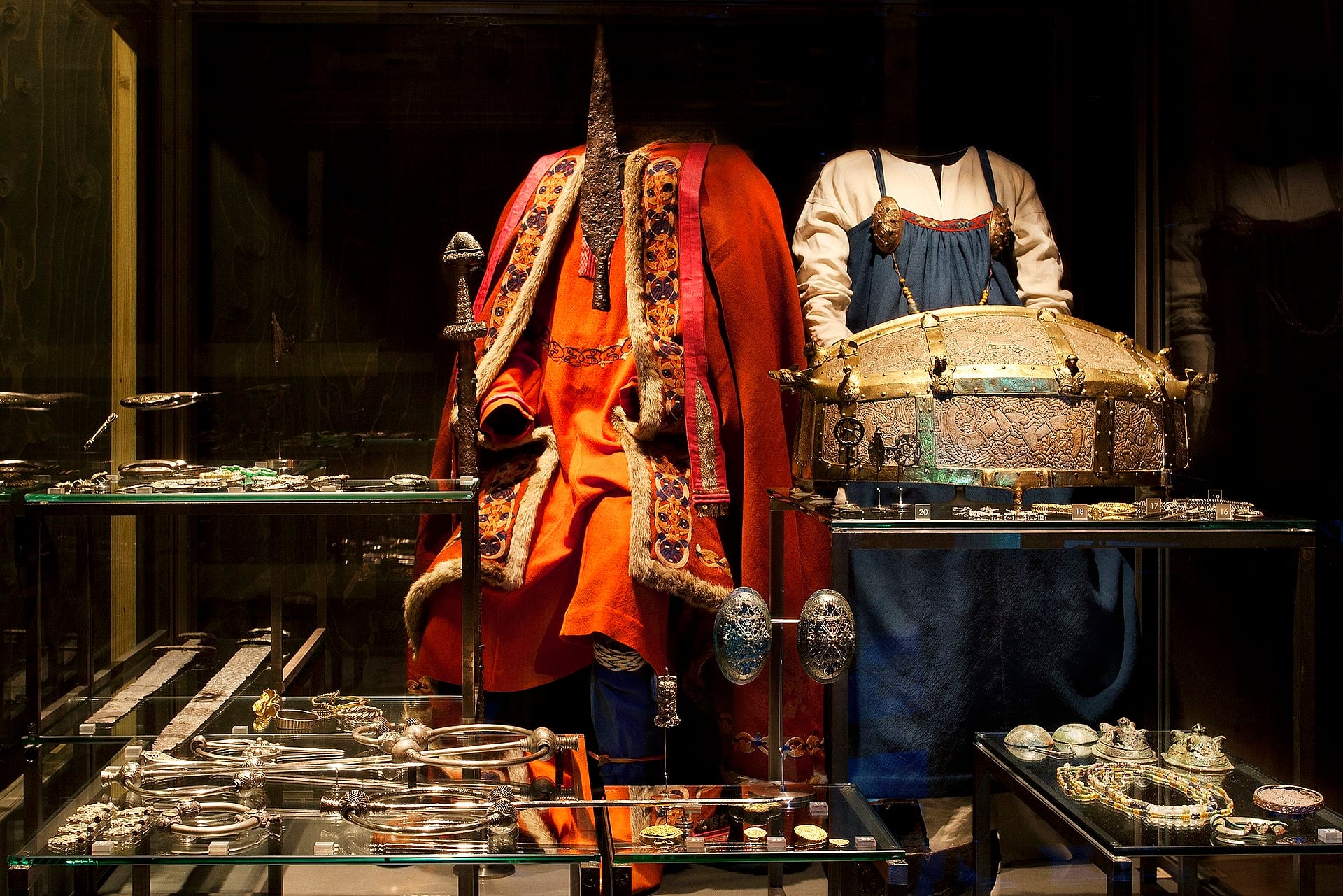
Hero image source: Wolfgang Sauber (CC BY-SA 4.0), via Wikimedia Commons