Warriors & Battles
The Viking Shield Wall: How Vikings Fought in Battle
The shield wall was the defining battle formation of the Viking Age. How the tactic worked, what weapons it required, and what Maldon, Hastings, and Stamford Bridge reveal.
Contents
No Hollywood duels, no wild free-for-all of lone fighters: the Viking Age relied on one dominant, decisive tactic on the open battlefield, the shield wall, Old Norse skjaldborg. Understanding it means letting go of the romantic image of the solitary berserker. Battles in this period were almost always won or lost on discipline, formation, and one simple question: whose line held longer.
What a Shield Wall Actually Was
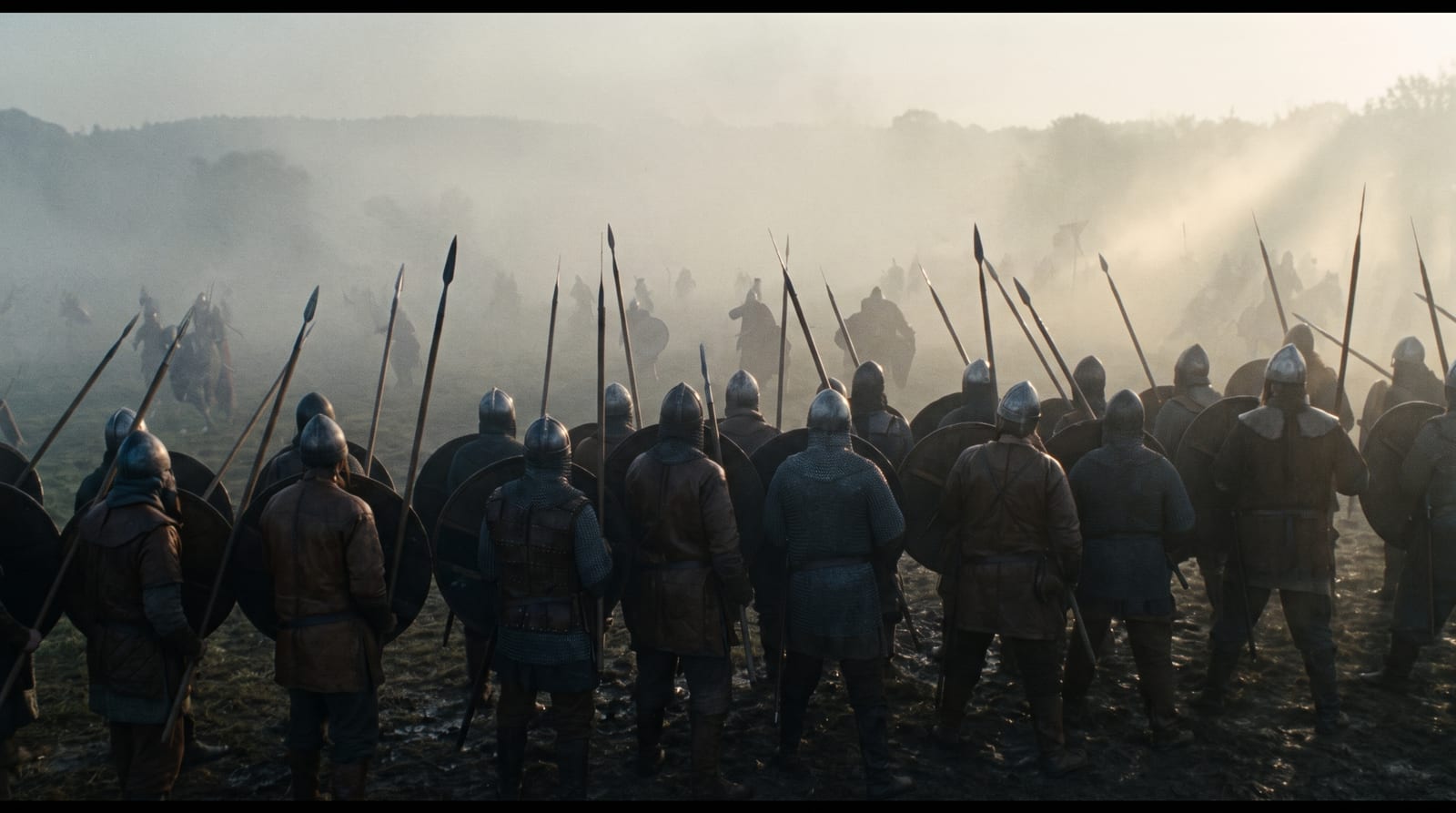
At its core, a shield wall was a line of fighters standing shoulder to shoulder, holding their round shields so they overlapped and left almost no gap, forming a nearly continuous barrier. Each man protected not only himself but also his neighbor’s right side, the side his own shield could not cover, since the shield was typically carried on the left arm while the weapon hand worked from the right. That mutual dependence is exactly what made the formation so effective and, at the same time, so fragile: if one man fell or stepped back, a gap opened that an enemy could use to roll up the entire line.
The front rank usually held the most experienced, best-equipped fighters, often wearing mail and a helmet, armed mainly with spears thrust over the rim of the shield. The ranks behind supported with further spear thrusts, thrown weapons, and, when needed, stepping forward to fill the front line the moment someone there fell.
The Equipment: Round Shield, Spear, Axe
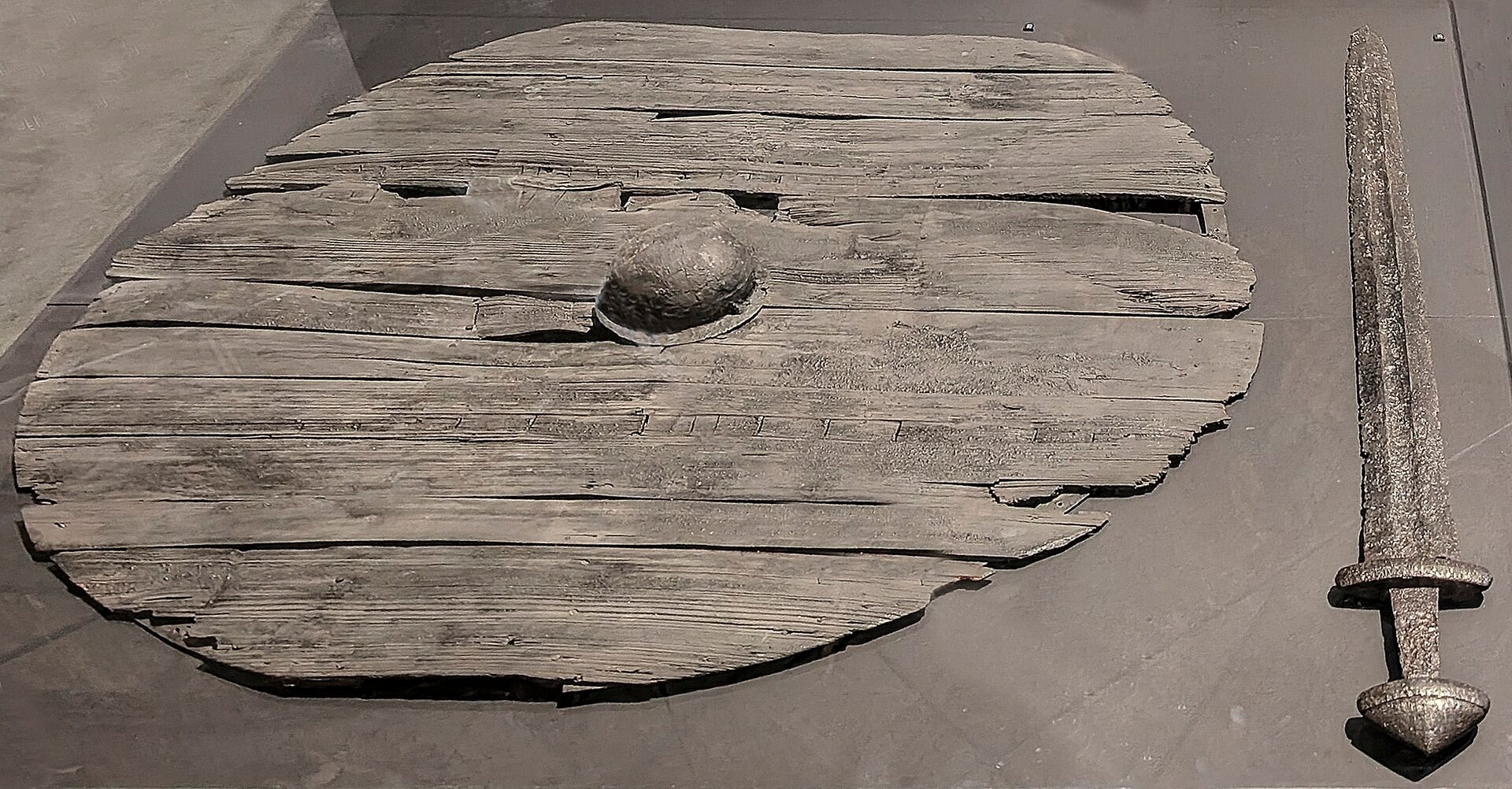
The formation’s most important tool was the round shield, typically 80 to 90 centimeters across, made of lightweight linden wood, bound at the rim with leather, and protected at the center by an iron boss that shielded the hand gripping it. Linden wasn’t chosen by accident, it’s light but tough, and doesn’t splinter into dangerous shards on impact as readily as harder wood.
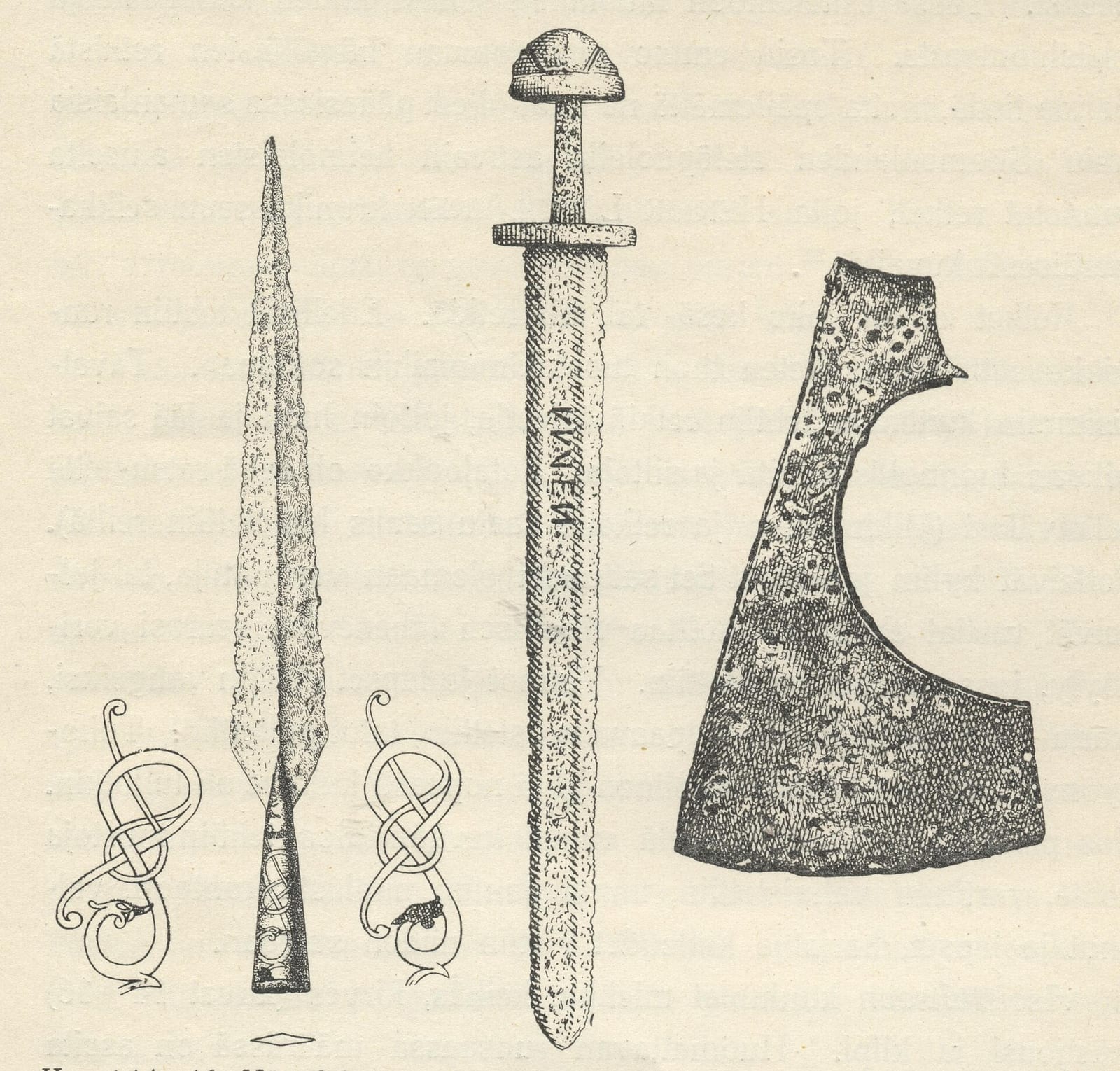
Most fighters’ primary weapon was the spear, not the sword. A spear was cheaper to produce, allowed thrusts over the top of the shield wall without opening one’s own guard, and could be thrown if needed. The sword, expensive and labor-intensive to forge, remained more of a status symbol for wealthy warriors, as shown by the famous Ulfberht blades covered in our separate article. Axes, cheap and already common in everyday farm life, worked especially well for hooking shields downward or striking at legs once two formations had locked together.
Head and body protection was distributed quite unevenly within the formation. A full helmet like the famous Gjermundbu find, covered in our separate article, was rare and expensive, as was mail armor, which consumed hours of labor and considerable amounts of iron. Most men in the rear ranks likely fought in simple leather clothing or no armor at all, which made the front rank, where nearly all the available metal was concentrated, the real life-insurance policy for the entire formation.
Noise Before Combat: Clashing Shields and War Cries
Before the first weapon connected, a battle was already an acoustic event. Sagas repeatedly describe vapnabrak, the rhythmic clashing of weapons against one’s own shield, by which warriors signaled approval of a speech or worked each other up into fighting spirit, along with loud shouting, the herop, meant to intimidate the enemy and synchronize one’s own ranks. Neither was pure theater. A formation that roared as one at the same instant demonstrated cohesion, and a formation that stayed uncoordinated revealed to the enemy, before the first clash even happened, just how stable it actually was.
Some fighters, often positioned at the edges or slightly ahead of the main line, aimed deliberately at intimidation, through wild gesturing or, as later tradition attributes to the berserkers, through an altered, frenzied combat state covered in more depth in our dedicated article. Whether such individual fighters actually stepped out in front of the closed line or instead secured its flanks is disputed among scholars, but it is plausible that psychological warfare began well before the first spear thrust.
How a Battle Actually Unfolded
A shield-wall battle generally followed a recognizable pattern, even though no single source or find hands us an exact script.
- Deployment: both sides formed up within sight of each other, often preceded by an exchange of insults, threatening gestures, and the occasional thrown spear or arrow.
- Advance: the lines moved toward each other in step, careful not to tear the formation apart prematurely.
- First impact: shields met shields, spears thrust over the rims, and the front ranks exerted enormous pressure against one another.
- Attrition: minutes to hours of mutual shoving, stabbing, and localized pushes, where exhaustion often mattered more than individual heroics.
- The break: once a line broke at any one point, usually through losses in the front rank or a focused push, the battle frequently tipped very quickly in favor of the side that stayed intact.
That exact pattern plays out at the Battle of Stamford Bridge in 1066, which we cover in detail elsewhere: as long as Harald Hardrada’s shield wall stayed closed, it held against the English assault. The collapse came when the formation was torn apart at a narrow bridge crossing and could no longer re-close.
Maldon, Hastings, and the Limits of the Formation
Perhaps the most vivid literary source on the subject is the Old English poem The Battle of Maldon, describing the Anglo-Saxon defeat against a Viking force in 991. The commander Byrhtnoth explicitly orders his men to form and hold the shield wall, a line that shows just how central that single instruction was to the outcome, even before the actual fighting began. The poem also describes a fateful tactical decision: Byrhtnoth allows the attacking Vikings to cross a river ford unopposed, apparently out of a mix of honor and overconfidence, voluntarily giving up his own formation’s protected position, a decision the poem later names explicitly as pride, Old English ofermod.
Seventy-five years later, in 1066, the Bayeux Tapestry depicts in stitched images how the Anglo-Saxon housecarls at Hastings formed a closed shield wall against the charging Norman cavalry, a tactic that held for hours until repeated Norman feigned retreats finally lured the formation into breaking apart to pursue. That tactic, an orderly withdrawal meant to tempt the opposing line into an unplanned pursuit, only works if your own formation keeps its nerve under pressure while the enemy’s loses exactly that discipline. That the Normans pulled it off at Hastings, after the housecarls had held for hours, shows how genuinely close that battle was, and how much its outcome hinged on a single tactical moment rather than raw numerical superiority.
| Battle | Year | Role of the shield wall |
|---|---|---|
| Maldon | 991 | Byrhtnoth orders the formation; the Anglo-Saxons still lose |
| Stamford Bridge | 1066 | Harald Hardrada’s wall holds until the bridge splits the line |
| Hastings | 1066 | Housecarls hold the formation for hours against cavalry |
Notably, at Hastings it was not the Vikings but the Anglo-Saxon defenders using the shield wall, evidence that the tactic was never an exclusively Norse invention, but a practical solution that emerged wherever foot soldiers carrying round shields faced numerically comparable opponents.
The Wedge: Svinfylking as a Possible Attack Variant
Later Icelandic sagas, including parts of the Heimskringla, mention an attacking formation called svinfylking, literally “swine array” or wedge formation, in which a group of experienced fighters drove into the enemy line in a wedge shape to force a breakthrough. How much of this description reflects real tactics versus later literary embellishment is impossible to say for certain, since the sagas describing it were written centuries after the events. Still, as a possible complement to the purely defensive shield wall, it is plausible, and it fits archaeological finds of densely clustered weapon graves among some warrior groups. Tactically, such a wedge makes real sense: a closed line is sturdy but also rigid, while a concentrated push at a single point offers a chance to break through wherever your own strength is greatest, provided your own flanks stay adequately covered in the meantime.
Why the Shield Wall Decided Most Battles
The shield wall was not an elegant tactic, it was a brutally simple one. It demanded little individual skill but a great deal of nerve, discipline, and trust that the man to your left was covering your exposed side. Those qualities, not spectacular single combat, decided most battles of the Viking Age. For more on the specific weapons that equipped these formations, see our article on Viking weapons.
Our take after comparing the battle accounts: modern popular culture has turned the Viking Age into an era of wild lone fighters, full of duels and individual heroics. The sources paint a considerably more sober picture. Anyone who wanted to survive this period did not primarily practice the perfect sword stroke, they practiced disciplined standing in a line with no way out except victory or the collapse of the entire formation.