Recipes
Dark Viking Rye Bread: The Recipe
Dark viking rye bread recipe: a moist, hearty loaf with honey and buttermilk, plus the true story of rye in the North. Baked step by step, Viking style.

Contents
Dense, dark, faintly sour, and still moist days after baking: no bread says “the North” quite like a proper rye loaf. This Viking rye bread recipe delivers exactly that - dark rye flour, honey, and buttermilk, baked into a hearty loaf that would not have looked out of place in a 10th-century storehouse. Along the way, you get the real story of rye in Scandinavia, which is stranger than the cliché suggests.
Because here is the twist: the image of a Viking slicing into dark rye bread every morning is only half true. Charred loaves from burial sites, pollen from Danish fields, and one brutally honest poem from the Edda tell us how it actually was.
A Latecomer That Conquered the North
Rye did not start out as a crop at all. It started out as a weed. It grew uninvited among wheat and barley, and because it shrugs off cold, poor soil, and soggy summers, it quietly won ground the farther north farming spread. Botanists call this a secondary crop: a stowaway that eventually took over the ship.
In the Viking Age proper, barley still ruled the table. The famous charred loaves from the graves of Birka in Sweden are mostly barley and oats, coarsely ground and stretched with whatever the farm could spare. But toward the end of the era the picture shifts. From the 10th century onward, rye cultivation expands noticeably in Denmark and southern Scandinavia. The weed became the bread grain of the medieval North - and the flat barley flatbread from the pan slowly gave way to the dark loaf that Denmark still worships today as rugbrød.
So if you want to be strict about it: early Viking Age means barley flatbread. But if you want to taste the late Viking Age, the era of the great trading towns and the first real cities, a dark rye loaf is precisely the right thing to bake.
Bread and Status in the Poetic Edda
Bread in the North was also a matter of class, and we know this from an unusually vivid source: the Rigsthula, a poem preserved in the Eddic tradition. In it, the god Rig visits three households and is served three very different meals. At the thrall’s table, the poem describes the bread with merciless precision:
“Heavy and thick was the loaf, packed full of bran.” - Rigsthula, our translation
At the nobleman’s house, by contrast, thin white wheat loaves are laid out in a basket. The message could hardly be clearer: the darker and coarser your bread, the harder your life. White wheat bread was a luxury for the few. Dark bread of barley, oats, and increasingly rye was everyday reality for everyone else.
There is a fine irony in how this story ends. The rough, dark bread of thralls and farmhands is exactly the bread we now prize as the honest, flavorful, healthy one. The servant’s loaf outlived the jarl’s white wheat rounds.
Myth vs. Fact: Bread in the Viking Age
| Myth | Fact |
|---|---|
| Vikings ate dark rye bread every day | Barley was the everyday grain; rye only became important from the 10th century, above all in Denmark |
| Viking bread was a tall, round loaf | Mostly flat rounds baked on hot stones, since most farms had no bread oven |
| Bread was the great staple food | Porridge of barley and oats was on the table at least as often |
| Sourdough is a modern invention | Norse households were master fermenters, but whether they kept a deliberate sourdough culture is not securely documented |
If you want the bigger picture of what actually simmered in the cauldron and hung in the storehouse, our overview of the Viking diet covers it in depth.
The Viking Rye Bread Recipe
Let us be upfront about one thing: this is not a museum reconstruction. A tall, oven-baked loaf raised with yeast borrows from the centuries after the Viking Age. Every single ingredient, though, would have been at home on a Norse farm around the year 950: rye, honey, buttermilk, salt, flaxseed. And after a good number of test loaves, our honest verdict is this - the combination tastes closer to the North than any pale supermarket bread ever will. You get the earthy depth of rye, a whisper of sweetness from the honey, and a gentle tang from the buttermilk.
The recipe is deliberately simple. No sourdough starter that demands a week of babysitting, no special equipment. A loaf pan, an oven, and a little patience while the bread cools. The sourdough version for ambitious bakers is waiting in the tips below.
Ingredients
For 1 loaf (loaf pan, about 10 inches / 25 cm):
- 400 g (3 1/3 cups) dark rye flour
- 100 g (3/4 cup) spelt or wheat flour
- 1 packet (7 g / 2 1/4 tsp) active dry yeast
- 1 1/2 tsp salt
- 2 tbsp honey
- 200 ml (3/4 cup plus 1 tbsp) buttermilk, at room temperature
- 175 ml (3/4 cup) lukewarm water
- 2 tbsp flaxseed (optional, but very Norse: flax grew on nearly every farm)
- Butter for the pan, a little rye flour for dusting
Instructions
- Mix the liquids. Stir together buttermilk, water, and honey until the honey dissolves. The mixture should be lukewarm, never hot, or the yeast will suffer.
- Mix the dry ingredients. Thoroughly combine both flours with the salt, yeast, and flaxseed in a large bowl.
- Make the dough. Pour in the liquid and stir vigorously for 4 to 5 minutes with a wooden spoon or a dough hook. The dough stays sticky and heavy - that is exactly right. Rye has almost no gluten and will never turn stretchy like wheat dough.
- First rise. Cover the bowl and let the dough rise in a warm spot for 60 to 90 minutes, until visibly grown and bubbly.
- Into the pan. Butter the loaf pan generously. Fill in the dough with wet hands, smooth the top, and dust it with rye flour. Score it lengthwise if you like.
- Second rise. Cover and let it rise another 30 to 45 minutes. Meanwhile, preheat the oven to 425°F (220°C) and set an ovenproof dish on the oven floor.
- Bake. Slide the pan into the oven and pour half a cup of water into the hot dish: the steam builds the crust. After 15 minutes, reduce to 350°F (180°C) and bake another 40 to 45 minutes. The loaf is done when it sounds hollow if you knock on the bottom.
- Let it cool. Turn the bread out onto a rack and let it rest at least 4 hours, better overnight. Straight from the oven, rye crumb is still gummy - the wait is both the hardest step of this recipe and the most important one.
Tips & Variations
- With real sourdough: Replace the yeast with 75 g of active rye starter and stretch the first rise to 8 to 12 hours at room temperature. The result is tangier, moister, and probably the closest to what late Viking Age bakers actually made.
- With nuts: A handful of chopped hazelnuts in the dough is a perfect fit - hazelnuts were gathered across the North and turn up in settlement finds again and again.
- Darker and sweeter: Raise the honey to 3 tbsp. The loaf browns more deeply and picks up a subtle malty note.
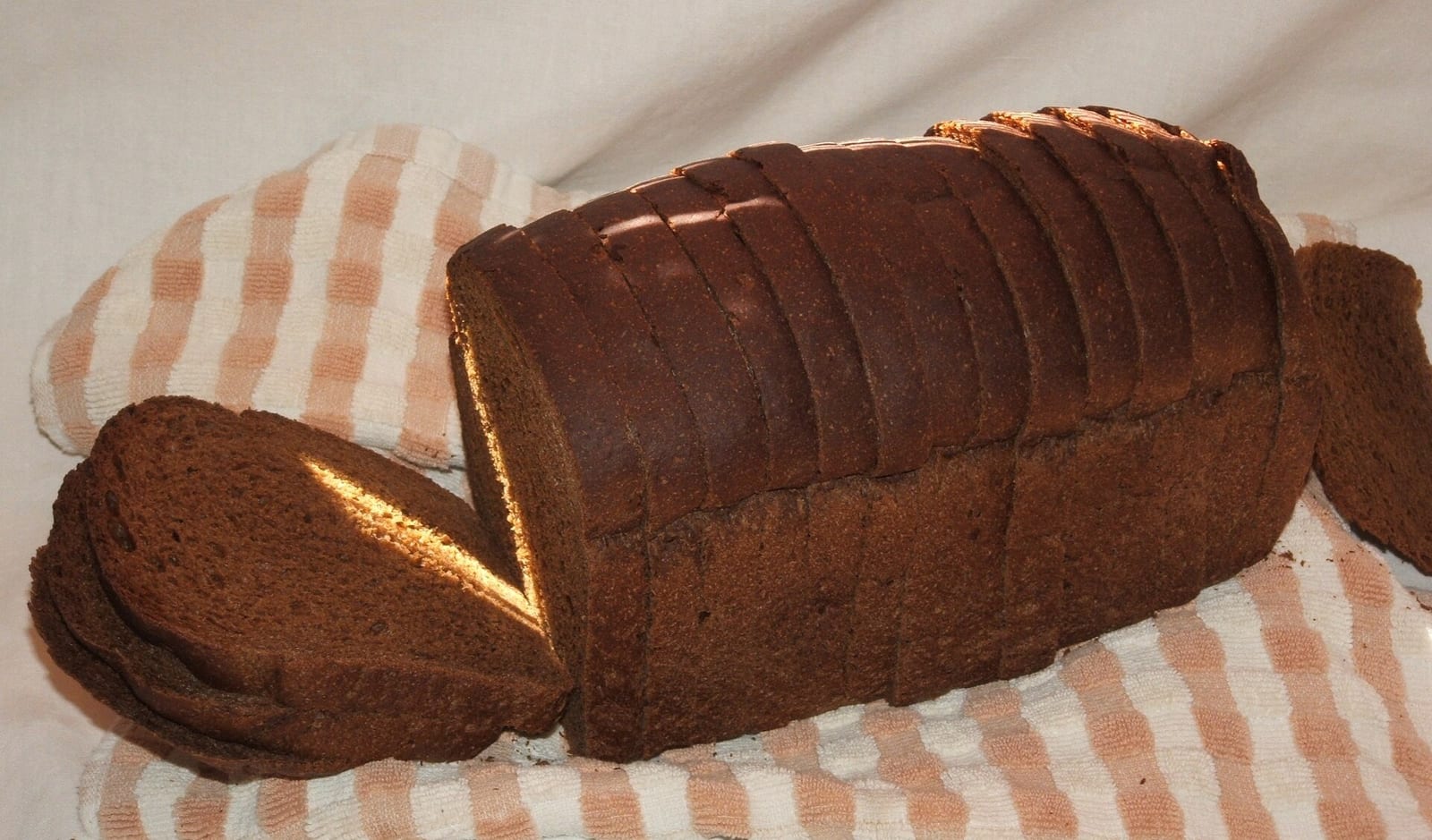
- Free-form like a hearth loaf: Hold back about 25 ml of the water and the dough turns firm enough to shape into a round with well-floured hands. Baked on a stone or tray without a pan, it comes out as a rustic hearth-style loaf like the one in our photo.
- Serve it like a Norseman: Spread thickly with butter and top with smoked fish, sharp cheese, or simply more honey. This loaf tastes better cold than warm.
- Storing: Wrapped in a linen or kitchen towel, the bread keeps for a good 5 days. From day two it actually gains flavor as the gentle sourness settles in.
- Crumb too moist? Then the resting time was too short or the bake too brief. Next time, bake 5 minutes longer and genuinely wait until the following day.
By the way: rye bread stays fresh so long because of the pentosans in rye, gums that bind water in the crumb. Exactly this quality later made dark bread the ideal provision for long winters and long journeys.
If this loaf turns out well, treat it as a beginning: our cookbook “Viking Feast” gathers 141 recipes of the Norse kitchen, from honey bread and hearty stews to mead you brew yourself. See the cookbook
A dark loaf on a board, a knife, butter, and honey within reach: in a modern kitchen, you will not get much closer to the storehouse of a late Viking Age farm. The sagas sing of kings and battles, but it was this quiet, heavy bread that actually carried the North through its long winters. Bake it once, wait until morning, and cut the first slice. You will understand why the North never gave up on rye.
Images: Marbus1966 (CC BY-SA 4.0) and Glane23 (CC BY-SA 3.0), via Wikimedia Commons