Recipes
Viking Lamb Skewers Recipe: Fire-Grilled the Norse Way
A Viking lamb skewers recipe with juniper, honey and thyme, plus the real archaeology behind Norse open-fire cooking and how to build the right bed of embers.
Contents
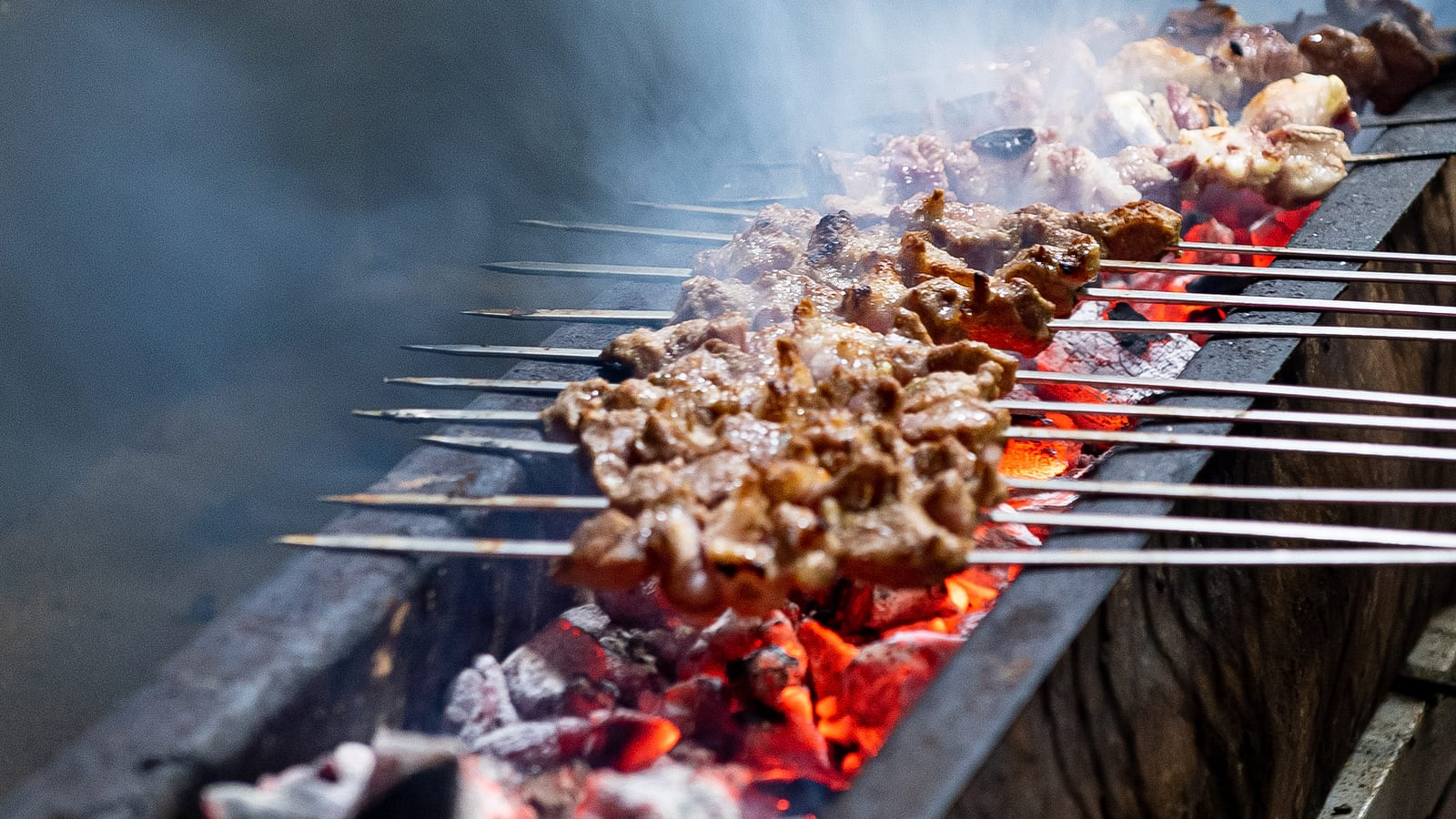
Meat, a stick, and a bed of embers. This Viking lamb skewers recipe is about as stripped down as cooking gets, and that is exactly why it works. No oven, no pan, no sauce to hide behind. You need an animal that grazed on every farm in the North, a handful of plants that grew within walking distance of the door, and a fire that has stopped flaming and settled into heat. What follows is both the recipe and an honest account of which parts of it the archaeology actually supports, because that turns out to be the more interesting story.
The short version for anyone already reaching for the charcoal: 1.75 lb of lamb, ten juniper berries, honey, coarse salt, and two hours of marinating. Everything after that is fire management.
Sheep Was the Meat of the North
To know what people on a Viking Age farm actually ate, skip the sagas and read the rubbish pits. Across the North Atlantic, one animal dominates: sheep. On Icelandic farmsteads of the period, sheep and goat bones are among the most common food remains on site. The best-studied example is Hofstaðir in the Mývatnssveit district of northeast Iceland, excavated over more than a decade by Fornleifastofnun Íslands, the Icelandic Institute of Archaeology. Hofstaðir became famous for something else: cattle skulls each struck cleanly in the forehead, read as the remains of repeated feasting events. The everyday diet alongside them was far less dramatic, and mostly sheep.
The economics are simple. In the North, sheep are the most efficient animal a household can keep: they cope with thin pasture and give wool for sails and clothing, milk for skyr and cheese, and meat at the end. Cattle eat more and need far more winter fodder. That is why settlers loaded sheep onto ships bound for Iceland, the Faroes and Greenland. Today’s Icelandic sheep descend from those animals and belong to the Northern European short-tailed group: smaller than modern meat breeds, hardy, and noticeably gamier.
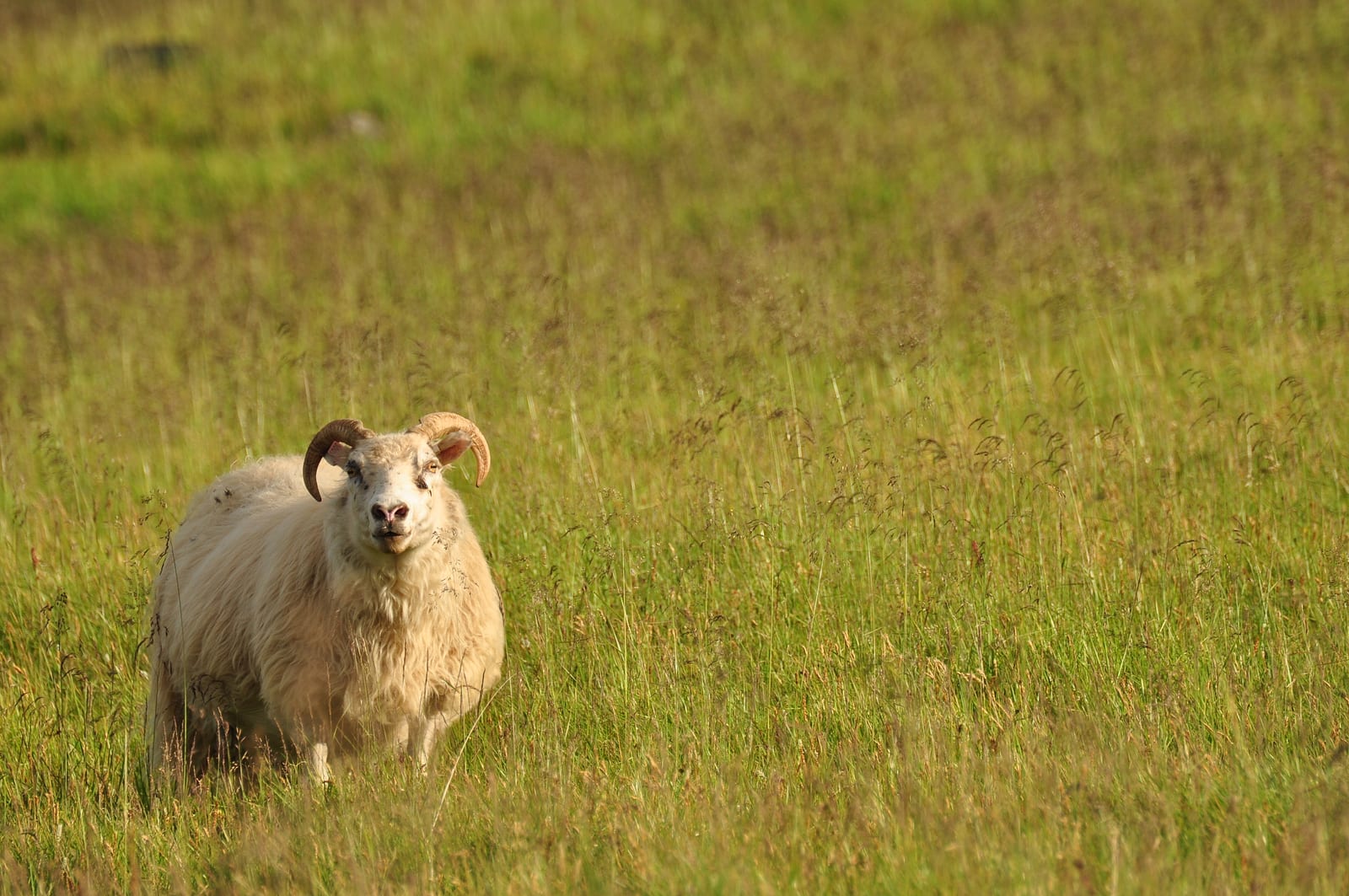
Image source: Raffael Herrmann (CC0), via Wikimedia Commons
One detail most recipes skip: tender young lamb was the exception in the North, not the rule. Slaughtering happened in autumn, once a household knew how many animals it could feed through winter. The Old Norse month name gormánuðr, falling across late October and November, is usually read as the slaughter month. So the meat over the fire was more often a grown animal than a spring lamb. We still call for lamb, which cooks through in twelve minutes on a skewer.
What a Viking Lamb Skewers Recipe Can Honestly Claim
Here comes the awkward part. The image of a Norseman holding a hunk of meat on a spit over leaping flames comes from film, not from the finds. What shows up in Viking Age graves and settlements in real numbers is cookware of a different kind: cauldrons, cauldron chains, pot hooks. The Oseberg ship burial in Norway, dated to around 834, contained a full household kit alongside the textiles, sledges and cart: an iron cauldron with its tripod, wooden buckets and troughs, a hand quern. That is a boiling kitchen, not a grilling one.
The best-known literary description points the same way. In the Hákonar saga góða, part of Snorri Sturluson’s Heimskringla, the account of a sacrificial feast describes fires burning down the middle of the floor with cauldrons hung above them, and the meat cooked in those cauldrons. No spit. No grate. A pot.
Myth versus fact. Myth: Vikings roasted their meat on spits over open flames. Fact: the material record points overwhelmingly to boiling in cauldrons, supported by smoking, drying and baking on hot stones. What is genuinely well attested is the combination of embers, sheep meat, and native flavouring plants. So this dish is not a reconstruction. It is an honest translation: Norse ingredients, a Norse heat source, a modern shape.
In our view a recipe gains rather than loses by saying this out loud. Anyone selling you an authentic Viking barbecue is selling a story no source supports. Say instead which ingredients are documented and which step is modern convenience, and you still end up with food that tastes convincingly northern, without bending the evidence to get there.
Cooking Pits, Cauldrons and the Truth About Embers
Open fire was everywhere in the North, just used differently than most people imagine. Norwegian archaeology has recorded several thousand kokegroper, cooking pits dating mainly to the Iron Age, some still used into the Viking Age. The method: dig a pit, build a fire in it, pile stones on top to soak up the heat. Once the flames die back, wrapped meat goes onto the hot stones, everything is covered, and the food cooks in stored heat. Not flame, but residual warmth. That is the principle to carry to the grill.
| What is documented | Evidence | What it means for the grill |
|---|---|---|
| Sheep as the main meat animal | Animal bone from Icelandic farms including Hofstaðir | Lamb and mutton are the right starting point |
| Cauldrons over the hearth | Cauldrons, chains and hooks from graves such as Oseberg | Boiling was standard, grilling was not |
| Fires down the hall floor with cauldrons above | Snorri Sturluson, Hákonar saga góða | Feast food came out of a pot, not off a spit |
| Cooking in heated stone pits | kokegroper, recorded across Norway | Embers and stored heat beat open flame |
| Juniper, dill, mustard, ramsons | Plant remains from settlement and burial deposits | The marinade can be resinous and herbal |
| Honey | Beekeeping and mead production in the North | Sweetness came from the honey pot, not sugar |
The practical takeaway: these skewers do not go over flames but over a calm bed of coals filmed with grey ash. Hold them in an open fire and you get charcoal outside and raw lamb inside. For which plants were available in a Norse kitchen, see our piece on Viking herbs and spices.
Worth knowing: The English word steak comes from Old Norse steik, a roast, tied to the verb steikja, to roast on a spit. The Norse brought the word to England, even if their daily cooking looked more like a stew than a steakhouse.
Ingredients
Makes 4 skewers, serving 4:
- 1.75 lb (800 g) boneless leg or shoulder of lamb
- 2 tbsp honey
- 3 tbsp rapeseed oil or melted clarified butter
- 10 juniper berries
- 1 tsp coarse salt, plus more to finish
- 1 tsp dried thyme, or 2 tbsp finely chopped wild garlic
- 1 large onion
- 1 tart apple (optional)
- Freshly ground black pepper
Instructions
- Prepare the meat. Trim away heavy sinew and cut the lamb into cubes of about 1.2 inches (3 cm). Even sizing matters more than neat cubes, or the skewers will cook unevenly.
- Mix the marinade. Crush the juniper berries coarsely in a mortar, then stir them together with the honey, oil, salt, thyme and a generous grind of pepper.
- Marinate. Turn the lamb in the marinade, cover, and chill for at least 2 hours, ideally 4. Take it out of the fridge 30 minutes before cooking.
- Build the fire. Let charcoal or a wood fire burn down until no flames are left and the coals carry a film of grey ash. This takes roughly 20 minutes and is the most important step in the whole recipe.
- Thread the skewers. Cut the onion and apple into thick wedges. Thread the lamb onto the skewers, alternating with onion and apple, pushing the pieces together without cramming them.
- Grill. Lay the skewers over the coals and cook for 10 to 12 minutes, turning every 2 to 3 minutes. If flare-ups start or fat drips into the coals, move the skewers to the cooler edge for a moment.
- Rest and serve. Rest the finished skewers for 3 to 5 minutes, sprinkle with coarse salt, and serve straight away.
Tips & Variations
- Choice of wood: Beech and birch give a steady, long-lived bed of coals. A few juniper twigs thrown on at the end echo the resin note in the marinade.
- Mutton instead of lamb: For the older, stronger flavour, use mutton and stretch the marinating time to 8 to 12 hours.
- Wooden skewers: If you would rather avoid metal, soak wooden skewers for at least 30 minutes first. Freshly cut, peeled hazel twigs work too.
- No grill? A screaming hot cast-iron pan does the job indoors. The browning comes from the pan rather than the smoke, and the result is still very good.
- What to serve with it: Flatbread, skyr stirred with wild garlic, or roasted root vegetables. To try the same meat the way it genuinely was cooked in the Viking Age, our Viking lamb stew takes it back into the cauldron.
If this mix of archaeology and cooking appeals to you, this recipe is only a small slice of it. Our cookbook “Viking Feast” collects 141 recipes from the Norse kitchen, from flatbread to stews to feast-day roasts, each one with the history behind it. Get the cookbook
What is left is a dish that need not dress up as a reconstruction. Sheep, juniper, honey and embers are well attested in the North. The skewer, in this form, is ours. Drawing that line clearly, between what the evidence shows and what the kitchen adds, is what makes Norse cooking worth doing: smoke, resin, and a piece of North Atlantic pasture on a stick.
Image credits: hero image N509FZ (CC BY-SA 4.0), sheep image Raffael Herrmann (CC0), both via Wikimedia Commons