Recipes
Viking Ale Brewing: A Barley Beer Recipe From the North
A Viking ale brewing recipe for Nordic barley beer with juniper and honey, plus the real evidence from grave finds, sagas and medieval Norwegian ale law.
Contents
Picture a Norse hall and you probably picture mead going round in drinking horns. The truth is more ordinary. What the North drank day in and day out was ale: cloudy barley beer, sometimes thin, sometimes strong, brewed not in a brewery but in a kettle on the farm, usually by the woman who ran the household. This Viking ale brewing recipe walks that road back - malt, juniper, honey and patience. It is no fantasy potion from a television series but an honest reconstruction from what archaeology and written sources actually support, and it tastes surprisingly good.
Ale Was Everyday, Mead Was Occasion
Barley was the workhorse grain of Scandinavia. It ripens where wheat gives up: short summers, sour soils, salt wind off the water. Whatever did not become porridge or flatbread went into the brewing kettle, which made Viking ale food and drink at once. It carried calories, kept far better than standing water, and everyone from farmhand to jarl had a cup. Mead was another matter, because mead demanded honey by the bucket, and honey was expensive. We cover the honey side of the story in how to make mead.
That ale mattered is not merely implied between the lines of the sagas. The Norwegian law codes of the high Middle Ages, the Gulathing Law above all, obliged farms to brew ale for Yule and to bless it. The wording is Christian, but it preserves a much older duty, and skipping the Yule brew carried a penalty. A drink written into statute is not a marginal habit.
Here is what the evidence actually looks like:
| Evidence | Site or source | What it tells us |
|---|---|---|
| Barley in settlement layers | Hedeby (Schleswig), Birka (Sweden) | Barley dominated the Viking Age grain supply |
| Charred sprouted grain | several Iron Age and Viking Age farms in northern Europe | Malting was an established craft skill |
| Bronze strainer with residues | woman’s grave at Juellinge, Lolland, Denmark | A fermented grain drink with bog myrtle and berries, Roman Iron Age |
| Birch bucket with residues | grave of the Egtved Girl, Denmark, Bronze Age | Honey, grain and bog myrtle in one fermented drink |
| Compulsory Yule ale | Gulathing Law, Norway | Brewing as a legally defined duty of the farm |
| Poisoned ale in a horn | Egil’s Saga, chapter 44 | Ale as the ordinary drink of the saga feast |
The two Danish graves predate the Viking Age, and that is why they matter: the Nordic formula of grain, honey and wild herbs was already old when the first longships appeared off Lindisfarne. The Vikings did not invent this craft. They inherited it.
Bog Myrtle, Juniper, Honey: Flavour Before Hops
This is where reconstruction parts company with kitsch. Hops, which we treat as the definition of beer, only became standard across northern Europe during the high Middle Ages. Before that, brewers seasoned with whatever grew along the track and out on the bog. The key plant was bog myrtle, Myrica gale, called pors in Danish and Norwegian: a resinous, bitter shrub whose traces turned up in both the Egtved and the Juellinge residues.
Juniper did the rest. In the farmhouse brewing traditions of Finland, Estonia and western Norway it remains indispensable: branches and berries are boiled, the infusion becomes the brewing liquor, and the same branches line the lauter tun as a filter bed. Finnish sahti and Norwegian maltøl still run on this logic. They are not ninth-century Viking ale, but they are the closest thing we can still taste.
Myth: A written Viking recipe for ale survives somewhere. Fact: It does not. Not one brewing recipe comes down to us from the Viking Age. What survives is ingredients, vessels, chemical residues and law codes. Every Viking ale sold today is reconstruction, and the only real difference between versions is how honestly they admit it.
So we build ours from verified parts: barley malt, a juniper infusion, one bitter bog herb and a spoonful of honey for body. No invented spice blend, no runes carved into the kettle.
Did you know? The Hávamál, the Norse poem of counsel attributed to Odin, warns bluntly about ale: drink robs a man of his wits and loosens the tongue he should have kept still. One of Europe’s oldest arguments for moderation comes from the culture we picture drinking hardest.
The Viking Ale Brewing Recipe in a Modern Kitchen
This Viking ale brewing recipe fits in an ordinary kitchen provided you own a pot of at least four gallons. You also need a thermometer, a grain bag, a fermenter with an airlock and around twenty swing-top bottles. The most important tool, though, is cleanliness: anything touching the cooled wort must be sanitised, or stray microbes decide the flavour for you.
One practical note people skip: home brewing rules vary. In the United States it is federally legal for personal use within annual limits; in Germany you may brew up to 200 litres a year duty-free, but must notify the customs office first.
And yes, the result is alcohol, around 5 to 6 percent depending on the fermentation. Not for anyone pregnant, underage or driving.
Ingredients
For roughly 10 litres (2.6 US gallons) of finished ale, about 20 half-litre bottles:
- 2 kg (4.4 lb) pale barley malt, freshly crushed
- 300 g (10.5 oz) Munich or crystal malt for colour and malt sweetness
- 13 l (3.4 gallons) soft brewing water
- 1 large handful of fresh juniper branches with berries, about 30 g, unsprayed
- 10 g dried bog myrtle (Myrica gale), or 8 g of a mild hop such as Hallertau
- 200 g (7 oz) strong honey, forest or heather if you can get it
- 1 sachet of dry ale yeast, about 11 g
- 60 g (2 oz) honey or dextrose for bottle conditioning
Gather the juniper yourself if you can, from unsprayed stands. Bog myrtle turns up in herb shops and online; without it, hops give a very good beer.
Instructions
- Make the juniper infusion. Boil the branches in 13 l of water, steep 20 minutes, then lift them out. The water should smell resinous and green: the foundation of every Nordic farmhouse ale.
- Mash. Let the infusion drop to 68°C (154°F) and stir in the crushed malt. Hold at 66 to 68°C for 75 minutes, insulating the pot with blankets and stirring every quarter hour. Starch turns into fermentable sugar here.
- Mash out and lauter. Raise briefly to 78°C (172°F), strain the mash through the grain bag into a second pot, then sparge with roughly 3 l of hot water until you have about 12 l of wort.
- Boil and season. Boil the wort hard for 60 minutes. Add the bog myrtle or hops after 15 minutes, and stir in the honey during the final 10 so its aroma survives.
- Chill fast. Cool the pot in an ice bath to 20°C (68°F). The quicker this goes, the cleaner the finished ale.
- Ferment. Transfer to the sanitised fermenter, aerate well, pitch the yeast and ferment at 18 to 20°C for 7 to 10 days, until the airlock falls quiet.
- Bottle. Dissolve the 60 g honey in a little water, boil, cool and stir it gently into the young beer. Fill clean swing-top bottles, seal, leave 2 weeks at room temperature, then store cool and dark.
- Taste. Three weeks is the earliest this Viking ale is ready. Pour carefully and leave the sediment in the bottle.
Tips & Variations
- The yeast question: A neutral English ale yeast sits closest to an old farm strain. To experiment, look for Norwegian kveik, preserved in the farmhouse tradition of western Norway: it tolerates high temperatures and brings a fruity note.
- Small beer for the working day: Sparge the spent grain again and boil a weak second running from it. That is how everyday thirst was handled, while the strong ale waited for feasts.
- A hint of smoke: Swap 300 g of the pale malt for smoked malt. It moves the beer closer to something brewed over an open hearth in a smoky longhouse.
- Neither myrtle nor hops: A teaspoon of crushed juniper berries with a little mugwort in the boil gives a dry, herbal Viking ale. Go easy on the mugwort, it turns harsh fast.
- Safety first: Never exceed the priming sugar given here. Too much bursts bottles, and there is nothing romantic about that.
- On the table alongside it: For what else the hall ate, see our overview of the Viking diet.
If this kind of cooking speaks to you, our cookbook “Viking Feast” holds 141 recipes of the North, from flatbread and feast roasts to mead and the treasures of the storeroom. See the cookbook
A Mouthful of the North: Our Verdict
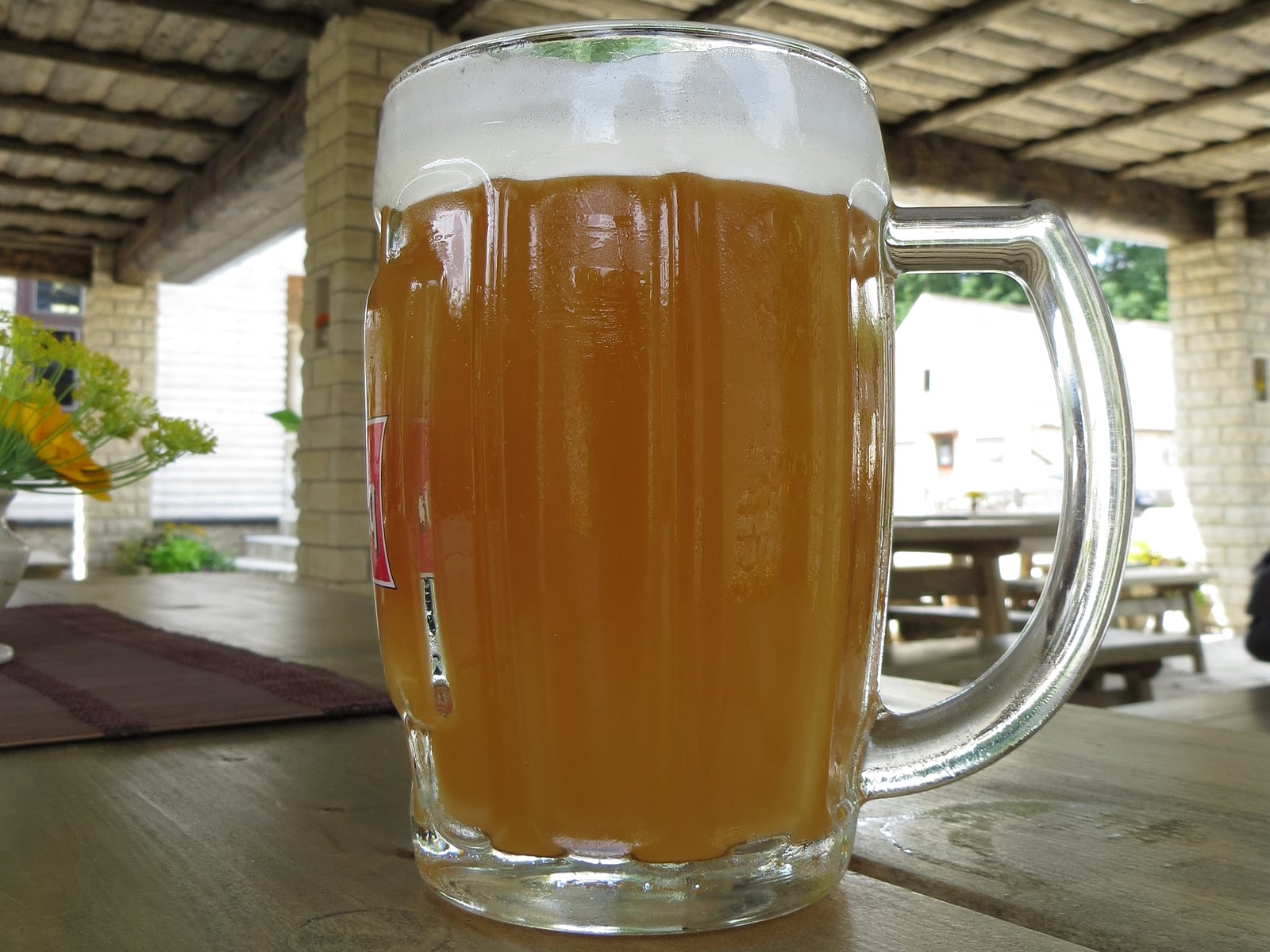
Our honest assessment after several batches: this Viking ale is no craft-beer revelation, and it is not trying to be. It comes out hazy, malt-forward, faintly resinous and far less bitter than a modern palate expects. That is the point. Juniper gives it a nose no hop can imitate, the honey stops the malt sweetness turning cloying, and the bog myrtle lays a dry edge underneath.
If this is your first brew, halve the batch and take the temperatures seriously, because everything is decided during the mash. And when you hold the first tankard to the light and see that cloudy gold, you understand why brewing was written into law up there. It was never about alcohol. It was about stores, community, and the certainty that when winter closed in, the hall would still have something to raise.
Image credit: Bernt Rostad (CC BY 2.0), via Wikimedia Commons