Recipes
Viking Barley Pancakes: A Recipe with Honey and Berries
Viking barley pancakes recipe: thick, nutty griddle cakes served with honey and wild berries, plus what archaeology really shows about barley in the North.
Contents
Barley has a reputation problem. It sounds like famine food, like something you eat because nothing better grew that year. This Viking barley pancakes recipe is an argument against that: small, thick, nutty griddle cakes that turn into something genuinely good once honey and wild berries land on top. The history is worth stating plainly, because most recipe sites blur it. Barley really was the grain of the North, honey really was the only concentrated sweetener, and baking really did happen on a flat plate over the embers. A written pancake recipe from the Viking Age, however, does not exist. What follows is a reasoned reconstruction, and a batter that works in a modern pan.
Why barley ruled the Northern field
Sift through the charred grain from Scandinavian settlement layers and the same species keeps surfacing: barley. At Hedeby, at Birka and on the early farmsteads of Iceland it dominates the botanical record, and the reason has nothing to do with flavour. Barley ripens faster than wheat and copes with short summers, cold nights and thin soil. It was the plant that still gave you a harvest in a bad year.
Wheat stayed rare in the North, and rare meant expensive. Rye spread gradually across southern Scandinavia. Oats were common but often went to the animals before they reached a human bowl. Barley was everywhere: as porridge, as flatbread, as the malt behind the ale.
| Grain | Presence in the North | Typical use |
|---|---|---|
| Barley | everywhere, dominates the finds | porridge, flatbread, malt for ale |
| Oats | widespread, strongest in the west | porridge, animal fodder |
| Rye | growing in southern Scandinavia | dark bread |
| Wheat | scarce, imported or a luxury | festival baking |
Barley carries one quirk that matters in a frying pan: it contains almost no gluten. A batter of pure barley flour binds poorly and tears the moment you flip it. Historically that was irrelevant, since unleavened barley flatbread cooked flat on a stone and never had to hold together as a soft cake. For pancakes you want a second flour in the bowl, which is how this recipe is built.
Baking without an oven
Nothing resembling a modern oven stood in an ordinary Norse farmstead. Baking happened on a flat surface above the embers, and the North had two answers. One was soapstone: a soft, heat-tolerant rock quarried on a serious scale in Norway and worked into vessels and plates. Soapstone bowls are among the most common household finds of the Viking Age. The other was iron, round plates with a handle, recovered from Scandinavian graves and read as bakestones.
Before that came the grinding. The rotary quern, two stacked stones turned by a wooden handle, stood on every farm. That this was an organised craft is clear from the millstone quarries at Hyllestad in western Norway, which shipped stone outward from the Viking Age onward. What those querns produced was never a soft powder, though. It was a gritty, slightly coarse meal.
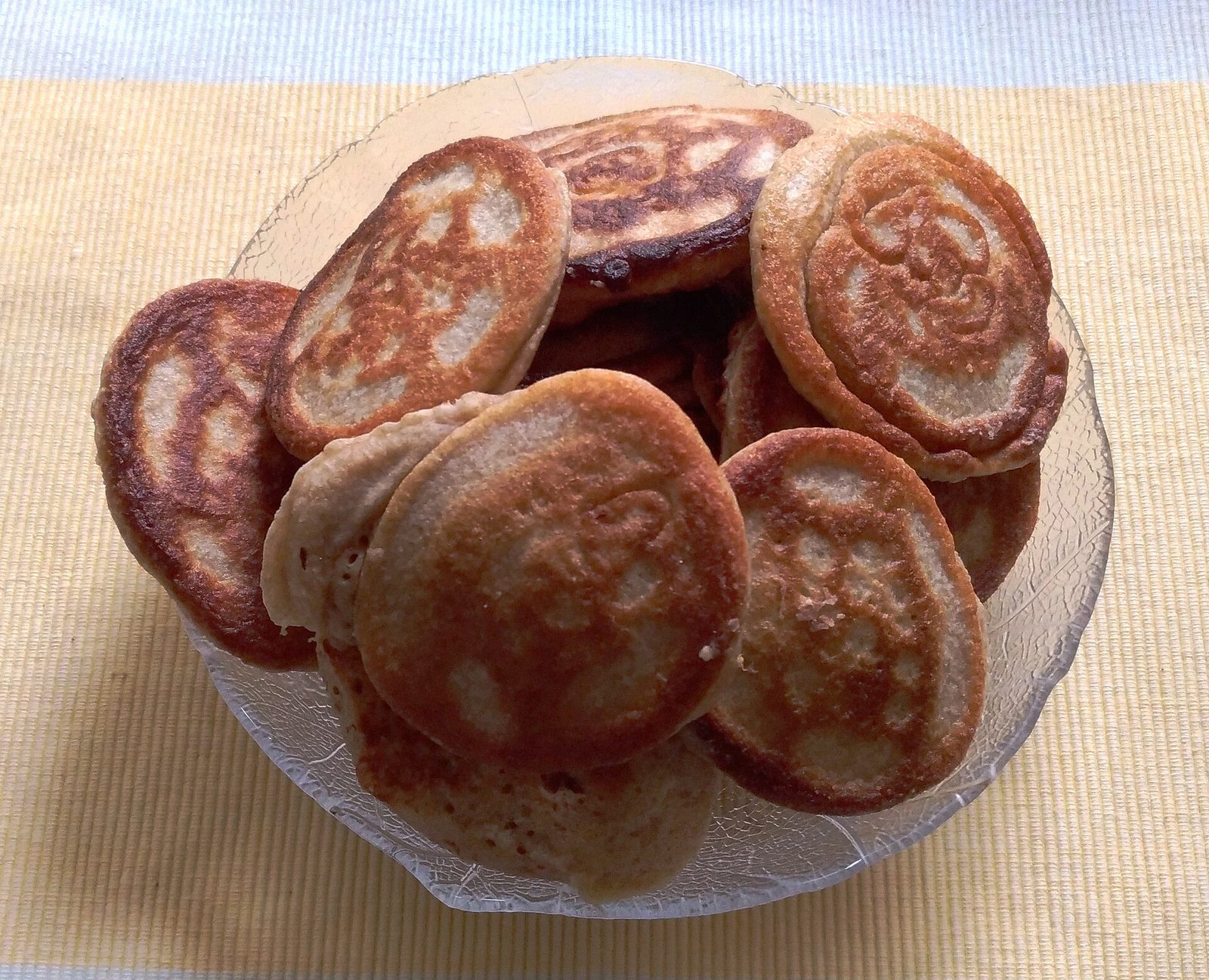
Our own verdict after several rounds in the test kitchen: that coarseness argues against the paper-thin crêpe and for the small, thick cake. Coarse barley batter will not swirl out thinly without tearing. Palm-sized pancakes are not only easier to handle, they are the more plausible shape.
What the Viking barley pancakes recipe can and cannot claim
A clear line is worth drawing, because many recipe pages sell guesswork as excavation. The components are documented. The dish is not.
What the North demonstrably had:
- Barley as the staple grain, recovered as charred remains from settlement after settlement.
- Bakestones of soapstone and iron, well attested as a find category.
- Dairy: buttermilk, soured milk and skyr, central to Norse farm economy.
- Hen eggs: chicken bones belong to the animal bone record of trading sites such as Hedeby and Birka.
- Honey, the one concentrated sweetener available, and the basis of mead.
- Wild berries: the waterlogged deposits at Coppergate in York, Viking Age Jorvik, produced seeds of bilberry, raspberry and bramble.
What is not documented: a recipe. No saga tells you how to make a pancake, and written batter recipes in Scandinavia begin centuries later. Anyone claiming the Norse ate pancakes is telling a plausible story, not a find.
The honest version: every ingredient sat on the farm, the technique existed, and the dish was never written down. Building a recipe from that is fair. Selling it as an original is not.
Myth and fact
| Claim | Where it stands |
|---|---|
| Vikings ate pancakes for breakfast | Unsupported. Porridge and flatbread are attested; the pancake is not. |
| Barley flour alone makes good pancakes | False in practice. Without gluten they fall apart in the pan. |
| Honey was everywhere in the North | Overstated. It was valuable, partly imported, and used sparingly. |
| There was sugar for sweet dishes | No. Cane sugar reaches Northern Europe much later, as a luxury good. |
| Baking happened in a built oven | Misleading for farm life. The norm was a flat plate over the embers. |
Ingredients
Makes about 12 small pancakes, enough for 4 people:
- 1 1/4 cups (150 g) barley flour
- 3/4 cup (100 g) spelt or plain wheat flour
- 2 eggs
- 1 1/4 cups (300 ml) buttermilk, or milk, or thinned skyr
- 1 tbsp honey for the batter
- 1 generous pinch of salt
- Butter or lard for frying
To serve:
- 3 tbsp honey
- 7 oz (200 g) wild berries, fresh or thawed
- 3.5 oz (100 g) skyr or sour cream, optional
Instructions
- Combine the flours. Whisk the barley flour, spelt flour and salt together so the heavier barley is evenly distributed.
- Mix the batter. Beat the eggs with buttermilk and honey, pour into the flour and stir only until no dry pockets remain. Overworking makes them tough.
- Let it rest. Cover and leave at room temperature for 30 minutes. Barley flour absorbs liquid slowly, and the batter visibly thickens as it sits.
- Check the consistency. It should drop heavily from the spoon rather than run. If it has stiffened too far, loosen it with buttermilk a spoonful at a time.
- Heat the pan. Bring a heavy skillet to medium heat and brush it thinly with butter. Too hot is the enemy: barley browns fast and leaves the centre raw.
- Fry. Spoon roughly 2 tablespoons of batter per cake and spread it to palm size. Cook 2 to 3 minutes, until the surface dulls and bubbles rise, then flip for 1 to 2 minutes more.
- Keep them warm. Stack the finished cakes under a cloth while you work through the rest of the batter.
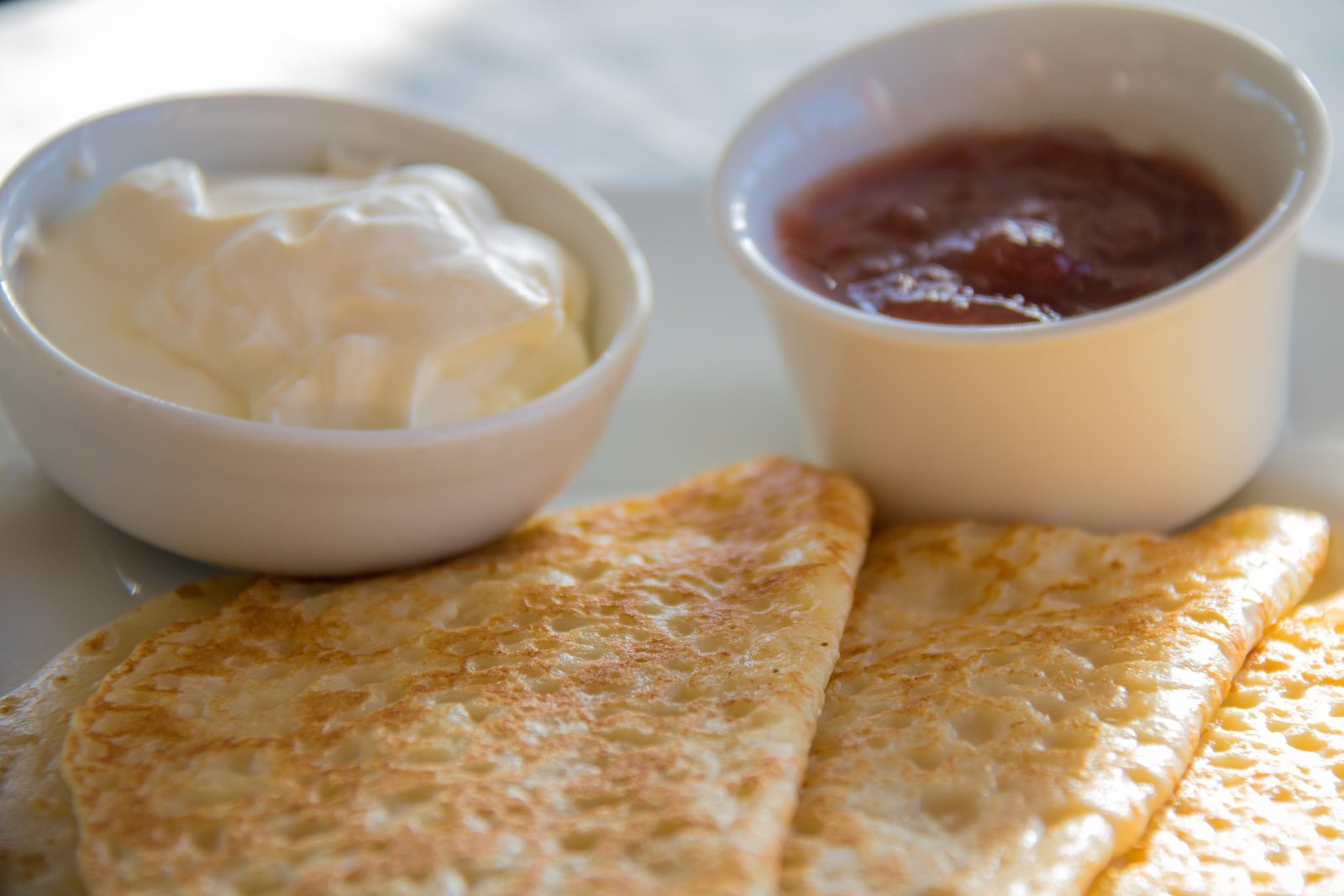
- Serve. Drizzle with honey, scatter the berries over the top and add a spoonful of skyr alongside.
Honey and berries, the sweet side of the North
The Norse world had no sugar. Sweetness meant honey, dried fruit and berries, and honey was valuable enough that nobody poured it over everything out of habit. It sweetened, it preserved, and fermented it became mead, a drink that appears far more often in Norse poetry than on an ordinary farm table.
Berries cost nothing but time. Bilberry, lingonberry, cloudberry and crowberry grew in quantity, and their acidity is the real reason this combination works. The barley tastes earthy, the honey supplies sweetness, and only the berries give the sharp note that keeps the plate from feeling heavy. Leave them off and you have a stodgy breakfast. Add them and you have a dessert.
The family resemblance to other Northern dishes is obvious. The same three elements carry our Viking barley porridge, except that there the work happens in a pot rather than a pan. For the leaner, unleavened cousin that needs neither eggs nor milk, see our Viking flatbread.
Tips & Variations
- No buttermilk? Stir a teaspoon of vinegar or lemon juice into plain milk and leave it 10 minutes. The faint acidity gives a lighter crumb.
- Savoury version: Drop the honey, add thyme and coarse pepper, and serve with smoked fish.
- More wholegrain: Swap the spelt for light wholemeal flour. The batter then wants 10 minutes more rest and a little extra liquid.
- Berry compote: Simmer 7 oz of berries with 2 tablespoons of honey and a splash of water for 5 minutes. Frozen berries work just as well.
- Over a fire: A cast-iron pan over a campfire works unchanged, as long as it sits at the edge of the embers, not the middle.
- Storage: Cooled, the cakes keep 2 days in the fridge. Warm them in a dry pan, never a microwave.
If this way of cooking appeals to you, the recipe sits in the same family as the breads, porridges and feast dishes in our cookbook Viking Feast, which gathers the Norse kitchen from everyday fare to the drinking hall. See the cookbook
In the end this is what good everyday cooking has always been: a handful of ingredients, a hot surface and something sweet on top that existed only for part of the year. That no excavation report backs it up does not make the dish worse. It only makes the story honest.
Image credits: Susanne Nilsson (CC BY-SA 2.0) and Off-shell (CC BY-SA 4.0), via Wikimedia Commons