Recipes
Viking Mussels Recipe: Steamed in a Coastal Herb Broth
Viking mussels recipe: blue mussels steamed in ale with leek, juniper and dill, on the table in 35 minutes, plus the real coastal history behind the pot.
Contents
Every honest Viking mussels recipe begins in the same place: at the line where the tide pulls back twice a day and leaves the rocks bare. No boat, no net, no bait, no gear worth stealing. A pot, a splash of liquid, a handful of herbs and ten minutes of heat is genuinely all it takes to open two kilos of blue mussels and coax out their own salty juice. That frugality is what makes the dish plausible for the ninth-century North. Before we get to scrubbing, it is worth asking what place shellfish really held on these coasts, and what they did not.
Why a Viking mussels recipe starts at the tide line
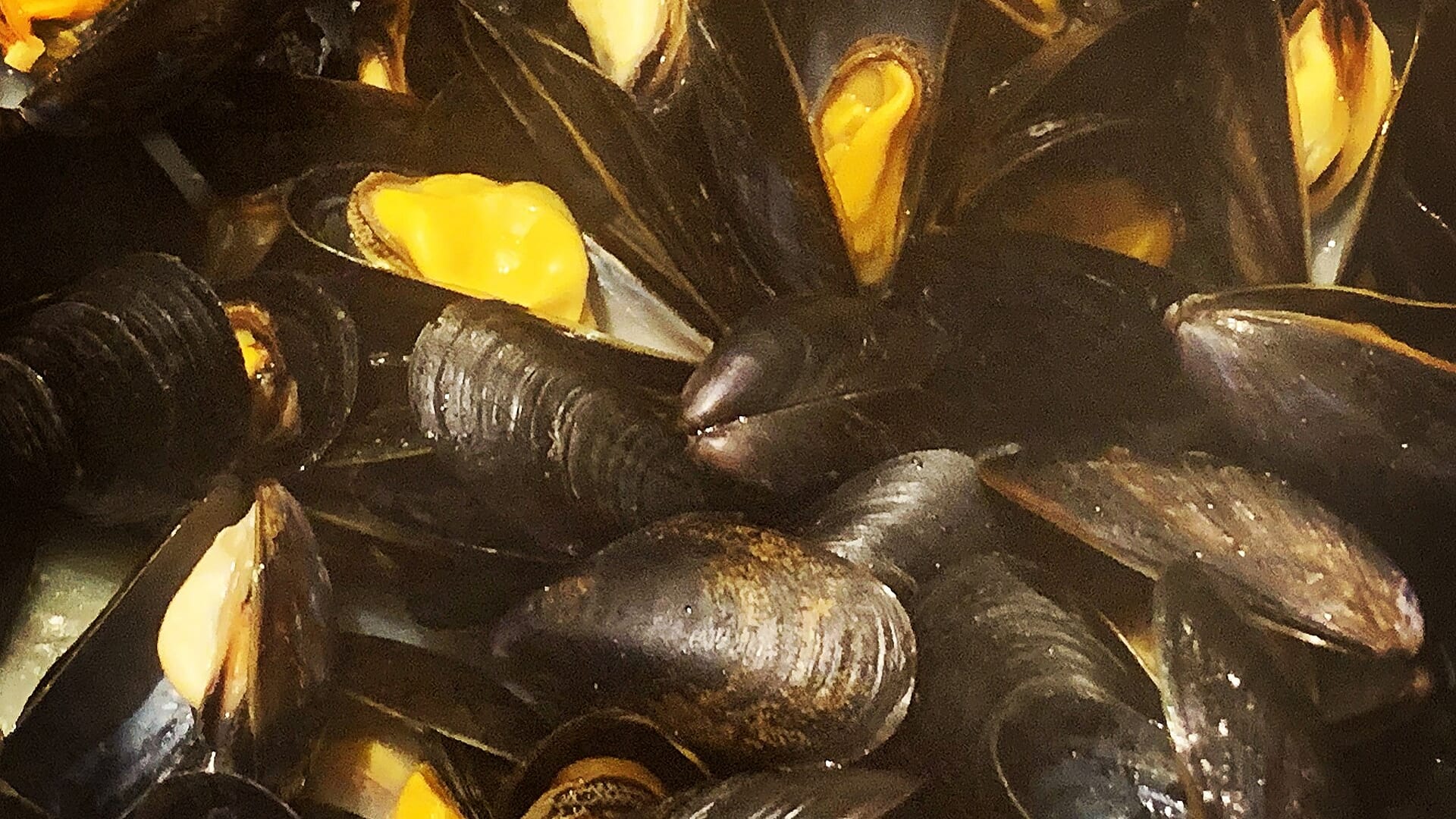
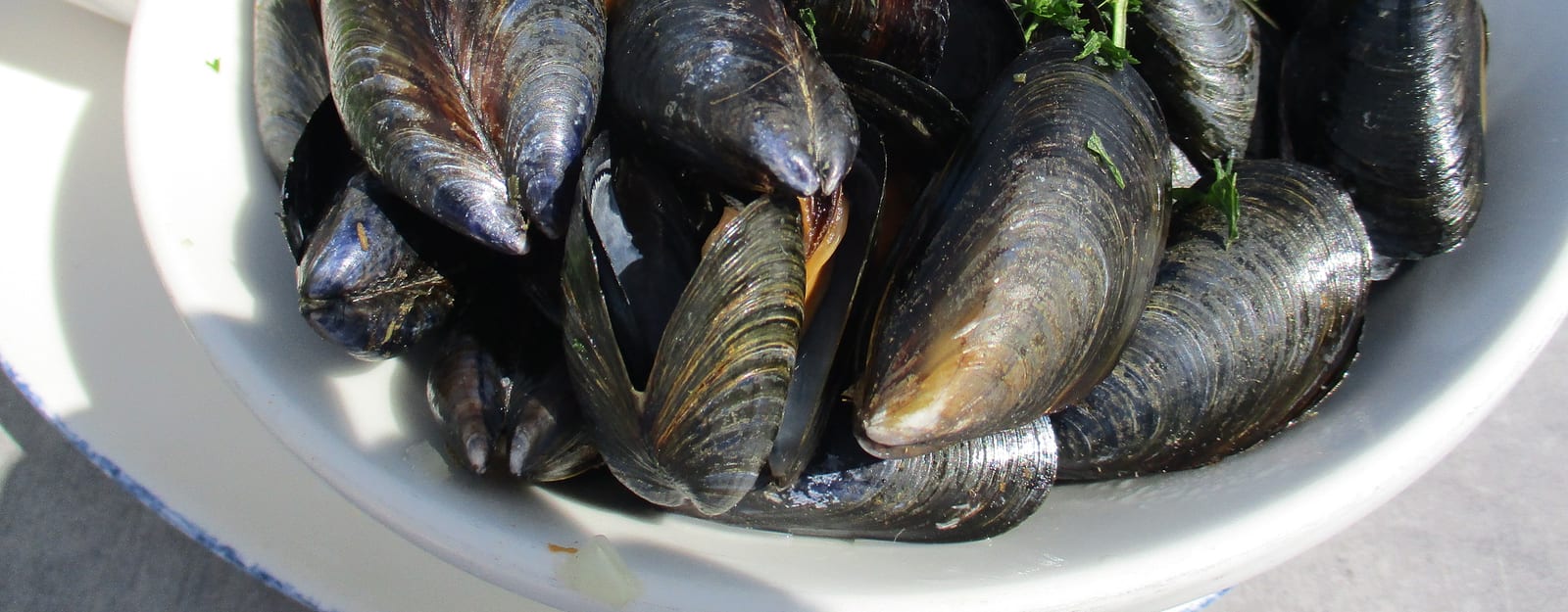
The blue mussel, Mytilus edulis, colonises almost the entire North European shoreline, from Brittany through the North Sea and the Norwegian fjords up to the White Sea. It clamps onto rock and anything else solid enough to hold it, and crucially it does so in the intertidal zone. At low water it simply lies there in the open.
That single fact separates mussel gathering from every other way of getting food in the North. Hunting required weapons and men who could be spared. Sea fishing required a boat, rigging and cooperative weather. Mussels required a basket and somebody able to stand at the water’s edge, so children and the old could do it too. They delivered protein in exactly the season when the storehouse ran thin and the fields had produced nothing yet.
How heavily Norse settlers leaned on the sea shows up in research that has nothing to do with mussels, which is precisely why it carries weight. Isotope analysis of skeletons from the Norse cemeteries of Greenland shows the marine share of the diet climbing dramatically over the generations, from the farm-based food of the first settlers to a diet that by the end came overwhelmingly out of the water.
What the finds actually prove
Mussel shells are calcium carbonate, so they outlast nearly everything else. That is a gift to archaeology and a trap at once, because visible evidence invites fast conclusions. The famous Danish køkkenmøddinger, those metre-deep shell mounds along the coasts of Jutland and Zealand, belong to the Ertebølle culture of the Stone Age, roughly 5400 to 3900 BC. They are why a Danish word for kitchen refuse heap entered archaeological vocabulary worldwide, and they have nothing to do with Vikings, however often popular accounts slide the two together.
| Evidence | What it shows | Where it stops |
|---|---|---|
| Danish shell middens | mussels were a staple on these coasts for millennia | Stone Age, some 4000 years before the Viking Age |
| Isotope values from Norse graves in Greenland | the marine share of the diet rose sharply over time | measures sea food in general, not mussels specifically |
| Shell layers in coastal settlement deposits | mussels were eaten and discarded on the spot | shells migrate, dating and quantity often stay fuzzy |
| Icelandic kræklingur, Old Norse skel | shellfish had settled names in the language | a word proves nothing about how it was cooked |
One limitation runs underneath all of it: not a single written cooking recipe survives from the Viking Age. Nothing in the archaeology tells us whether anybody dropped herbs into the broth. Our own assessment is that mussels were almost certainly an everyday food in the Norse coastal world, and that this is exactly why they are so poorly documented: food that costs nothing generates no trade, no tax and no mention in a saga. Any Viking recipe for mussels is a reconstruction, ours included. It stays honest as long as it sticks to ingredients that demonstrably existed in the North.
Njord and the gifts of the sea
Norse myth assigns the shoreline its own patron. Njord, one of the Vanir in Snorri’s Gylfaginning, lives at Nóatún, the ship enclosure by the sea. He governs the course of the wind, calms water and fire, and seafarers and fishermen call on him. Not a war god and not a dramatic figure, but the god of a good yield, which makes him a decent match for a dish gathered off wet rock.
Did you know? Njord is married to the giantess Skadi, and the marriage fails. She wants to live in the mountains, he wants the sea. So they alternate between the two and neither can bear the other’s: the howling of wolves keeps him awake, the screaming of seabirds keeps her awake. Norse tradition understood the gap between coast and highland long before any cookbook noticed it.
Myth and fact
A handful of claims cling to mussels, old and modern, and most need qualifying.
| Claim | Assessment |
|---|---|
| Mussels were purely food for the poor | Misleading. Shore food was cheap but entirely normal. Rich and poor explain little here. |
| Only eat mussels in months with an R | An old rule from a world without refrigeration. It targets spawning season and warm water. With chilled, farmed stock it has lost its purpose. |
| Mussels that stay shut are poisonous | Not poisonous. Usually the adductor muscle is simply stubborn. Discard them anyway: the rule is easy and the cost trivial. |
| Vikings cooked mussels in wine | No. Wine reached the North as an expensive import. The everyday liquids were ale, water and plain sea water. |
| Authentic Viking recipes have come down to us | None have. Everything called that today is reconstructed from finds, language and rural practice. |
Buying, storing and cleaning mussels
At the fishmonger one hard rule applies: the mussel has to be alive. Closed shells are fine. Gaping shells are fine if they close when tapped. Shells that stay open, and any that are cracked, go in the bin.
At home they belong in a bowl under a damp cloth, in the coldest part of the fridge. Never submerge them in fresh water and never seal them airtight, since both will kill them. Cooking them the same day beats cooking them the next.
Clean them shortly before cooking. Scrub under cold water, scrape off barnacles and pull out the beard, the tough tuft of fibres the mussel anchors itself with, pulling towards the pointed end rather than the hinge. For four as a main course, reckon on 2 kg; as a starter, 1 kg is plenty.
Ingredients
Serves 4 as a main course:
- 4.5 lb live blue mussels (2 kg)
- 1 large leek or 2 onions
- 3 tbsp butter (40 g)
- 1 1/4 cups pale ale (300 ml), or water with 1 tsp salt
- 1 tsp juniper berries, lightly crushed
- 2 sprigs thyme
- 1 small bunch dill
- 1 tsp mustard seeds, coarsely crushed
- Freshly ground black pepper
- 1 tbsp cold butter, to finish
Instructions
- Prepare the mussels. Scrub the mussels under cold water, pull off the beards and discard any that are cracked or refuse to close. Drain in a colander.
- Start the broth. Slice the leek into fine rings. Melt the butter in a large lidded pot and sweat the leek over medium heat for 4 to 5 minutes, without letting it colour.
- Add the aromatics. Add the juniper berries, mustard seeds, thyme and the dill stalks and cook for another minute, until the pot smells of them.
- Deglaze. Pour in the ale and bring it to a hard boil. If you are cooking without alcohol, use salted water instead.
- Steam the mussels. Tip the mussels into the boiling broth, clamp on the lid and cook over high heat for 5 to 7 minutes, shaking the pot firmly twice so the bottom layer comes up.
- Check. They are done when the shells stand wide open and the meat comes away cleanly. Discard anything still shut.
- Finish and serve. Take the pot off the heat, stir in the cold butter, season with pepper and scatter chopped dill over the top. Serve at once, with bread and a spoon for the broth.
Tips & Variations
- The broth is the dish. Do not pour it away. Strained through a fine sieve it becomes the base of a fish soup the next day.
- Bread instead of cutlery. Traditionally you eat mussels using an empty shell as tongs. A sturdy Viking flatbread to mop up the broth belongs on the table.
- A smoky note. A spoonful of flaked smoked fish in the broth shifts the dish towards winter cooking and sits well with the juniper.
- Without ale. Water with a splash of apple cider gives a brighter, sharper broth, and historically that is arguably the likelier version.
- More green. Wild garlic in spring or lovage in summer can replace the dill and push the pot in a more aromatic direction.
- Leftovers. Shelled mussel meat keeps in its broth in the fridge for a day. Cold, with onion rings and a little vinegar, it makes a salad that takes no further work. For the wider picture of what sat on Norse tables, see our overview of the Viking diet.
If this way of cooking appeals to you: mussels in broth is one of many preparations in our cookbook Viking Feast, which gathers the fish, breads, stews and feast-day dishes of the Norse kitchen. See the cookbook
In the end the dish is a reminder that the richest larder in the North was never a storehouse but the line where the water draws back twice a day. Anyone standing there with a basket did not go home hungry.
Image credits: Benoît Prieur (CC0) and Arnaud 25 (CC BY-SA 4.0), via Wikimedia Commons