Warriors & Battles
Varangian Guard: Norse Warriors in Byzantine Service
How Scandinavian warriors became the Byzantine emperors' elite guard: from the 988 Rus alliance to Harald Hardrada and runes carved into Piraeus marble.

Contents
- From the Rus to the Imperial Throne: The Alliance of 988
- Axe Bearing Barbarians at the Heart of the Empire
- Harald Hardrada: From Guardsman to King
- Runes in Marble: The Silent Witnesses of Piraeus and Constantinople
- Timeline: The Varangians in Byzantium
- Legend and Reality: What the Editorial Team Considers Solid
- A Legacy in Marble and Parchment
Some Vikings took their longships west, raiding monasteries like Lindisfarne. Others turned the opposite direction, following the great rivers of Eastern Europe until they reached the Bosphorus and stood before the walls of the richest city in the known world. There, in Constantinople, these same men formed one of history’s most famous mercenary units: the Varangian Guard, the personal bodyguard of the Byzantine emperors, recruited from the north and feared for their axes.
The Varangian Guard is one of those chapters of the Viking Age that has stayed oddly underexposed in public memory, even though the sources are comparatively rich: Byzantine chronicles, Icelandic sagas, and even runic inscriptions carved into stone and marble that survive to this day. Taken together, they sketch a force that formed the backbone of imperial security for roughly two centuries, and whose most famous recruit later became a king in his own right.
From the Rus to the Imperial Throne: The Alliance of 988
To understand the origins of the Varangian Guard, we first have to look toward Kiev rather than Scandinavia. From the late 9th century onward, roughly the 870s or 880s, Scandinavian traders and warriors known as the “Rus” had built a sphere of control along the Dnieper and Volga rivers, out of which the Kievan Rus state gradually took shape. For generations these Rus maintained close, often tense contact with the Byzantine Empire, appearing sometimes as trading partners and sometimes as raiders.
In 988 that relationship shifted decisively. Prince Vladimir of Kiev struck an alliance with Emperor Basil II that tied together two things at once: his marriage to the Byzantine princess Anna and his conversion to Orthodox Christianity, alongside military support for the embattled emperor. At the time, Basil II faced an internal revolt led by the general Bardas Phokas that seriously threatened his throne. As part of the agreement, Vladimir sent the emperor roughly 6,000 Varangian warriors, and with their help Basil II crushed the rebellion.
That force then stayed in imperial service and formed the core of a new, permanent bodyguard, answerable directly to the emperor and kept separate from the rest of the Byzantine army. That separation was precisely the point. As foreigners with no family ties, land holdings, or political ambitions in Byzantium, the Varangians were largely insulated from Byzantine court intrigue, which made them unusually reliable guardians of the emperor’s person.
Axe Bearing Barbarians at the Heart of the Empire
How the Byzantines themselves perceived the Varangian Guard can be traced in the work of the chronicler John Skylitzes, whose eleventh century chronicle stands as one of the most important narrative sources for middle Byzantine history. Skylitzes and other Byzantine authors repeatedly describe the Varangian Guard as “axe bearing barbarians,” a phrase that carries both respect and cultural distance in equal measure. Their signature weapon really was the two handed Danish axe, a tool that must have been hard to miss in the close quarters of the imperial palace and stood in visible contrast to the lighter arms carried by some of the other palace guards.
The Varangian Guard accompanied the emperors on campaign as well as at court ceremonies, where, according to later accounts, they were sometimes turned out with polished weapons and even gilded equipment to impress. Recruitment initially drew heavily from the Rus lands and wider Scandinavia, but later, particularly after the Norman conquest of England in 1066, Anglo-Saxon warriors fleeing their new Norman rulers increasingly joined the ranks as well. For decades the guard remained a living gathering point for Norse, and later English, fighters at the Byzantine court.
Harald Hardrada: From Guardsman to King
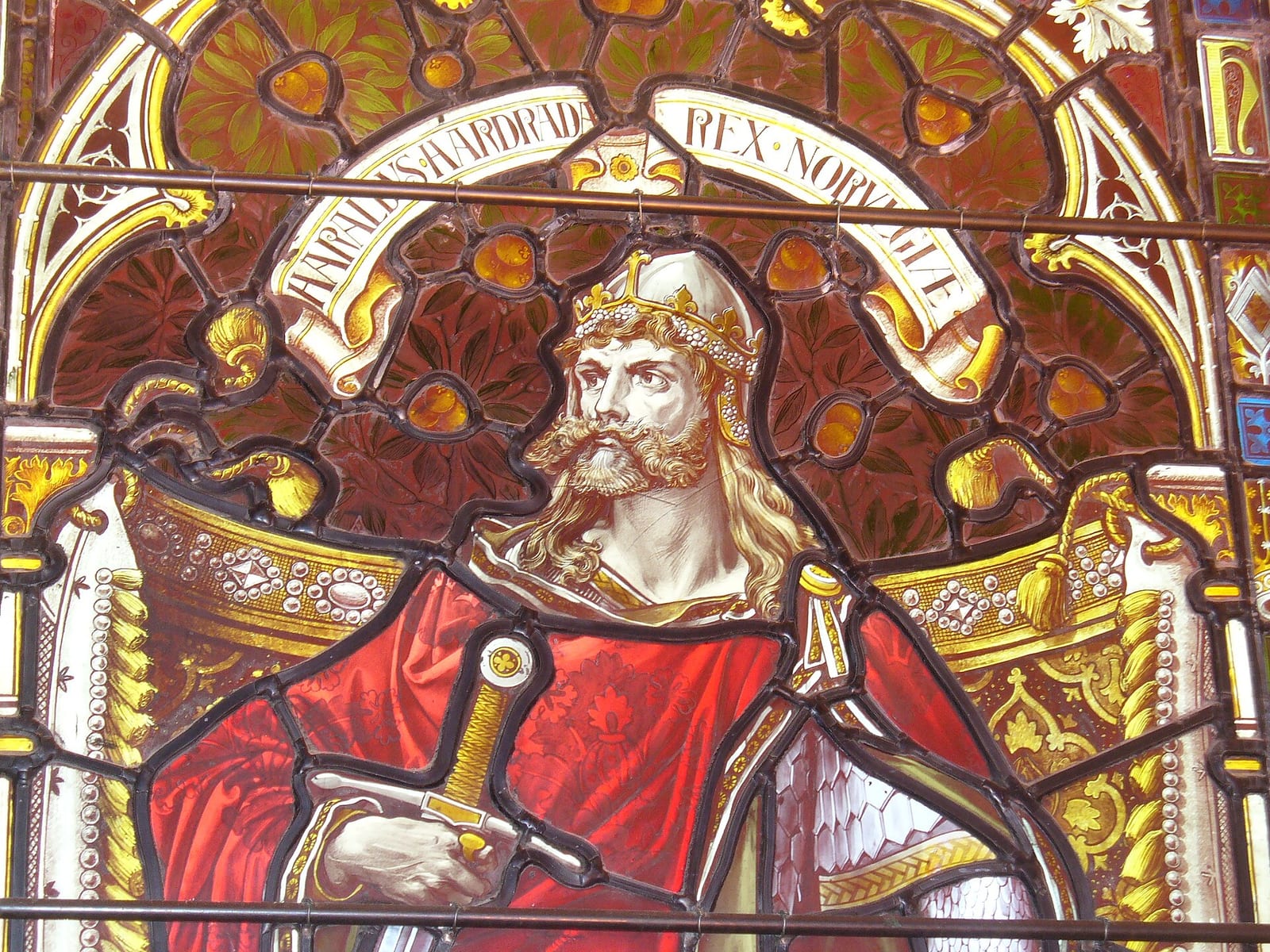
No member of the Varangian Guard is better known today than Harald Sigurdsson, remembered as Harald Hardrada. Most of what we know about his time in Byzantium comes from Snorri Sturluson’s Heimskringla, written roughly two centuries after the events it describes, so historians treat the finer details with appropriate caution, even though the broad outline is supported by Byzantine and other independent sources.
According to the Heimskringla, Harald arrived in Constantinople in the 1030s and joined the Varangian Guard after having already served Prince Yaroslav the Wise of Kiev. In Byzantine service he fought in Sicily and southern Italy against Arab and Norman opponents, as well as in the Balkans against rebellious Bulgarian forces, apparently rising to a position of leadership within the guard. Snorri also records a turbulent episode at the imperial court: Harald is said to have been imprisoned at one point in Constantinople, caught up in court intrigue surrounding Empress Zoe, before managing to escape the city and make his way back north across the Black Sea and through Kiev.
Carrying the wealth and military reputation he had built in Byzantium, Harald eventually returned to Norway, where he ruled as co king from 1046 and as sole king from 1047. His life ended in 1066 at Stamford Bridge in England, where he fell attempting to claim the English crown, just weeks before William the Conqueror landed at Hastings. For the Varangian Guard, Harald remained the ultimate poster child for generations afterward, proof that the road from northern mercenary to royal throne genuinely existed, even if only a handful of men ever walked it to the end.
Runes in Marble: The Silent Witnesses of Piraeus and Constantinople
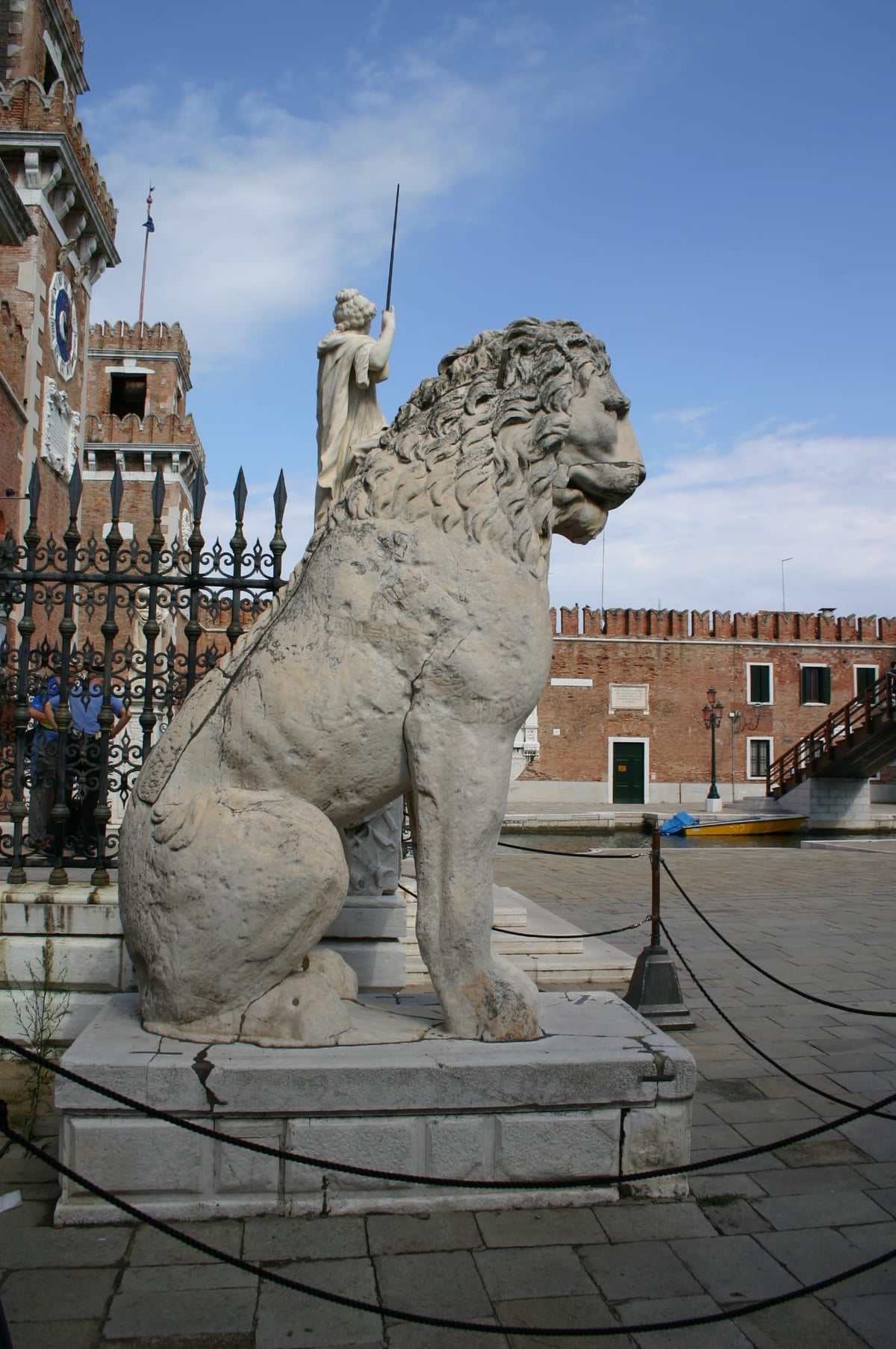
While written sources like Skylitzes’ chronicle or the Heimskringla tell the story of the Varangian Guard from a distance, there is also direct, physical evidence left behind by the guardsmen themselves. The best known example is the so called Piraeus Lion, a marble lion statue that originally stood in the harbor of Piraeus near Athens and was carried off to Venice in 1687 as war booty by the Venetian commander Francesco Morosini, where it still stands in front of the Arsenal today.
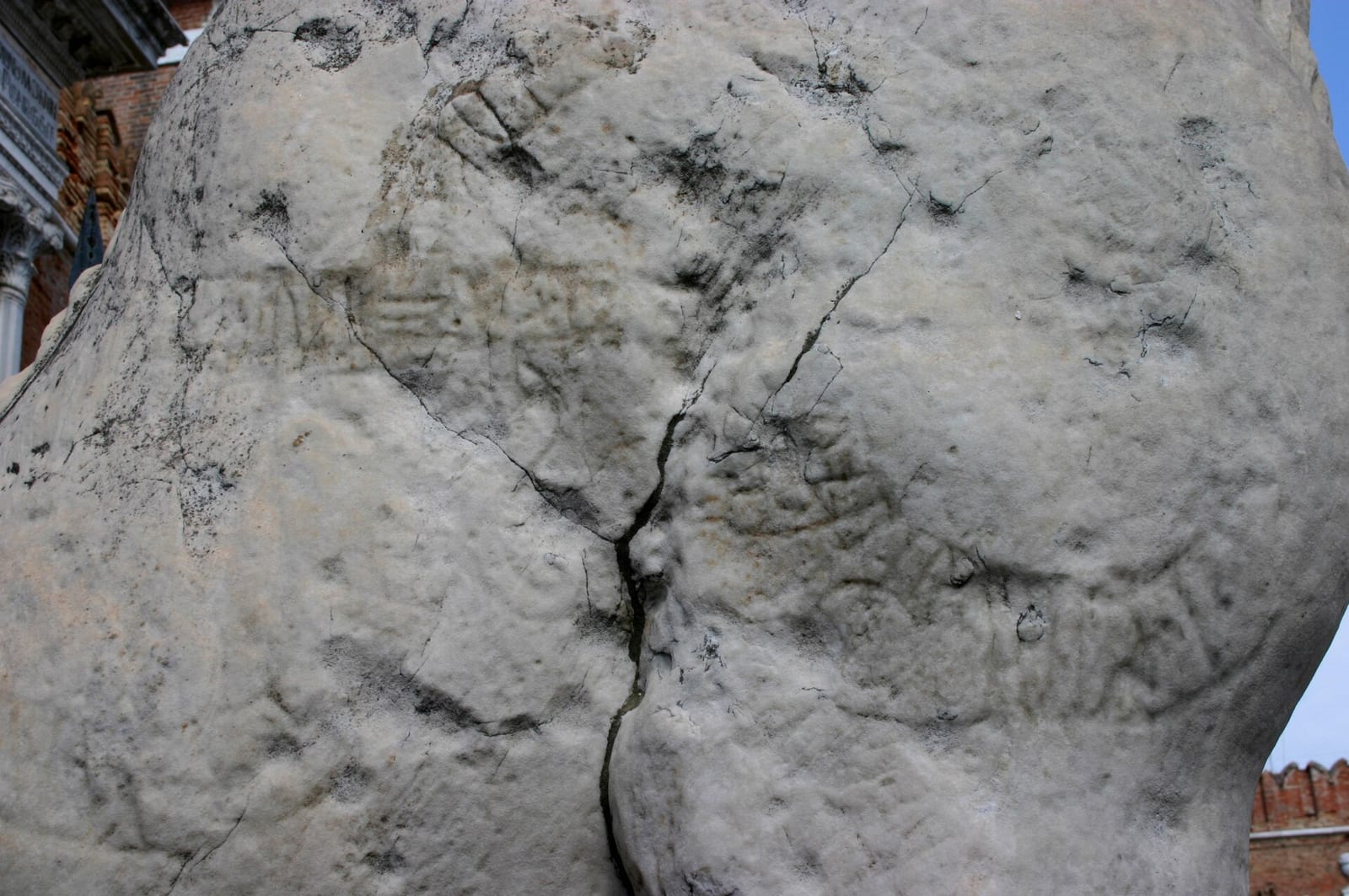 Image source: G.dallorto (Attribution), via Wikimedia Commons
Sometime around the 1040s, likely during a mutiny or a campaign on the Greek mainland, Varangian guardsmen carved a band of runes into the lion’s flanks. The inscription is now badly weathered and only fragmentarily legible, but runologists have studied it closely since the nineteenth century. The Swedish runologist Erik Brate published a widely cited reconstruction in the early twentieth century that links parts of the inscription to a Swedish origin for the carvers, though Brate himself, like later scholars, stressed that the poor state of preservation allows only isolated words and name fragments to be read with any confidence, not the full original text.
A second, shorter but equally famous inscription survives in the Hagia Sophia in Istanbul, scratched into the balustrade of the upper gallery. The heavily worn runic line is usually read, roughly, as “Halfdan carved these runes,” a brief, almost offhand greeting from a Norse guard or visitor who left his mark, in a moment of boredom or pride, inside one of the most important buildings in the Christian world. Together, the Piraeus Lion and the Hagia Sophia graffito are among the rare cases where the presence of Norse warriors in Byzantium isn’t just inferred from foreign chronicles, but comes directly from the men themselves, in their own writing.
Timeline: The Varangians in Byzantium
| Period | Event |
|---|---|
| c. 874/882 | Emergence of an early Rus sphere of control along the river routes of Eastern Europe, out of which the Kievan Rus state later grew |
| 988 | Alliance between Prince Vladimir of Kiev and Emperor Basil II, dispatch of around 6,000 Varangian warriors, founding of the permanent Varangian Guard |
| 1030s to 1040s | Harald Hardrada serves in the Varangian Guard, campaigning in Sicily, southern Italy, and the Balkans |
| c. 1040s | Likely period when the runic inscription on the Piraeus Lion was carved |
| 1066 | Death of Harald Hardrada at Stamford Bridge, shortly after his reign as king of Norway |
| 1204 | Sack of Constantinople by the Fourth Crusade, often cited as marking the decline of the classical Varangian Guard |
Legend and Reality: What the Editorial Team Considers Solid
At this point it’s worth taking a sober look at what’s actually documented and what has thickened into legend over the centuries. Solidly established are the existence of the Varangian Guard as an institutionalized imperial bodyguard, its founding around the alliance of 988, its description by Byzantine chroniclers like Skylitzes, and the physical runic inscriptions on the Piraeus Lion and in the Hagia Sophia. Harald Hardrada’s service in Byzantium is also considered historically solid, supported by several independent lines of evidence.
Less solid are many of the decorative details found in the Heimskringla, such as dramatic dialogue, precise troop numbers for individual engagements, or the exact circumstances of Harald’s court intrigue and imprisonment. Snorri wrote as a saga author, not a modern historian, and he wrote for an audience that valued a gripping story just as much as reliable fact. The editorial team’s rule of thumb is simple: the broad historical framework, that Scandinavians really did serve in large numbers as an elite guard in Constantinople and that Harald Hardrada really was among them, rests on solid ground. The colorful details of individual episodes deserve the same healthy skepticism readers bring to the battle scenes of the berserkers in the sagas: probably rooted in something real, but dressed up for the telling.
A Legacy in Marble and Parchment
After the sack of Constantinople in 1204 by the Fourth Crusade, the Varangian Guard in its classical form gradually lost significance, even though successor formations and the name itself persisted for some time afterward. What remains is an unusually layered picture: an alliance between a Kievan prince and a Byzantine emperor that brought Norsemen to the Bosphorus, a future Norwegian king who earned his credentials there, and a handful of fleeting runic lines in marble, carved by men who probably never imagined their names and greetings would outlast them by nearly a thousand years.
That is exactly what makes the Varangian Guard such a striking counterpoint to other Viking Age chapters. It shows that the expansion of the Norse world was never a one way street to the west. While Lindisfarne is still remembered today for the raids on English monasteries, other Norsemen stood in ornate uniforms in the throne room of Constantinople, serving the most powerful ruler of their age as his most personal and most feared guard.
Image source: G.dallorto (Attribution), via Wikimedia Commons