Runes & Symbols
The Piraeus Lion: Viking Runes on an Ancient Statue
The Piraeus Lion carries weathered Viking Age runes, was looted to Venice in 1687 by Francesco Morosini, and remains runology's most debated inscription.
Contents
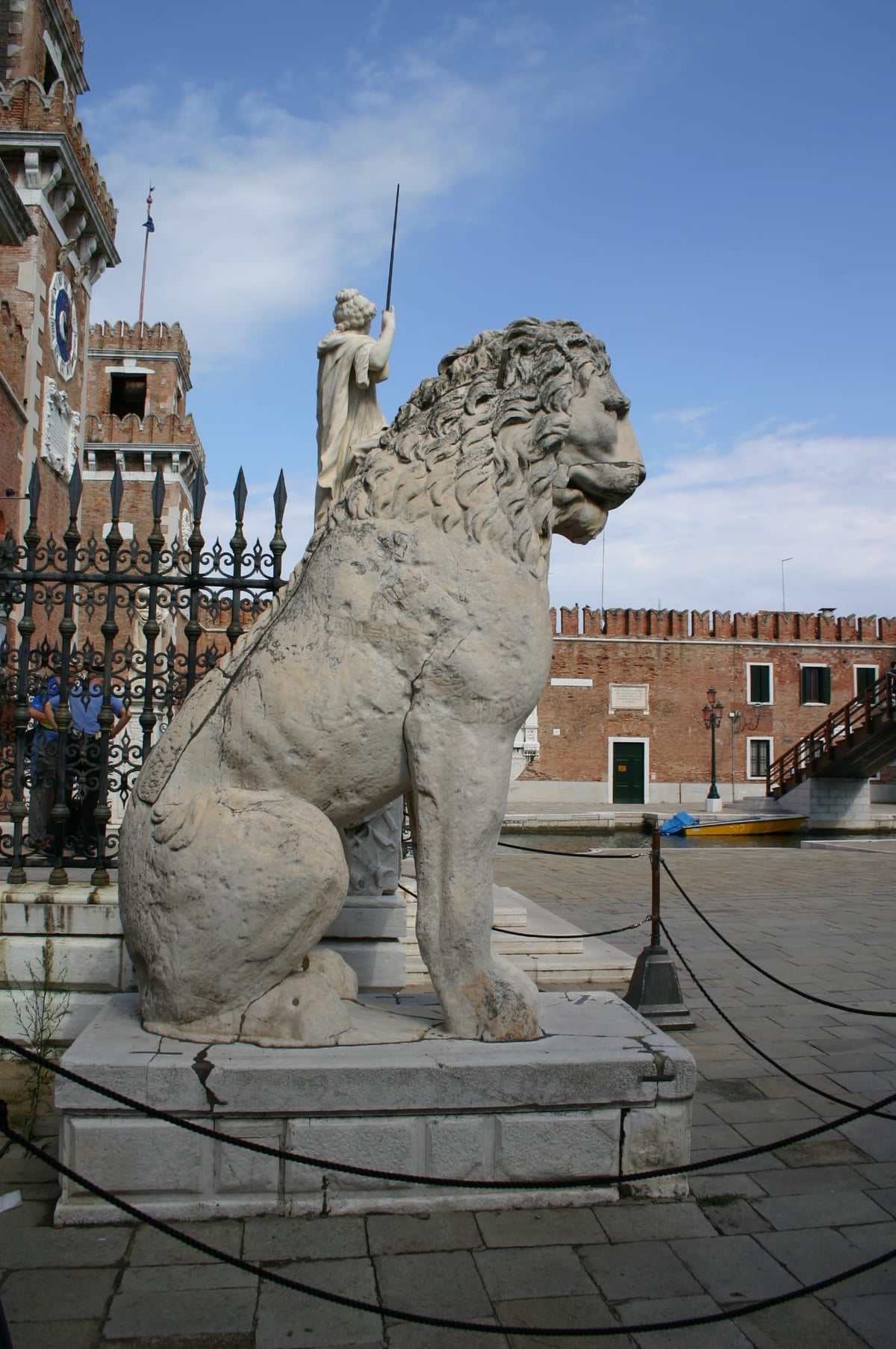
Outside the gate of the Venetian Arsenal stands a marble lion that is older than the city guarding it, carrying a message on its shoulders that nobody can fully read any more. The Piraeus Lion collapses three entirely different worlds into a single block of stone: the ancient Greek world that carved it, the Viking Age that added the runes, and the Republic of Venice that hauled it off as plunder. Anyone searching for “Piraeus Lion runes” runs straight into one of the stubbornest unsolved puzzles in the whole field of runology, a genuine, undisputed inscription that still cannot be properly translated today.
A Lion from Ancient Piraeus
The statue did not start out in Venice. It began its life at Piraeus, the ancient port city serving Athens. Art historians generally place the marble lion in the Hellenistic period, with proposed dates ranging roughly from the 4th to the 2nd century BC, though the exact date remains an open question among classicists. What is not in doubt is that the lion stood prominently at the harbor entrance for centuries, visible to every ship that sailed in or out. It left such a mark on local identity that Italian and Venetian sailors came to call the harbor of Piraeus simply “Porto Leone,” the Lion Port, a name that stuck long before anyone had noticed anything unusual carved into the statue itself.
To an ancient visitor, a monumental lion guarding a harbor entrance would have seemed unremarkable. Large animal statues at ports and public squares were common across the Hellenistic Mediterranean. What set this particular lion apart from countless similar works happened centuries later, and not in Greece at all, but through visitors who had traveled from far to the north.
Scandinavian Script on Greek Marble
At some point, most runologists estimate the 11th century, Scandinavian hands carved a band of runes across the lion’s shoulders and flanks. That is far less strange than it first sounds. In the 11th century the region around Athens and Piraeus lay under Byzantine imperial control, and the Byzantine Empire at exactly that time employed large numbers of Scandinavian soldiers, most famously in the Varangian Guard, the Byzantine emperors’ personal bodyguard. These troops were not confined to Constantinople: they campaigned and were garrisoned across the empire, mainland Greece included.
It is entirely plausible that a group of Norse mercenaries, whether during a mutiny, a stint of harbor guard duty, or simple boredom while passing through, decided to leave their mark on the single most impressive statue in sight. Similar graffiti left by Scandinavian visitors survives elsewhere in Byzantine territory, most famously a short runic scratching on a balustrade inside the Hagia Sophia in Constantinople. The Piraeus Lion is therefore not an isolated oddity but part of a wider pattern: Norsemen, far from home, leaving traces of themselves in stone and marble wherever they went.
Francesco Morosini and the Plunder of 1687
Nearly six centuries after the runes were likely cut, the event occurred that finally tore the lion out of its Greek context for good. In 1687, Venetian forces under the commander Francesco Morosini captured the area around Athens and Piraeus as part of the Morean War, itself a theater of the wider Great Turkish War against the Ottoman Empire. Morosini, who would later rise to become Doge of Venice, had several ancient statues from the region shipped back to Venice as war trophies, the Piraeus Lion among them.
Once in Venice, the statue found its permanent home outside the Arsenal, the city’s historic naval shipyard and the engine room of its maritime power, where other looted lions from different eras already stood or would later join it. There, at the gate of one of the most formidable naval arsenals in Europe, the lion has remained for more than three centuries now, far from the Mediterranean harbor it was built for, and even farther from the northern homeland of the men who once carved their runes into its hide.
The Puzzle of the Piraeus Lion Runes
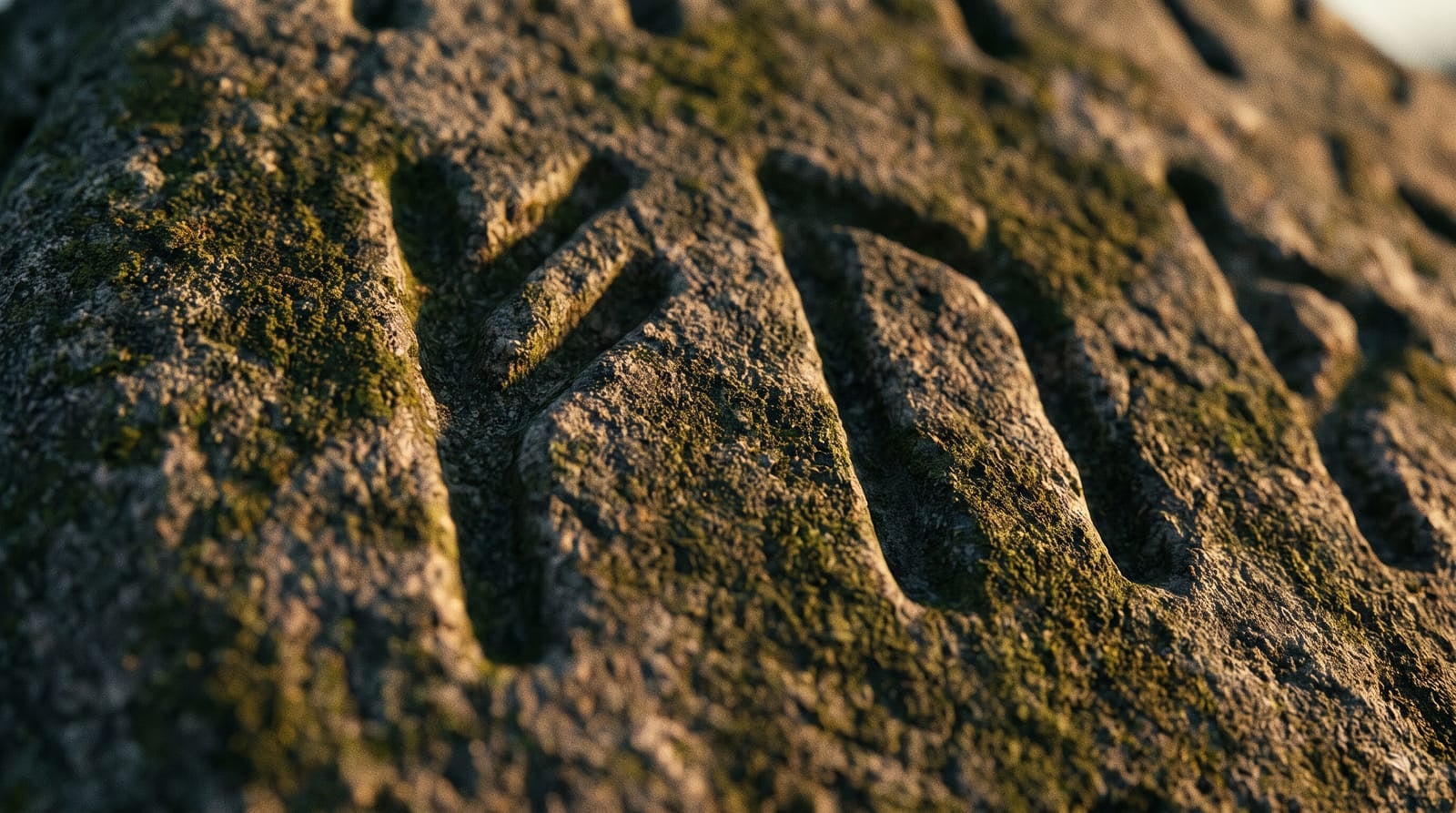
This is where the story becomes both its most frustrating and its most fascinating. Centuries spent outdoors, first at the harbor of Piraeus and then, since 1687, in the open Venetian air, have taken a severe toll on the inscription. The runes today are so heavily worn that they are barely recognizable as a continuous band of writing to the naked eye, and even with modern techniques any reading remains deeply fragmentary.
Scholarly interest in the inscription stretches back a long way. The Swedish diplomat and orientalist Johan David Åkerblad, who also took part in early attempts to decipher the Rosetta Stone, was among the first scholars to recognize the markings as Scandinavian runes and document them systematically, around the turn of the 19th century. Later in the 1800s, the Danish antiquarian Carl Christian Rafn, one of the founding figures of Nordic antiquarian scholarship, studied the inscription further and published his own attempted reading. Subsequent runologists, including the Swedish scholar Erik Brate in the early 20th century, offered their own reconstructions.
What stands out across all of this work is that no two readings fully agree with each other, and none is accepted by the field as definitive. Some scholars have proposed that fragments of the text might contain personal names, or echo the kind of commemorative formula familiar from Swedish rune stones, along the lines of “X and Y had these runes carved.” Such proposals, though, remain speculative readings of a handful of faint, often barely legible characters, not a settled translation of the inscription as a whole. It is worth being blunt about this: there is no generally accepted, complete translation of the runes on the Piraeus Lion, and any account that presents one as settled fact is overstating what runology can actually support.
A lion of Greek marble that once stood watch over a Mediterranean harbor, was marked by Norse mercenaries with runes, and was finally dragged off as war booty to a Venetian arsenal gate, now carries a message nobody can read. That very unreadability may be what makes the Piraeus Lion one of the most honest monuments the Viking Age left behind. It promises no tidy story, only the certainty that someone, once, was there.
What We Actually Know: The Varangian Connection
If the exact wording of the runes cannot be pinned down, what can be said with confidence? Quite a lot, as it turns out. The band of script follows the same decorative style found on numerous rune stones from central Sweden, with the characters set inside an interlacing, ribbon-like pattern. That formal similarity to Swedish memorial stones is one of the strongest arguments that the inscription really is Scandinavian work, even though its precise content stays out of reach.
Then there is the historical backdrop, which is well documented quite independently of the inscription itself. Byzantine chroniclers describe at length the use of Scandinavian mercenaries through the 11th century, the Varangian Guard was a fixture of imperial life, and Greece and its port towns sat squarely within the operational reach of these troops. The parallel with the runic graffito inside the Hagia Sophia reinforces the point: this was not a one-off accident but, apparently, a recurring habit among Norse travelers and soldiers moving through Byzantine territory. Readers interested in the wider world of Norse symbols and script will find more on the subject in our overview of Viking symbols and their meaning.
So while any confident translation of the Piraeus Lion’s runes should be treated with real caution, the statue still offers solid material evidence that Norse warriors genuinely reached the eastern Mediterranean, long before “Vikings in Byzantium” became a settled chapter of popular history.
Timeline: From Ancient Harbor to Venetian Arsenal
| Period | Event |
|---|---|
| roughly 4th to 2nd century BC | The marble lion is carved, most likely for the harbor of Piraeus near Athens |
| 11th century | Probable period in which the runic inscription was carved, likely by Scandinavian mercenaries in Byzantine service |
| 1687 | Francesco Morosini captures the Athens and Piraeus region during the Morean War and has the lion shipped to Venice as war booty |
| from 1687 onward | The lion is installed outside the Venetian Arsenal, where it still stands today |
| late 18th / early 19th century | Johan David Åkerblad identifies the markings as Scandinavian runes and documents the inscription |
| 19th century | Carl Christian Rafn and later Nordic antiquarians attempt further readings, without reaching full agreement |
| today | The inscription is badly weathered and its exact wording remains disputed among specialists |
A Monument of Three Ages
In the end, the Piraeus Lion refuses any simple label. It belongs to ancient Greece, to the Viking Age, and to early modern Venice all at once, and none of those three periods gets the final word on what it means. For the history of the Vikings, it matters above all because, much like the Varangian Guard itself, it shows just how far the Norse world really reached, not only west toward England and North America, but also deep into the southeast, all the way to the coasts of Greece and into the service of the Byzantine emperor.
Anyone standing today in front of the Venetian Arsenal, looking at the faint, barely visible lines across the lion’s flanks, is looking at one of the oldest surviving traces of Norse travelers in the Mediterranean, even though that trace itself has fallen silent. Perhaps that is the real lesson the Piraeus Lion has to offer: not every historical puzzle needs to be solved to matter. Sometimes it is enough that the trace exists at all.