History
Harald Hardrada: The Last Great Viking King
Harald Hardrada's life from teenage survivor at Stiklestad to Varangian commander in Constantinople and Norwegian king who died at Stamford Bridge in 1066.
Contents
Few lives sum up the entire range of the Viking Age quite like that of Harald Hardrada. He fought in a battle at fifteen that he barely survived, served as an elite mercenary commander in the grandest city of the age, became king of Norway, and finally fell in a battle that historians still treat as the symbolic end of the Viking Age itself. His byname Harðráði, “hard-ruler” or Hardrada, wasn’t an exaggeration invented by later chroniclers - his own contemporaries already thought it fit. If you want to grasp how far the world of the Norsemen actually reached, from Norway to the imperial court of Byzantium, Harald’s biography is the fullest answer you’ll find.
The main source for his life is the Heimskringla by the Icelandic scholar Snorri Sturluson, specifically the Haralds saga Sigurðarsonar it contains, supplemented by the somewhat older Morkinskinna and, for his death, the Anglo-Saxon Chronicle. Snorri wrote roughly two centuries after the events, but drew on orally transmitted skaldic verse, some of it composed during Harald’s own lifetime, including poems by the skald Þjóðólfr Arnórsson, who accompanied him for years.
A King’s Son in the Shadow of Saint Olaf
Harald was born around 1015 in Ringerike, Norway, the half-brother of King Olaf II, later Norway’s patron saint. That kinship shaped his entire life, since Olaf’s downfall was what set Harald’s political career in motion in the first place. When the exiled Olaf returned in 1030 to reclaim his throne from the great landowners allied with Denmark, fifteen-year-old Harald marched into battle at his side.
At Stiklestad, one of the most consequential battles in Norwegian history, Olaf fell and his army was crushed. Harald himself was wounded but survived, fleeing over the mountains into Sweden with a small band of loyal followers. For most men, a defeat like that would have ended any political ambition. For Harald, it was the starting point of one of the most remarkable careers of the entire Viking Age.
Flight East: In the Service of the Prince of Kiev
From Sweden, Harald pressed further east into Kievan Rus, to the court of Prince Yaroslav the Wise. This route was hardly unusual for Norse warriors; the trade corridors along the Russian rivers, through Novgorod and Kiev down to the Black Sea, had been travelled by Norsemen (the so-called Rus) for generations. Harald served several years as a warrior in Yaroslav’s retinue and took part in his campaigns before deciding to press on even further: to Constantinople, capital of the Byzantine Empire.
The Varangian Commander of Constantinople
In Constantinople, Harald joined the famous Varangian Guard, the elite bodyguard of the Byzantine emperors, traditionally made up of Norse and, later, Anglo-Saxon warriors. Within a few years he rose to become one of the unit’s leading figures. The sagas describe campaigns in Asia Minor, against pirates in the Mediterranean, in Bulgaria, and even a pilgrimage to Jerusalem, said to have been undertaken under imperial safe conduct during a period of relative peace.
What stands out about this episode is the sheer scale of wealth Harald reportedly accumulated in Byzantine service - gold and silver that, following Norse custom, he sent partly to Kiev and partly directly home to secure his eventual return. Whether every episode in the sagas is historically precise remains debated among historians, but that Harald genuinely spent years in Byzantine service and came away with considerable riches is generally accepted, and indirectly corroborated by Byzantine sources such as the writings of Michael Psellos.
The Heimskringla also describes a dramatic falling-out at the imperial court itself: after Emperor Michael IV died, Harald reportedly fell out of favor and was even briefly imprisoned, possibly because he refused to hand his accumulated fortune over to the empire, or because he had become entangled in an affair with a relative of Empress Zoe. The saga tells of a princess who helped free him from his cell with the aid of his fellow Varangians, after which he fled the city in secret while Byzantine guard ships blocked the exit from the Golden Horn. Whether every detail of this escape story is accurate is hard to verify at this distance, but it illustrates how tightly Harald’s rise was bound up with the intrigues of the Byzantine imperial court, one of the most complex and dangerous political stages in Europe at the time.
“He was the tallest of men, and all his weapons were mounted with gold.” - Snorri Sturluson, Haralds saga Sigurðarsonar
Homecoming and a Crown: Harðráði Becomes King of Norway
Around 1045, Harald returned to Scandinavia via Kiev, where he married the princess Elisiv. At the time, Norway was ruled by his nephew Magnus the Good, son of Saint Olaf. Rather than open conflict, uncle and nephew first agreed to a joint kingship, with Harald sharing part of his Byzantine fortune with Magnus - an arrangement that benefited both. When Magnus died unexpectedly in 1047, Harald became sole king of Norway.
His reign was dominated by nearly two decades of war against the Danish king Sweyn Estridsson, a grinding conflict over control of Denmark that only ended with a peace settlement in 1064, without Harald ever achieving his real goal, the Danish crown. The high point of that war came at the Battle of Niså in 1062, a bloody naval engagement Harald won outright but that gave him no lasting strategic advantage, since Sweyn kept regrouping resistance each time. During this period, later tradition credits him with developing Oslo into a royal trading town. At home he ruled rebellious chieftains with an iron hand, which is precisely what earned him the byname the Icelanders gave him: Harðráði, the hard-ruler.
That harshness was hardly reserved for foreign enemies. Several sagas describe clashes with powerful Norwegian landowners and even with his own court poet Þjóðólfr when the latter voiced criticism, as well as the brutal suppression of a revolt led by the chieftain Einar Thambarskelfir, whom Harald had removed through trickery. Episodes like these show that Harald’s byname wasn’t a minor footnote but described an actual style of rule that tolerated no rival center of power inside Norway, even one drawn from his own nobility.
| Life Stage | Period | Central Event |
|---|---|---|
| Youth in Norway | until 1030 | Battle of Stiklestad, flight east |
| Kievan Rus | 1031-1034 | Service under Prince Yaroslav the Wise |
| Byzantium | 1034-1045 | Varangian Guard, campaigns, fortune |
| Return | 1045-1047 | Joint rule with Magnus the Good |
| Kingship | 1047-1066 | Sole rule, war against Denmark |
| England | 1066 | Invasion, Fulford, death at Stamford Bridge |
The Reach for England: Fulford and the End at Stamford Bridge
In 1066, Harald saw one last, enormous opportunity. After the childless English king Edward the Confessor died, not only did William of Normandy claim the English throne, but Harald did too, citing an alleged inheritance agreement from earlier Anglo-Danish treaties. Allied with Tostig Godwinson, the exiled brother of English king Harold Godwinson, Harald landed in northern England with a fleet of roughly 300 ships.
At Fulford, near York, his army crushed the earls Edwin and Morcar on September 20, 1066. Just five days later, however, King Harold Godwinson, having raced north with astonishing speed, caught the victory-flushed Norwegians off guard at Stamford Bridge - many without armor, since the hot weather and the absence of any expected threat had led them to leave their mail shirts at the ships. Harald died in the battle from an arrow to the throat; Tostig fell as well. Of the roughly 300 ships that had originally sailed, only 24 are said to have carried survivors home to Norway.
Snorri Sturluson has Harald deliver one last, defiant half-verse before the battle, expressing his composure in the face of the overwhelming force bearing down on him, a literary flourish unlikely to be verbatim but one that fits neatly with the picture the sagas paint of him: a man determined to guard his reputation as an unbending warrior even staring down certain defeat. We cover the full course of Stamford Bridge in detail, including the famous episode of a lone Norwegian axeman said to have held the bridge over the Derwent single-handedly, in our article on the Battle of Stamford Bridge.
Legacy: Why Historians Call Him the “Last Viking”
Just three weeks after Stamford Bridge, William the Conqueror landed on England’s south coast, and King Harold Godwinson, his army still worn out from the forced march and the battle in the north, lost to him at Hastings. That timing has long led historians to treat Harald’s defeat as the symbolic close of the Viking Age proper: the last great Scandinavian bid for a foreign crown, led by a king whose life had literally spanned the entire geographic reach of the Norsemen, from Norway through Kiev to Byzantium. In a sense, the raid on Lindisfarne, which had opened the Viking Age some 270 years earlier, and Harald’s death at Stamford Bridge form the two bookends of an era that ended with a single arrow.
What sets Harald Hardrada apart from many other Viking kings isn’t just the sheer number of lands he crossed, but how consistently he lived up to what his byname described: a man who seized every opportunity for power with unrelenting toughness, whether in Byzantium, in Norway, or finally on an English battlefield that still carries his name into the story of an entire era’s end.
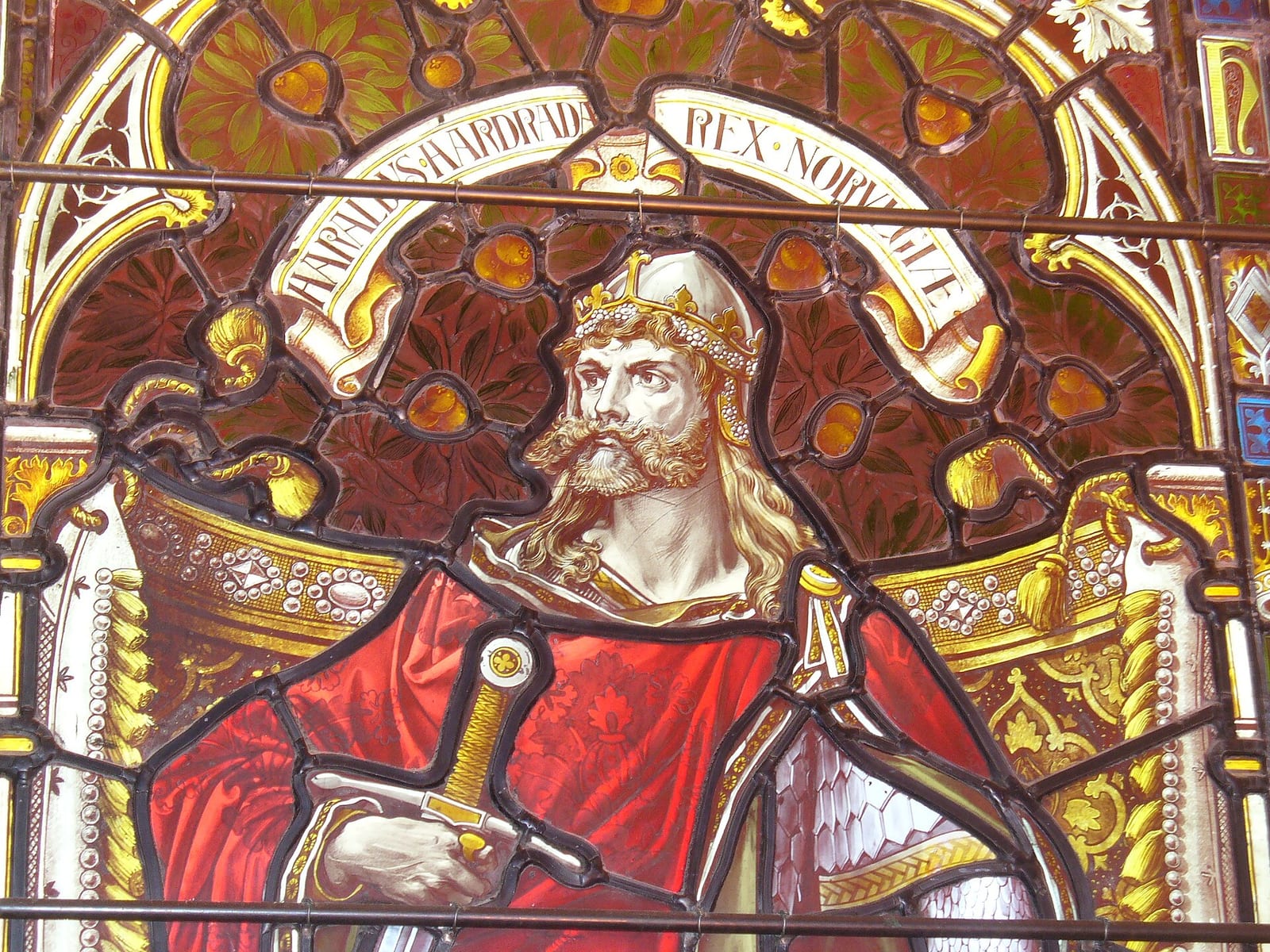
Image source: Colin Smith (CC BY-SA 2.0), via Wikimedia Commons