Warriors & Battles
Berserkers: The Frenzied Warriors of the Vikings
Who were the Viking berserkers really? What the Ynglinga saga, Haraldskvæði and Grettis saga reveal about battle fury, wolf-warriors and their outlawing.

Contents
Few figures of the Viking Age fire the imagination quite like the Viking berserkers: warriors who charged into battle without armour, bit the rims of their shields and, in their frenzy, supposedly feared neither fire nor iron. Hollywood loves them. Video games even more so. But how much of that actually stands in the old sources-and how much is modern embroidery?
The honest answer: the berserkers were probably both. Real elite warriors with a cultic background and literary bogeymen who had already become legend by the Middle Ages. To separate the one from the other, we have to go where everything begins-to the texts themselves.
What the Sources Say About the Viking Berserkers
The most famous description comes from Snorri Sturluson, the Icelandic scholar who around 1225 composed the Heimskringla, a great history of the kings of Norway. In its opening section, the Ynglinga saga, he describes the warriors of Odin-and in doing so created the image that shapes every notion of the berserker to this day:
“His men went without mail-coats and were frantic as dogs or wolves. They bit their shields and were strong as bears or bulls. They slew men, and neither fire nor iron could harm them. This is called the berserk fury.” - Snorri Sturluson, Ynglinga saga (paraphrased)
A gripping picture-but be careful. Snorri wrote roughly two hundred years after the end of the Viking Age, as a Christian, about a heathen past he himself knew only from poems and tales. His berserkers are already figures of memory, not of the present.
Even the name poses a riddle. In Old Norse, berserkr can mean two things: “bear-shirt” (ber- as in bear) or “bare shirt” (berr, bare, naked)-so either a warrior in a bearskin or one who fights without armour. Most scholars today lean towards the bear-shirt, not least because there is an exact counterpart, which we will come to shortly. Yet the dispute has never been fully settled. And is that not telling? The fog begins with the very name.
Haraldskvæði: The Oldest Evidence
Fortunately there is one source that stands much closer to the events. The praise poem Haraldskvæði (also Hrafnsmál, the “raven song”) is attributed to the Norwegian skald Þorbjörn Hornklofi and was composed around 900, within the lifetime of King Harald Fairhair. It is framed as a dialogue: a raven that follows the battlefields tells a Valkyrie about the king’s life of war. If you want to know more about those choosers of the slain, you will find them in our article on the Valkyries.
It is in this poem that berserkers appear by name for the very first time. The raven tells of the sea battle of Hafrsfjord (traditionally dated around 872), by which Harald secured his rule over Norway-and it describes two groups of warriors aboard the king’s ship:
- The berserkers, who “roared” in battle and about whose lot the Valkyrie specifically asks-the poem calls them men who wade in blood.
- The úlfheðnar, literally “wolf-coats”, who “howled” and carried bloodied shields.
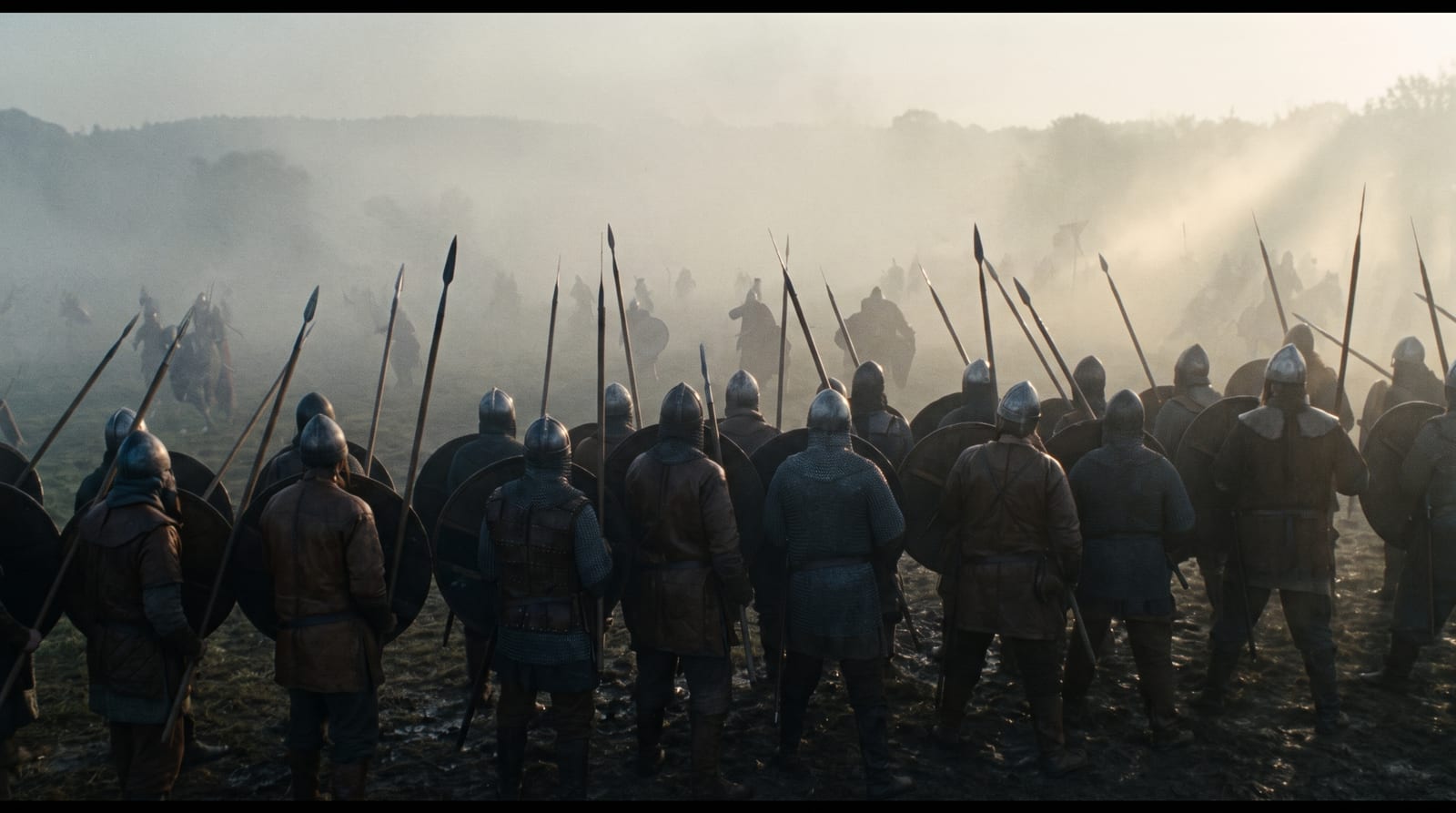
That is remarkably sober. No invulnerability, no foaming at the mouth-but, apparently, a recognisable elite unit in the retinue of a historical king. If the berserkers were ever real, it was here: as guard and shock troops whose very appearance was meant to spread fear. And that a ruler surrounded himself with such men makes perfect strategic sense. In the shield wall, terror was a weapon like any other.
Úlfheðnar: The Wolf-Warriors of Odin
The wolf-coats deserve a closer look, for they are the counterpart to the “bear-shirt” mentioned above. Where the berserker is linked to the bear, the úlfheðinn stands for the wolf. The Vatnsdæla saga likewise mentions úlfheðnar in Harald’s following and describes them as men who wore wolf pelts over their mail.
What astonishes is how far back the visual tradition reaches. On the Torslunda plates from the Swedish island of Öland-bronze dies from the Vendel era, the 6th to 7th centuries, and thus from before the Viking Age proper-we see a weapon dancer in a horned helmet beside a warrior in a wolfskin with drawn sword. Those very plates appear in the hero image above. Many researchers read the scene as a cultic war dance: a ritual in which the fighter symbolically transforms into the beast.
Which brings us to Odin. Snorri explicitly calls the berserkers “Odin’s men”, and the connection is a natural one: Odin is the god of ecstasy, of frenzy, of boundary-crossing states-his very name is related to the Old Norse óðr, “raging, inspired”. Some historians of religion therefore suspect that berserkers and úlfheðnar belonged to cultic warrior brotherhoods whose members became “animal warriors” through rites of initiation. It cannot be proven, but it would explain why the idea of animal transformation clings to them so stubbornly. If you want to understand the world of that dark, knowledge-hungry god, you will find him in our overview of the Norse gods.
From Elite Warrior to Saga Villain
And then something strange happens. In the Icelandic sagas, written down from the 13th century onwards, almost nothing remains of the royal elite warrior. The saga berserker is a thug, a brawler-the stock villain against whom the hero gets to prove himself.
The Grettis saga demonstrates this perfectly. Its hero Grettir slays an entire ship’s crew of berserkers led by Þórir Paunch and Ögmund the Evil, who mean to ravage an island. Later the berserker Snækoll challenges a farmer and demands his daughter-a classic motif: the berserker calls for the holmgang, the formal duel, and claims the wife or farm of the loser. Grettir ends the performance almost comically: as Snækoll works himself into a howling rage and bites the rim of his shield, Grettir kicks the shield upward into the berserker’s mouth. Of superhuman invulnerability there is no trace.
The Egils saga also knows the fury, but treats it with more nuance. Egil’s grandfather is called Kveldúlfr, “Evening Wolf”-a man whispered to be a shape-shifter. The saga records a detail about him that rings strangely true: after the great rage comes the great exhaustion. Whoever has passed through the berserk fury is afterwards “as weak as an invalid”. Such incidental details are rarely invented-they sound like real, observed experience. And in the Hrólfs saga kraka the hero Böðvarr Bjarki even fights in the shape of a bear while his body lies sleeping in camp-the animal-warrior idea, raised to the level of fairy tale.
Where Did the Battle Fury Come From?
Perhaps the most frequently asked question about the berserkers is simply: how did they do it? The answers by now fill entire bookshelves.
- Fly agaric: The most famous theory goes back to the Swedish theologian Samuel Ödmann (1784). It is also the weakest: not a single source mentions mushrooms, and the fly agaric’s effects tend towards stupor rather than rage.
- Henbane: More recent suggestions point to the nightshade plant, whose seeds were indeed found in a Viking Age grave at Fyrkat in Denmark-though in the grave of a presumed seeress, not a warrior.
- Alcohol: Obvious, but banal-and drunken warriors are, as every commander knows, worse warriors.
- Trance and ritual: Probably the most plausible reading today. Self-hypnosis, rhythmic group frenzy, dancing, roaring, shield-biting as a trigger-a culturally learned state of exception, of the kind ethnographers know from many warrior cultures.
In all honesty: we do not know. Perhaps the question itself is badly posed. Whoever hunts for the one substance treats the berserk fury as a medical problem-but the sources describe it as something between cult, combat technique and reputation. A reputation, mind you, from which every berserker profited: a man believed to be invulnerable had to fight far less often.
The End of the Fury
However terrifying the berserkers may have been, their days were numbered-and it was the ordering power of the new faith, of all things, that sealed their end. Around the year 1015, Jarl Eiríkr Hákonarson had duels banned in Norway and berserkers declared outlaws; the Grettis saga reports as much. In Christian Iceland, the law book Grágás made the berserk fury a punishable offence: whoever fell into the rage risked outlawry-and so did anyone standing by who failed to restrain him.
Within a few generations the berserkers vanish from contemporary accounts. What remains is literature: there the berserker drifts into the role of the heathen brute whom the Christian narrator delights in bringing down. One may read that as a reckoning-the new age mocking the terrors of the old.
What Remains of the Berserker
And today? Today the berserker still stalks through our language: whoever loses control goes berserk. A small, uncanny warrior elite of the North has become a worldwide metaphor for the loss of self-command.
Perhaps that is the real point of the story. The Vikings themselves never unambiguously admired the berserker-in their own tales he is more often a threat than a role model, more often Snækoll than hero. Yet he fascinated them all the same, just as he fascinates us: as an image of the question of what happens when a human being deliberately crosses the line towards the beast. The sagas’ answer is astonishingly modern. In the short term, he wins every battle. In the long run, he loses everything.
Image: Wikimedia Commons (CC BY 4.0), via Wikimedia Commons