History
The Oseberg Ship: The Most Lavish Viking Burial Ever Found
The Oseberg ship is the richest Viking ship burial ever found: excavated in 1904/05, two buried women, carved animal head posts, and a mystery that endures.

Contents
Few archaeological finds have shaped our picture of the Viking Age as much as the Oseberg ship. When a farmer near Tønsberg in southern Norway dug into a suspiciously soft, dark patch of earth in the summer of 1903, nobody imagined what lay beneath the mound: a ship over 21 meters long, elaborately carved, that had served as the final resting place for two women in the 9th century, surrounded by a wealth of grave goods unmatched by any other Viking burial ever unearthed. To this day the Oseberg ship stands as the single most spectacular find in all of Norse archaeology, and to this day the identity of the two women buried inside it remains only partly resolved.
The Discovery: A Mound Full of Secrets
The find site sits on the farm of Lille Oseberg, not far from Tønsberg, one of Norway’s oldest towns. When farmer Oskar Rom dug into the burial mound in August 1903 and struck timber, he recognized at once that this was something significant and alerted the university in Kristiania, present day Oslo. Archaeologist Gabriel Gustafson inspected the site that same year, and what he found convinced him to launch a full excavation the following summer.
That excavation, which ran from 1904 into 1905, ranks among the most carefully documented digs of its era. Gustafson and his team recorded every layer, every object, every position with painstaking care, and that diligence turned out to be a stroke of luck: the mound was packed with dense, oxygen blocking blue clay that preserved wood, textiles, and leather in a condition unheard of elsewhere after more than a thousand years in the ground. Without that fortunate soil chemistry, we would know far less about the craft, art, and daily life of the Viking Age.
Dendrochronology, dating by tree rings, later supplied precise figures: the timber used to build the ship was felled around 820 AD, while wood from the burial chamber itself dates to 834 AD. By the time of the burial, the ship had already been in use for roughly a decade, a detail suggesting it was genuinely sailed before it was repurposed as a grave.
A Ceremonial Ship of Oak
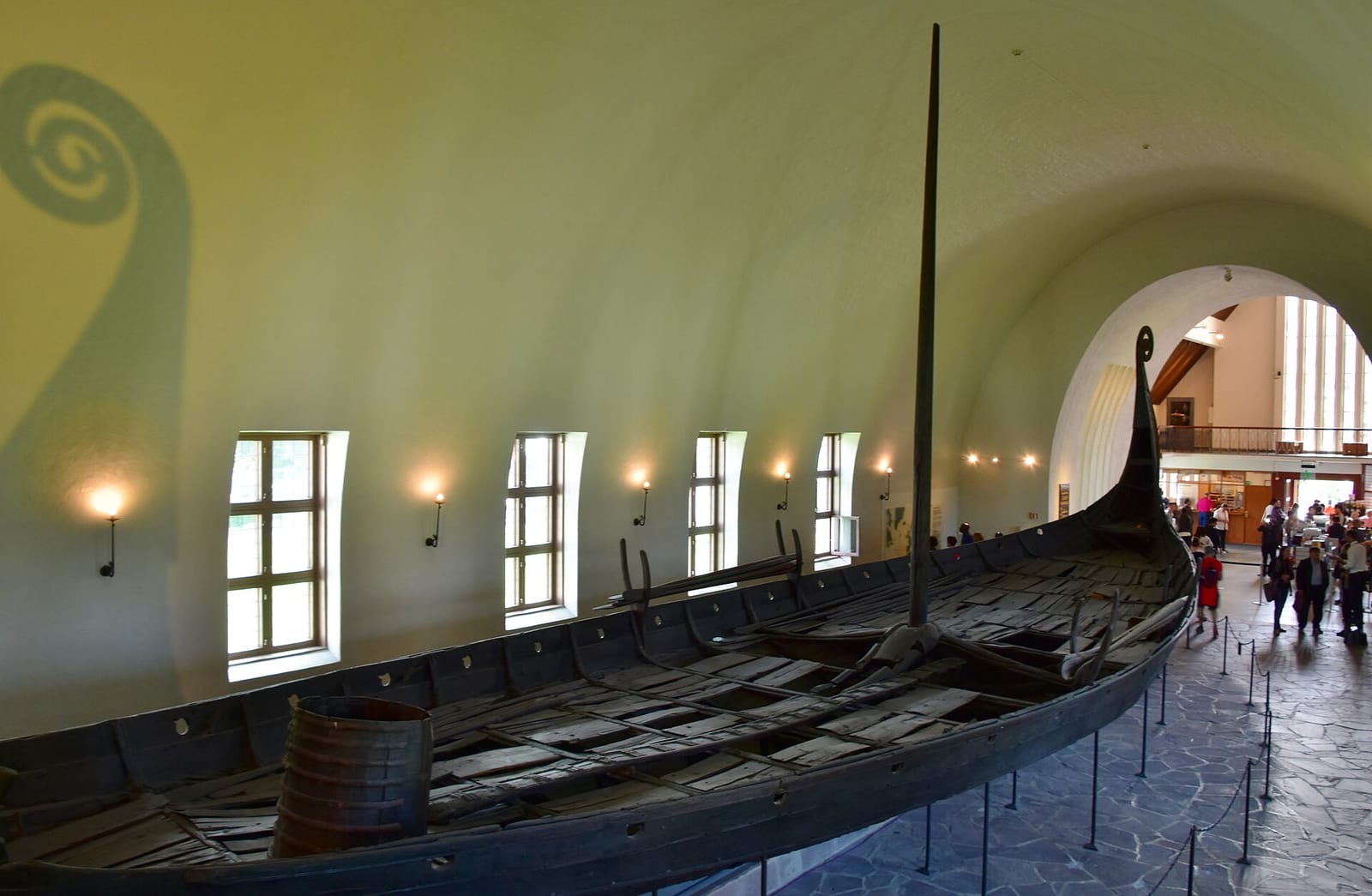
The Oseberg ship measures 21.58 meters in length, about 5 meters across, and is built entirely of oak in the clinker style typical of Viking vessels, in which overlapping planks give the hull the flexibility that also made the classic longship so seaworthy. Unlike pure warships such as the later discovered Gokstad ship, however, the Oseberg ship was built above all for calm water and ceremonial use. Its shallow keel and comparatively light construction made it fast and elegant on fjords and rivers, but poorly suited to heavy open sea.
What truly sets the ship apart is its ornamentation. Bow and stern taper into intricately carved spirals that run along the entire hull, and the burial chamber also contained several separate animal head posts, elaborately carved wooden staffs in the so called gripping beast style, whose exact purpose is still debated. They were likely portable ceremonial objects, perhaps meant to ward off evil spirits, perhaps markers of rank. The carving on these posts is regarded as among the finest craftsmanship to survive from the entire Viking Age.
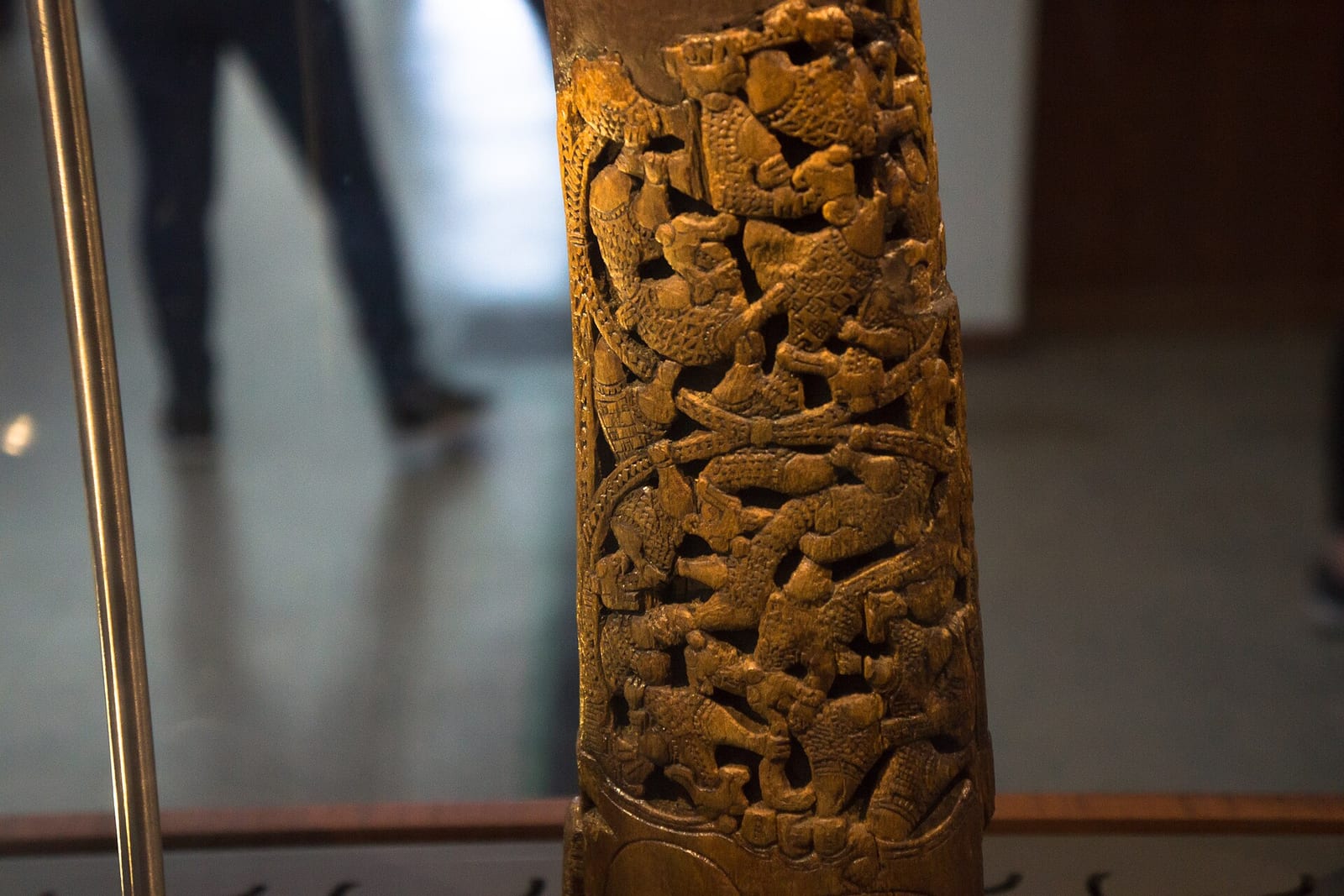 Image source: William Allen, Image Historian (CC BY-SA 2.0), via Wikimedia Commons
Listen to Wellerman while you keep reading, a rough sea shanty that captures the spirit of a seafaring people:
Two Women at the Heart of the Mystery
At the center of the burial chamber, beneath a tent of woven textiles, lay the remains of two women. Osteological analysis shows that one was between roughly 70 and 80 years old at death, while the other was noticeably younger, around 50. Both had, by the standards of their era, lived remarkably long lives, which alone points to considerable wealth and a privileged existence.
Who these two women actually were is one of the most debated questions in Norse archaeology, and the honest answer is that we simply do not know for certain. Norwegian saga tradition names a queen called Åsa associated with the Vestfold region, and some researchers have wondered whether one of the buried women could be her. That link cannot be proven, however. The sagas were written down centuries after the events they describe and must be treated with caution as historical sources. Other hypotheses range from a high ranking noblewoman accompanied by a servant or attendant to the possibility that one of the women was a völva, a seeress or cult leader with special religious standing, a theory some point to given certain grave goods, including possible herbal remains and a staff that may have held ritual significance.
The most honest answer to who rests in the Oseberg ship is this: two women of evidently high status whose names and exact roles history simply did not record.
It is also worth noting that the relationship between the two women remains unclear. Were they related, perhaps mother and daughter? Was the younger woman an attendant, or even a companion ritually sacrificed to accompany the elder, similar to the enslaved woman the Arab traveler Ibn Fadlan described at a Rus ship burial on the Volga? None of these possibilities can be confirmed or ruled out with the evidence available, and that very uncertainty is what makes the Oseberg grave a case where archaeology runs up against its own limits.
A Treasure Preserved in Blue Clay
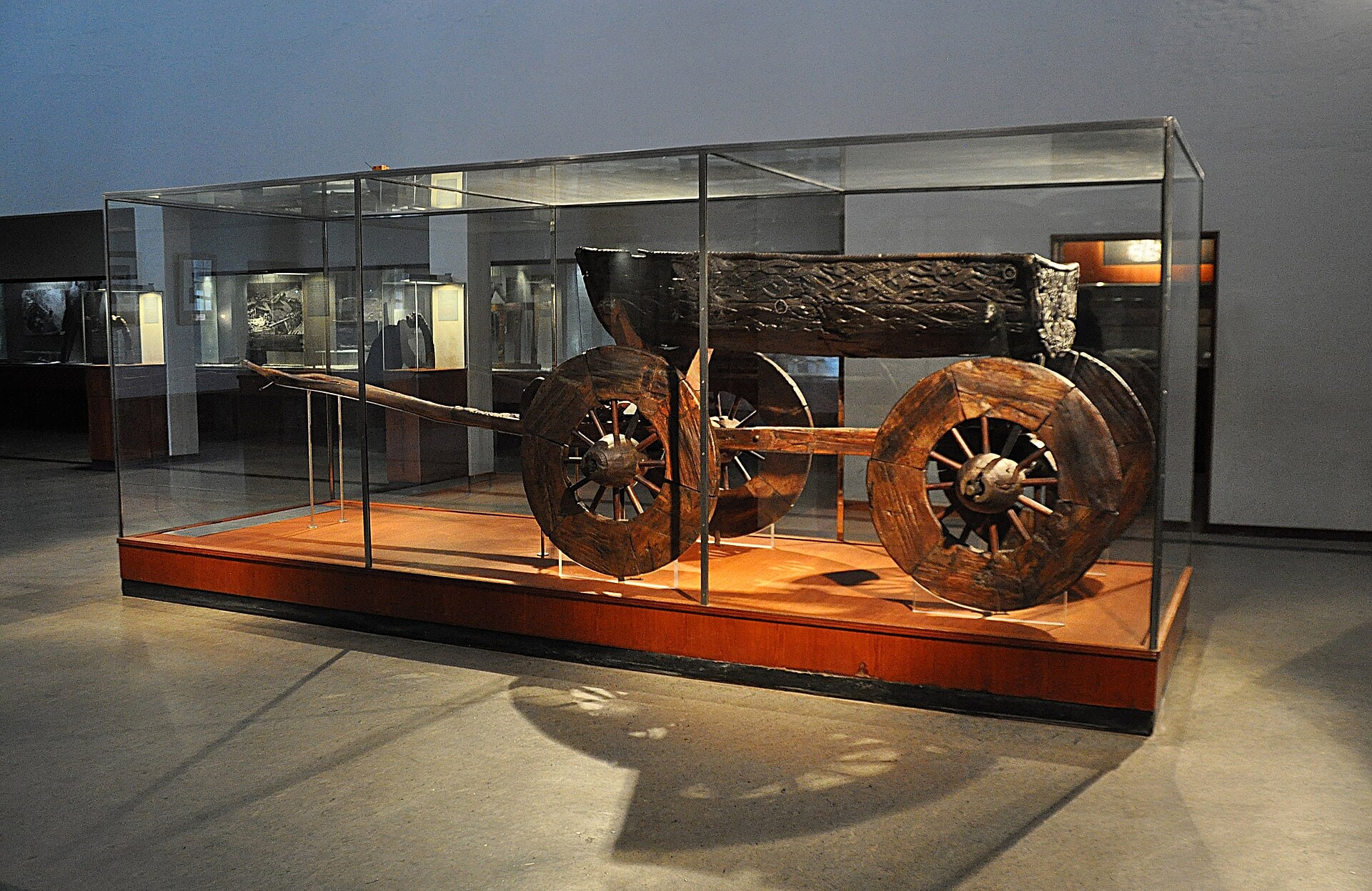
What the burial chamber contained in the way of grave goods surpasses almost every other Viking Age find in sheer variety and condition. Alongside the ship itself, archaeologists found a richly decorated ceremonial cart, likely intended for ritual processions, along with several sledges, some elaborately carved. There were also farming tools, kitchen equipment, a loom, chests, beds, and combs, a comprehensive inventory of what a wealthy Viking Age household would have owned.
Especially significant are the fragments of a woven tapestry, among the oldest surviving pieces of Norse textile art. The surviving fragments depict a procession scene with carts, riders, and human figures, and scholars are still debating what exactly it shows. Some read it as a ritual or mythological scene, possibly connected to the Norse gods and their cults, while others see a straightforward depiction of a worldly ceremony. Neither reading can be proven conclusively, but the mere existence of such a complex, figurative woven image from the 9th century is an extraordinary stroke of luck for textile history.
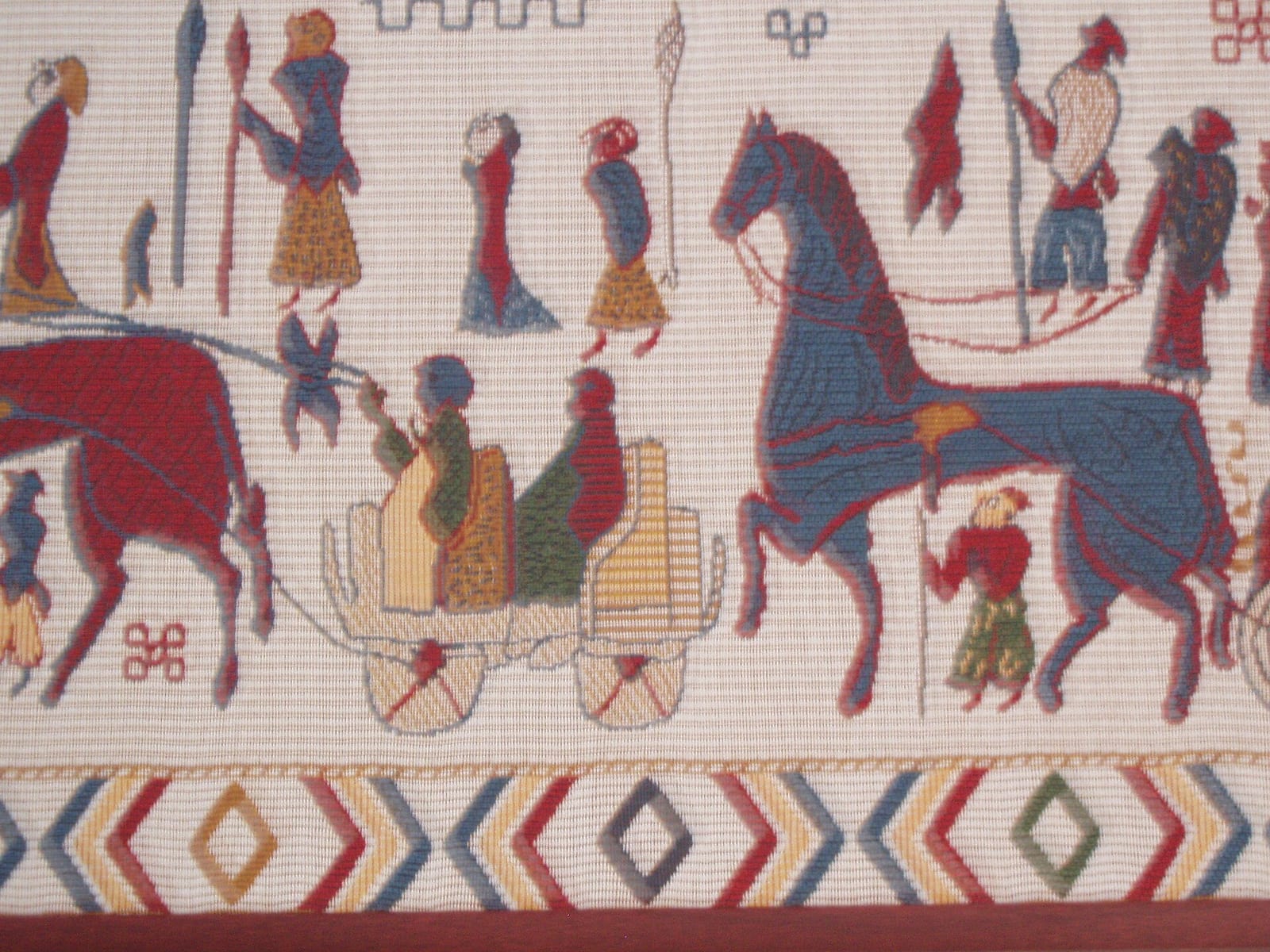 Image source: Skadinaujo (CC BY-SA 2.5), via Wikimedia Commons
Among the most unusual finds is a small bucket fitted with bronze mounts in the so called Buddha bucket style, whose ornamentation stylistically points to workshops far outside Scandinavia, likely from the area of present day Ireland, with possible roots in even more distant artistic traditions. An object like this offers striking proof of just how far the trade and raiding networks of the Viking Age actually reached, long before most people picture that kind of international connection.
The animal sacrifices deserve mention too: several horses and dogs, and in some records an ox, were buried alongside the two women, a practice known from other Viking ship burials as well and suggestive of an afterlife belief in which animals were still needed.
| Find | Significance |
|---|---|
| Ship hull (21.58 m, oak) | Ceremonial ship repurposed as a burial chamber, dendrochronologically dated to about 820 AD |
| Animal head posts | Elaborately carved ceremonial objects in the gripping beast style, likely ritual in purpose |
| Tapestry fragments | One of the oldest surviving pieces of Viking Age textile art, depicting a procession scene |
| Ceremonial cart | Richly decorated ritual wagon with no parallel among other finds of the period |
| Sledges (several) | Some elaborately carved, likely used for winter processions |
| Farming tools | Evidence of everyday rural life in the Viking Age, unusually well preserved |
| ”Buddha bucket” | Bronze mounts of foreign stylistic origin, evidence of far reaching trade contacts |
| Animal sacrifices (horses, dogs) | Points to afterlife beliefs in which animals were still considered necessary |
What is missing is just as notable. The burial chamber was demonstrably opened and disturbed already during the Viking Age itself, likely in the 10th century. Archaeologists believe the intruders were searching specifically for precious metal objects, jewelry, weapons, or coin, none of which survive. Ironically, that is a stroke of luck for scholarship: the looters had no interest in wood, textiles, or tools, so it was precisely that material, the very things that tell us the most about everyday craft and life in the Viking Age, that survived intact.
What Is Confirmed, and What Remains Speculation
A find of this magnitude calls for a sober accounting. Firmly established are the excavation dates of 1904/05 under Gabriel Gustafson, the dendrochronological dating to 834 AD, the ship’s exact dimensions and construction, the full inventory of surviving grave goods, and the fact that the chamber was looted already in the Viking Age. The ages of the two buried women are also considered settled.
Almost everything tied to identity and meaning, on the other hand, remains speculative: who the two women were, how they were related to one another, whether one of them was truly a queen, what the scenes on the tapestry actually depict, and why this particular ship, this place, and these individuals received such an elaborate burial. Serious archaeology draws a clear line between what the finds directly demonstrate and what is plausible but unproven interpretation. Anyone who encounters a confident claim online that “the Oseberg queen” has been definitively identified should treat it with caution. The scholarly literature itself remains deliberately cautious on that question.
The Viking Ship Museum: Where the Ship Stands Today
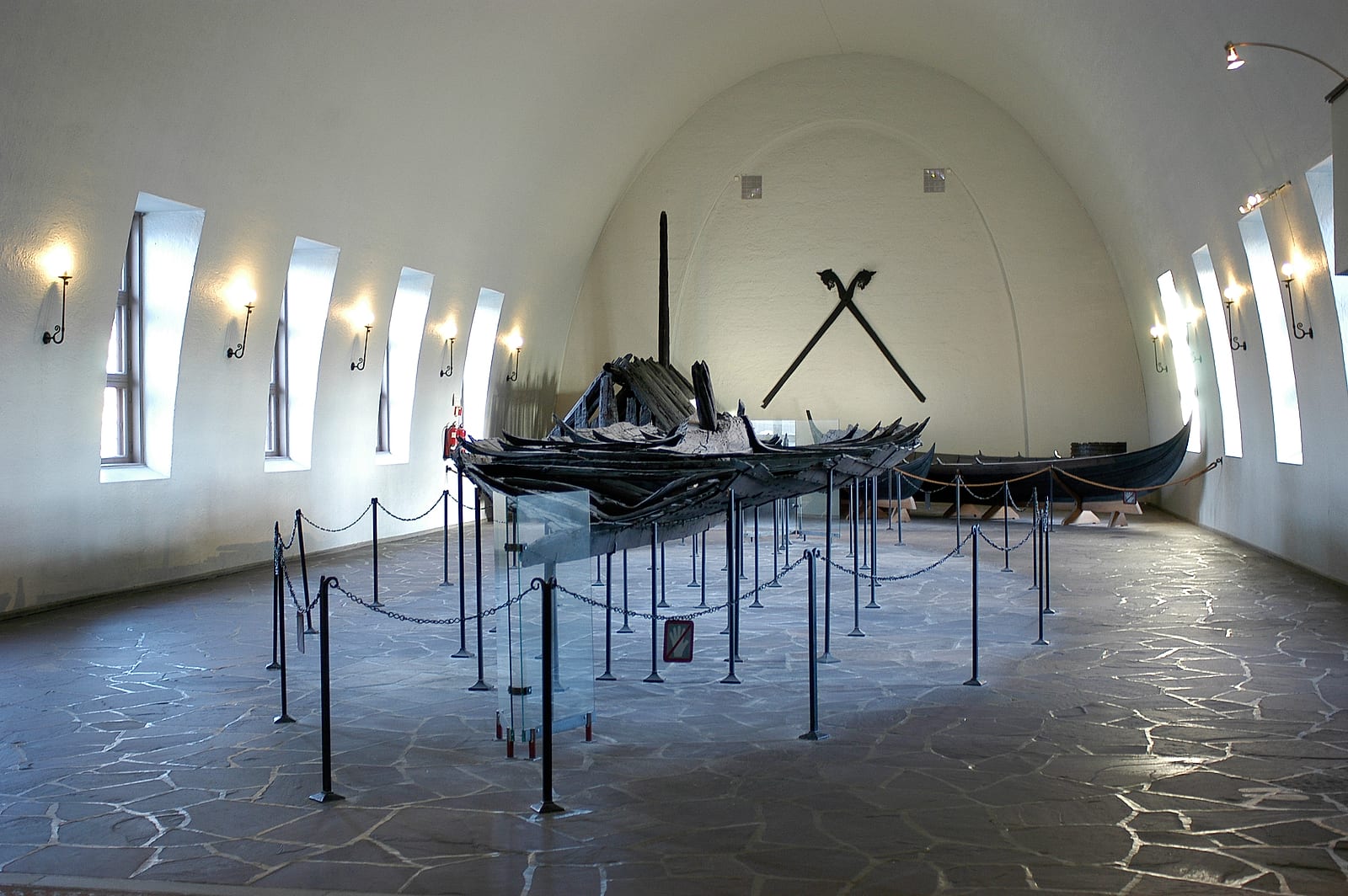
Today the Oseberg ship, along with most of its grave goods, is on display at the Viking Ship Museum on the Bygdøy peninsula in Oslo, alongside the Gokstad ship and other major finds. The museum ranks among Norway’s most visited, and standing before the restored hull, it becomes immediately clear why this find still shapes our idea of the Viking Age.
Because of the condition of the historic museum building and growing concern over the long term conservation of such fragile wooden objects, a new, considerably larger museum building is currently underway to house the collection in the future. Until it is complete, the Oseberg ship remains on view at its long standing home, a testament in its own right to more than a century of Norwegian museum history.
No other find shows quite so vividly how much a single grave can tell us about an entire era, and how many questions even the richest finds ultimately leave open.
Image source: Daderot (Public domain), via Wikimedia Commons