Daily Life & Culture
The Oseberg Cart: A Viking Wagon Carved for the Final Journey
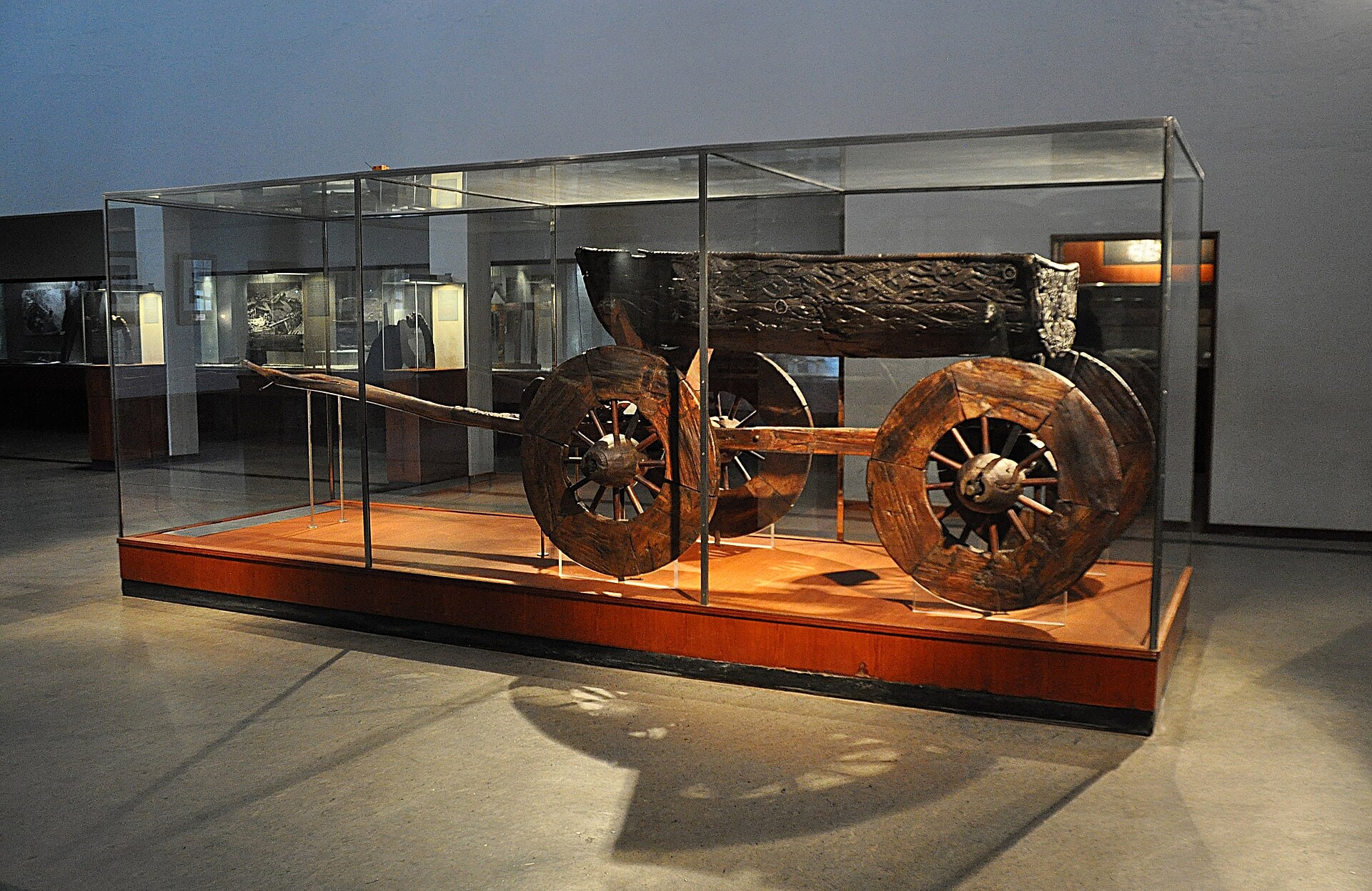
The Oseberg cart is the only Viking wagon to survive intact. Its carvings, its fixed axle and its 834 AD burial tell us what it was really built to do.
Contents
- 1. One Oseberg Cart, No Second Example
- 2. A Vehicle That Could Only Go Straight
- 3. Reading the Carvings: Riders, Snakes and Cat Faces
- 4. What Else Rolled Into the Grave
- 5. Nerthus, Freyja and the Long Habit of Wagon Processions
- 6. Wagon Bodies as Coffins: Oseberg Was Not Alone
- 7. Where the Oseberg Cart Is Now, and What It Still Has Over Us
Some artefacts impress by scale. Others impress because there is exactly one of them. The Oseberg cart belongs firmly in the second group: not a single other complete four-wheeled wagon has come down to us from the Viking Age in Scandinavia, only fragments of wheels, bits of axle, scattered fittings. Everything we can say about Norse wagon-building as a craft rests, in the end, on this one vehicle pulled out of a Norwegian burial mound in 1904.
And here is the twist that most picture-book accounts skip: the Oseberg cart could not turn a corner. Look at how the front axle is fixed to the frame, and a large part of the interpretive argument about what this object was for settles itself before you have looked at a single carving.
1. One Oseberg Cart, No Second Example
The wagon came out of the same chamber as the Oseberg ship, excavated between 1904 and 1905 by the Norwegian archaeologist Gabriel Gustafson at the farm of Lille Oseberg in Vestfold. Tree-ring dating puts the burial chamber at AD 834, with the ship’s timbers felled roughly fourteen years earlier. The cart almost certainly belongs to the same window, although its own construction date cannot be pinned down with quite the same confidence.
Its survival was not down to Viking craftsmanship but to soil chemistry. The mound was built of dense blue clay that kept oxygen out and effectively pickled the contents. Wood, leather and textiles, the very materials that normally vanish within a generation or two, sat there for more than a thousand years. Without that accident, our picture of Norse woodworking would be almost entirely guesswork drawn from tool marks and post holes.
The body itself is an oak trough with outward-flaring sides. It does not sit bolted to the chassis. It rests in two forked supports whose ends were carved into heads, which means the whole box can be lifted off in one piece. That single feature turns out to matter more than it first appears, and we come back to it further down.
2. A Vehicle That Could Only Go Straight
The front axle of the Oseberg cart does not pivot. There is no turntable, no swivelling bolster, none of the mechanism that lets a four-wheeled wagon follow a curve. A cart built this way rolls in one direction and one direction only. To change course, you stop, lift, and reposition it by hand.
For a working farm vehicle that is a fatal flaw. Yards, gateways, sunken lanes and market squares all demand steering. For something designed to move slowly and in a straight line down an avenue of onlookers, however, it is perfectly adequate. The fixed axle is therefore the single strongest piece of evidence that this was never a transport vehicle at all, but an object built for display, procession and ritual.
The wheels are heavy and deliberately overbuilt, their rims assembled from several curved segments, their spokes thick enough to carry serious weight. A horse almost certainly did the pulling: the burial contained a substantial number of sacrificed horses, along with dogs and cattle.
Put Grim on while you read the rest. It moves at roughly the pace of a wagon in a procession:
3. Reading the Carvings: Riders, Snakes and Cat Faces
Barely a square inch of the body was left plain. Its outer faces carry a dense mesh of animal bodies, interlaced bands, gripping claws and small masks, worked in the tangled manner that art historians named the Oseberg style after this very find. In places the cutting is so deep and so layered that the surface reads more like sculpture than joinery.
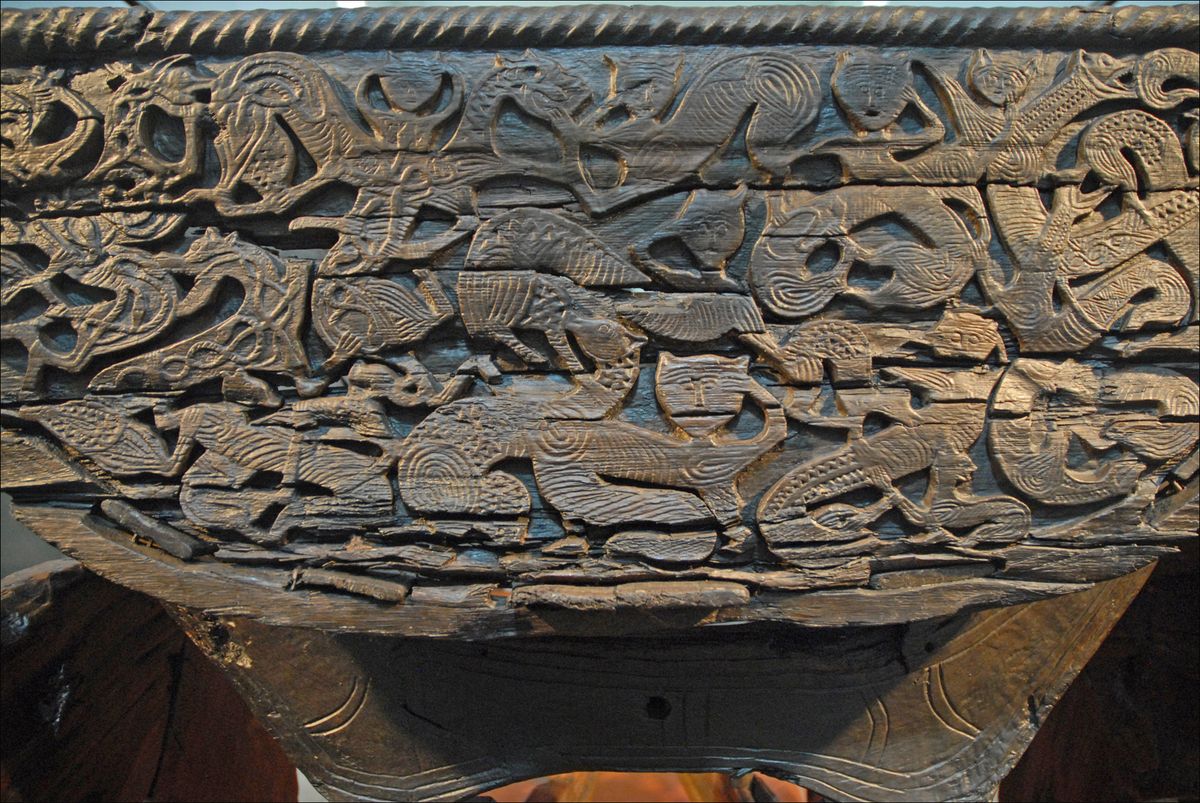 Image credit: Annie Dalbéra (CC BY 2.0), via Wikimedia Commons
The figural panels are where things get genuinely interesting, and also where popular accounts tend to overreach. One side shows human figures on the move, a rider, a horse, someone reaching for a bridle, someone else holding an object aloft. These scenes carry practically the entire weight of every attempt to say what the wagon meant.
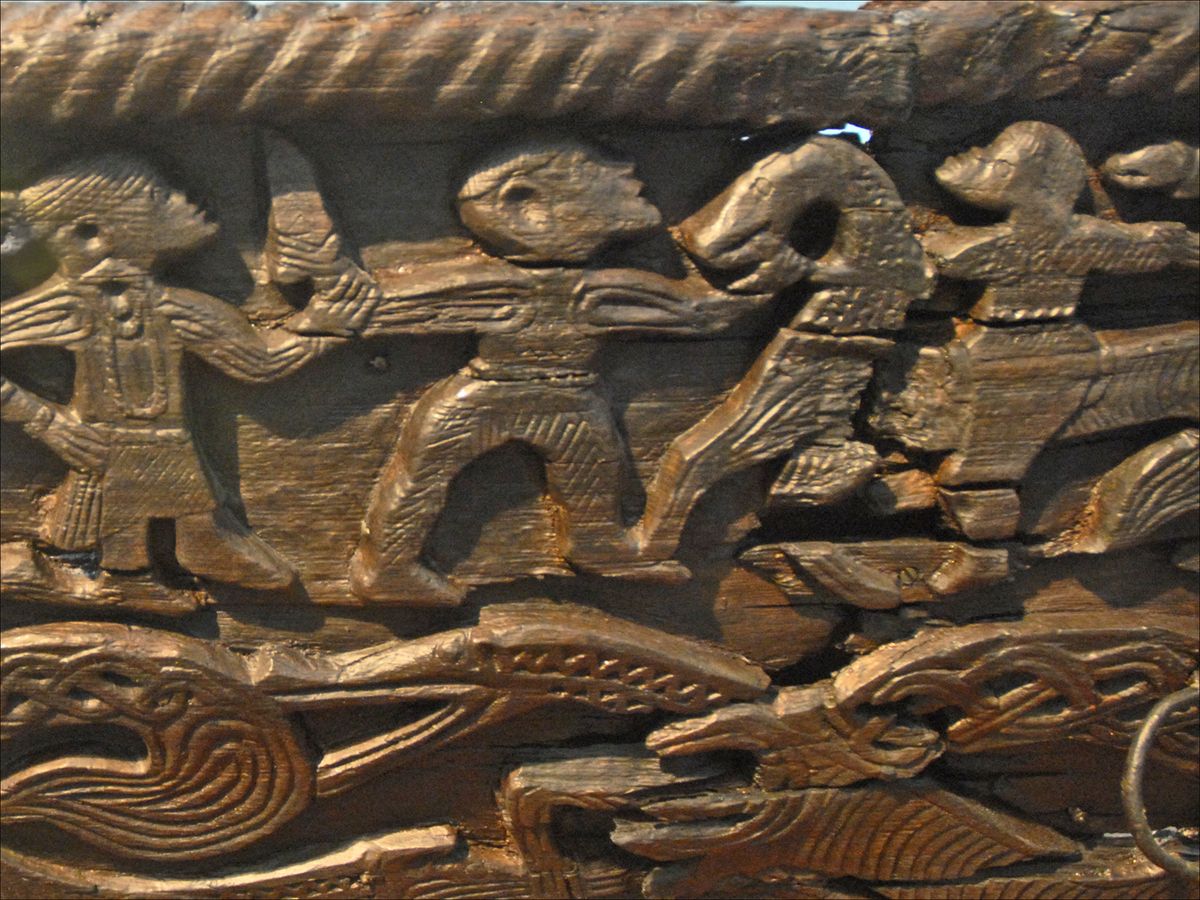 Image credit: Annie Dalbéra (CC BY 2.0), via Wikimedia Commons
The most famous panel shows a man entangled with snake-like bodies. It has long been read as Gunnar in the snake pit, an episode from the Nibelung material that also turns up on Norwegian stave church portals and Swedish picture stones. The reading is reasonable. It is not proven. A man among serpents was not a unique motif in Norse imagery, and the wagon predates the written versions of those legends by several centuries.
Then there are the heads. Some, at the ends of the supports and along the edges, look bearded and human. Others are flat, broad and unmistakably feline. Those cat faces have launched a great deal of interpretation, which brings us to the sources.
4. What Else Rolled Into the Grave
The cart did not travel alone. The chamber also held several sledges, three of them elaborately carved and one built plainly for work. That contrast is worth pausing on, because it shows a burial that was assembled rather than simply piled up: prestige and practicality side by side.
| Vehicle or object | Condition and workmanship | Most likely purpose |
|---|---|---|
| Four-wheeled cart | Complete, densely carved, fixed front axle | Ceremonial or processional, unusable for daily haulage |
| Three ornate sledges | Richly carved, some with animal heads at the corners | Winter equivalents of the cart, same workshop culture |
| One plain sledge | Barely decorated, functional build | Genuine working sledge |
| Animal-head posts | Five separate, superbly carved staves | Function disputed, probably ritual objects |
| Sacrificed horses | Numerous animals recovered from the mound | Draught animals and status display at once |
One detail that rarely makes it into coffee-table books: those wheels are high-end craftsmanship. Wheelwrighting is difficult precisely because hub, spokes and rim segments swell and shrink at different rates. That any of them survived at all gives us a rare direct look at a trade otherwise known only from wear patterns and tool marks.
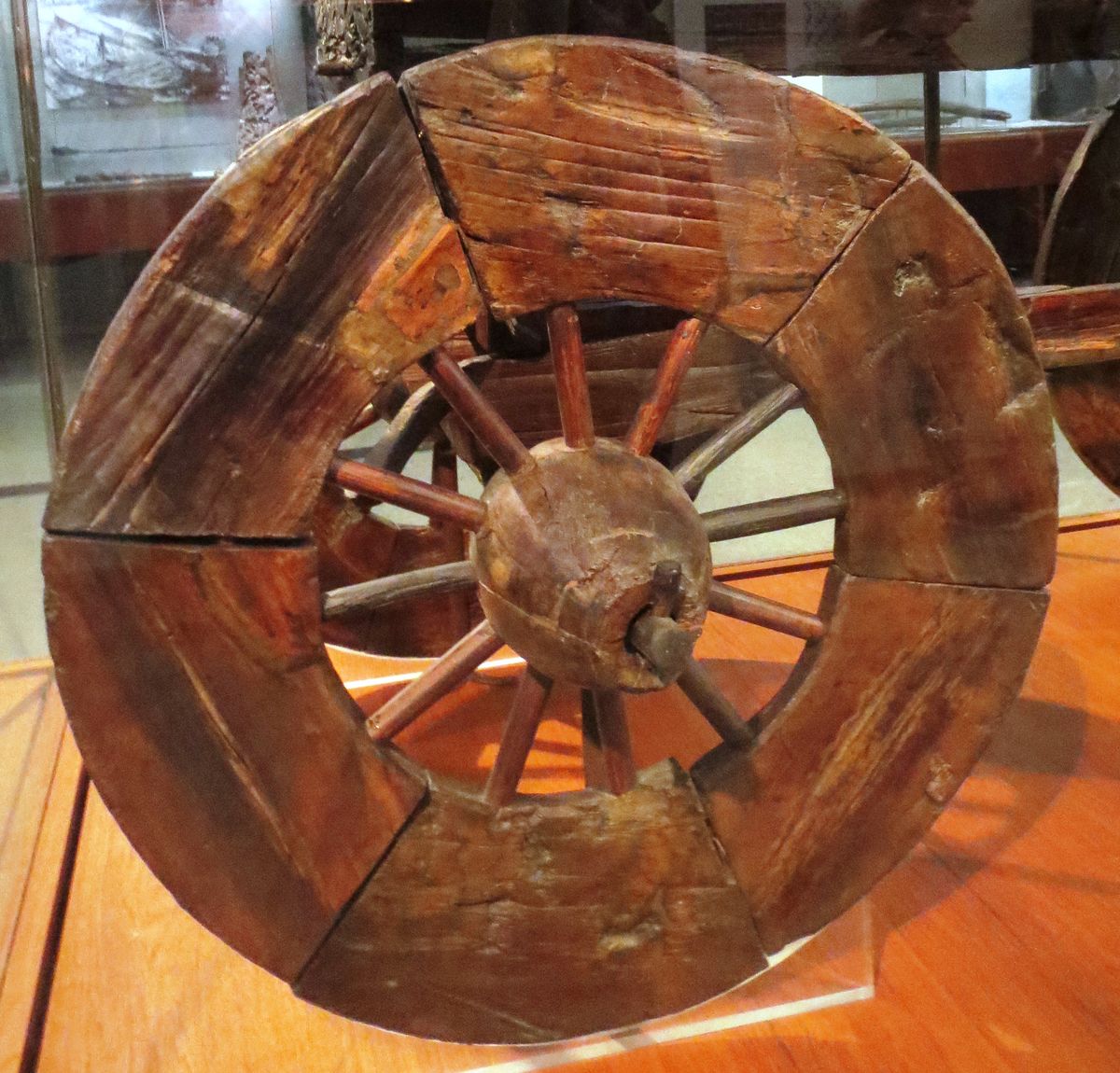 Image credit: Bjoertvedt (CC BY-SA 4.0), via Wikimedia Commons
5. Nerthus, Freyja and the Long Habit of Wagon Processions
The idea that a deity might be driven around the countryside on a wagon is genuinely old in the Germanic world, and it is attested in writing. The Roman writer Tacitus, in chapter 40 of the Germania (written around AD 98), describes the cult of a goddess called Nerthus whose veiled wagon was drawn by cattle through the settlements, accompanied by festival days and a suspension of weapons. That is roughly seven centuries before Oseberg, but it is a real source rather than a modern invention.
The second pillar of the argument comes from the North itself. In Gylfaginning, the first part of his Prose Edda, Snorri Sturluson writes that Freyja travels in a chariot drawn by cats. Anyone who has seen the feline heads on the Oseberg cart makes that connection almost involuntarily. The catch is chronology: Snorri wrote in the thirteenth century, some four hundred years after the burial, and he wrote as a Christian scholar shaping older material into literary order.
Archaeology adds a third strand from outside Norway. Two lavishly fitted ceremonial wagons of the pre-Roman Iron Age were recovered from a bog at Dejbjerg in Jutland and are now in the National Museum of Denmark. The surviving fragments of the Oseberg tapestry likewise show a procession that includes wagons.
Two wagons across two millennia, a Roman report and an Icelandic scholar add up to a very persuasive pattern. They do not add up to proof about this particular vehicle.
Because the two categories get blended constantly online, here is the split.
| Claim | Status |
|---|---|
| The wagon could not steer | Established, the front axle is rigid by design |
| It is the only complete Viking Age wagon | Established, everything else survives as fragments |
| Germanic cults used processional wagons | Established via Tacitus and finds such as Dejbjerg |
| Freyja drove a cat-drawn chariot | Established as a text in Snorri, not as observed practice |
| The cat heads depict Freyja’s chariot | Interpretation, unprovable |
| The snake panel shows Gunnar | Plausible interpretation, contested |
| The cart belonged to a priestess | Pure speculation |
6. Wagon Bodies as Coffins: Oseberg Was Not Alone
That removable box leads somewhere unexpected. From tenth-century Denmark and the southern Baltic region archaeologists know a distinct burial type in which a wealthy woman was laid to rest not in a coffin but inside the detached body of a wagon. The box did two jobs: first a vehicle part, then a container for the dead.
This places Oseberg in a wider pattern. Norse ship burial and its relatives seem to run on a single recurring idea: death is a change of place, and a change of place needs a vehicle. Whether that vehicle was a ship, a sledge or a cart depended on region, season, wealth and probably on the role the deceased had held in life.
The gender pattern is striking. Wagon-body graves are overwhelmingly female burials, and the Oseberg mound held two women. Whether that points to a specific link between wagon symbolism and women’s ritual roles is discussed seriously in the literature, but it has not been settled.
7. Where the Oseberg Cart Is Now, and What It Still Has Over Us
An honest editorial verdict: the most important detail of this find is not the snake panel. It is the axle. The Gunnar-and-Freyja debate has been going round in circles for decades, because images without accompanying text stay stubbornly ambiguous. The axle, by contrast, is physics. It answers the question of function cleanly and without recourse to mythology, and it does so with a decisiveness that Viking archaeology very rarely offers. Anyone writing about this object should start there rather than with the serpents.
The second thing the cart has over us is simply completeness. The Viking Age has left us thousands of blades, tens of thousands of beads and many hundreds of graves, but hardly any intact wooden equipment. This wagon shows how high the standard of woodworking actually was, and it shows it on an object that was not made for war but for a performance.
The cart is curated by the Museum of Cultural History at the University of Oslo and was displayed for decades in the Viking Ship House on Bygdøy alongside the ship, the sledges and the animal-head posts. That site has been closed to normal visits since 2021 while a larger Museum of the Viking Age is built around the collection, so anyone planning a trip should check the museum’s own current information rather than trust an older guidebook.
What remains is a vehicle that was never meant to arrive. It rolled straight ahead, once, into a chamber of blue clay, and that is precisely why it is still here.
Image credit: Bochum1805 (CC BY-SA 2.0), via Wikimedia Commons