History
The Tune Ship: The Forgotten Viking Ship Beside Oseberg
The Tune ship is the quiet Viking ship in Oslo: excavated in 1867, only half preserved, built around 900 AD, and living in Oseberg's shadow ever since.
Contents
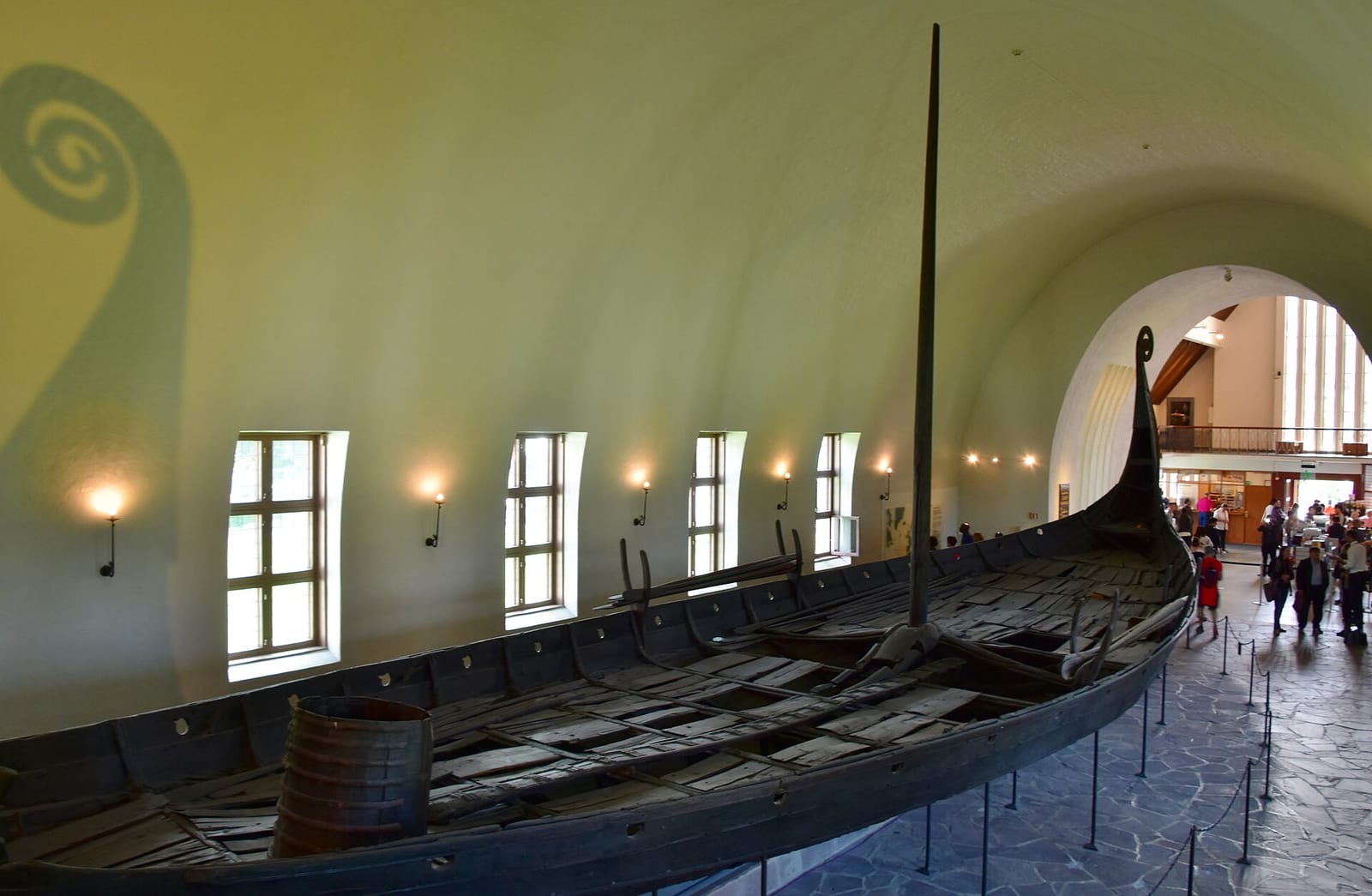
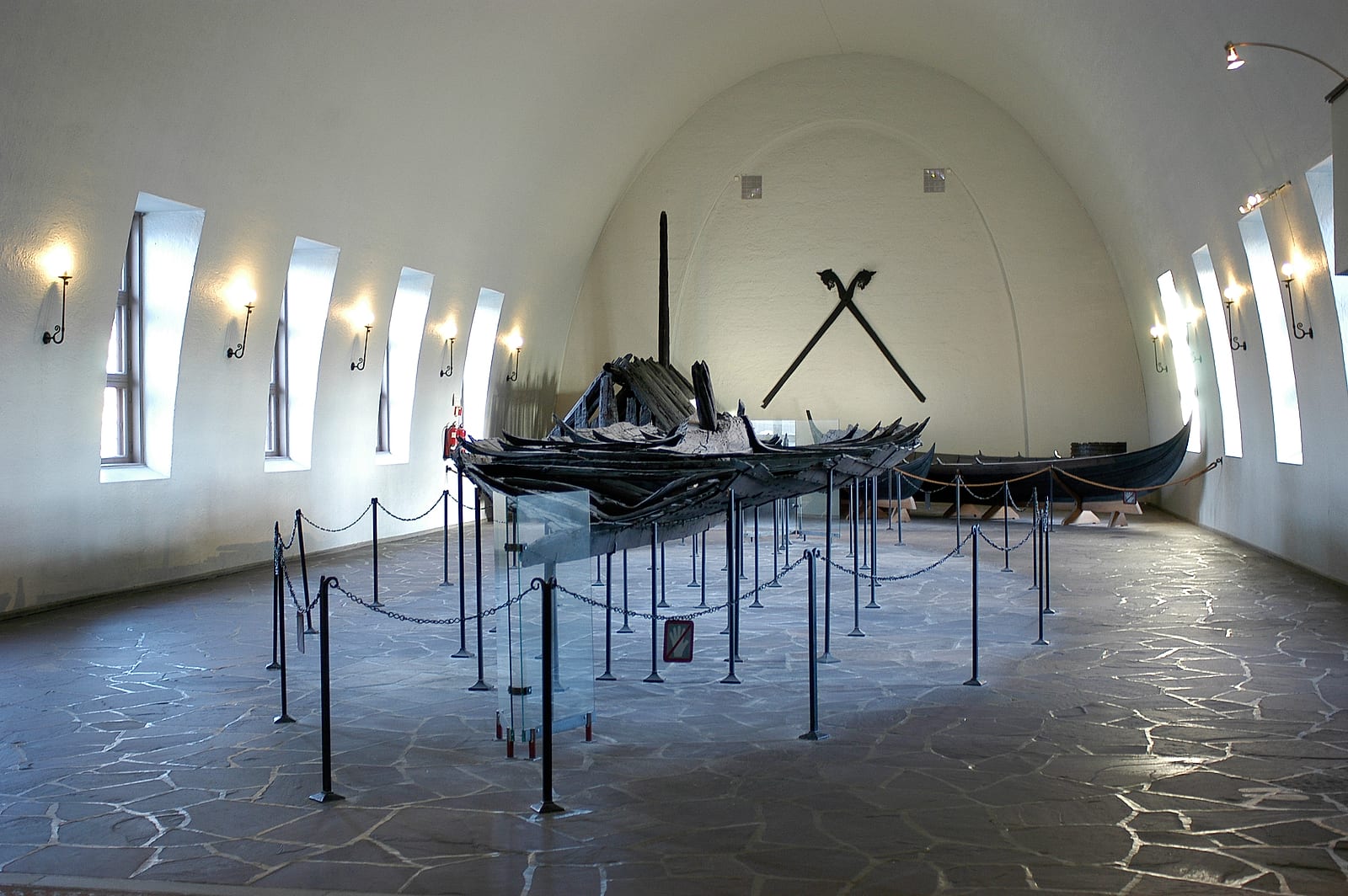
Most visitors walk into the Viking Ship House in Oslo with two names in their heads: Oseberg and Gokstad. Standing quietly between those two showpieces is a third vessel that almost nobody remembers on the way out. The Tune ship was the first Viking ship ever excavated in Norway, lifted out of a mound in Østfold in 1867, and it is by far the least photogenic of the three: a half-preserved hull resting on thin steel posts, with no carved prow, no ceremonial wagon, no royal mystery attached. And that is precisely why this Viking ship says something the other two cannot. It shows you what a ship burial actually looks like after soil, centuries and grave robbers have all had their turn.
Dug Up in Two Weeks: The Excavation of 1867
The find lies at Haugen farm on Rolvsøy, in the old parish of Tune, today part of Fredrikstad in southeastern Norway. Local farmers had known the mound for generations and simply called it “Båthaugen”, the boat mound, which suggests that folk memory had a rough idea of what was buried there long before any archaeologist turned up. When timber finally surfaced in 1867, Oluf Rygh of the university in Christiania, now Oslo, took charge of the dig.
By modern standards, what followed was a sprint. Rygh had the ship uncovered in roughly two weeks. That figure only makes sense in context. At Gokstad in 1880 every plank was numbered; at Oseberg in 1904 and 1905 the team recorded layer after layer across two summers. In 1867 no such standard existed yet, for the simple reason that it was invented on those later digs. Tune came first, and first attempts are rarely tidy.
There was a second problem, and nobody was to blame for it: the ground itself. Oseberg and Gokstad sat in dense blue clay that locked out oxygen and kept wood, textile and leather intact for a thousand years. The mound at Rolvsøy offered nothing like those conditions. Much of the upper hull had already rotted away before a single spade went in. What survived was essentially the lower part of the vessel, the keel, the bottom planking and the lower strakes.
The recovered timbers went to Christiania and spent decades in makeshift storage. Only in 1932 did the Tune ship move into the purpose-built hall on the Bygdøy peninsula where it still sits. A photograph taken that same year by the Oslo photographer Anders Beer Wilse shows the hull in the freshly plastered gallery, propped up and roped off, and it looks oddly familiar. Remarkably little about the display has changed since.
| Year | Event |
|---|---|
| c. 900 | The ship is built from oak and buried in the mound soon afterwards |
| 1867 | Oluf Rygh excavates the mound, Norway’s first Viking ship dig |
| 1880 | The Gokstad ship is found and methods change for good |
| 1904/05 | The Oseberg ship is excavated, the richest find of all |
| 1932 | The Tune ship is installed in the Viking Ship House on Bygdøy |
| 2016 | The surviving hull is fully documented in a 3D scan |
| from 2021 | A new museum rises around the ships, the old hall closes to visitors |
What the Tune Ship Reveals About Viking Shipbuilding
Even in its fragmentary state, the hull gives up a surprising amount of information. The vessel measured roughly 18.7 meters long and about 4.35 meters across the beam, built entirely of oak using the clinker technique, with overlapping planks that give the hull the springy flexibility typical of Norse vessels. The spacing of the frames and the surviving oar positions point to eleven or twelve pairs of oars, a noticeably smaller crew than the sixteen pairs pulled aboard the Gokstad ship.
One detail is easy to walk straight past in the museum. The reinforcement above the keel that carried the mast step survives, which settles an important question: the Tune ship was a sailing vessel, not merely a large rowing boat. Combine that with a comparatively deep keel and a narrow beam and you get the profile of a fast craft built for open water, not just for gliding along sheltered fjords.
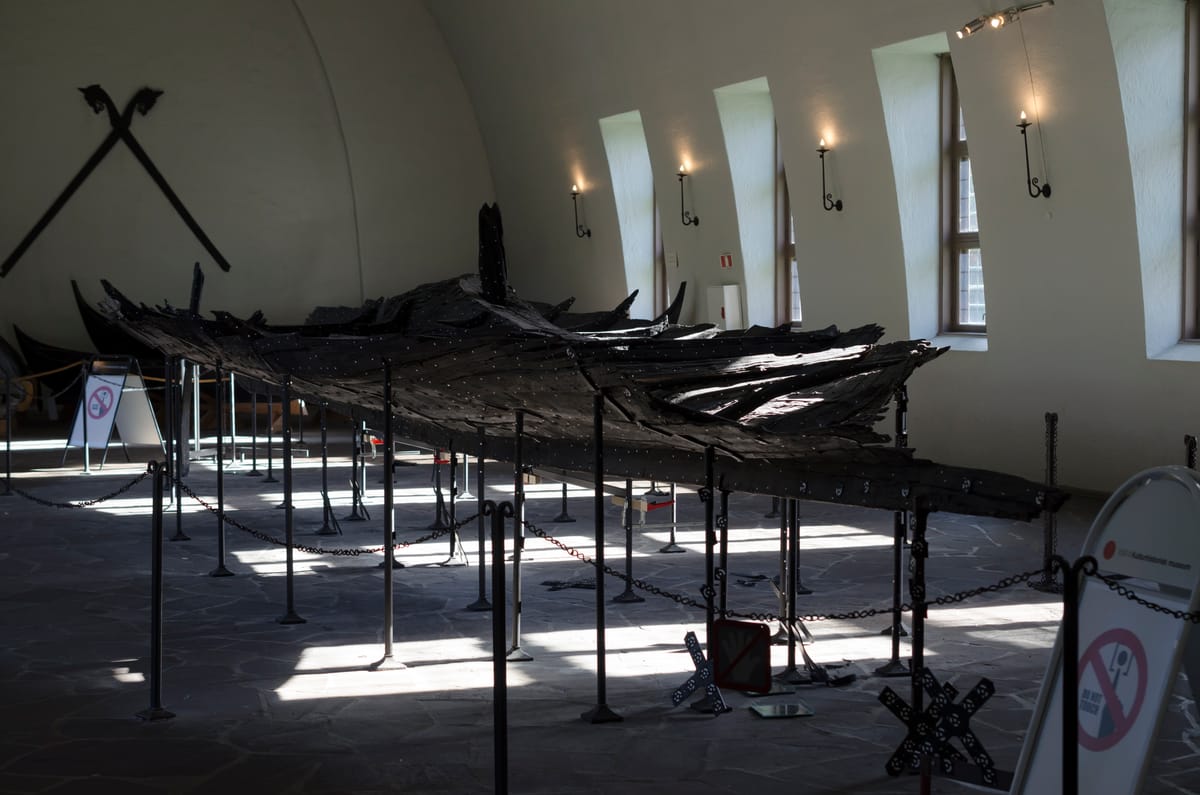 Image source: Peulle (CC BY-SA 4.0), via Wikimedia Commons
Dating places construction around 900 AD, with the burial following soon after. That puts the Tune ship in the same generation as the Gokstad ship and roughly two lifetimes younger than the Oseberg ship. Three vessels, roughly eighty years apart, and three completely different fates underground.
Put on Wellerman while you read on, a rough sea shanty that catches the mood of a seafaring people:
The Man in the Chamber, and Everything That Was Taken
A wooden burial chamber originally stood inside the ship. Inside it, excavators found the sparse remains of a man along with horse bones, plus fragments of wood and textile. What is almost entirely missing is metal. No weapons, no jewellery, no fittings of any rank. The pattern is familiar from Oseberg and Gokstad alike: the chamber was broken open and cleared out long before modern archaeology arrived, probably within a few generations of the funeral.
Those horse bones are not a footnote. Animal sacrifice was standard practice in high-status ship burials, with twelve horses, six dogs and even a peacock recorded at Gokstad, and several horses and dogs at Oseberg. The logic is consistent: the dead were not simply given a vehicle, they were given an entire household of mobility and standing. How many animals lay in the Tune mound to begin with can no longer be established, thanks to the speed of the 1867 dig. Gaps like that are the bill the earliest archaeology left for everyone who came later.
Who the man was, nobody knows. There is no inscription, no saga passage that can be tied to this grave with any confidence, and no credible identification. Only the social bracket is clear. Building a ship this size, maintaining it, then committing it to the ground as a coffin was something only a very thin upper layer of Viking Age society could afford. Petty king, jarl or wealthy landholder with a crew of his own: the evidence does not say.
The Tune ship is the most honest of Oslo’s three finds. It shows exactly as much as actually survived, and not a centimeter more.
That, in our editorial view, is the real reason this ship stays in the background. It is not a matter of scientific value but of presentation. Oseberg and Gokstad were heavily restored and reassembled into things a visitor instantly reads as ships. The Tune ship was largely left alone. Stand in front of it and you see a skeleton of blackened oak, with the rest left to your imagination. That is a harder ask for a museum, but it is the more truthful option, because every reconstruction is also an interpretation.
Tune, Gokstad and Oseberg Side by Side
| Feature | Tune ship | Gokstad ship | Oseberg ship |
|---|---|---|---|
| Excavated | 1867 | 1880 | 1904/05 |
| Region | Rolvsøy, Østfold | Sandefjord, Vestfold | Tønsberg, Vestfold |
| Length | approx. 18.7 m | 23.24 m | 21.58 m |
| Beam | approx. 4.35 m | 5.20 m | approx. 5 m |
| Oar pairs | 11 to 12 | 16 | 15 |
| Built | c. 900 | c. 890 | c. 820 |
| Preservation | lower hull, roughly half | almost complete | almost complete |
| Burial | one man, horses | one man, many animal offerings | two women, rich goods |
| Grave goods | almost everything looted | metal looted, wood intact | wood and textile intact |
Laid out like this, the table exposes what fame in archaeology really rests on: preservation and the sheer quantity of grave goods, not the amount we can learn. If the question is how an ordinary, seaworthy Viking Age ship was actually built, the narrow Tune hull is at least as informative as the loaded showpiece from Oseberg.
From Obscurity to 3D Scan
Since the 2000s the Tune ship has quietly begun a second scientific life. The Norwegian ship archaeologist Knut Paasche presented a doctoral thesis in 2010 in which he digitally reconstructed the hull and concluded that earlier drawings had given the vessel too broad and bulging a shape. In his reconstruction the ship comes out slimmer, faster and far more clearly built as an ocean-going sailer than had long been assumed.
In 2016 the entire surviving hull was covered with hundreds of small white reference markers and scanned in three dimensions. Scans like that are more than a digital catalogue entry. They track deformation over time, record the exact condition before any move, and let researchers test reconstructions without laying a finger on the original. For an object that has been out of its preserving soil for more than 150 years, this is not a gimmick. It is insurance.
One further twist is worth mentioning. Østfold, the region that produced the Tune find, has pushed its way back into the headlines. Not far away, ground-penetrating radar picked up traces of another ship burial, the Gjellestad ship, excavated from 2020 onwards. Almost nothing survived beyond an imprint in the soil, yet the dig was the first of its kind in Norway in about a century. The land around the Oslofjord has evidently not given up all of its ship graves.
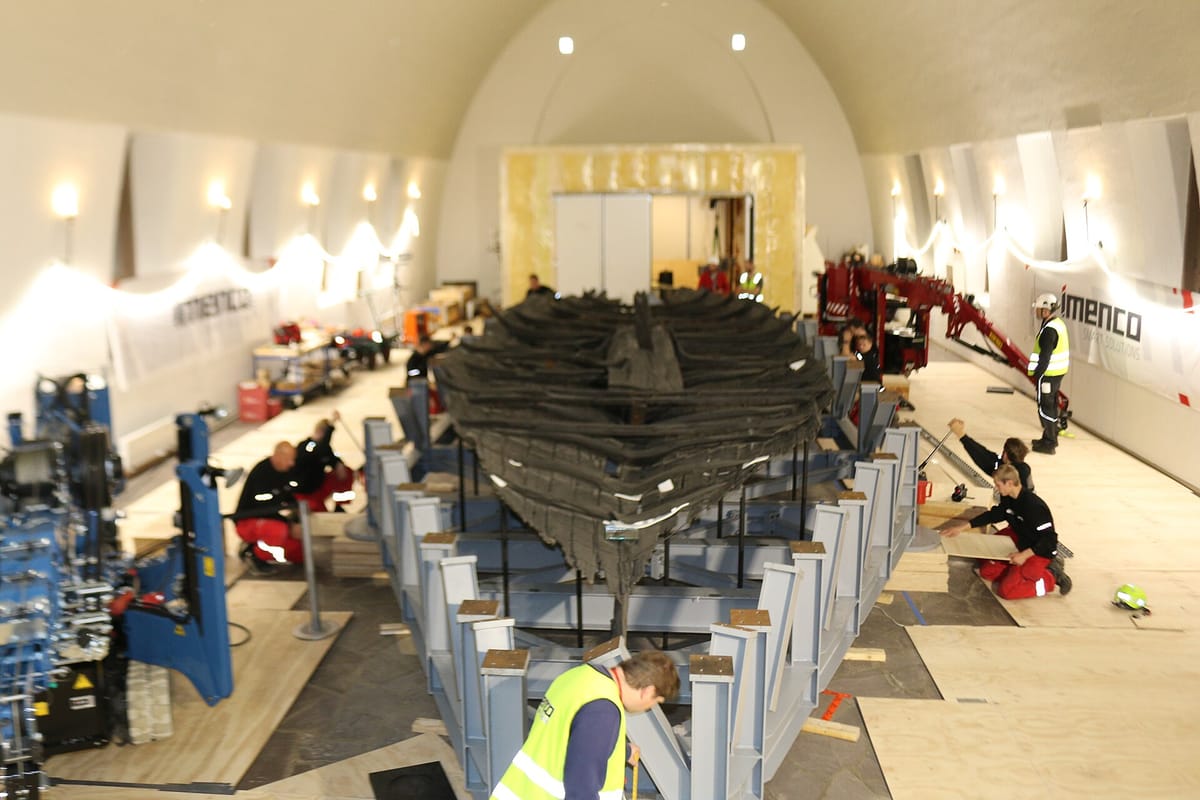 Image source: Industriinfo (CC BY-SA 4.0), via Wikimedia Commons
What Is Certain and What Is Not
With a find excavated this long ago, it pays to separate the two carefully. Firmly established: the 1867 excavation under Oluf Rygh, the dimensions and clinker construction, the surviving mast step area proving this was a sailing ship, a build date around 900 AD, the burial of a man together with horse bones, and the fact that the chamber had been robbed before archaeologists ever saw it.
Still open: the identity of the man, the original number of sacrificed animals, the shape of the stem and stern, the rigging, and how much the grave once held. If you come across articles online that confidently attach a named king to the Tune ship, treat them with caution. Claims like that lean on sagas written down centuries after the fact, not on anything found in the mound.
Where the Tune Ship Stands Today
Since 1932 the Tune ship has shared a roof with the Gokstad and Oseberg finds in the Viking Ship House on Bygdøy in Oslo. Over the decades the building proved too small and too unstable in its climate control for timber this delicate, which is why a far larger museum, the Museum of the Viking Age, is going up on the same site. The old hall has been closed to the public since 2021.
The trickiest part of the whole project concerns the objects at the heart of it. The ships are considered too fragile to be carted off somewhere else, so the new building is being raised around them while sensors keep watch on every vibration. Photographs from the construction phase show the Tune ship resting on a purpose-built steel cradle, surrounded by conservators, engineers and lifting gear. It is a fitting image for this vessel: never in the spotlight, yet without it the whole story of Norse ship archaeology would never have started.
When the new museum opens, the quiet third member of the trio finally gets a stage worthy of its importance. It has been owed one for over 150 years.
Image source: Petter Ulleland (CC BY-SA 3.0), via Wikimedia Commons