Mythology
The Norse Gods Family Tree: Odin's Kin Explained
The Norse gods family tree explained: from Ymir and Audhumla to Odin, Thor, the Vanir and Loki's brood, and why the medieval sources often flatly disagree.
Contents
- Where the Norse gods family tree actually comes from
- It begins with a cow, not with a god
- Odin’s children and the mothers nobody lists
- The Vanir: a second family grafted onto the Norse gods family tree
- Loki and the branch that breaks the tree
- The whole thing on one page
- Myth versus fact, and why no single chart can be correct
Draw the Norse gods family tree on paper and something strange happens. The boxes fill up quickly, the lines start crossing, and within three generations you are drawing arrows to the giants, the very creatures the gods spend the whole mythology fighting. That is not a mistake in the diagram. It is the mythology.
The Aesir are not a sealed dynasty. They are a mixed household built out of marriages into enemy families, hostages traded after a war, and at least one adopted outsider who turns out to be the father of the monsters that will end the world. Odin is half giant on his mother’s side. So is Thor, on his. Once you stop expecting a tidy royal lineage, the whole structure makes far more sense.
Where the Norse gods family tree actually comes from
No Viking Age Scandinavian ever drew a genealogy chart of the gods. Every version you will find online is a modern reconstruction, stitched together from scattered lines in texts written down centuries after conversion. Four of them do most of the work.
- Gylfaginning, the mythological section of Snorri Sturluson’s Prose Edda, composed around 1220. It supplies most of the explicit parentage statements.
- Skáldskaparmál, Snorri’s handbook for poets, which encodes kinship inside kennings. A poet who writes “son of Gríðr” expects you to know he means Vidar.
- The Poetic Edda, especially Völuspá, Vafþrúðnismál, Hyndluljóð and Lokasenna.
- The Ynglinga saga in Snorri’s Heimskringla, which runs the divine line forward into the historical kings of Sweden.
They disagree with one another, and not about trivia. They disagree about whose son Tyr is. Treat any chart that presents one answer with confidence as an editorial decision rather than a fact.
It begins with a cow, not with a god
The root of the tree is empty space. Snorri calls it Ginnungagap, the yawning void between the ice of Niflheim and the fire of Muspelheim. Where rime meets sparks, something drips into being: Ymir, the first giant.
Ymir does not father children in any ordinary sense. He sweats, and a man and a woman grow from under his left arm. His legs produce a six-headed son. This is the origin of the jötnar, which makes the giants the oldest bloodline in the entire scheme, older than any god.
Alongside Ymir stands the cow Audhumla, who feeds him with her milk and licks at salty rime-stones for her own nourishment. Over three days a man emerges from the stone: Búri. His son Borr marries Bestla, daughter of the giant Bölthorn, and their three sons are Odin, Vili and Vé.
Pause on that for a moment. The first generation of gods is already half giant, and their first recorded act is to kill Ymir and build the world from his corpse, the sea from his blood, the mountains from his bones. The founding event of Asgard is the murder of a relative.
Put Voor Odin on while you read the rest:
Odin’s children and the mothers nobody lists
Odin is the hub of the chart, and he is a hub in a way that clearly embarrassed later Christian copyists. His children come from at least four different mothers, and only one of them is his wife.
With Frigg, daughter of Fjörgynn, he fathers Baldr, whose death in Snorri’s telling starts the slide toward Ragnarok. Baldr marries Nanna, daughter of Nep, and their son Forseti presides over legal judgments in his hall Glitnir.
His most famous son has a different mother entirely. Thor is the child of Odin and Jörd, the earth personified, named in the sources as a giant’s daughter. Thor then doubles the pattern himself: with his wife Sif he has a daughter, Thrud, and with the giantess Járnsaxa a son, Magni. A second son, Módi, appears beside Magni in Vafþrúðnismál as one of the two who will inherit Mjölnir after the world ends. Ullr, the archer and ski-god, is Sif’s son by an earlier partner, which makes him Thor’s stepson.
Two more of Odin’s sons exist almost entirely to carry out a single act of vengeance. Vidar, son of the giantess Gríðr, tears apart the wolf Fenrir at Ragnarok. Váli, son of Rindr, is one night old when he avenges Baldr, according to Völuspá, and does not wash his hands or comb his hair until the deed is done. Hermod rides to Hel on Odin’s behalf and is called his son by Snorri.
Heimdall resists the format completely. Hyndluljóð states that he was born of nine mothers, nine sisters at the edge of the world. Anyone trying to fit that into a box with a single line running into it has already lost, and the poem probably intended exactly that.
The Vanir: a second family grafted onto the Norse gods family tree
Running in parallel to the Aesir is an entirely separate kin group, the Vanir, associated with harvest, sea and wealth. They enter Asgard not by birth but by treaty. After the first war in the world, the two sides exchange hostages.
Njörd, god of the sea and of prosperity, arrives with his two children, Freyr and Freyja. Snorri drops their mother’s identity almost casually in Ynglinga saga: she was Njörd’s own sister, because among the Vanir marriage between siblings was permitted, and among the Aesir it was not. One sentence, two legal systems placed side by side.
In Asgard, Njörd marries Skadi, daughter of the slain giant Thjazi, as compensation for her father’s death. The match collapses over something almost domestic. She cannot sleep for the screaming of gulls at his coast, he cannot stand the howling of wolves in her mountains, and after nine nights they separate.
Freyr falls for the giant’s daughter Gerd and gives away his sword to win her, a bargain that will cost him his life at Ragnarok. Their son Fjölnir is where the mythology quietly turns into dynastic history: through him, Ynglinga saga traces the Yngling kings of Sweden. Freyja, for her part, is married to the elusive Ód, who leaves her, and she weeps tears of red gold. Her daughters are Hnoss and Gersemi, two Old Norse words that both mean “treasure”.
Loki and the branch that breaks the tree
Loki sits inside every chart of the gods and belongs in none of them. He is the son of the giant Fárbauti and of Laufey, he has two brothers named Býleistr and Helblindi, and he is tolerated in Asgard for exactly one reason: Odin once mixed blood with him. In Lokasenna, Loki reminds the Allfather of that oath at the precise moment it becomes inconvenient.
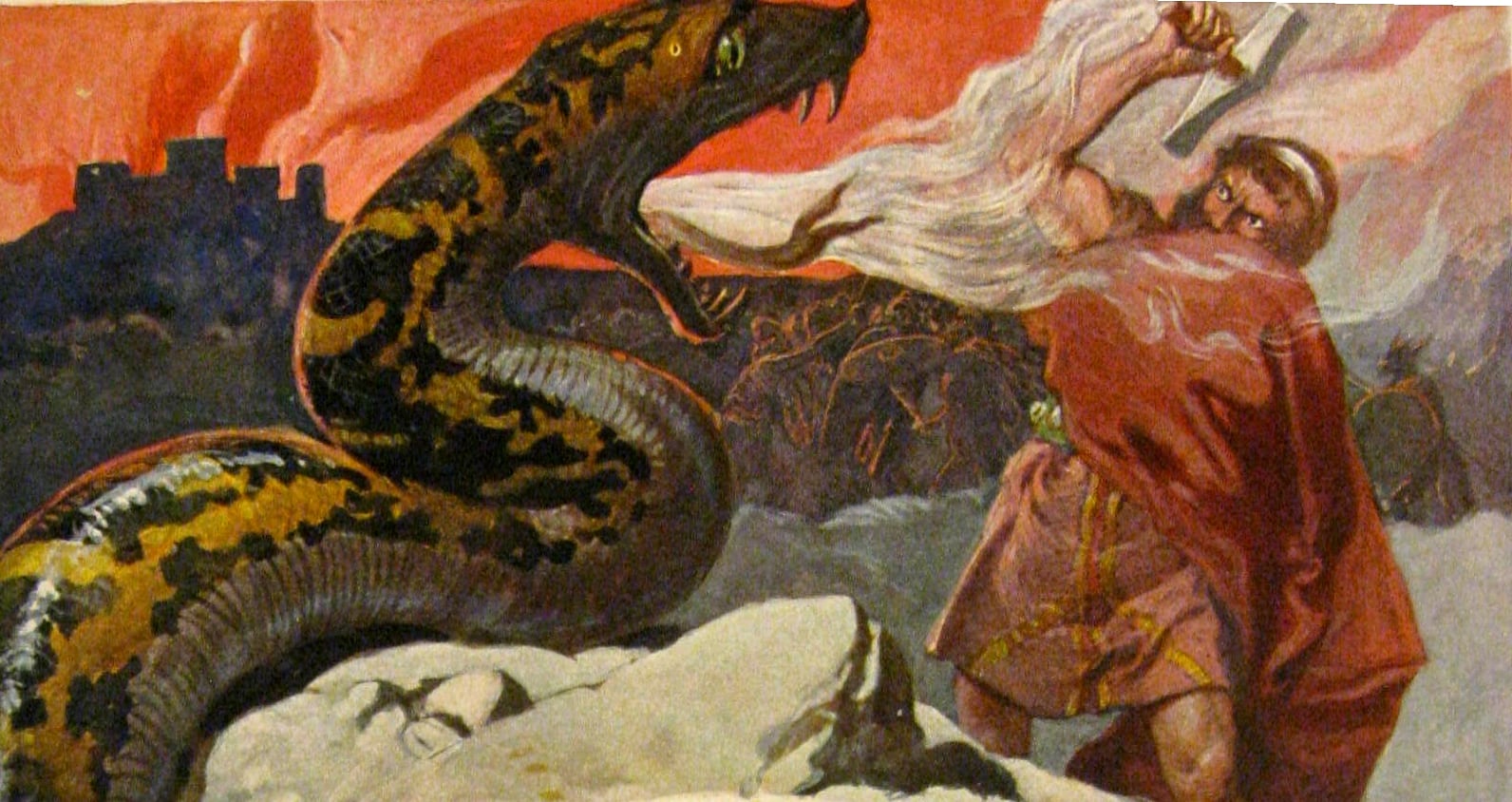
His offspring form the most dangerous line in the system. With the giantess Angrboda he fathers three children, each of whom threatens a different part of the cosmos: the wolf Fenrir, the world serpent Jörmungandr, and Hel, who rules the dead. With his wife Sigyn he has two sons, Narfi and Váli, and the punishment the gods devise uses that kinship as its instrument. Váli is turned into a wolf and tears his brother apart, and Loki is bound to the rock with Narfi’s entrails.
Then there is the detail that undoes any neat chart. In the shape of a mare, Loki gives birth to the eight-legged horse Sleipnir and gives him to Odin. The Allfather’s mount is therefore the child of his own blood-brother, and he rides it into the final battle against that brother’s children.
The monsters of Norse myth are not invaders from outside. Fenrir, Jörmungandr and Hel are family, and everyone at Ragnarok knows it.
The whole thing on one page
The table below groups the main lines by generation. It is a reading aid, not a record: several of these entries are contested in the sources themselves.
| Generation | Who | Parents according to the sources | Reference |
|---|---|---|---|
| 1 | Ymir, Audhumla | formed from rime and heat | Gylfaginning |
| 1 | Búri | licked free from the salt stone | Gylfaginning |
| 2 | Borr | son of Búri, marries Bestla (giant’s daughter) | Gylfaginning |
| 3 | Odin, Vili, Vé | Borr and Bestla | Gylfaginning, Völuspá |
| 4 | Baldr | Odin and Frigg | Gylfaginning |
| 4 | Thor | Odin and Jörd (giantess) | Gylfaginning |
| 4 | Vidar | Odin and Gríðr (giantess) | Skáldskaparmál |
| 4 | Váli | Odin and Rindr | Völuspá, Baldrs draumar |
| 4 | Freyr, Freyja | Njörd and his sister | Ynglinga saga |
| 5 | Magni, Módi, Thrud | Thor with Járnsaxa and with Sif | Skáldskaparmál, Vafþrúðnismál |
| 5 | Forseti | Baldr and Nanna | Gylfaginning |
| 5 | Hnoss, Gersemi | Freyja and Ód | Gylfaginning, Ynglinga saga |
| side branch | Fenrir, Jörmungandr, Hel | Loki and Angrboda | Gylfaginning |
| side branch | Sleipnir | Loki himself, as a mare | Gylfaginning |
Myth versus fact, and why no single chart can be correct
Three widely repeated claims do not survive contact with the texts.
- Myth: Thor is Odin’s son, end of story. Fact: In Gylfaginning, yes. But in the Prologue to the same Prose Edda, Snorri recasts Thor as a prince of Troy and makes Odin his distant descendant, some twenty generations later. One manuscript, two incompatible genealogies.
- Myth: Tyr is a son of Odin. Fact: That is Snorri’s version. The older eddic poem Hymiskviða has Tyr calling the giant Hymir his father. Both readings are transmitted; neither is the authoritative one.
- Myth: The gods are one pure line and the giants are the outsiders. Fact: Bestla, Jörd, Gríðr, Rindr, Járnsaxa, Angrboda, Gerd and Skadi are all giantesses. Remove them and the family tree collapses after two rows.
Our own reading is blunt. The Norse gods family tree is not a parish register, it is a political document. Snorri was writing in thirteenth-century Iceland during a century of murderous clan feuds, and he was writing for Norwegian kings. A lineage that runs from Odin through Freyr and Fjölnir into a living royal house does exactly what every aristocratic pedigree of that era was built to do: it turns power into inheritance. The inconsistencies did not trouble medieval readers, because freedom from contradiction is a standard we imposed later.
Read the chart that way and it becomes far more interesting. It does not record who descended from whom. It records who wanted to be counted as kin, and it quietly states the most uncomfortable fact in the whole mythology: the Aesir and the giants were never two peoples. Ragnarok is not a war against strangers. It is the largest family quarrel ever told.
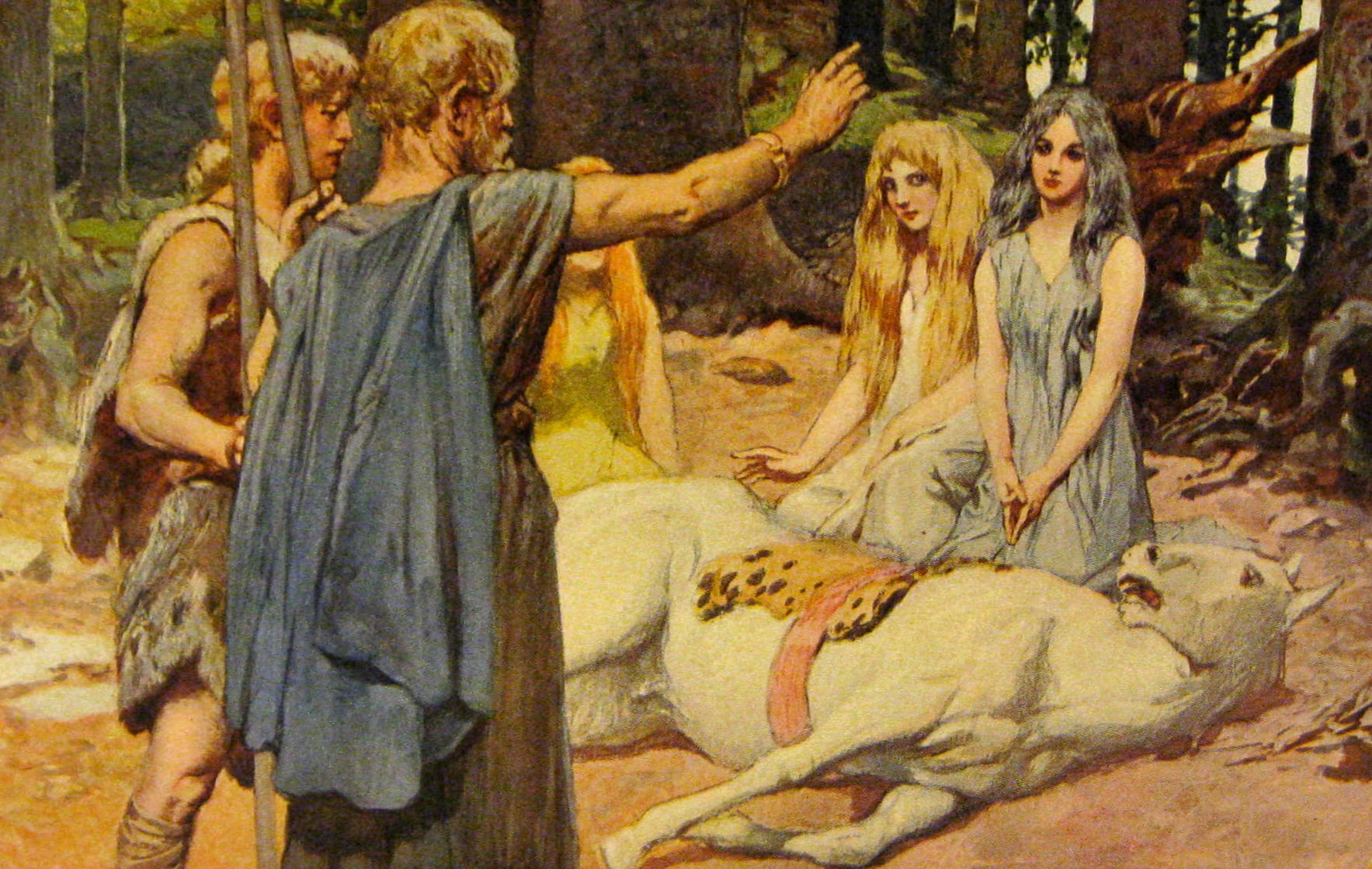
Image source: Emil Doepler, from Walhall, die Götterwelt der Germanen (c. 1905), public domain, via Wikimedia Commons