Mythology
Jormungandr the Midgard Serpent: Thor's Oldest Enemy
Jormungandr the Midgard Serpent explained: Loki's child in the world ocean, Thor's fishing trip with Hymir, Viking carvings, and their last duel at Ragnarok.
Contents
Most mythologies keep their monsters at a safe distance, somewhere beyond the map, waiting for a hero with a sword. Norse mythology does something stranger. Jormungandr the Midgard Serpent is not lurking at the edge of the world; it is the edge of the world. The creature grew until its body wrapped all the way around the inhabited earth, and then it bit down on its own tail. Midgard has a shape because the serpent is holding that shape closed. That single idea makes Jormungandr one of the most unsettling figures in the entire Norse canon, and it explains why Thor, the most physical of all the gods, spends three separate episodes failing to deal with it.
The sources here are unusually solid by Norse standards. The serpent turns up in the Poetic Edda, chiefly in the Völuspá and the Hymiskviða, and again in the Prose Edda that Snorri Sturluson compiled in early thirteenth-century Iceland. Older still are two skaldic poems: the Húsdrápa, composed around 985 by Úlfr Uggason to describe carved wooden panels in an Icelandic hall, and the Ragnarsdrápa attributed to Bragi Boddason. Both of them describe the same scene Snorri would retell centuries later. And beyond the texts there is harder evidence: stones, carved by people who were not writing for scholars.
Loki’s Middle Child
According to Snorri’s Gylfaginning, the serpent is one of three children born to Loki and the giantess Angrboða in Jotunheim. The siblings are the wolf Fenrir, Hel who rules the realm that carries her name, and Jormungandr. The three of them function as the architecture of the Norse apocalypse: each one represents a threat the gods learned about through prophecy long before it arrived.
Odin responded the way gods in this tradition almost always respond, with a precaution that quietly becomes part of the disaster. Hel was sent down to the underworld. Fenrir was raised in Asgard and eventually bound with the dwarf-made ribbon Gleipnir. Jormungandr was simply thrown into the sea that surrounds Midgard, on the apparent logic that deep water and distance would settle the matter.
They did not. Out in the world ocean the serpent kept growing, unobserved and unchecked, until its body was long enough to circle every inhabited shore. It has rested on the seabed ever since with its own tail clamped in its jaws. The name carries the scale: Old Norse jǫrmun- means vast or monstrous, while gandr can mean a staff, a magical creature, or simply a monster. The plainer alternative name is Miðgarðsormr, the worm or serpent of Midgard.
Jormungandr the Midgard Serpent: A Boundary, Not a Beast
This is the part that popular retellings tend to flatten. Jormungandr the Midgard Serpent is not besieging the human world. It is the thing that defines where the human world stops. Outside that coiled ring lies everything uncharted, unruled and giant-haunted. As long as the serpent lies still and keeps its tail in its mouth, the world stays a closed and knowable shape.
That is why the myth sits so uncomfortably. In this one figure, the order of the cosmos and the greatest threat to it are the same animal. If the serpent lets go, it is not a prisoner escaping; it is the frame of the world coming apart. For seafarers who experienced the horizon as a concrete limit rather than an abstraction, that image would have landed with a force modern readers have to work to recover.
Listen to Midgard while you read on:
The Cat at Utgard
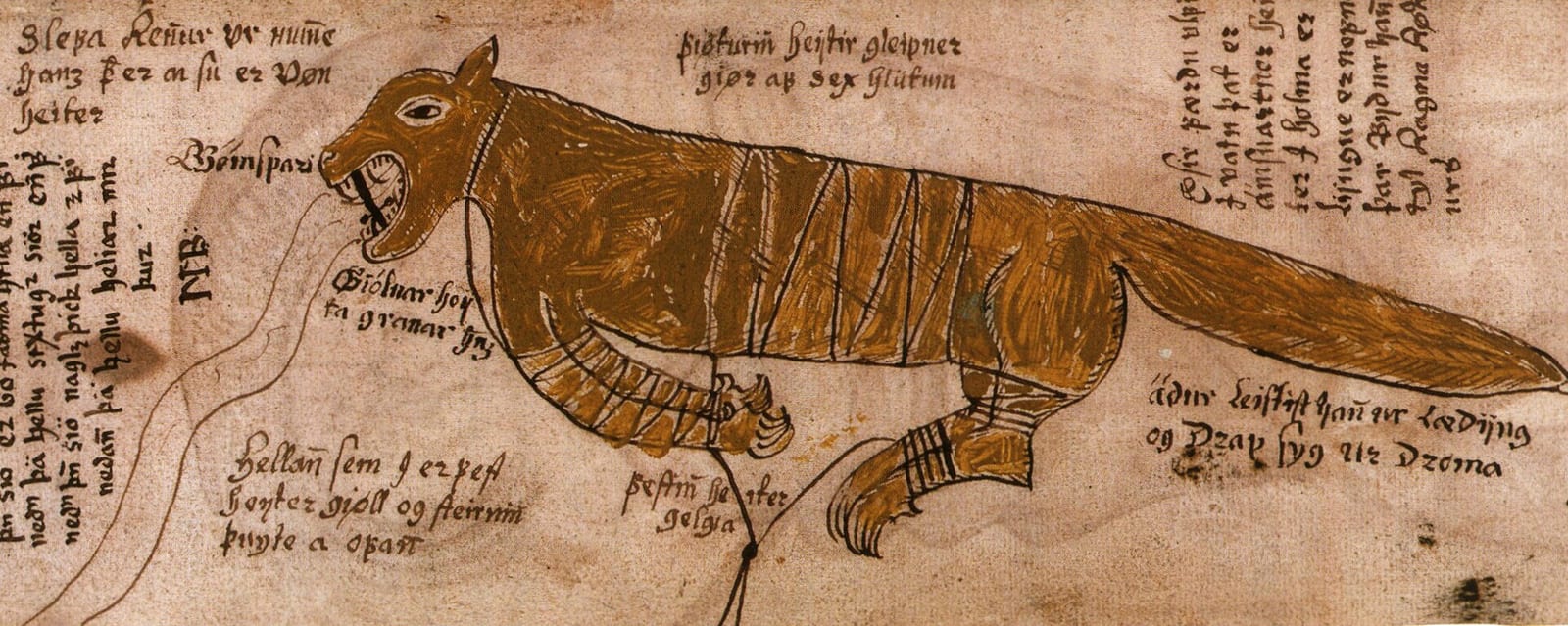
The first meeting between Thor and the serpent is the only one Thor does not recognise while it is happening. In the Gylfaginning, Snorri sends the god to the stronghold of the giant king Útgarða-Loki, where he is set a series of contests that look trivial and turn out not to be.
One of them is lifting a grey housecat off the floor. Thor grips, hauls with everything he has, and manages to raise exactly one paw. Only afterwards does the giant king admit what the guests were really looking at: the cat was Jormungandr, shrunk by illusion, and for a moment Thor came close to hoisting the world serpent out of the ocean. Útgarða-Loki says openly that the sight frightened him.
It is one of the rare passages where Norse tradition lets comedy and cosmic dread share a scene. Thor loses a wrestling match to a cat, and in losing it very nearly unhooks the structure of the world.
Thor’s Fishing Trip: The Myth the Vikings Carved
The fishing expedition is the famous one, and in evidential terms it may be the best-attested episode in all of Norse mythology. It appears in the Hymiskviða, in Snorri, in the Húsdrápa and in the Ragnarsdrápa, and then it appears again in stone.
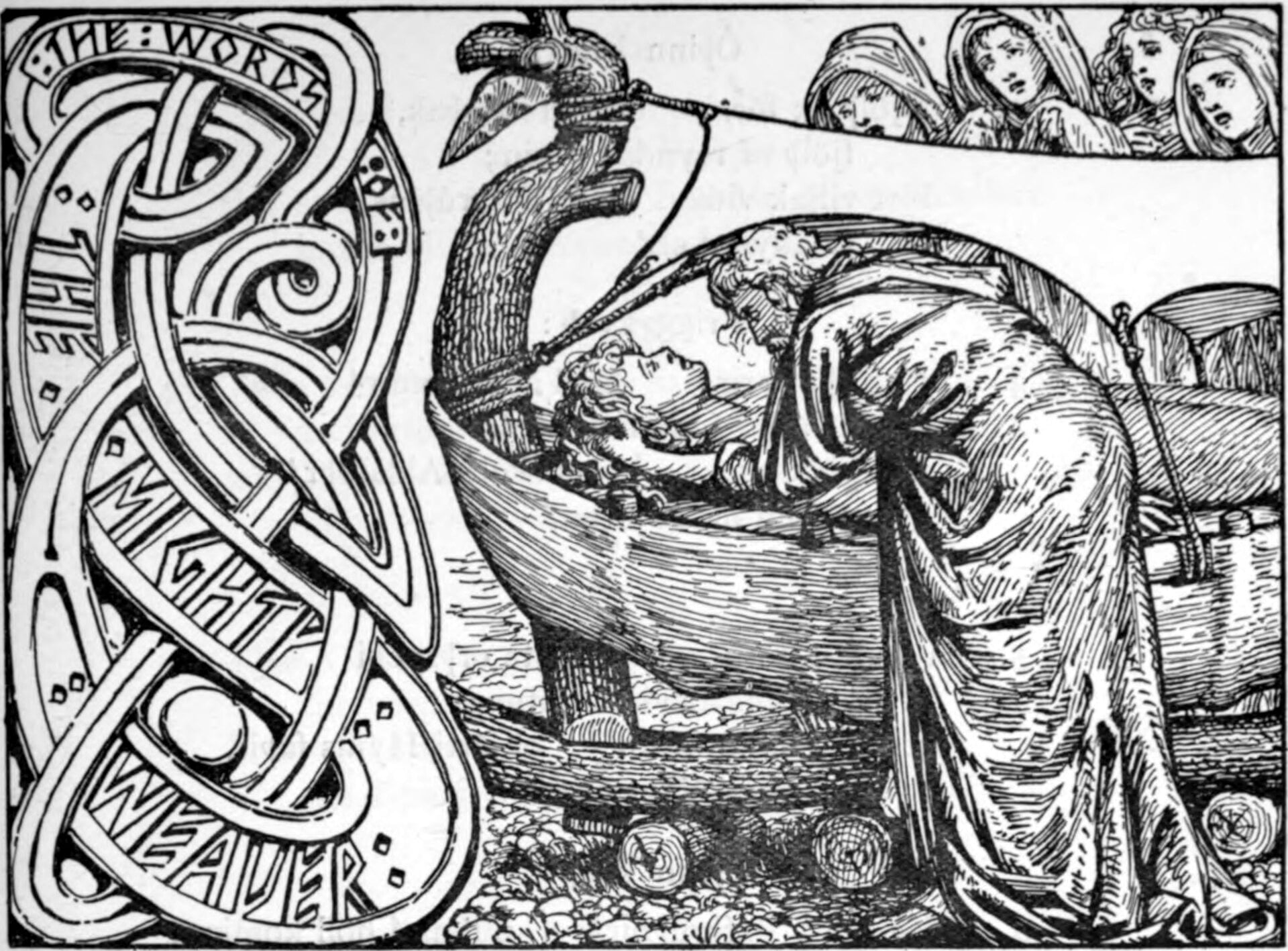
Thor arrives as a guest of the giant Hymir, who is heading out to fish. For bait Thor takes the head of Hymir’s largest ox, Himinhrjóðr, and forces his reluctant host to row far past the familiar grounds. Then he casts. What takes the bait is Jormungandr.
Thor braces so hard that his feet punch through the hull and find purchase on the seabed. He hauls the serpent up until its head breaks the surface. For one moment the two face each other knowingly for the first time: the god with his hammer up, the creature with venom in its mouth. Then Hymir panics and cuts the line, and the serpent sinks away.
The sources disagree in an interesting way at precisely this point. Snorri has the giant’s fear save the serpent, after which Thor knocks Hymir overboard with his fist. The Hymiskviða hints that Thor landed a blow with the hammer before the creature went back down. The carved versions, with the hammer already raised, sit more comfortably with the second reading.
| Encounter | Source | Outcome |
|---|---|---|
| The cat at Utgard | Gylfaginning (Snorri) | Thor lifts one paw, never realising what he is holding |
| The fishing trip with Hymir | Hymiskviða, Gylfaginning, Húsdrápa | Hymir cuts the line and the serpent escapes |
| Ragnarok | Völuspá, Gylfaginning | Thor kills Jormungandr and dies of its venom |
Where the Myth Survives in Stone
It would be easy to assume the fishing scene is a thirteenth-century literary tidy-up. The objects say otherwise, and several of them predate Snorri by two hundred years or more. Four finds carry most of the argument:
- The Altuna runestone (U 1161), Uppland, Sweden. An eleventh-century carving showing a figure in a boat with a raised hammer, a fishing line and an ox head on the hook. The feet clearly break through the bottom of the boat.
- The Hørdum stone, Thy, northern Jutland, Denmark. A fragmentary carved slab, again with a boat, a line and a foot pushing through the hull.
- The Gosforth Fishing Stone, Cumbria, England. Part of a tenth-century stone assemblage that mixes Christian and Norse imagery. Two figures in a boat and an ox head on the line are plainly legible.
- Ardre image stone VIII, Gotland, Sweden. A Gotlandic picture stone whose crowded sequence of scenes includes a boat episode widely read as this one.
What matters here is the spread. Sweden, Denmark and Norse-settled northern England all show the same scene with the same identifying details: the boat, the ox head, the foot through the hull. This was not a local variant. It was shared visual property across the Norse world, and it was evidently so familiar that a single detail was enough to call the whole story to mind.
Ragnarok and the Nine Steps
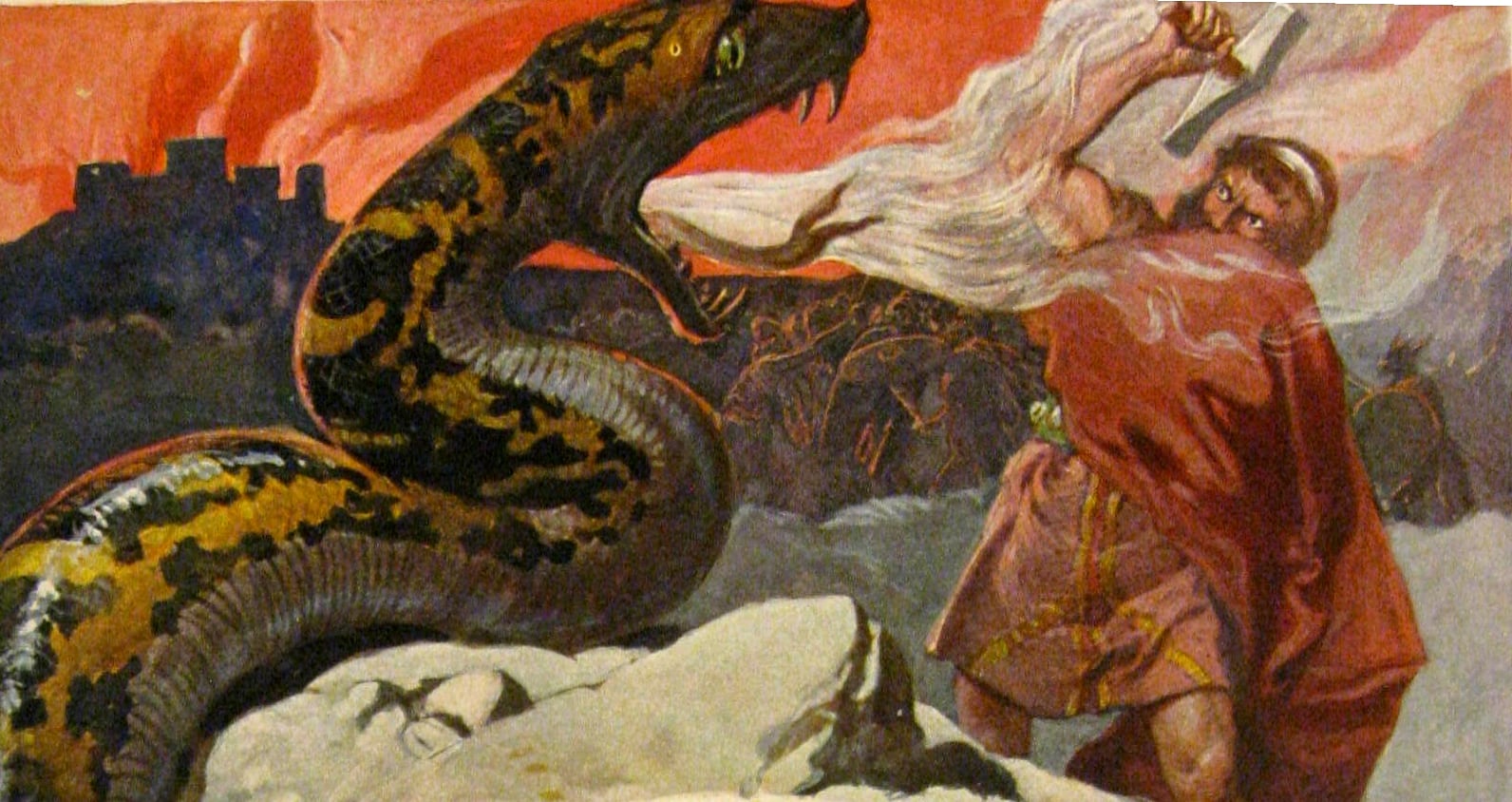
The third meeting settles everything. At Ragnarok Jormungandr releases its own tail and comes ashore. The Völuspá describes the sea rising over the coasts as the enormous body begins to move, and the air itself turning poisonous.
Thor and the serpent meet for the last time, and this time no frightened giant is standing by to cut the line. Thor kills it with Mjolnir. Then he walks nine paces and falls dead, poisoned by the breath of the creature he has just destroyed.
Nine steps the son of Fjorgyn takes, undone by the worm, yet unashamed.
Those nine steps are among the most economical images in the whole tradition. Thor wins. He genuinely wins, and the outcome is still his death. There is no triumph, no rescue in the final line, only a short counted distance between victory and the end of everything. Nine recurs with suspicious regularity in Norse material, from the nine worlds to Odin’s nine nights on the world tree, and the number here reads as a deliberate completion rather than a rough estimate.
What the Serpent Says About Norse Fatalism
Our own view is that Jormungandr is the most honest figure in Norse mythology, precisely because it wants nothing personal. Fenrir has a grievance: he was deceived by the one god who had earned his trust. Loki has insults to repay and moods to indulge. The serpent has none of that. It lies in the ocean and simply exists until the clock runs out.
That makes it the sharpest available expression of what this tradition means by fate. Not punishment, not malice, but a fact that keeps growing while nobody is looking at it. Odin threw the serpent into the sea to make the problem go away, and all he actually achieved was moving it out of sight and giving it room. The same logic governs Fenrir’s binding, and in both cases it fails for the same reason.
Thor’s role deserves a second look too. He is the god of farmers and sailors, the one called on in a storm, and his function in this myth is not wisdom but refusal. He knows how it ends. He rows out anyway, casts anyway, and swings anyway. That posture, rather than the prophecy itself, is probably what mattered to the people who carved this scene into rock across three countries. A myth about hopeless resistance does not get repeated that widely unless the audience recognises something of itself in it.
So the Midgard Serpent is far more than a sea monster. It is the boundary of the world, the clock counting down inside it, and the proof that in this mythology winning a fight and surviving it are two entirely different things.
Image: Emil Doepler (Public domain), via Wikimedia Commons