Mythology
Sleipnir: Odin's Eight-Legged Horse Between Myth and Rune Stone
Sleipnir, Odin's eight-legged horse: what the Prose Edda says about his strange birth, and what the Tjängvide picture stone from Gotland can actually prove.

Contents
- Sleipnir in the Prose Edda: Loki’s Strangest Birth
- The Best of All Horses: Sleipnir in the Grímnismál
- The Tjängvide Stone: The Oldest Image of an Eight-Legged Horse?
- The Ardre VIII Stone: A Second Witness from Gotland
- Myth vs. Fact: What the Text and the Stone Actually Support
- Sleipnir’s Duties: From Asgard to the Realm of the Dead
- Why Sleipnir Still Fascinates Us
No mount in world literature is as strange, and as precisely described, as Sleipnir, the eight-legged horse of the god Odin. Grey, faster than any other steed in the nine worlds, born from a story that is unusual even by Norse standards: Sleipnir is the son of a god who turned into a mare. But alongside the texts there is a second trail, carved in stone, centuries older than the written sources. This article puts both trails side by side: what the Edda tells us about Sleipnir, and what archaeology can actually prove once picture stones enter the conversation.
Sleipnir in the Prose Edda: Loki’s Strangest Birth
The story of Sleipnir’s birth is set down in black and white in the Gylfaginning, the mythological core of the Prose Edda written by the Icelandic scholar Snorri Sturluson around 1220. It begins with a construction project: an unnamed builder, in truth a giant, offers the gods a deal, he will finish the wall around Asgard in just three half-years of winter. As payment he demands the sun, the moon, and the goddess Freyja as his wife. On Loki’s advice the gods agree, convinced the deadline is impossible to meet anyway.
The builder, however, owns an extraordinary stallion named Svaðilfari, who hauls twice as much stone as his master, and the work advances at a frightening pace. Just before the wall is finished, the gods panic and hold Loki responsible for the mess. To sabotage the deadline after all, Loki transforms himself into a mare and lures Svaðilfari away from the building site for an entire night. The builder loses crucial time and misses the deadline, and Thor kills him with Mjölnir the moment it becomes clear a giant was hiding behind the disguise.
Some time later, Snorri reports matter-of-factly, Loki gave birth to a foal, grey and with eight legs. That foal is Sleipnir. Snorri mentions the episode almost in passing, without dramatizing it, a god who changes sex, mates, and gives birth is simply reported as fact in the Edda, tucked between a building story and a piece of divine trickery. Readers who want the full picture of Loki and his far more threatening offspring can find it in our article on Odin, the Allfather, whom Sleipnir would later serve as his most loyal mount.
The Best of All Horses: Sleipnir in the Grímnismál
While the Gylfaginning explains where Sleipnir came from, it is the Poetic Edda, specifically the Grímnismál, that records his standing among horses. In stanza 44, Odin himself lists the best of every category, the best of trees is Yggdrasil, the best of gods are the Aesir, and the best of horses is Sleipnir. The line is usually rendered in translation as something close to “Sleipnir is the best of horses,” a terse, almost offhand verdict that scholars nonetheless cite often, because it confirms Sleipnir’s status independent of the birth story. Sleipnir is not merely a curious footnote to a Loki anecdote, he is anchored in a separate text as the measure against which every other horse is judged.
This double attestation, once as the outcome of a shapeshifting tale in the Gylfaginning, once as a settled attribute in the Grímnismál, makes Sleipnir one of the better textually documented figures in Norse animal mythology. Two independent works, both written down in Iceland during the 13th century, agree on the essentials: Sleipnir belongs to Odin, and Sleipnir is unmatched for speed.
Before we turn to a very different kind of source, it is worth pausing on the music that picks up this same bond between god and horse.
The Tjängvide Stone: The Oldest Image of an Eight-Legged Horse?
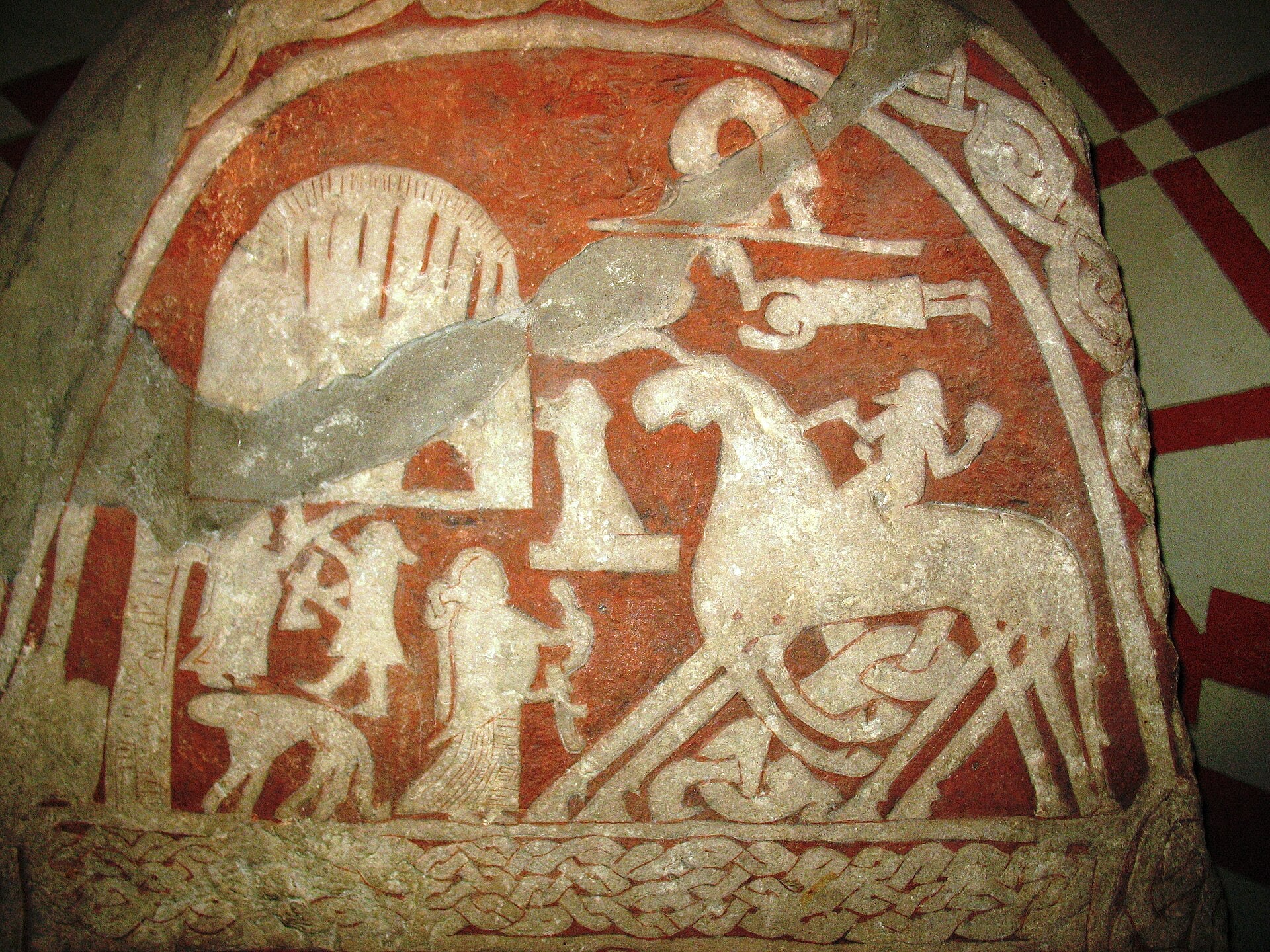
Text is one type of source, stone is another, and this is where things get interesting. The Tjängvide picture stone comes from Alskog on Gotland and is dated to the 8th or 9th century, several centuries before Snorri wrote down the Prose Edda. In rough outline it shows a horse with eight visible legs, carrying a rider who is greeted by a second figure holding a drinking horn, with a ship under full sail carved below. The stone now stands in the Swedish History Museum (Statens historiska museum) in Stockholm and ranks among the best known of all Gotland picture stones.
The obvious reading is that Odin rides Sleipnir and is welcomed by a valkyrie or some other female figure with a drink of welcome, an arrival scene set in the afterlife. This reading has become close to the default in popular accounts, and it is a plausible one, since it fits what the Edda tells us about Sleipnir and about Odin’s journeys into the world of the dead.
But this is exactly where a serious engagement with the source has to slow down. The stone carries no inscription that names the figure. Nobody in the 9th century left a note explaining who this was meant to be. The identification with Odin and Sleipnir rests entirely on a later comparison with written sources that were not composed until roughly 400 years after the stone was carved.
The Ardre VIII Stone: A Second Witness from Gotland
The Tjängvide stone does not stand alone with this motif. The Ardre VIII stone, also from Gotland and also held in the Swedish History Museum, is a considerably larger slab packed with several scenes stacked on top of one another, and among them is another horse with eight legs, surrounded by additional figures and buildings that some researchers link to Valhalla. The stone is regarded as one of the most image-dense Gotland picture stones to survive, and, like the Tjängvide stone, it is dated to the Viking Age.
The fact that two independent Gotland stones both depict an eight-legged horse strengthens the case that this really could be Sleipnir, since a coincidence that repeats itself starts to look statistically more like a pattern. At the same time, scholars of picture-stone art caution against building a confirmed iconography out of just two examples. It remains entirely possible that the eight-legged image was simply an artistic convention Gotlandic carvers used to suggest a horse’s speed or motion, not unlike how modern visual language uses motion lines, regardless of whether a specific mythical animal was intended at all.
Myth vs. Fact: What the Text and the Stone Actually Support
At this point a sober side-by-side comparison is worthwhile, because the two kinds of sources, text and stone, answer different questions and cannot simply be translated into one another.
| Aspect | What the myth claims | What archaeology can confirm |
|---|---|---|
| Sleipnir’s origin | Born of Loki in mare form and the stallion Svaðilfari, according to the Gylfaginning | Cannot be verified archaeologically, no picture stone shows a birth scene |
| Status of the horse | ”Best of horses,” according to Grímnismál, stanza 44 | No picture stone carries an inscription naming any horse “Sleipnir” |
| Tjängvide and Ardre VIII stones | Popularly read as Odin riding Sleipnir | Demonstrably show an eight-legged horse with a rider, the rider’s identity is never named |
| Dating | Prose Edda and Poetic Edda were fixed in writing in the 13th century | Both stones date to the 8th or 9th century, considerably older than the text |
| Safe conclusion | A narrative tradition around an eight-legged divine horse existed by the 13th century at the latest | The visual motif of an eight-legged horse already existed on Gotland centuries earlier |
What follows from this is worth sitting with. The picture stones prove that the idea of an eight-legged horse was already circulating during the Viking Age, long before Snorri put it in writing. Whether that image already referred to the same Sleipnir the later Edda describes, or whether it was an older, more general motif that the Sleipnir story was only attached to afterward, cannot be settled by archaeology alone. Stone and text tell two stories that very probably, but not provably, refer to one another.
Sleipnir’s Duties: From Asgard to the Realm of the Dead
Within the mythology, Sleipnir is far more than a fast set of legs. In the Poetic Edda poem Baldrs draumar, Odin himself rides Sleipnir down into Niflhel to wake a dead seeress and question her about the fate closing in on his son Baldr, one of the few passages where Odin personally guides the horse across the boundary between the world of the living and the world of the dead. After Baldr’s death it is not Odin but his son Hermóðr, according to Snorri’s Gylfaginning, who borrows Sleipnir to ride into Hel and beg its ruler for Baldr’s release, a ride that carries him through nine nights of dark, deep valleys before he crosses the river Gjöll. That episode belongs to the prelude of the end of the world, which we cover in full in our article on Ragnarök.
Sleipnir, then, is a horse that crosses the boundary between the nine worlds with ease, regardless of who sits in the saddle. That same ability to move between life and death likely explains why scholars so readily connect arrival scenes on picture stones with Sleipnir in the first place, an eight-legged horse carrying a rider into another world fits precisely the role the texts assign the animal, even where the stone itself offers no proof.
Why Sleipnir Still Fascinates Us
What remains, in the end, is a figure that unusually ties together two kinds of sources that otherwise rarely line up so cleanly. The Nordweg editorial team thinks it is worth staying honest here: the link between the Gotland picture stones and the Sleipnir of the Edda is one of the most frequently repeated, and one of the most weakly directly evidenced, attributions in all of Norse iconography. It is plausible, it is the obvious reading, and most scholarly publications on the Viking Age now treat it as the most likely interpretation. But it cannot be proven in the strict sense unless an inscribed parallel turns up that names the horse outright.
That very uncertainty, in the editorial team’s view, is what makes Sleipnir such an instructive case for how we approach Norse mythology as a whole. Texts and images complement each other, but occasionally disagree on what they can actually prove. Anyone who wants to take Sleipnir seriously has to let both stand side by side, the story of Loki’s transformation and Odin’s rides, and the plain, unlabeled horse on two stones from Gotland that may, but cannot be shown for certain to, capture that same story in stone. It is in that tension between narrative and artifact, more than in any single source on its own, that the real fascination of Odin’s horse lives.
Image: Berig (CC BY-SA 4.0), via Wikimedia Commons