Mythology
Loki: The Trickster Among the Norse Gods
Loki trickster god of Norse myth: his giant blood, the true story of Sleipnir's birth, his role in Baldr's death, and his punishment under a venomous serpent.

Contents
- Origins: Giant Blood in Asgard
- Loki’s Children: Fenrir, Jörmungandr, and Hel
- Sleipnir: How Loki Became a Mother
- The Shapeshifter: Both Help and Harm
- Lokasenna: The Quarrel That Changes Everything
- Baldr’s Death: The Break That Cannot Be Mended
- The Binding: Sigyn’s Bowl and the Serpent’s Venom
- Why Loki Resists Any Simple Reading
Few figures in Norse mythology resist easy categorization the way Loki, the trickster god, does. He is not, strictly speaking, a god at all. He is friend and traitor in the same breath, savior and saboteur, father of monsters and, in one of the strangest episodes in all of Old Norse literature, the mother of a horse. Reduce him to “the villain” and you have missed most of what the sources actually say. Know him only from modern pop culture, and you have missed even more.
So let’s start where the Eddas themselves do: with the question of who Loki actually is, and where he comes from.
Origins: Giant Blood in Asgard
The most surprising thing about Loki may be that he isn’t really one of the Æsir at all. The Prose Edda, written by the Icelandic scholar Snorri Sturluson, names his father as the giant Fárbauti (“dangerous striker”) and his mother as Laufey (also called Nál) - which is why the sources usually call him “Loki Laufeyjarson,” son of Laufey, rather than naming him after his father as convention demanded. Even that small break with tradition signals something: Loki never quite belongs.
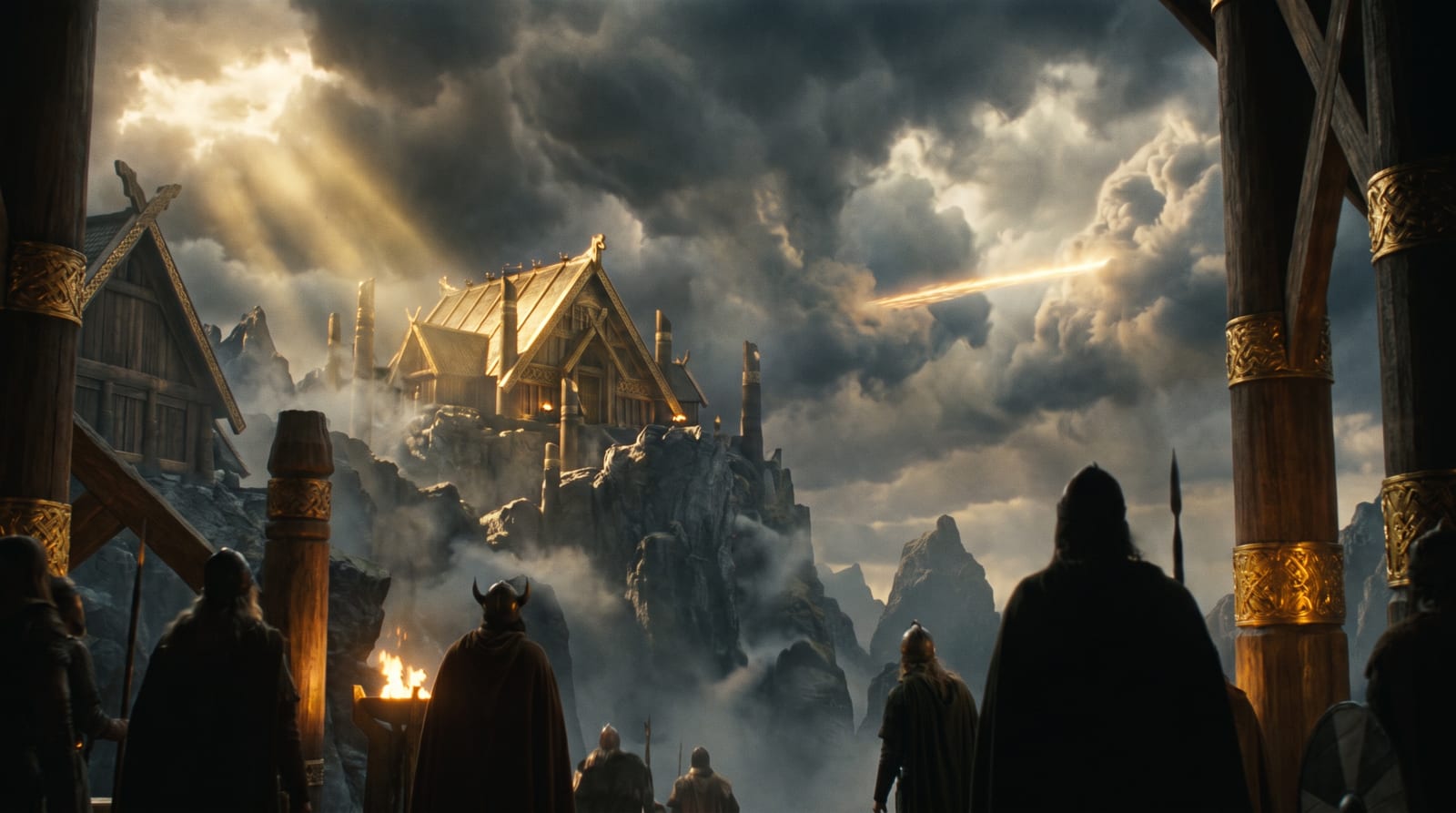
How he ended up among the Æsir at all is told in Snorri’s Gylfaginning: at some point, Odin and Loki became blood-brothers. The text never explains why - but the bond holds, with all its consequences, right up until the eve of Ragnarök. From then on Loki lives in Asgard, sits at the gods’ table, travels with Thor and Odin across the Nine Worlds - and yet, by blood, remains a giant’s child among the sworn enemies of giants. That in-between status isn’t incidental to the story; it’s the engine driving it. Loki can undermine the gods so effectively precisely because he was never fully one of them.
Loki first marries the giantess Angrboða (“the one who brings grief”), and together they produce the three monstrous children who will shadow the mythology all the way to its end. Later he takes Sigyn as his wife - and her role only reveals its full weight at the bitter close of his story.
Loki’s Children: Fenrir, Jörmungandr, and Hel
Most people who know Norse mythology know the names of Loki’s children, even if they rarely hear how they connect. With Angrboða, Loki fathers three beings the gods judge so dangerous that they intervene before disaster can strike:
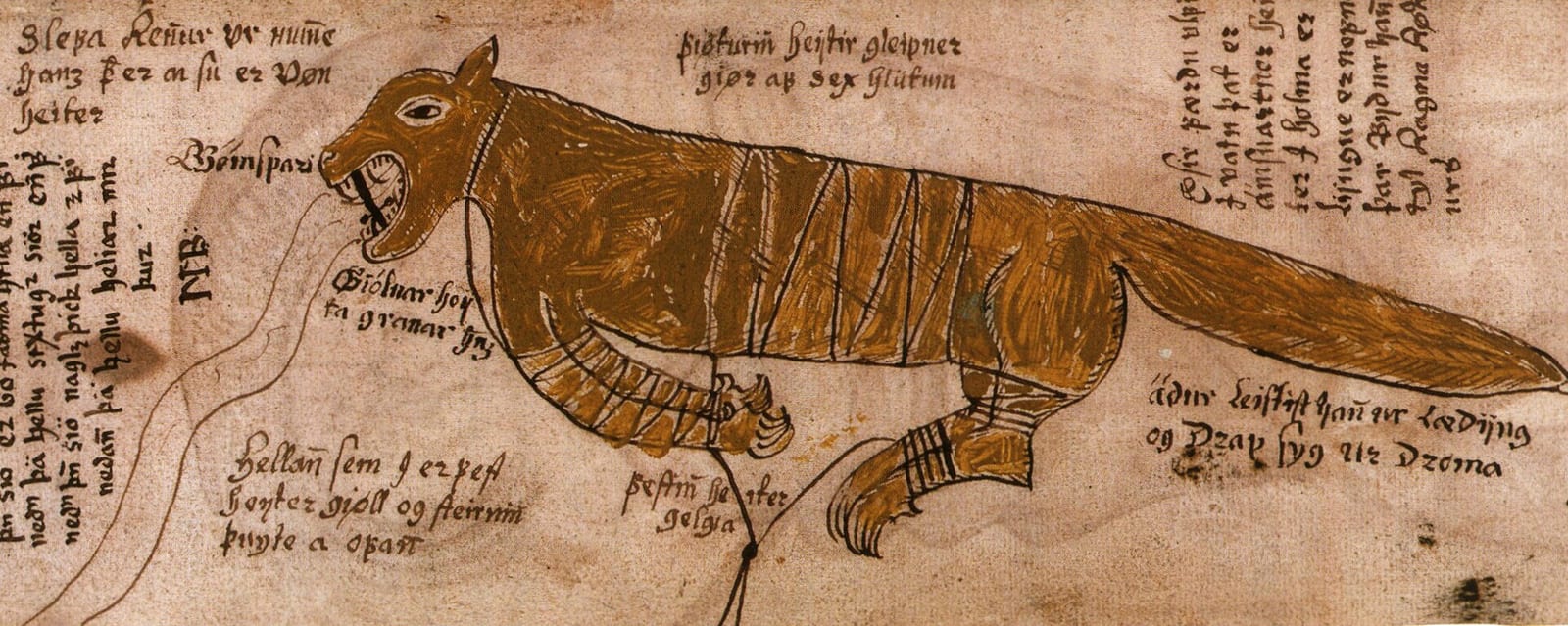
- Fenrir, the wolf, who grows so powerful that the Æsir have him bound with the magical fetter Gleipnir - at the cost of the god Týr’s hand.
- Jörmungandr, the World Serpent, whom Odin casts into the sea, where it grows until it encircles the entire world, biting its own tail.
- Hel, whom Odin sets to rule over the realm of those who die outside of battle - half living, half rotted in the face, as Snorri describes her.
The Prose Edda is blunt about the reason: the gods fear these three because prophecy has marked them for great calamity. That very fear plants the seed that comes to fruition at Ragnarök, when Fenrir and Jörmungandr return as the gods’ enemies - we tell that part of the story in our article on Ragnarök.
Sleipnir: How Loki Became a Mother
And then there is a story that popular retellings conspicuously tend to skip, even though it sits right there in Snorri’s Gylfaginning in black and white: Loki is not only the father of monsters. He is also the mother of a horse.
The tale begins with the building of the wall around Asgard. A master builder - secretly a giant in disguise - offers to raise the fortress in a single year and a half. As payment he demands the sun, the moon, and the goddess Freyja as his wife. On Loki’s advice, the gods agree, confident the deadline is impossible to meet. But the builder owns an extraordinary stallion named Svaðilfari, who hauls twice the stone his master can, and the work advances at a terrifying pace.
With the wall nearly finished, the gods panic - and turn their fury on Loki, who talked them into the bargain in the first place. He is told to find a way out, or suffer for it. So Loki transforms himself into a mare and lures the stallion Svaðilfari away from the building site for an entire night. The builder loses crucial time, misses the deadline by a hair, and Thor kills him with Mjölnir once it becomes clear a giant was hiding beneath the disguise.
Paraphrased from the Gylfaginning: some time later, Loki, having consorted with Svaðilfari, gave birth to a foal, grey and eight-legged - the finest horse among gods and men.
That foal is Sleipnir, Odin’s eight-legged steed, the fastest horse in all Nine Worlds and the Allfather’s companion even on journeys into Helheim. It is one of the strangest episodes in the entire mythology: a god who changes sex, mates, and gives birth, told by the source with no particular sense of scandal attached. The Vikings apparently told this story without the discomfort modern audiences sometimes assume it must have caused. Snorri simply reports it as fact, tucked between a building contract and a piece of divine trickery.
The Shapeshifter: Both Help and Harm
Sleipnir’s birth is not an isolated oddity - it’s typical of Loki’s real gift, shapeshifting. Across the myths he becomes a salmon, a fly, an old woman, a falcon, usually either to escape a mess of his own making or to bail the gods out at the last possible moment.
That is exactly what makes Loki so hard to pin down: he is not consistently villainous. When Freyja’s falcon cloak is needed to retrieve Thor’s stolen hammer, it’s Loki who borrows it and hatches the plan. When the gods risk humiliation in an eating or drinking contest among giants, it’s often Loki who improvises a way out. Yet the same Loki also creates many of these crises to begin with - failing to guard Thor’s hammer in the Þrymskviða, or, in other tales, stealing Freyja’s necklace Brísingamen outright. He is, you might say, the principle of chaos that both threatens the ordered world of the Æsir and keeps it running.
Lokasenna: The Quarrel That Changes Everything
Nothing shows how deep this contradiction runs quite like the Lokasenna (“Loki’s Quarrel”) in the Poetic Edda. Loki crashes a feast of the gods uninvited and goes around the table hurling the ugliest truths and insults at each guest in turn - no one is spared, not Odin, not Freyja, not even Thor, who eventually threatens him with the hammer to drive him out.
The poem reads, in places, like a scandal transcript, but there’s more going on beneath it. Loki says aloud what everyone else prefers left unsaid, exposing old debts and double standards. That function - the mocker who holds up a mirror to society - is a familiar role across many mythologies. Here, though, it has fatal consequences.
Baldr’s Death: The Break That Cannot Be Mended
The real turning point in Loki’s story is the death of the god Baldr. Exactly how it happened - the mistletoe, the blind god Höðr, the trick by which Loki turned the one thing in the world that had never sworn an oath into a lethal weapon - we’ve told in full in our article on Ragnarök, since Baldr’s death also marks the opening act of the end of the world.
What matters most for Loki’s own story is what follows: after Baldr’s death, the rift between Loki and the rest of the gods is final. It’s the moment the tolerated troublemaker becomes an enemy.
The Binding: Sigyn’s Bowl and the Serpent’s Venom
After the Lokasenna and Baldr’s death, Loki flees - hiding, Snorri tells us, in the shape of a salmon in a waterfall - but the gods track him down. His punishment is among the cruelest in the entire mythology: the gods bind him to three rocks deep underground with the entrails of his own son. Above his head they fix a venomous serpent, whose drops fall unceasingly onto his face.
But Loki is not entirely alone. His wife Sigyn kneels beside him, holding a bowl above his face to catch the venom. Only when she must empty the full bowl does a drop strike him - and Loki writhes in such agony that, according to Viking belief, the earth itself shakes. Snorri records this explanation directly: that, it is said, is the cause of earthquakes.
It’s an image of startling tenderness amid cruelty - a wife who endures for millennia beside her bound and punished husband, sparing him what pain she can. Loki remains bound until Ragnarök, when he finally breaks free to fight alongside the giants and monsters against the very gods who once made him a blood-brother.
Why Loki Resists Any Simple Reading
So what is Loki, in the end - villain or rescuer, giant or god, father or mother, friend or traitor? The honest answer is: all of it, at different points in the story.
That contradiction is probably not a flaw in the tradition but its very core. Norse mythology has no pure devil in the later Christian sense - it has a force that disrupts order because order without disruption would simply freeze solid, but that same force also conjures the very disaster that eventually destroys everything. Loki brings the gods Sleipnir and recovers Brísingamen for them, but he also brings Baldr’s death and, in the end, his own ruin.
Perhaps that’s why Loki still won’t let us go: he’s the reminder that no order - not even that of the gods - survives without the constant, unruly visit of chaos. And that the very force holding everything together can, in the end, be the one that brings it all down.
Image: Johannes Gehrts (1855-1921) (Public domain), via Wikimedia Commons