History
Jorvik: How the Vikings Shaped York - The Coppergate Finds
Jorvik was Viking York. What the Coppergate finds reveal about crafts, trade and daily life - and why the famous Coppergate helmet is not a Viking helmet.
Contents
There is a second city underneath the shopping streets of York. Its name was Jorvik, it was probably the second largest town in England after London during the tenth century, and it survived in waterlogged, oxygen-starved ground more completely than almost any other Viking Age settlement. Anyone who wants to know how the Vikings actually lived in York ends up at one street: Coppergate. Between 1976 and 1981 archaeologists dug roughly 1,000 square metres of it, in places down to nine metres, and pulled out a world made of timber, leather, cloth and bone. Which is to say, made of exactly the materials that rot away to nothing on an ordinary excavation.
From Eboracum to Eoforwic to Jorvik
York is a city with three names, and each one belongs to a different empire. The Romans founded the legionary fortress of Eboracum here around AD 71, and it grew into the administrative centre of northern Britain. After the legions withdrew it became Anglo-Saxon Eoforwic, the chief place of the kingdom of Northumbria and, from the seventh century, a bishopric and later an archbishopric. Norse speakers reshaped the name into Jórvík, and Jórvík eventually wore down into York.
Geography explains why a major town rose here three times over. York sits at the confluence of the Ouse and the Foss: far enough inland to be defensible, yet connected through the Ouse and the Humber straight to the North Sea. A ship could sail off open water and tie up in the middle of town. For a culture whose entire economy ran along shipping routes, that was not merely an advantage. It was the advantage.
A short timeline puts the key dates in order:
- 1 November 866: The Great Heathen Army takes York, on All Saints’ Day according to the Anglo-Saxon Chronicle.
- 21 March 867: The Northumbrian kings Osberht and Ælla are killed attempting to retake the city.
- 876: Halfdan shares out the land of Northumbria among his men. An army camp turns into permanent settlement.
- c. 900 to 950: The Coppergate craft tenements flourish, and York strikes its own coinage.
- 954: Eric Bloodaxe is driven out, and the independent kingdom of Jorvik comes to an end.
- 1976 to 1981: The Coppergate excavation uncovers four plots of the Viking town.
- 1984: The Jorvik Viking Centre opens directly above the site.
How Viking York Became Jorvik
The conquest itself is well recorded, largely because it horrified English chroniclers. The Great Heathen Army, that coalition of Scandinavian leaders campaigning in England from 865 onwards, exploited a succession dispute between Osberht and Ælla and took York in 866 with little resistance. The counterattack the following spring was a disaster: both kings died, and Northumbria lost its ruling class in a single day. For how that army came together and moved through England, see our longer piece on the Great Heathen Army.
But the year that mattered most for the town was not 866. It was 876, when Halfdan divided Northumbrian land among his warriors, who then settled, ploughed and built. Occupiers became landholders, traders and craftsmen. That transition is legible in the ground at Coppergate, where the earliest Viking Age layers are not encampments at all. They are workshops.
What did not happen is just as striking. The archbishopric of York survived. Christian and pagan populations lived side by side. And by about 900 the rulers of Jorvik were minting coins bearing the name of Saint Peter. A Norse kingdom striking saints’ coinage sits awkwardly with the image of the plundering heathen. It sits very comfortably indeed with people who had worked out that coins only function as money if the locals are willing to take them.
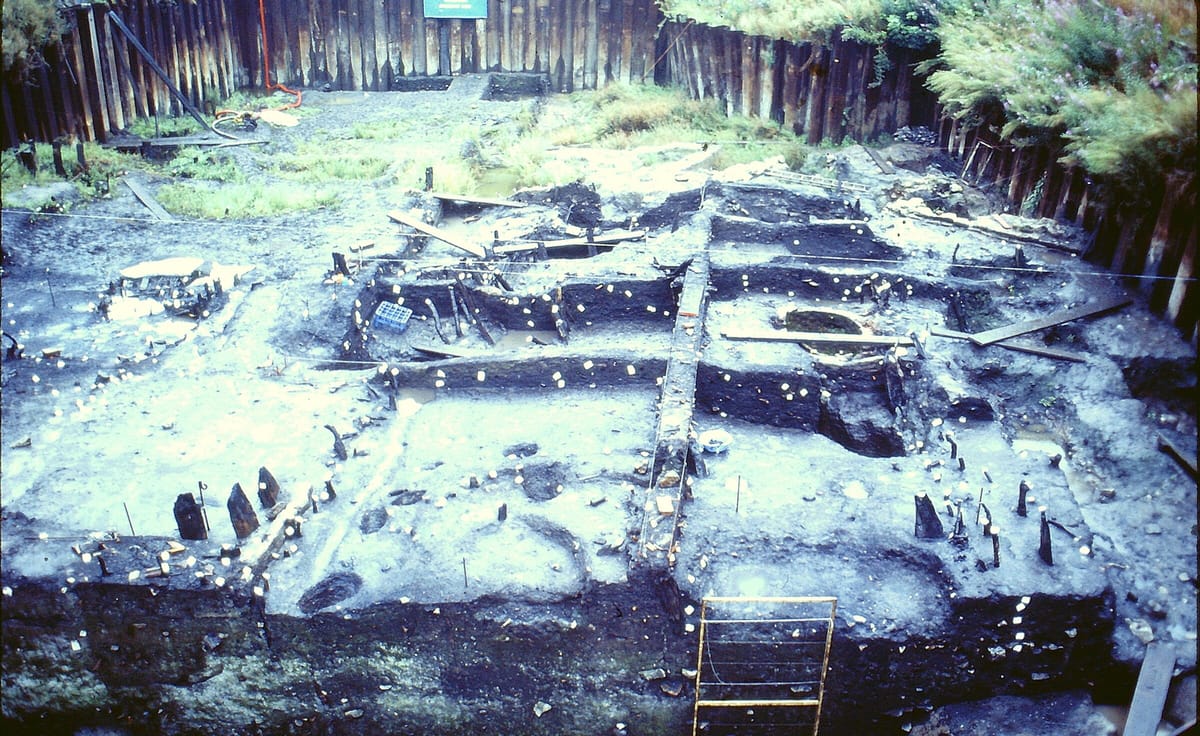 Image credit: Sandy Gerrard (CC BY-SA 2.0), via Wikimedia Commons
Coppergate: Five Years of Digging, Nine Metres of History
That Coppergate of all places was excavated came down to an accident of town planning. A shopping development was due to go up on the site of a former confectionery works, and the York Archaeological Trust, directed by Richard Hall, got the chance to dig first. A short evaluation turned into five years of work.
The reason lay in the soil. The ground slopes towards the River Foss, the subsoil is permanently waterlogged, and standing water keeps oxygen out. Without oxygen the bacteria that break down organic matter simply cannot work. The result is an archaeological windfall: Coppergate preserved not only metal and pottery but house timbers, wattle walls, leather shoes, woollen cloth, hairnets, barrels, spoons, even fruit stones and insect remains.
The dig exposed four narrow tenement plots, each about five and a half metres wide, running back from the street towards the river. Those boundaries stayed fixed across generations, which tells us the town had an ordered and evidently enforced property layout rather than sprawling as a camp would. In the earlier phase the plots held ground-level wattle-and-daub buildings; from around 975 these gave way to sturdier semi-sunken structures with plank walls and cellar-like lower floors, well suited to storage and selling.
The street name is a find in its own right. “Coppergate” has nothing to do with copper. It comes from Old Norse koppari, a cup-maker or wood-turner, joined to gata, a street. The street of the turners, in other words. That the excavation then produced quantities of lathe-turning waste on exactly that spot, the discarded cores left behind when a bowl is hollowed out, is one of the neatest confirmations archaeology and philology have ever handed each other.
What the Wet Ground Kept
In total the dig produced some 40,000 individual objects, together with roughly a quarter of a million sherds of pottery and several tonnes of animal bone. That bulk is the real prize. The value is not any single showpiece but the chance to reconstruct entire workshops and households.
| Category | Examples from Coppergate | What it tells us |
|---|---|---|
| Woodworking | Turned cores, bowls, cups, barrel staves | Tableware produced in series for sale |
| Leather | Shoes, sheaths, offcuts from cutting patterns | Shoemakers worked on site, not merely traders |
| Textile | Woollen cloth, spindle whorls, loom weights, a nalbinding sock | Cloth made at home, not simply imported |
| Metal | Smithing slag, tools, equipment linked to striking coins | York minted its own money under ruling control |
| Luxury goods | Amber, Whitby jet, silk, carnelian beads | Raw materials and finished wares from half of Eurasia |
| Everyday waste | Fruit stones, fish bones, animal bone, parasite eggs | Diet, hygiene and health of the inhabitants |
The unglamorous items are often the most eloquent. A woollen sock made by nalbinding, a single-needle looping technique older than knitting, says more about a winter in Jorvik than any sword does. And at a neighbouring site on the street called Pavement, the York Archaeological Trust recovered in 1972 a complete preserved human stool, the so-called Lloyds Bank coprolite. It held the eggs of whipworm and maw-worm. Unappetising, certainly, and also one of the hardest pieces of evidence we possess about living conditions in a densely built Viking town.
The Viking Age usually reaches us through graves, which are carefully staged farewells. Coppergate hands us the opposite: the rubbish, the workbench, the broken shoe. That is precisely why the site matters.
The Coppergate Helmet: Myth Against Fact
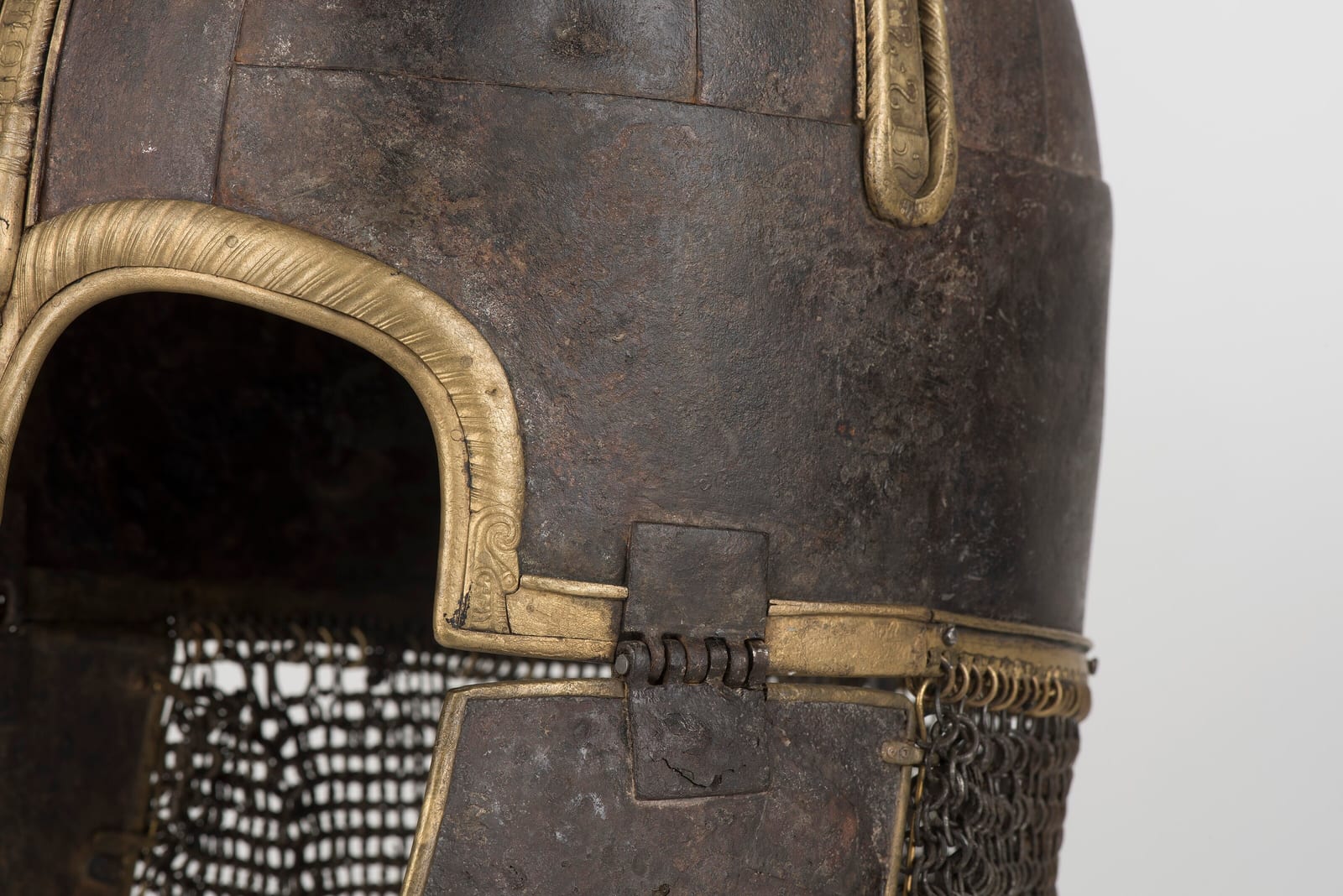
The most famous object from the site is a helmet, and almost every visitor gets it wrong at first glance. In May 1982, after the main excavation had finished, a mechanical digger working on the foundations of the Jorvik Viking Centre struck a timber-lined pit. Inside lay a near-complete iron helmet with gilded brass bands, hinged cheekpieces and a mail curtain to protect the neck. It is now displayed in the Yorkshire Museum.
| Common assumption | What the find actually supports |
|---|---|
| A Viking helmet from Jorvik | Anglo-Saxon, dated to the eighth century, roughly a century before the conquest of 866 |
| Worn by a Norse warrior | The Latin inscription on the brass bands names Oshere, an Anglo-Saxon name |
| Pagan war gear | The inscription is a Christian invocation in the name of God |
| Typical kit of the period | Complete early medieval helmets are extremely rare across all of northern Europe |
| Part of the settlement layers | It lay in a purpose-dug pit, and why it was deposited there remains unexplained |
The helmet is therefore not a Viking object at all. It is an Anglo-Saxon prestige piece that the Norse either found in York or never knew about, since it may have gone into the ground long before they arrived. It remains inseparable from the story of Jorvik all the same, because without the construction of a Viking museum nobody would ever have found it. What it cannot do is show us how Norse warriors in York were equipped, which is exactly the caption it keeps being given.
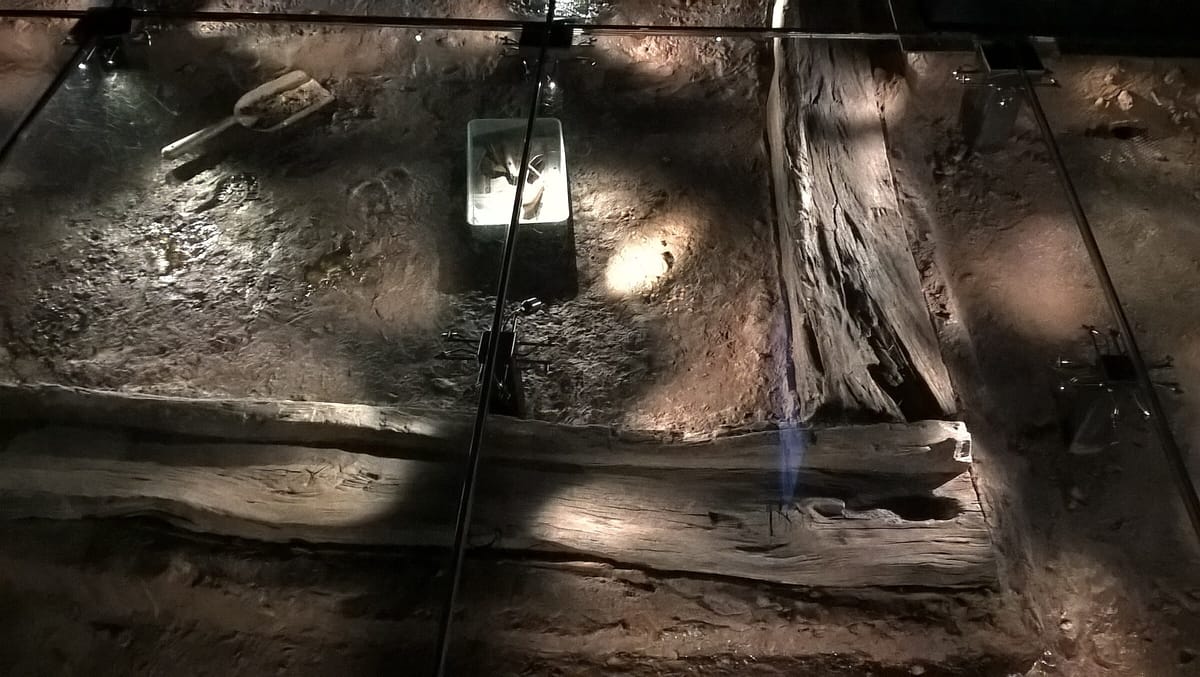 Image credit: Chemical Engineer (CC BY-SA 4.0), via Wikimedia Commons. The timbers come from the excavation; the surrounding soil and water are reconstructed.
A Trading Town with Byzantine Silk
Jorvik was never an isolated North Sea harbour. It was a node in a network reaching from the North Atlantic to the Near East. The amber came from the Baltic, the glossy black jet from nearby Whitby, and the silk of a head covering found at Coppergate from the eastern Mediterranean, most likely through Byzantine intermediaries. Add carnelian beads whose raw stone comes from the belt between the Persian Gulf and India, and a cowrie shell native only to the Indian Ocean or the Red Sea.
None of this proves that a merchant from York personally travelled to Baghdad. It proves something else, and arguably something more interesting: that York was embedded in a relay system where goods changed hands many times over. Every stage took its cut, and at the far end an Indian carnelian bead ended up on a workbench in northern England. Comparable patterns turn up at Hedeby on the modern Danish-German border, which did for the Baltic what Jorvik did for the North Sea and the Irish Sea.
The coinage fits the same picture. York struck coins in quantity in the early tenth century, including the well-known Saint Peter series, and Coppergate yielded equipment connected with minting. Striking coins requires silver, control of a market, and an authority willing to prosecute forgery. Jorvik evidently had all three.
Our Assessment
Coppergate is routinely sold as “the Viking dig”, which is fair enough as marketing and too narrow as history. What came out of the ground is first and foremost an English town of the tenth century, in which Norse settlers, Anglo-Saxon residents and imported goods are so thoroughly interwoven that the strands often cannot be separated at all. A leather shoe does not record whether its wearer had Danish or Northumbrian grandparents.
That, to our mind, is where the real value of the site lies. It corrects a picture the written sources imposed for centuries, simply because monks wrote about raids rather than about turners’ workshops. Coppergate shows the other half: people hollowing out bowls, patching shoes, eating fish, carrying parasites and minting money. Both halves are true, the violence of 866 and the workbench of 950. Tell only one of them and you have told the Viking Age wrong.
It is worth noting that the Jorvik Viking Centre had to be rebuilt after severe flooding at the end of 2015 and reopened in 2017. The wet ground that preserved these finds for a thousand years is the same ground that now threatens them. Let it dry out and the timber crumbles. What lies beneath the streets of York is not a city in storage. It is one that has to be actively kept alive.
Hero image credit: Coppergate helmet, York Museums Trust (CC BY-SA 4.0), via Wikimedia Commons