History
Ribe: Scandinavia's Oldest Viking Town and Its Traders
Ribe is Scandinavia's oldest town. How excavations dated its market to the year 710 and what the Ribe viking town really traded in beads, antler and silver.
Contents
Walk through Ribe today and you get cobbles, leaning gables, storks on the rooftops and a cathedral built from volcanic tuff shipped up from the Rhineland. It looks like a well-kept provincial town in southwest Jutland, and that is exactly what it is. It is also, by a comfortable margin, the oldest town in Denmark and in Scandinavia as a whole, and the claim rests on spade work rather than on tourist brochures. Beneath the pavement lies a surveyed marketplace laid out around 704 to 710, and the layers above it record people melting glass and weighing silver generations before any longship reached England. The Ribe viking town was built by merchants and craftworkers, not by raiders.
A Market Laid Out Before the Viking Age Began
Ribe sits on the Ribe Å, a modest river running west into the tidal flats of the Wadden Sea. Modest is the point. Shallow-draught vessels could sail in from open water, while the few kilometres inland gave shelter from storm surges and from anyone arriving with bad intentions. Frisia lay a short voyage south, the Frankish ports beyond that, and the overland route across the neck of Jutland reached the Baltic without the long, dangerous sail around the Skagerrak.
What makes the site remarkable, though, is not geography but geometry. Excavations along the north bank uncovered narrow plots set at right angles to the water, separated by shallow boundary ditches, each only a few metres wide. Layouts like that do not happen by accident. Someone measured the ground, allocated the parcels and almost certainly collected something in return, which implies an authority with the reach to tell visiting foreign merchants where to stand. The finds never name that authority. Most scholars assume a Jutish king or magnate who understood that organised trade pays better than disorganised trade, and that remains an assumption rather than a documented fact.
Dendrochronology and the sequence of occupation layers place the first layout at roughly 704 to 710. That is some ninety years before the raid on Lindisfarne, the event usually treated as the opening of the Viking Age. The town, in other words, was already running before the era it belongs to had officially started.
The Ribe Viking Town: From Summer Market to Permanent Settlement
For its first decades Ribe was probably not a place where anyone lived year round. It was a seasonal fair. Traders and craftworkers arrived in spring, pitched tents or threw up light booths on their assigned plots, worked and sold through the summer, and left again in autumn. The stratigraphy shows precisely that rhythm: thin working surfaces packed with workshop debris, separated by wind-blown sand and traces of vegetation from the quiet months.
Pinning down when that changed was the aim of the Northern Emporium project, run in 2017 and 2018 by Aarhus University together with the Museum of Southwest Jutland and directed by the archaeologist Søren M. Sindbæk. The team excavated a small area in the middle of modern Ribe at unusually fine stratigraphic resolution. Their result: activity thickens through the eighth century, and towards its end the seasonal gaps disappear. Ribe becomes permanently occupied, and at the same time the volume of imported goods climbs sharply.
That finding matters well beyond local history. It indicates that long-distance exchange in the North did not take off because of the raids. The causality runs the other way. A dense trading network already existed, and the raids happened against that backdrop, using its ships, its routes and its knowledge of foreign coastlines. Ribe stands at the head of a sequence of such places that later included Hedeby on the Schlei.
Put on Scar while you read on, a hymn that carries the harsher side of this world:
What the Workshop Rubbish Reveals
Few early Viking Age sites give such a concrete picture of what people actually did for a living. The waste is more informative than the finished treasures, because waste proves that something was made on the spot rather than merely resold.
- Glass beads and glass waste. Ribe’s bead makers melted down mosaic tesserae of the kind used for Mediterranean wall decoration. The raw material travelled thousands of kilometres before it went liquid again in a Jutish booth.
- Antler combs. Comb makers worked reindeer antler, which does not occur anywhere near flat southwest Jutland. It came down from northern Scandinavia, which requires a dependable supply line, not a lucky delivery.
- Bronze casting. Crucibles, moulds and spilled metal point to jewellery production to order and in series.
- Amber. Raw lumps and working debris from the nearby Wadden Sea coast, turned into beads and pendants.
- Rhenish imports. Pottery and querns of Eifel basalt lava document steady contact with the Frankish world to the south.
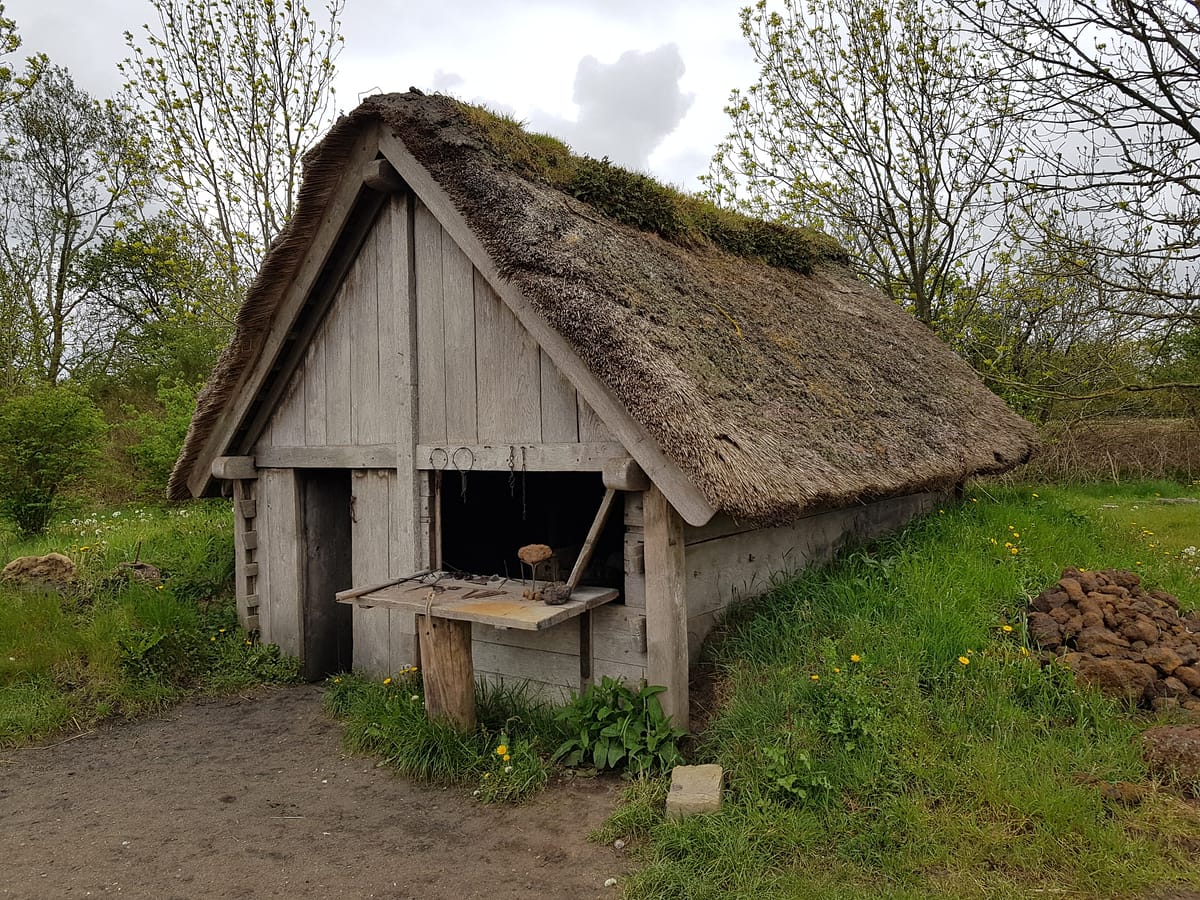 Image source: Hjart (CC BY-SA 4.0), via Wikimedia Commons
Taken together this is not the archaeology of plunder being sold off. It is the archaeology of specialists with working supply chains. Bead makers need glass, comb makers need antler, casters need copper alloy, and all of it had to arrive reliably enough that a household could plan around it. That reliability is the real discovery.
The North’s First Coins
A market of this size eventually needs something smaller than a silver ingot. Ribe answered that need earlier than anywhere else in Scandinavia, striking small silver sceattas of the type known as Wodan/Monster, generally dated to around 720. One face shows a stylised bearded head, the other a beast, both borrowed from Frisian and Anglo-Saxon models.
The imagery is less telling than the quantity. These coins turn up in the Ribe excavations in substantial numbers as stray finds trodden into the market surface, which is to say as lost pocket money. People only lose small change if they are using small change. That points to frequent, low-value transactions between many parties rather than occasional bulk exchanges between a handful of chieftains. Folding balances and sets of weights fill in the rest of the picture, since silver was also reckoned by weight rather than by face value.
Compared with Birka in Sweden, whose heyday came later and whose silver arrived largely from the east, Ribe faces the other way: towards Frisia, the Frankish empire and the British Isles. Both towns belong to the same system. They simply plug into opposite ends of it.
Odin on a Skull, a Church on the River
In 1973 a Ribe excavation produced one of the strangest objects in Danish archaeology: a fragment of human cranium, pierced so it could be worn, and carved with runes. It dates to roughly 725. The usual reading gives the personal name Ulfr together with Odin, while the remainder of the sequence is still argued over. What specialists broadly agree on is the function. This was an amulet, most likely intended to heal or to protect.
For the history of religion that is an unusual piece of evidence. It names Odin on a contemporary, everyday object, centuries before Snorri Sturluson and the written transmission of the Edda. Not poetry about belief, but belief in use.
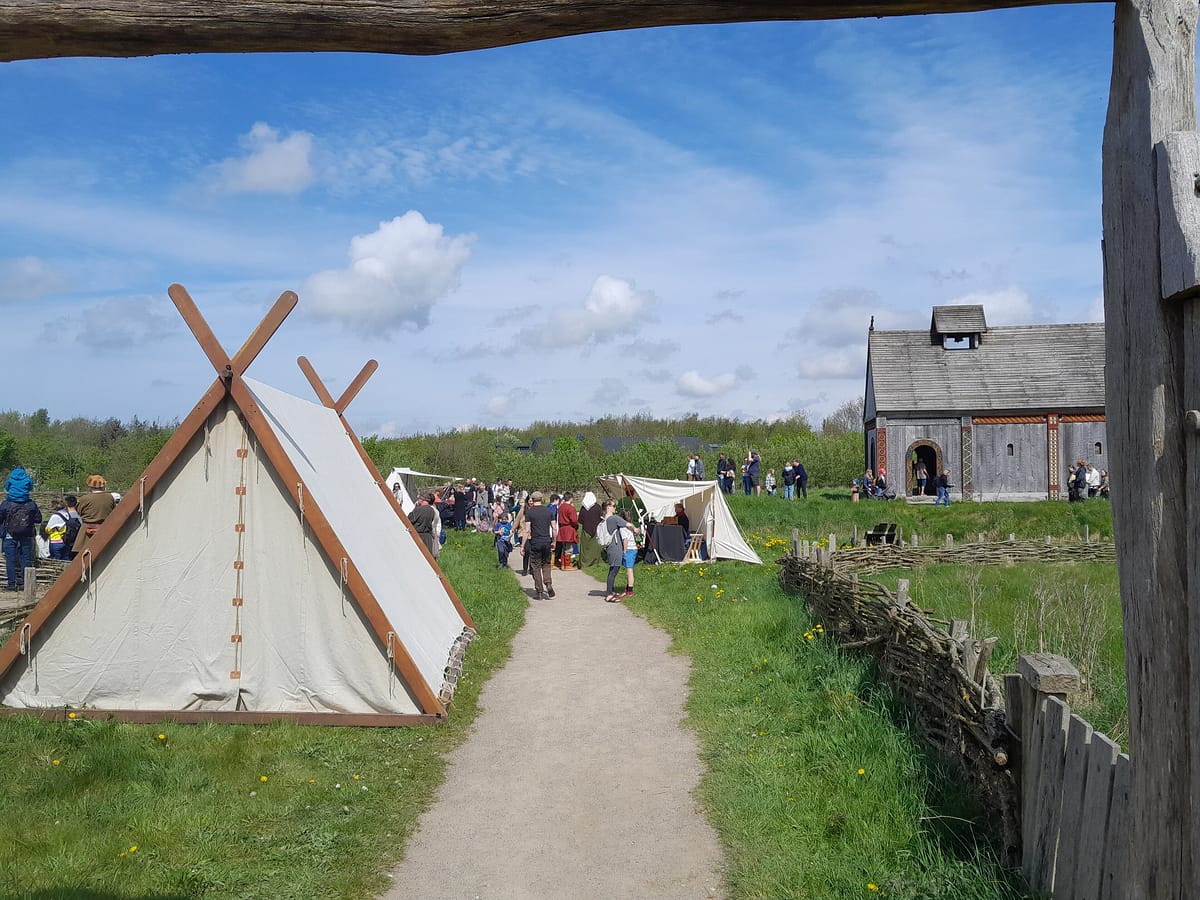 Image source: JakobHosp (CC0), via Wikimedia Commons
Barely a century later the same riverbank becomes a stage for early Christianity. In his Vita Ansgarii, the life of the missionary Ansgar, the cleric Rimbert records that the Danish king Horik granted permission for a church to be built at Ribe, an episode conventionally placed around 860. The usual caution applies to any hagiography, since Rimbert wrote to honour Ansgar rather than to file a neutral report. The excavations, however, support the general direction of travel: a cemetery with Christian-oriented burials from the ninth century has been found in the town.
Ribe is one of very few places where both halves of that transition sit in the same ground. An Odin amulet from the eighth century and a Christian burial ground from the ninth, less than two hundred years and a few hundred metres apart.
In 948 Ribe became a bishopric alongside Schleswig and Aarhus, among the first on Danish soil. The trading post had turned into an institution.
Ribe in Nine Dates
| Date | Event |
|---|---|
| c. 704 to 710 | Surveyed market plots laid out on the north bank of the Ribe Å |
| c. 720 | Silver sceattas struck, the first coins in Scandinavia |
| c. 725 | Skull fragment inscribed with runes naming Odin |
| late 8th c. | Shift from seasonal market to permanent, year-round town |
| c. 860 | Permission for a church, according to Rimbert’s Vita Ansgarii |
| 948 | Ribe becomes a bishopric |
| from c. 1150 | Cathedral begun, built of imported Rhenish tuff |
| 1634 | A severe storm surge strikes the town and the surrounding marsh |
| 1874 | The port of Esbjerg opens and Ribe loses its sea trade for good |
Ribe’s decline was neither sudden nor violent, which sets it apart from Hedeby. The town was simply left behind. The river silted, ships grew larger, and eventually deep water lay too far away. The storm surge of 1634, whose high-water mark is still recorded on a column at the old harbour, hit a place that was already weakening. When Esbjerg opened its modern port in the nineteenth century, maritime trade moved north and stayed there.
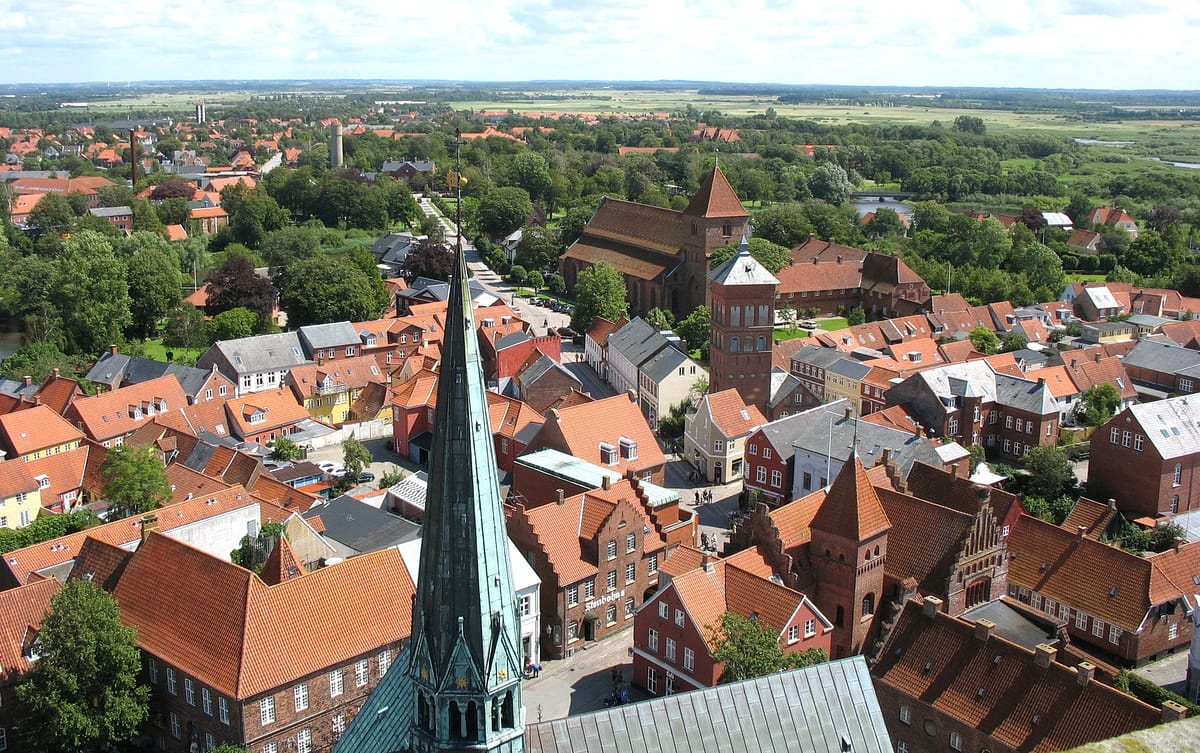 Image source: Hubertus45 (CC BY 2.5), via Wikimedia Commons
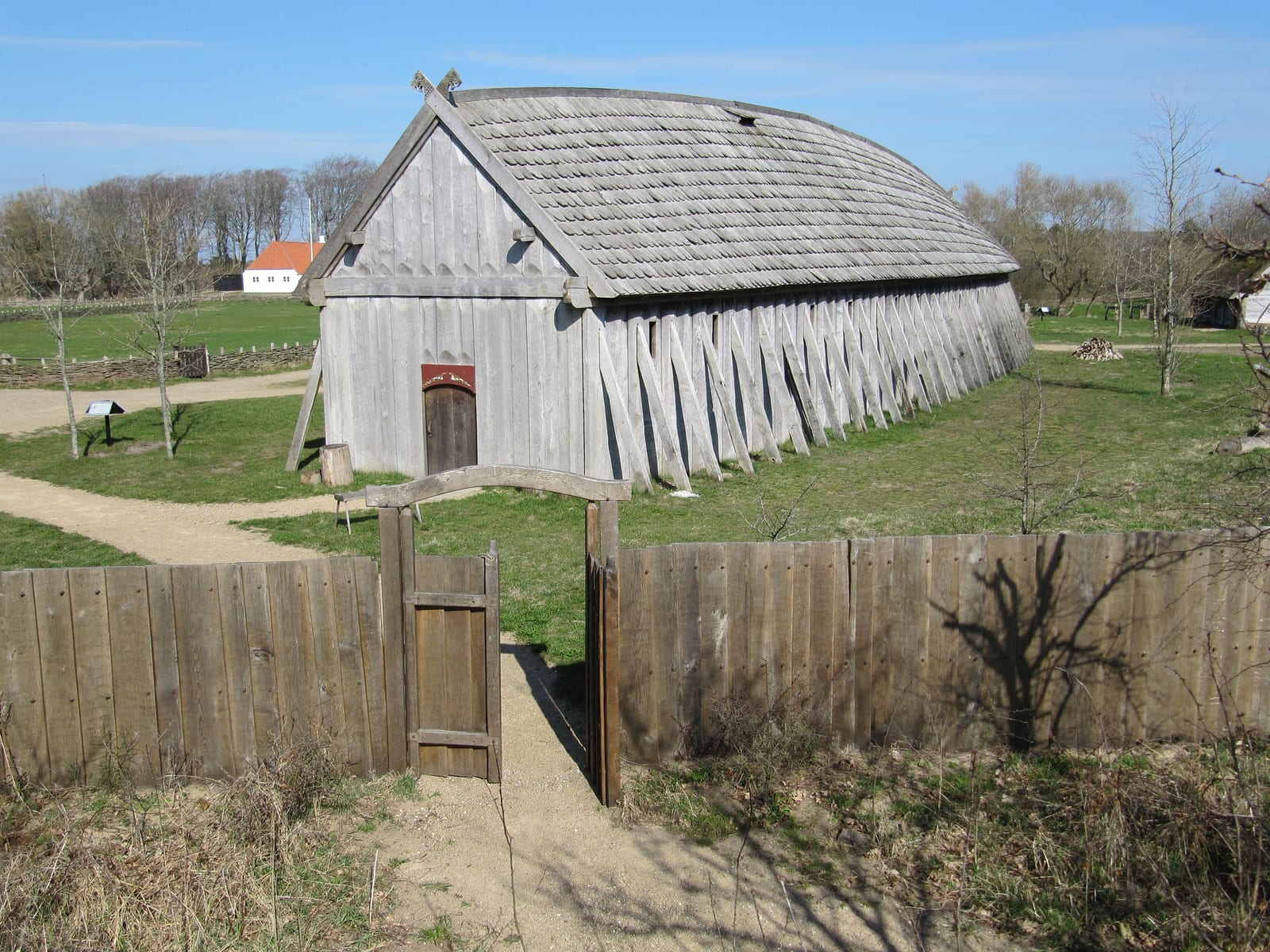
That loss of importance is precisely what saved the old town. Ribe never industrialised, so the medieval street plan survived intact, and because the Viking Age market lies directly beneath it, almost every building trench produces new finds. The objects are displayed at the Museum Ribes Vikinger in town, while the Ribe VikingeCenter to the south reconstructs the marketplace, a farmstead and a working smithy based on the excavated evidence.
Our Assessment
Ribe quietly corrects a story most people have absorbed. In the popular version the Viking Age opens with a burning monastery. In Ribe it opens with a surveyor’s ditch, a bead workshop and a handful of silver coins, almost a hundred years earlier. Anyone wondering how Norse crews could appear off English coasts so abruptly after 793 will find part of the answer here. The ships, the routes, the contacts and the working knowledge of foreign shores had all been assembled through trade.
A sober caveat belongs with that enthusiasm. Ribe is extraordinarily well dated, but politically it stays blank. We know somebody organised the market, and we have no name, no title and no written word about them. Calling it a royal foundation is reasonable guesswork rather than evidence, and it is better to leave that gap open than to plug it with a good story. What remains is still striking: a town whose birth certificate lies in the soil, legible to within a decade.
Hero image source: Hjart (CC BY-SA 4.0), via Wikimedia Commons