History
Jarlshof in Shetland: A Viking Settlement at the Edge of the World
Jarlshof Shetland Viking longhouses sit on 4,000 years of building. What the excavation really proves, and why the famous name was invented by a novelist.
Contents
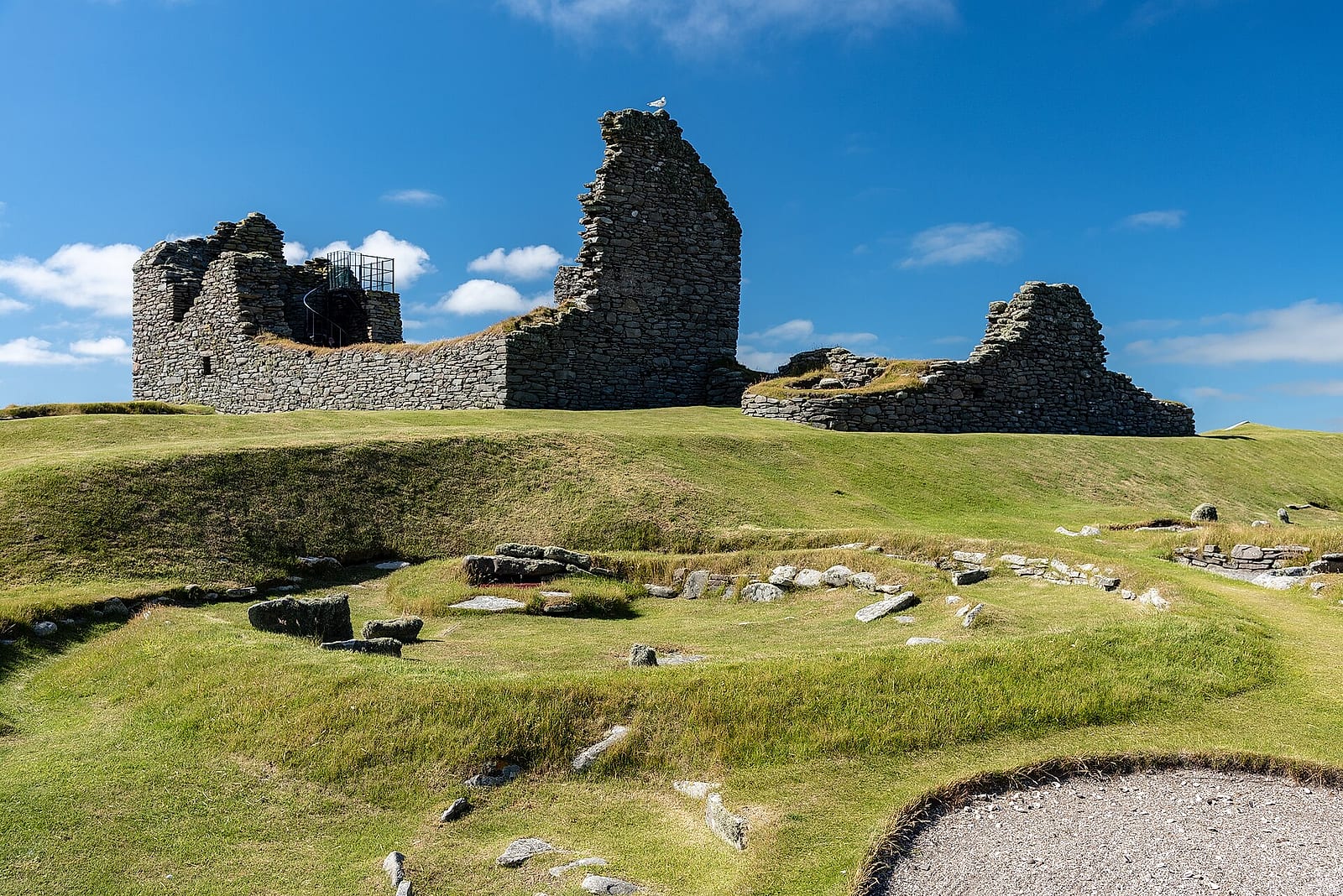
Walk to the southern tip of Shetland’s Mainland, past the end of Sumburgh airport’s runway, and the ground simply stops at the sea. On that last stretch of grass sits a low mound that looks like nothing at all. It is one of the densest archaeological sites in northern Europe. The Jarlshof Shetland Viking farm is only one chapter of it: beneath the same turf lie Bronze Age houses, an Iron Age broch, wheelhouses, Pictish traces, Norse longhouses and finally the gable of a sixteenth-century laird’s house. Four thousand years of people choosing the same bay.
That stacking is what makes the place unusual. Most Viking Age settlements are excavated in isolation, leaving archaeologists to guess what came before and what followed. At Jarlshof the whole sequence is in one section of earth, and the Norse arrival of the ninth century can be read against what was already standing there.
Why Everyone Kept Building on the Same Mound
Sumburgh Head offers the short list of things a northern settlement actually needs. A shelving beach where boats can be pulled up. Fresh water. Sandy, workable soil for barley. Peat within walking distance, driftwood on the shore and seabird colonies on the cliffs. People found that combination attractive in 2500 BC and were still finding it attractive in AD 1600.
| Period | What stood on the site |
|---|---|
| from c. 2500 BC | Late Neolithic and Early Bronze Age oval stone houses with hearths and stock pens |
| Late Bronze Age | A bronze smith’s workshop, with clay moulds for axes and swords |
| Iron Age | A roundhouse, then a broch whose seaward half has long since fallen into the surf |
| c. 2nd to 4th century AD | Wheelhouses, with cells arranged like spokes around a central floor |
| Pictish period | Occupation layers and small finds, including painted pebbles |
| 9th to 14th century | Norse longhouses in a succession of rebuilds |
| 16th century | The Stewart lairds’ house, the ruin visible from the road today |
Nothing here was preserved deliberately. The mound grew because each generation levelled the previous one and built on the rubble, and the sea has been quietly eating the western edge ever since.
A Storm Did the First Excavation
No archaeologist found Jarlshof. A gale in the winter of 1896-97 tore open the bank along the shore and exposed masonry nobody knew was there. The landowner, John Bruce, started digging soon after, in the manner of a Victorian gentleman antiquarian rather than a scientist.
Proper work began in the 1920s and 1930s under Alexander Ogston Curle, formerly director of the National Museum of Antiquities of Scotland. John R. C. Hamilton then took over for the Ministry of Works and published Excavations at Jarlshof, Shetland in 1956, still the foundation of everything written about the site. Hamilton’s achievement was to turn a baffling tangle of walls into a readable sequence of phases.
It is worth being honest about the limits of that achievement. Hamilton dated his phases largely by stratigraphy and by comparing artefacts, because radiocarbon dating was in its infancy while he worked. The broad order of the periods is secure. The precise year attached to any individual house is not. Our editorial advice when reading about Jarlshof: treat the sequence as solid and the calendar dates as working estimates.
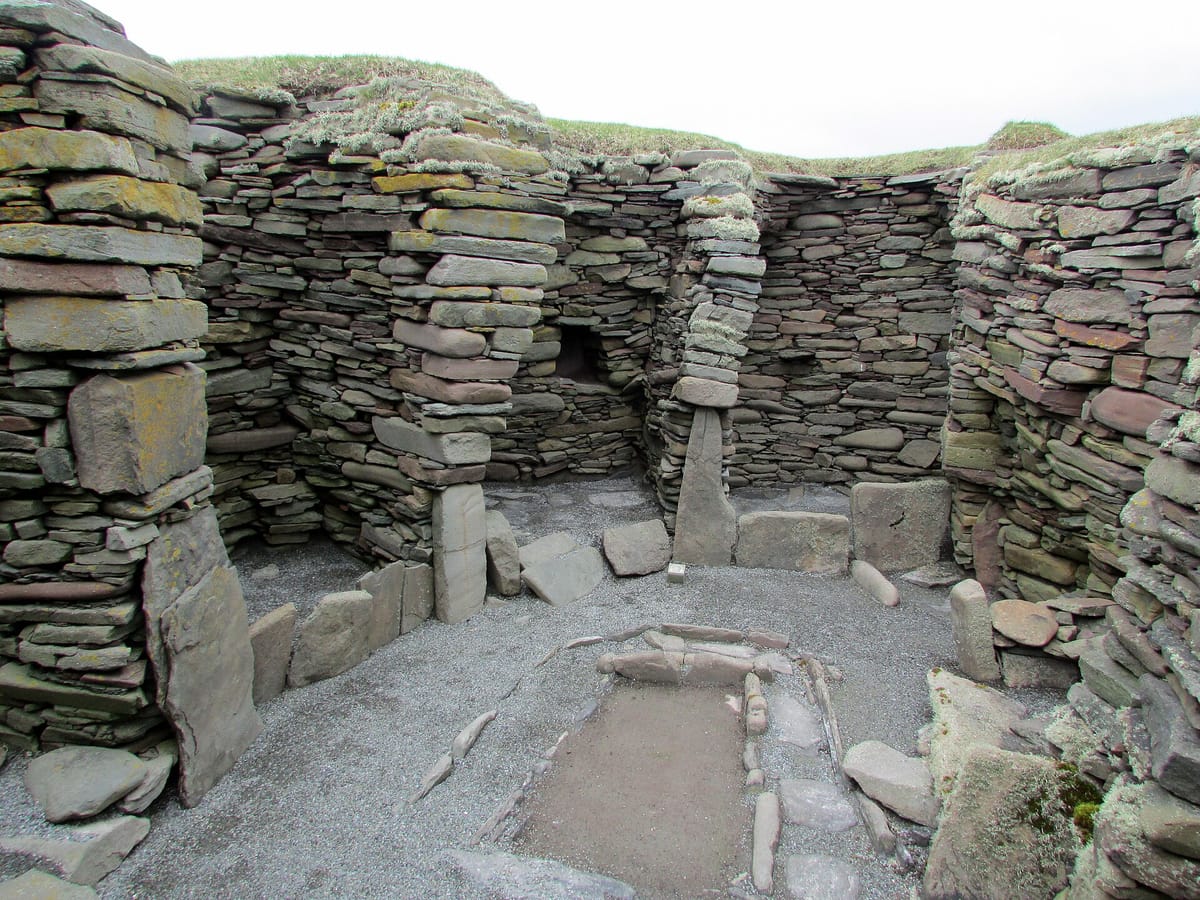 Image source: Reading Tom (CC BY 2.0), via Wikimedia Commons
The Viking Longhouses of Jarlshof, Shetland
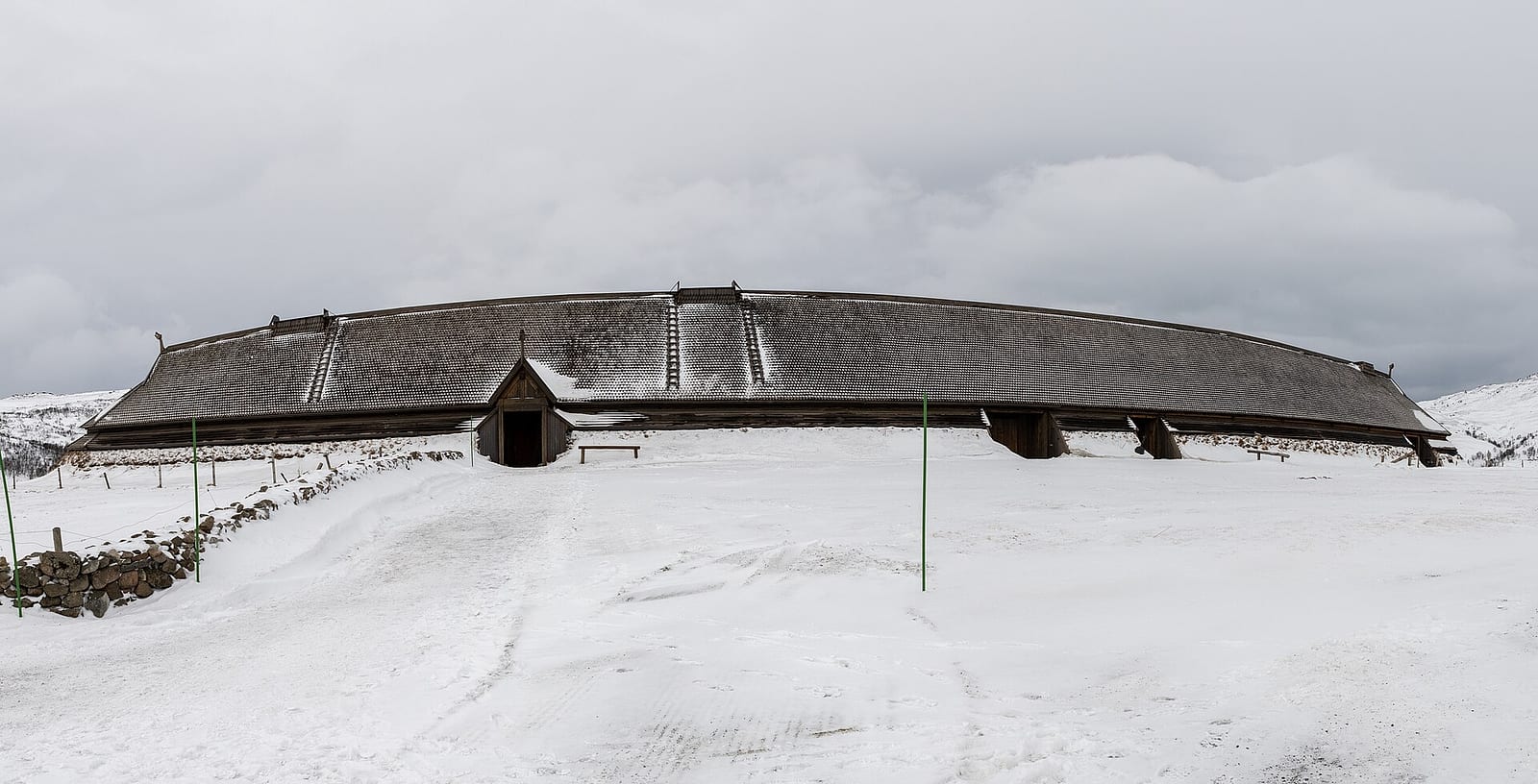
Early in the ninth century, settlers from western Norway put up their first longhouse beside the abandoned wheelhouses. The plan is the familiar one: a long, narrow room with a central hearth, raised earth benches along both walls, walls of stone and turf, a roof carried on timber posts. Heat came from peat, which Shetland has in abundance, and cooking was done with hot stones.
Over the following centuries that house was not simply inhabited. It was replaced, again and again, each new farm sliding slightly across the site like cards pushed over a table. The layout changed with it. The single long hall gave way to separate buildings: a dwelling, a byre for cattle, a barn, a kiln for drying barley before it could be ground, and a small smithy. The same drift from one hall to a scatter of specialised outbuildings turns up across the North Atlantic, from Iceland to the Hebrides. Our piece on everyday Viking life looks at what went on inside those walls.
What is missing matters as much as what survives. There is no rampart, no weapon burial, no destruction layer. Nobody garrisoned this place. Jarlshof records farmers and fishermen, the undramatic majority of the Viking Age, and that is precisely why it is worth more than another hoard.
The Finds: A Working Farm, Not a Treasure House
Measured against the site’s fame, the Norse finds are modest. They are also unusually informative, because they are the ordinary equipment of a household rather than the contents of a rich grave.
| Find group | What it tells us |
|---|---|
| Steatite bowls and baking plates | Soapstone almost entirely replaced pottery in Shetland, quarried locally at sites such as Catpund near Cunningsburgh |
| Steatite line sinkers and net weights | Fishing was structural to the economy, not a sideline |
| Loom weights and spindle whorls | Cloth production indoors, probably including wadmal and sailcloth for trade |
| Bone pins and combs | Domestic craft, partly worked from imported antler |
| Incised slate fragments | Doodles of ships, animals and a bearded human head: the site’s most celebrated small finds |
| Fish bone, mainly cod and ling | Rising sharply in the later Norse levels |
Those scratched slates deserve a second look. They are not commissioned art. They are what somebody produced with a flake of slate and an idle hour: a vessel under a square sail, a beast with its jaws open, a face with a beard and a pointed helmet. Objects made for no audience bring you closer to the people than any ceremonial deposit.
The fish bone tells a story too. Its increase in the later layers fits a pattern the archaeologist James Barrett traced right across the North Atlantic around AD 1000, as fish shifted from household food to a dried, shipped commodity. Shetland sat exactly where that trade needed it to sit.
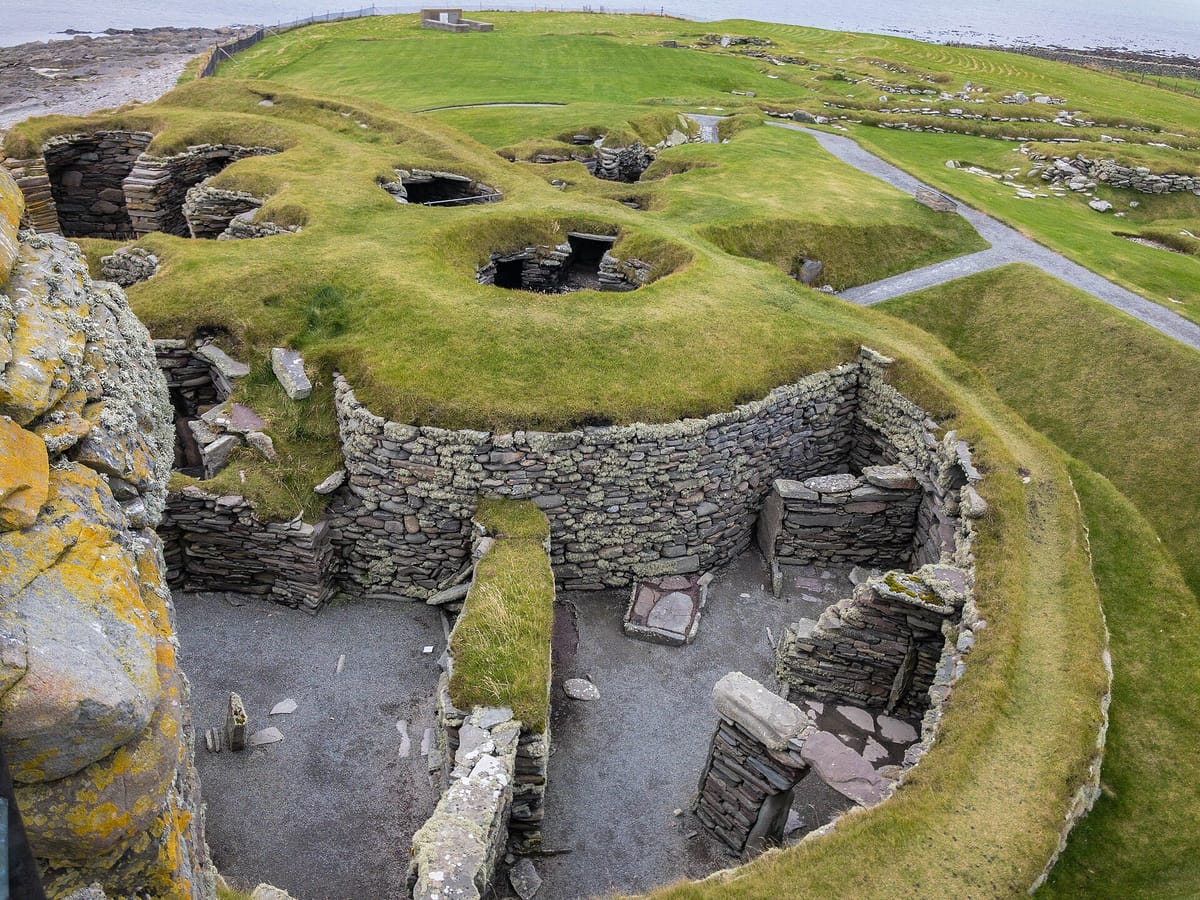 Image source: Stephan Ridgway (CC BY 2.0), via Wikimedia Commons
Shetland Became Norse and Stayed Norse for Centuries
Jarlshof is the best-studied point in an island group that was comprehensively reshaped. Shetland place names are overwhelmingly Norse: voe, wick, setter, ness, gard. Almost nothing survives from the naming layer that must have existed before, and that absence sits at the heart of a long argument. The Shetland historian Brian Smith has read it as evidence that the Pictish population was violently displaced. Others argue for rapid cultural assimilation, in which names and language changed while the people largely stayed. Jarlshof supplies material for both readings and settles neither.
Politically the islands stayed northern far longer than most people assume. Only in 1469 did Christian I of Denmark and Norway pledge Shetland to the Scottish crown as part of the dowry of his daughter Margaret on her marriage to James III; Orkney had been pledged the year before. The pledge was never redeemed. The language lasted longer still: Norn, the island tongue descended from Old Norse, faded out of daily use only during the eighteenth and early nineteenth centuries. That Norse culture reached deep into Scotland is clear elsewhere too, not least from the Lewis chessmen found in the Outer Hebrides.
Sailing west from Bergen, a crew reached Shetland faster than a rider could reach Oslo overland. These islands were never the edge of the Norse world. They were a staging post in the middle of its sea roads.
Myth and Fact at Jarlshof
Few Scottish sites attract as many attractive untruths. A plain comparison helps.
| Claim | What the evidence supports |
|---|---|
| Jarlshof is the old Norse name of the place | Invented by Walter Scott for his novel The Pirate (1821-22); the Viking Age name is unknown |
| The site is a Viking settlement | Only in part; the Norse phase is one of at least five periods of occupation |
| A jarl held court here | No evidence of a lordly seat; the finds describe a substantial farm |
| The Norse arrived to find empty land | Picts lived here first; only their fate is disputed |
| Up Helly Aa is a surviving Viking rite | The Lerwick fire festival took its Norse form in the 1880s |
| The ruin on the mound is Norse | It belongs to the Stewart laird’s house of the late sixteenth century |
The naming is the best joke in the whole story. Scott visited Shetland in 1814 on an inspection voyage with the lighthouse engineer Robert Stevenson, saw the ruin above the bay, and turned it into the mansion “Jarlshof” in his novel. The name later attached itself to an entire settlement that had not yet been discovered. Scotland’s most famous Viking site is named after a location in a work of fiction.
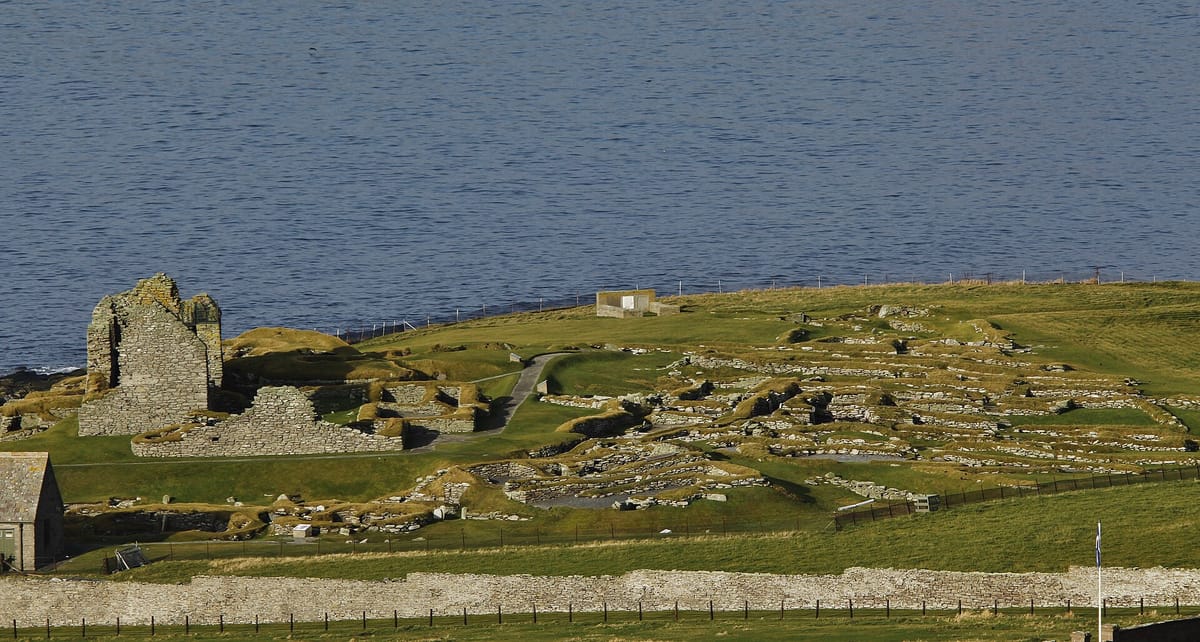 Image source: Ronnie Robertson (CC BY-SA 2.0), via Wikimedia Commons
What the Site Is Really Worth
Jarlshof is in the care of Historic Environment Scotland, with a small visitor centre explaining the layers; the finds are held by Shetland Museum in Lerwick and National Museums Scotland. Standing there, the first impression is underwhelming. Low wall lines, grassy humps, a few openings into dark cells. The effect arrives on second thought, when you realise that each wall belongs to a different millennium.
The surrounding area rewards the trip as well. Old Scatness lies three kilometres away, found during road works in 1975 and excavated by the University of Bradford between 1995 and 2006, with a broch and an Iron Age to Pictish village. Further north stands the broch of Mousa, which appears in both Orkneyinga saga and Egils saga. And in 1958 a Pictish silver hoard came to light on St Ninian’s Isle, buried in roughly the years when Norse ships were becoming a regular sight.
Our verdict: the site is marketed as a Viking place, but its real value lies just to one side of that label. It shows that the Norse takeover of Shetland was not a single violent moment but a transfer that played out across generations in house plans, soapstone bowls and fish bones. Tell the Viking Age only through raids and you lose almost everyone who actually lived it: people cutting peat, drying barley, and scratching a ship into a scrap of slate because the evening was long.
Hero image source: Mustang Joe (CC0), via Wikimedia Commons