History
The Great Heathen Army: The Invasion of England
In 865 the Great Heathen Army landed in East Anglia - the conquest of Northumbria, the killing of King Edmund, and the birth of the Danelaw.

Contents
- The Opening Move: Landing in East Anglia, 865
- Chronicle of a Conquest: The Key Stages
- York Falls: The End of Northumbria
- The Death of Edmund: A Kingdom Extinguished
- 871: The Year of Battles
- What the Archaeology Confirms: Repton and Torksey
- What Became of the Leaders
- The Legacy: The Danelaw and Permanent Settlement
In the year 865, a force landed on the coast of East Anglia unlike anything England had seen before. The Anglo-Saxon Chronicle simply calls it the mycel hæþen here, the “Great Heathen Army” - not an ordinary raiding party, but a force that stayed for over a decade, brought down three of the four major Anglo-Saxon kingdoms, and eventually left an entire region under Danish rule. What began as a landing ended as a political reordering of England, one whose traces still show up in place names and legal traditions today.
The Opening Move: Landing in East Anglia, 865
Unlike the notorious hit-and-run raids of earlier decades, such as the raid on Lindisfarne in 793, the Great Heathen Army was oriented toward conquest from the start, not quick plunder. The Chronicle records that the force wintered in the kingdom of East Anglia, where the local king supplied the Vikings with horses, likely as a form of tribute meant to spare his own territory for the time being. That strategy of buying peace would prove, in hindsight, shortsighted.
Later sources, chiefly the Norse sagas, name the army’s leaders as sons of the semi-legendary Ragnar Lodbrok: Ivar the Boneless, Halfdan Ragnarsson, and Ubba. How much of that family connection holds up historically remains disputed among scholars - contemporary English sources name the leaders, but the genealogical link to Ragnar comes largely from much later Icelandic sagas, which need to be read with caution.
Chronicle of a Conquest: The Key Stages
| Year | Event |
|---|---|
| 865 | Landing in East Anglia, wintering, tribute paid by the East Angles |
| 866-867 | Capture of York, collapse of the kingdom of Northumbria |
| 869 | Return to East Anglia, death of King Edmund |
| 870s | Campaigns against Mercia, large areas fall under Danish control |
| 878 | Defeat by Alfred the Great at Edington |
| 878-886 | Treaty of Wedmore, formation of the Danelaw |
This table already reveals the pattern that runs through the entire campaign: one kingdom after another is destabilized, conquered, or forced into paying tribute, while the army regroups and moves on depending on the military situation.
York Falls: The End of Northumbria
In 866 the army pushed north and captured York, the capital of the kingdom of Northumbria, which was already weakened at the time by an internal power struggle between two rival kings, Ælla and Osberht. When both kings jointly attempted to retake the city the following year, the counterattack ended in a crushing defeat for the Anglo-Saxons. Both kings were killed in the fighting.
Norse saga tradition claims Ælla was executed through the gruesome “blood eagle” ritual - a story most modern historians treat as later literary embellishment rather than a reliable historical account.
York remained under the army’s control from then on and developed over the following decades into Jorvik, one of the most important Viking trading centers in England - a fact that shows military conquest was quickly followed by economic settlement, not just devastation.
The Death of Edmund: A Kingdom Extinguished
In 869 the army returned to East Anglia, whose king had apparently hoped that tribute payments would buy lasting tolerance. That hope went unfulfilled: King Edmund was defeated in battle, captured, and killed. Later hagiography, especially the Passio Sancti Eadmundi, written by Abbo of Fleury in the late 10th century, cast Edmund’s death as a martyrdom - he supposedly refused to renounce his Christian faith and was tied to a tree and shot full of arrows as a result.
How historically accurate this richly detailed account actually is can hardly be verified a century after the events themselves, but the cult of Saint Edmund grew quickly into one of the most significant in all of England - the town of Bury St Edmunds still carries his name today.
Listen to Ragnarök while you read on, an epic album that captures the sheer force of these invasion years:
871: The Year of Battles
In 871 the army was reinforced by the arrival of a second fleet, which the Anglo-Saxon Chronicle calls the micel sumorlida, the “Great Summer Army.” That same year saw a whole series of battles against Wessex, whose exact number the Chronicle records with remarkable precision: at least nine major clashes within a few months, including the battles of Reading and Ashdown.
At Ashdown, Alfred’s older brother, King Æthelred of Wessex, still led the Anglo-Saxon forces alongside Alfred himself, and won one of the few clear victories of that grim year. Æthelred died shortly afterward, likely from illness or wounds sustained in battle, and Alfred ascended the throne of Wessex that same year - under about as unfavorable circumstances as imaginable, in the middle of the invasion’s most brutal year.
What the Archaeology Confirms: Repton and Torksey
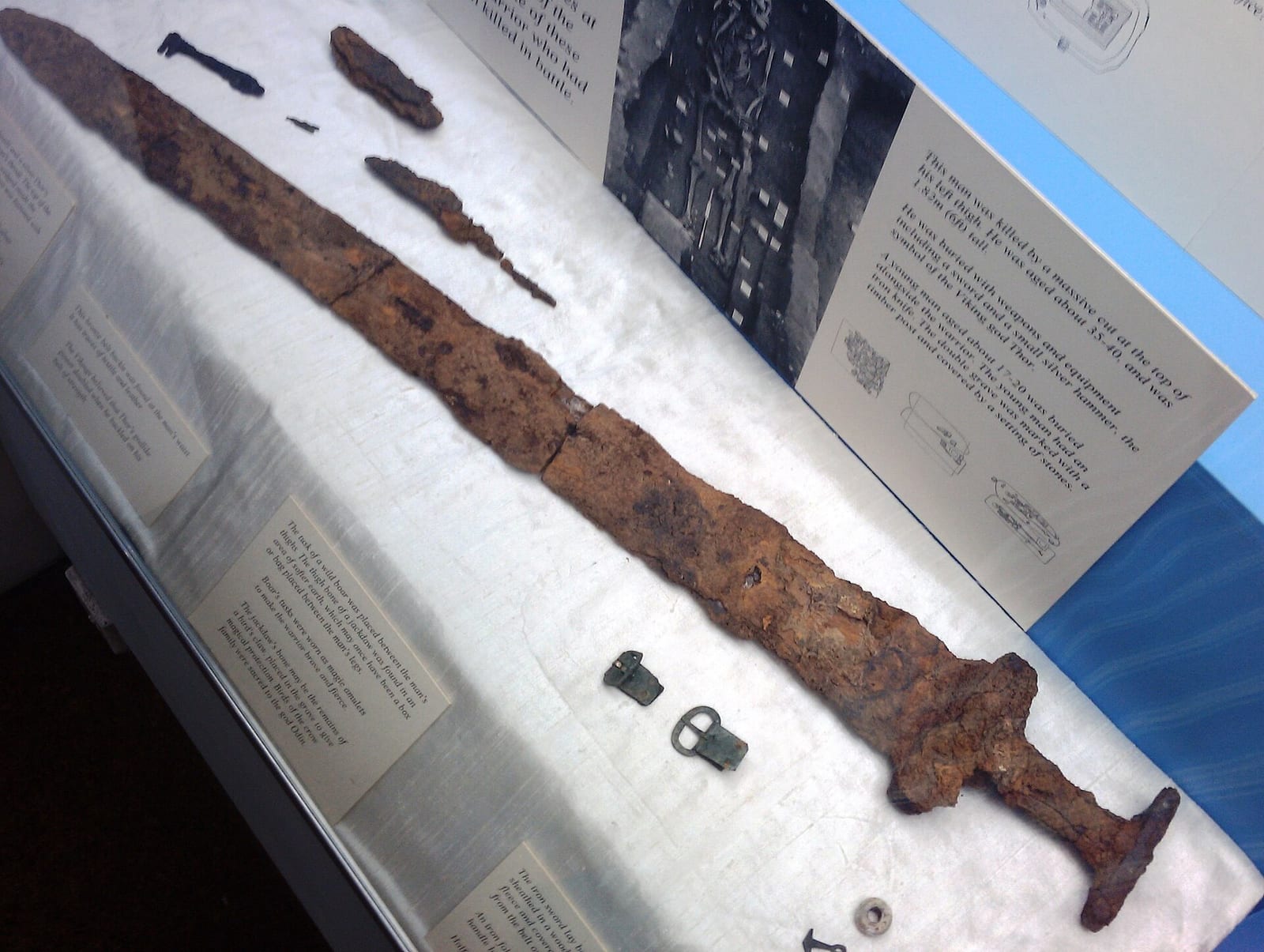
For a long time, our picture of the Great Heathen Army rested almost entirely on written sources. That changed with excavations at the English site of Repton, where the army is documented to have wintered in 873/874. Archaeologists found the remains of a fortified, D-shaped camp directly on the River Trent, along with a mass grave containing the remains of several hundred people, mostly men of fighting age, many bearing signs of violent trauma. Radiocarbon dating and dietary analysis of the remains support linking the site to the army’s winter camp.
Another significant site is Torksey in Lincolnshire, where the army camped over the winter of 872/873. Excavations and systematic metal-detecting surveys there recovered thousands of objects, from coins to weights to craft tools, pointing to a genuine temporary trade and craft center - not merely a military camp, but a kind of mobile Viking town where women and children also lived, as some of the grave goods suggest. These finds vividly confirm what the Chronicle only hints at: the army was far more than a pure fighting force, it was a mobile society with its own infrastructure.
What Became of the Leaders
The leaders’ later fates diverged sharply. Halfdan withdrew with part of the army to Northumbria in 875/876, where the Chronicle notes he began “sharing out the land among his men” - an early, direct record of permanent settlement taking hold. Ivar the Boneless appears in Irish annals under the name Ímar as a significant king of Dublin; his death is recorded there in 873, though historians disagree on whether Ímar and Ivar were truly the same historical figure. Guthrum, Alfred’s chief opponent in Wessex, took the Christian name Æthelstan after his defeat at Edington and went on to rule East Anglia as a recognized, baptized king - a striking example of how quickly a military enemy could become a politically integrated ruler.
The Legacy: The Danelaw and Permanent Settlement
Out of that treaty and the following decades emerged the so-called Danelaw, a vast region in eastern and northern England where Danish law and Danish customs applied, and where large numbers of Scandinavian settlers put down permanent roots. Unlike earlier raids, the Great Heathen Army ultimately aimed not just at plunder but at land itself - a fact still visible today in hundreds of English place names with Scandinavian endings like “-by” or “-thorpe,” found in towns like Derby, Whitby, and Scunthorpe.
Our take: what sets the Great Heathen Army apart from earlier Viking raids isn’t its brutality, but its staying power and strategic calculation. Instead of hitting isolated coastal sites, it systematically targeted entire kingdoms, negotiated when it paid off, and settled the moment military success made lasting control possible. If you want to understand how feared raiders like the berserkers eventually became settled lords of the land, this decades-long campaign is one of the most revealing examples from the entire Viking Age.