Mythology
Helheim: The Norse Underworld Explained
Helheim explained: who is Hel, what did the journey to the Norse underworld involve, and why was it a place of exhaustion rather than punishment.
Contents
- Who Was Hel? Daughter of Loki, Sister of the Apocalypse
- The Hall, the Hunger, and the Household Staff
- The Road to Helheim: the River Gjoll, the Bridge, and the Hound at the Cave
- Helheim Is Not Hell: a Confusion With a Long History
- Helheim Compared: Where the Dead Actually Went
- Helheim and Ragnarok: the End of the Underworld
- What Helheim Reveals About the Norse Worldview
Ask most people what the Norse afterlife looked like and they picture Valhalla: a golden hall, fallen warriors, an eternal drinking contest. In reality, Helheim was the far more likely destination for anyone living in the Viking Age. Valhalla only took those who died in battle, and even then only half of them, the rest went to Freyja’s Folkvangr. Anyone who died of illness, old age, or an accident, which is to say almost everyone, ended up instead with Hel, Loki’s daughter, in her cold realm deep beneath the roots of Yggdrasil.
That is the first misconception worth clearing up: Helheim was not a place of punishment. Unlike the Christian hell with which its name later merged, Helheim was simply the ordinary destination for an ordinary death. No judgment, no sin, no damnation, just cold, silence, and a ruler who administered her realm with a thoroughness that apparently impressed even Snorri Sturluson.
Who Was Hel? Daughter of Loki, Sister of the Apocalypse
According to Snorri Sturluson’s Prose Edda, specifically the section called Gylfaginning, Hel is one of three children Loki fathered with the giantess Angrboda. Her siblings are the wolf Fenrir and the world serpent Jormungandr, two beings who will tear the world apart in fire and flood at Ragnarok. Odin, recognizing the danger these offspring posed, scattered the three: Fenrir was bound in chains, Jormungandr was thrown into the world ocean, and Hel was sent down to Niflheim, given authority over nine worlds and over everyone who dies of sickness or old age.
Snorri describes her appearance in imagery that still resonates: half her body a normal, living skin tone, the other half blue-black like a corpse. Hel is herself a creature of the threshold, half alive, half dead, which makes her a fitting ruler over a realm that is neither heaven nor punishment, simply the end.
The number nine, which Snorri uses to describe the scope of Hel’s authority, is no arbitrary figure in Norse mythology. Nine worlds hang along the branches and roots of Yggdrasil, the world tree we cover in a dedicated article of its own, and the number recurs throughout eddic poetry as a kind of unit for cosmic order, including the nine nights Hermod later needs for his ride to Helheim. That Hel is described as ruling over so many worlds underscores just how central her office actually was within the wider mythological structure, even though modern retellings often reduce her to a minor figure standing in the shadow of her more famous siblings.
The Hall, the Hunger, and the Household Staff
What Snorri tells us about Hel’s possessions reads almost like a grim joke. Her hall is called Eljudnir, her plate Hungr (Hunger), her knife Sultr (Famine). Her manservant is named Ganglati, her maidservant Ganglot, both names meaning roughly “the slow one.” The threshold to her house is called Fallanda Forad, “stumbling peril,” and her bed is Kor (sickbed).
Snorri Sturluson, Gylfaginning: Hel was given power over nine worlds, so that she must provide lodging for all who are sent to her, namely those who die of sickness or old age.
This list of names is no accident and no filler from a bored medieval scribe. It describes a kind of anti-household. Where a Norse farmstead stood for hospitality, full plates and quick, useful servants, Hel’s house offers the exact opposite: slowness, hunger, a sickbed instead of a seat of honor. Arriving in Helheim brought no punishment, but no comfort either, only the sober continuation of what death had usually already involved: exhaustion and lack.
The Road to Helheim: the River Gjoll, the Bridge, and the Hound at the Cave
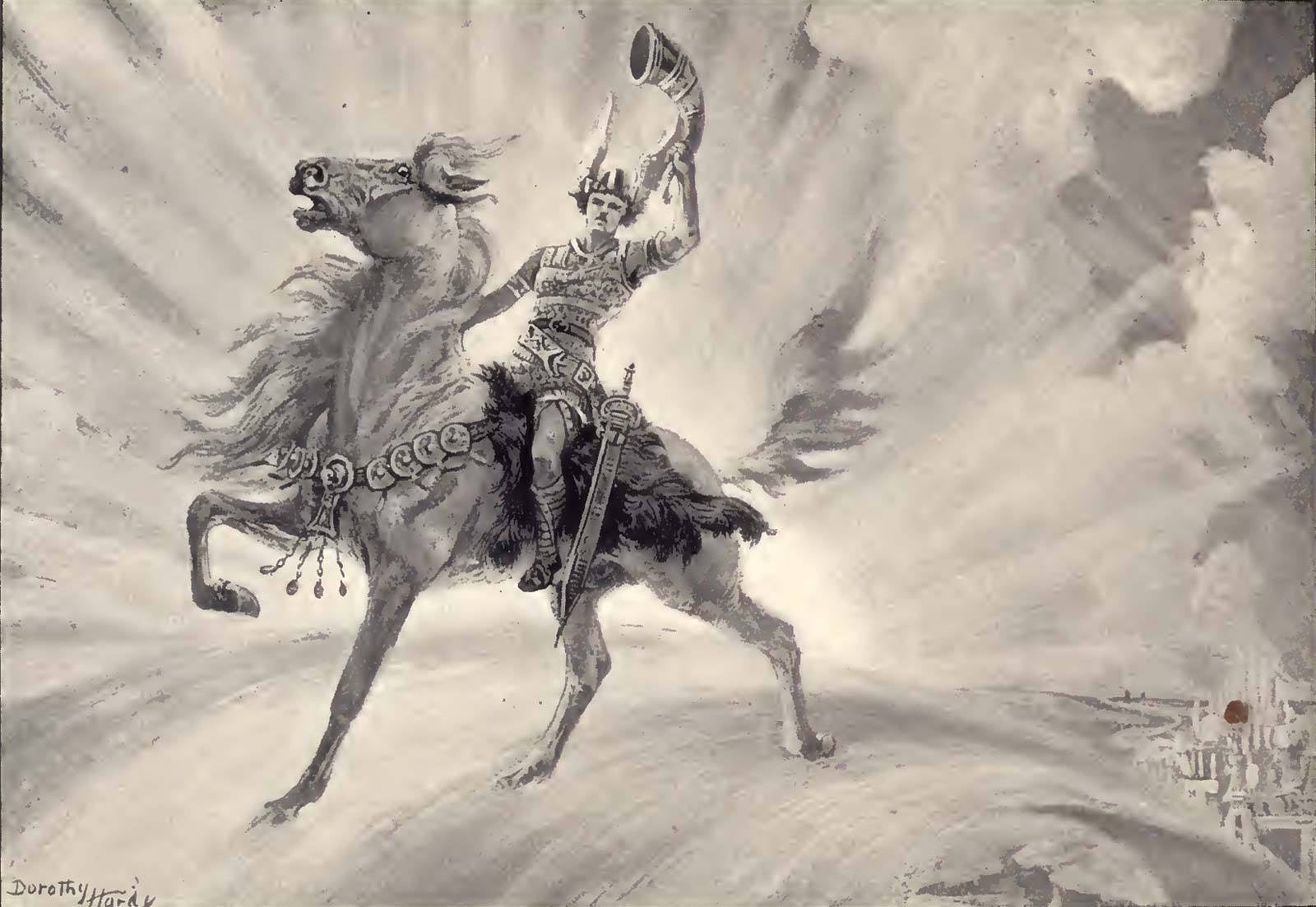
Helheim becomes most concrete not in the Prose Edda’s general description but in the eddic poem Baldrs draumar and in Snorri’s account of Baldr’s death. When the shining god Baldr dies, his brother Hermod rides Odin’s horse Sleipnir for nine nights through deep, dark valleys to try to bring him back. The road crosses the river Gjoll on a bridge paved with glowing gold and guarded by a giantess named Modgud. She asks every rider their name and lineage, telling Hermod that just the day before, five whole companies of dead men had ridden across the same bridge, and made less noise doing it than he does alone.
Beyond the bridge stands a high gate, which Hermod clears on horseback in a single leap, and beyond that lies Hel’s hall itself. Another frequently mentioned location is the cave Gnipahellir, guarded by a blood-stained hound named Garm, who will break loose at Ragnarok. Some scholars identify Garm with Fenrir, others treat them as separate beings; the sources themselves are not conclusive here, and that uncertainty is worth stating plainly rather than papering over.
Helheim Is Not Hell: a Confusion With a Long History
The similarity in sound has caused centuries of confusion. Hel and the Christian hell sound almost identical, and they do share a common root: a Proto-Germanic verb meaning “to conceal, to cover.” Both words describe, etymologically, a hidden place. But the meanings drifted apart. The Christian hell is a place of punishment for sinners, morally sorted, full of fire and torment. Helheim knows no such sorting. Arriving there meant you had done nothing wrong, only that you had not died in battle.
Later manuscripts, already heavily shaped by Christian thinking, increasingly blend the two ideas, which is exactly why caution is needed when reconstructing pre-Christian Norse belief. Religious historian Hilda Ellis Davidson made precisely this point in her work on Norse concepts of death: the later a manuscript, the more likely it has tinted the old image of Hel with Christian color.
Interestingly, Norse mythology did have a location that comes much closer to the Christian hell in substance, it just was not Helheim. The Voluspa, the oldest and most important source for eddic apocalyptic poetry, describes a hall called Nastrond, the “corpse shore,” far from the sun, its doors facing north, its walls woven from serpents’ backs, with venom dripping through the smoke hole. There, the poem says, oath-breakers, murderers, and seducers of other men’s wives must wade through heavy streams of poison, while the dragon Nidhogg feeds on the bodies of the dead. That detail matters: moral punishment after death was not a foreign concept to Norse belief, it simply happened in a completely different place from Hel’s realm, which remained the ordinary last address even for the most upright people.
Helheim Compared: Where the Dead Actually Went
Norse mythology never had one single, unified afterlife. It had several, sometimes contradictory, destinations depending on how and who had died, a variety that gets erased whenever Valhalla is treated as a stand-in for “the Norse afterlife.”
| Realm | Who goes there | Ruler |
|---|---|---|
| Helheim | most people, death by age or illness | Hel |
| Valhalla | half of those who fell in battle | Odin |
| Folkvangr | the other half of those who fell in battle | Freyja |
| Ran’s realm | those drowned at sea, in some sources | the sea giantess Ran |
| The burial mound | some sagas describe the dead remaining in their own mound | - |
Our assessment, after comparing the sources: this division was less a carefully engineered theology than a collection of local and literary ideas that Snorri only pulled into a semblance of order in the 13th century. For ordinary people in the Viking Age, Helheim was probably just the sober, unremarkable default expectation, not something anyone spent much time worrying about while healthy. For the far more famous alternative, see our article on Valhalla and the fallen warriors.
Helheim and Ragnarok: the End of the Underworld
Helheim is not a permanently stable place. At Ragnarok, the end of the world, the underworld itself breaks open: the ship Naglfar, built from the nails of the dead, sets sail from there, and the hound Garm tears free of his chain at Gnipahellir. Even death, the mythology suggests, is not a final resting state but part of a cycle that stirs again at the end of time. Our article on Ragnarok and the fall of the gods covers that connection in more depth.
What Helheim Reveals About the Norse Worldview
In the end, Helheim is less sinister than its name sounds today. It is a realm without moral judgment, without a tribunal, carrying only the uncomfortable truth that most people’s lives ended not as heroes but as the exhausted or the sick. That honesty is exactly the point: a society that glorified death in battle still knew perfectly well that most of its members died differently, and it built them a cold but far from cruel home of their own.
Anyone exploring Norse mythology today tends to run into Valhalla first, simply because it is the flashier, more martial story. Helheim deserves just as much attention, precisely because it is the more honest one. It does not tell you how to be remembered as a hero, it tells you how an entire culture made peace with the plain, universal fact of ordinary dying: without glorification, without threat, just a cold roof overhead and a ruler who took her job seriously.