Mythology
Baldr: The Death of the Shining God
Baldr god death explained: Frigg's oaths, the mistletoe, blind Höðr, Loki's trick and Hermod's ride to Hel, and why one killing sets Ragnarok in motion.
Contents
No other killing in Norse myth sets so much in motion. The death of Baldr, the god Snorri Sturluson describes as the brightest and most blameless of the Aesir, comes from a sprig of plant nobody thought worth mentioning. It is not a private tragedy but the hinge on which the whole cosmology turns, the point after which the clock runs down toward Ragnarok. If you want to know why Viking Age Scandinavians told the end of the world as the consequence of a murder inside one family, this is where you start.
The sources are unusually rich for once. Snorri’s Prose Edda carries the fullest narrative, several poems in the Poetic Edda preserve older and terser versions, and Saxo Grammaticus offers a Latin retelling so different it barely looks like the same myth. They contradict each other in important places, which is what makes them worth reading side by side.
Who Baldr Actually Was
In Gylfaginning, Snorri runs out of superlatives fast. Baldr is the second son of Odin and Frigg, the best of the gods, praised by everyone, so fair that light seems to come off him. As proof he offers a plant that still carries the name: Baldrs brá, “Baldr’s eyelash”, the brilliantly white scentless mayweed. A god you name a meadow flower after is not a war god.
His hall is Breidablik, “the broadly gleaming”, where nothing impure is said to survive. He is married to Nanna, and their son Forseti settles legal disputes from a hall called Glitnir. This branch of the pantheon is about judgment and order, a theme most retellings skip.
One line of Snorri’s has puzzled translators for centuries: Baldr is so wise and eloquent that none of his judgments holds. Some read praise wrapped in paradox, others quiet irony. The name is no clearer. Old Norse baldr may connect to a Germanic root meaning “bold”, or to Old English bealdor, “lord”. Anyone who tells you it simply means “the shining one” is selling a guess as a fact.
Bad Dreams, Frigg’s Oaths and the One Exception
The story does not begin with the throw. It begins with insomnia. Baldr sleeps badly, and in a culture that read dreams as forecasts, that is a public matter. The gods convene, Frigg starts working, and Odin goes looking for knowledge in the least comfortable place available.
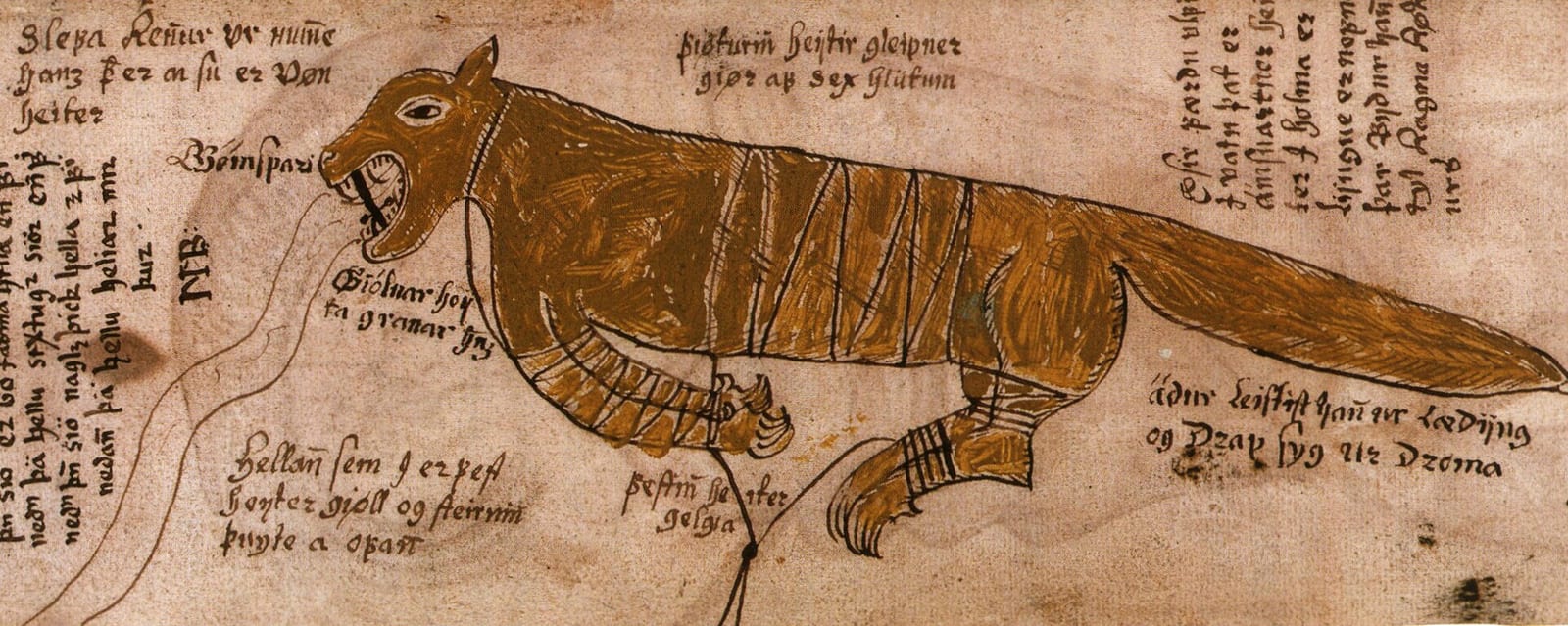
The Eddic poem Baldrs draumar covers the journey in a handful of cold stanzas. Odin saddles Sleipnir, rides down to Niflhel past a blood-spattered hound, and raises a long-buried seeress at the eastern gate with a corpse-charm. Her answer leaves no room: the mead is already brewed for Baldr, a shield laid over it, the benches made ready. And the one who will bring him down is Höðr, his own brother.
Odin keeps questioning until one of his questions gives him away. The seeress recognises him and falls silent. He rides home with the knowledge and no way around it: in Norse fate, foreknowledge buys preparation, never escape.
Frigg takes the legal route instead. She travels the world and extracts an oath from everything capable of doing harm: fire and water, iron and every metal, stones, earth, trees, sicknesses, animals, birds, poison, serpents. All of them swear. This is almost always described wrongly. Baldr is not made magically invulnerable; he is placed under contract, and the difference matters for everything that follows.
The gods turn it into entertainment. They stand Baldr in the middle of the assembly and shoot at him, strike at him, throw stones. Nothing touches him. Snorri presents this as a great honour, and you can feel how routine it had become.
One growing thing was skipped: the mistletoe, growing west of Valhalla, which Frigg judged too young to be asked. The choice of plant is quietly brilliant. Mistletoe is a hemiparasite that lives in the branches of another tree and never touches the ground, staying green while its host stands bare. A thing that is neither properly tree nor properly earth slips straight through an oath that sorts the world into categories. A footnote: mistletoe does not grow in Iceland, so Snorri worked from a tradition carried north from mainland Scandinavia.
Put Scar on while you read the rest:
The Death of Baldr: How a Blind God Became the Weapon
What follows is the most famous piece of scheming in the whole tradition. Loki takes the shape of a woman, calls on Frigg in her hall Fensalir, and asks casually what the gods are doing at the assembly. Frigg tells him about the oaths without hesitation. Asked whether truly everything had sworn, she names the exception and treats it as nothing.
Loki leaves, cuts the mistletoe, and returns to the assembly. Höðr stands at the edge of the ring doing nothing, because he is blind. Loki asks why he alone will not honour his brother. Höðr answers that he cannot see where to aim and has no weapon. Loki puts the shaft in his hand and points him in the right direction.
The sprig goes straight through Baldr, and he falls dead. Snorri calls it the greatest misfortune ever to befall gods and men. Then comes the detail that opens up the whole meaning: nobody could take revenge on the spot, because the place was a sanctuary where bloodshed was forbidden. The gods stand there unable to speak, unable to weep, unable to look one another in the face. Odin, Snorri notes, understood best what had been lost.
Hringhorni: The Largest Funeral in Norse Myth
The cremation is the most detailed funeral description in the entire Edda, and it reads like an inflated version of real Viking Age ship burials. Baldr is laid on his ship Hringhorni, the largest of all ships, and the gods cannot get it into the water.
So they send to Jotunheim for a giantess. Hyrrokkin arrives riding a wolf, using vipers for reins, and four berserkers are needed to hold the animal. She sets her shoulder to the prow and the ship goes into the sea so hard that fire springs from the rollers and the ground shakes. Thor, furious, reaches for his hammer to break her skull and has to be talked down. A small, awkward moment that says a lot about the mood that day.
Nanna sees her husband’s body and dies of grief on the spot. She is laid beside him. Thor consecrates the pyre with Mjölnir and kicks a dwarf named Litr into the flames when he strays underfoot. Odin lays his gold ring Draupnir on the fire, and Baldr’s horse goes on in full harness. Freyr comes in his boar-drawn wagon, Heimdall on Gulltopp, Freyja with her cats, and whole companies of giants attend without incident.
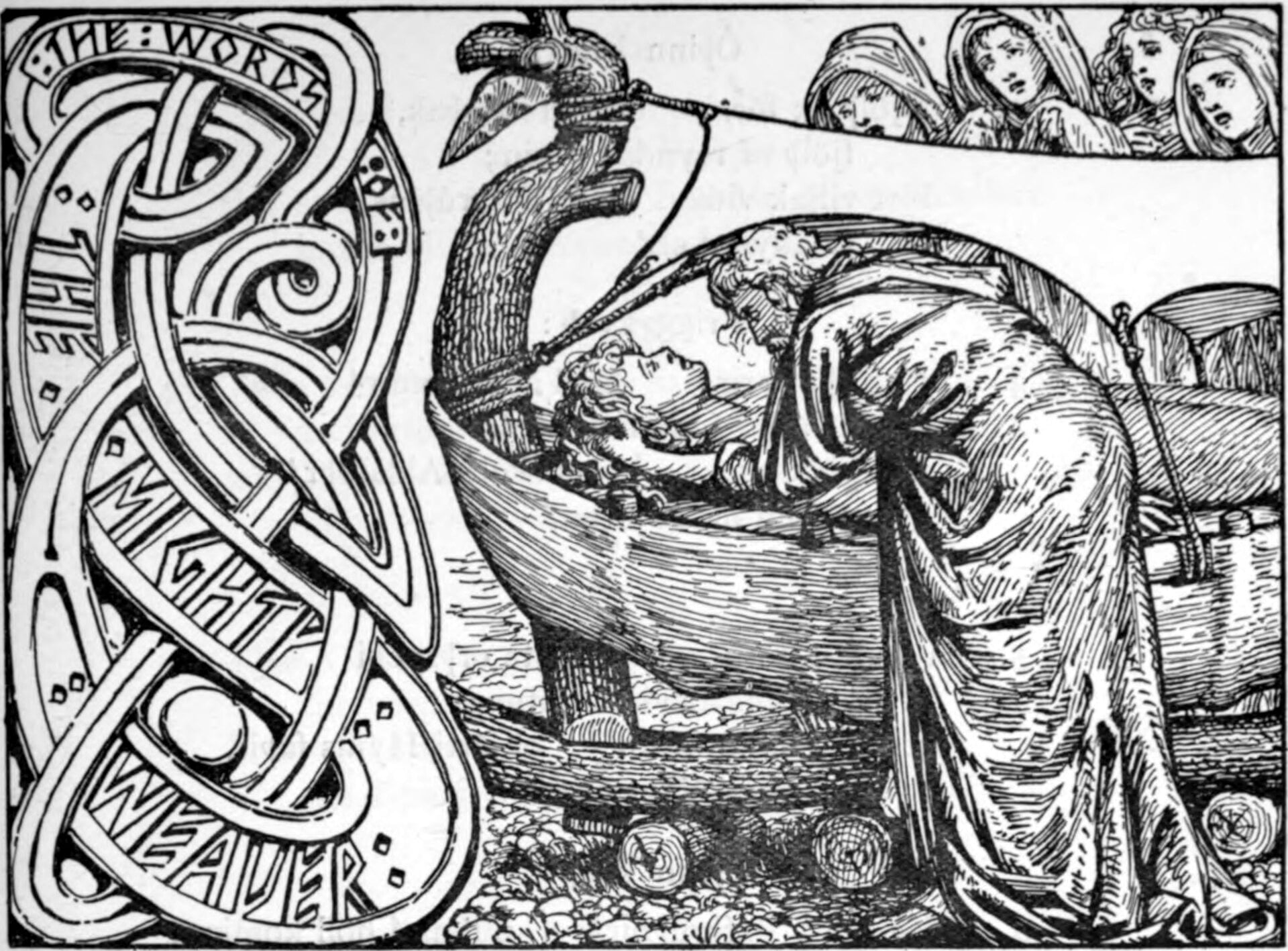
Before the fire is lit, Odin bends over the body and whispers something into his son’s ear. No source says what. Odin later uses that exact question in Vafthrudnismal as the one riddle no giant can answer. The historical illustration at the top of this article shows that moment.
Hermod’s Ride and the Giantess Who Would Not Weep
The gods do not give up. Hermod, another son of Odin, rides Sleipnir for nine nights through valleys so dark he can see nothing, until he reaches the gold-roofed bridge Gjallarbru. Its warden Modgud remarks that five troops of dead men crossed the day before and made less noise between them than he does alone.
In Hel’s hall he finds Baldr seated in the place of honour. Hel names a condition that sounds like Norse legal procedure and is quietly impossible: if every thing in the world, living and dead, weeps for Baldr, she will release him. Messengers ride out, and everything does weep, people, animals, earth, stones, trees and every metal. Snorri grounds the scene with an observation from real life, saying these things weep the way you have seen them do when they come out of frost into warmth.
Then the messengers find a giantess in a cave who calls herself Thökk, “Thanks”. She refuses.
“Thökk will weep dry tears at Baldr’s funeral. Living or dead, I got no use from the old man’s son. Let Hel keep what she holds.”
People reckon, Snorri notes drily, that this was Loki. Hermod rides back empty-handed, carrying only Draupnir as Baldr’s return gift and a linen robe Nanna sends to Frigg. Small tokens out of the land of the dead, which only make the loss sharper.
Why This Killing Breaks the World
Here is where we would push back on the popular reading, because the heart of this myth is legal rather than magical. A society organised around blood feud and compensation only works when killer and victim belong to different families. Baldr’s death detonates that logic. The thrower is a blind brother who knew nothing, the instigator is Odin’s own blood-brother, and the killing happens on ground where vengeance is forbidden. There is nobody to kill honourably and nobody who can pay.
What the gods do instead is telling. Odin fathers a son, Vali, on the giantess Rind, and the Völuspá has him take vengeance at one night old, refusing to wash or comb his hair until Baldr’s slayer is on the pyre. So the blind instrument is punished while the architect walks free, bound only much later after the Lokasenna. The scholar John Lindow argued in Murder and Vengeance Among the Gods (1997) that this collapse of legal remedy is the actual subject of the story, and we find that persuasive. Baldr’s death is less a myth about a dying light-god than about a community failing its own rules. The apocalypse begins not with a battle but with a case that cannot be settled.
Myth versus fact, briefly:
- Myth: Baldr was invented by Christian monks. Fact: the skald Úlfr Uggason recited his Húsdrápa around 985 at a feast at Hjardarholt, describing Baldr’s funeral procession as imagery already on the hall’s walls, before Iceland’s conversion around the year 1000. The Christian parallels are real; the story is older than Snorri.
- Myth: Baldr was invulnerable. Fact: the sources describe oaths, not enchanted skin.
- Myth: Höðr is the villain. Fact: in Snorri he is blind and deceived. In Saxo Grammaticus, Høtherus is a mortal hero and Baldr’s rival for Nanna, who kills him in open war.
- Myth: it was a mistletoe spear. Fact: Snorri calls it a teinn, a twig or shaft, and the sources disagree on whether it was thrown or shot.
| Source | Date | What it says about Baldr’s death |
|---|---|---|
| Völuspá | oral, manuscript 13th c. | Terse stanzas: the slender mistletoe, Höðr as the shooter, Vali as avenger |
| Baldrs draumar | Poetic Edda | The bad dreams, Odin’s ride, prophecy from a dead seeress |
| Húsdrápa | c. 985, Iceland | Skaldic account of the funeral procession, based on hall imagery |
| Gylfaginning | c. 1220, Snorri Sturluson | The full narrative: oaths, throw, cremation, Hermod’s ride, Thökk |
| Gesta Danorum, book 3 | c. 1200, Saxo Grammaticus | Balderus as a demigod warrior, Høtherus as human rival, war over Nanna |
The Return: The Only Comfort in Norse Myth
The story does not end in the fire. The Völuspá describes how, after Ragnarok, the earth rises green from the sea a second time and the surviving Aesir gather on the field of Idavoll, finding in the grass the golden gaming pieces they had lost in the old world. And there Baldr and Höðr come back together, victim and instrument, reconciled in a world where the old debt no longer applies.
That is arguably the most grown-up ending in Norse mythology. The shining god does not return because someone rescued him, because grief was sufficient, or because vengeance restored the balance. He returns because the world that could not absorb his death had to end first. Read as a fairy tale about a good god and a wicked trickster, the story loses all of that. Read properly, it says that some losses cannot be repaired inside the order that produced them.
Image source: W.G. Collingwood (1854 - 1932) (Public domain), via Wikimedia Commons