Mythology
Fenrir: The Wolf That Devours the Gods
Fenrir wolf mythology explained: how Loki's son was bound with the dwarven ribbon Gleipnir, why Týr lost his hand, and how Fenrir kills Odin at Ragnarök.
Contents
Norse mythology is full of monsters, but almost none of them unsettle the gods the way a single wolf does. No dragon, no army of giants provokes the same cold, calculated dread in Odin and his kin as one animal growing larger, day by day, in a cave at the edge of the divine world. Fenrir wolf mythology is built entirely around that dread, and it plays out with a narrative discipline that stands out even against the often sprawling, contradictory body of Norse myth. From birth to binding to the final battle of Ragnarök, Fenrir’s story follows an almost mechanical logic that neither gods nor men manage to escape. Anyone trying to understand how Viking Age Scandinavians thought about fate, betrayal, and the price of safety eventually has to reckon with this wolf.
The core sources for this story are the Poetic Edda - specifically the Völuspá (“The Prophecy of the Seeress”) and the Lokasenna (“Loki’s Flyting”) - and the Prose Edda, compiled by the Icelandic scholar Snorri Sturluson in the early thirteenth century, generations after Iceland’s conversion to Christianity. Its section known as Gylfaginning (“The Tricking of Gylfi”) gives Fenrir’s story its fullest prose treatment, drawing on older oral tradition and shaping it into connected narrative. That combination - archaic verse plus later systematizing prose - makes Fenrir one of the best-documented figures in the Norse pantheon.
Parentage: A Child Between Worlds
Fenrir isn’t some unexplained force of nature; he’s the product of a very specific union. His father is Loki, the shape-shifting trickster who occupies an uneasy, half-outsider position among the Aesir despite his blood-brotherhood with Odin. His mother is Angrboða, a giantess from Jotunheim whose name translates roughly to “she who brings grief.” According to Gylfaginning, this pairing produced three children: the wolf Fenrir, the sea-serpent Jörmungandr, and Hel, ruler of the underworld realm that shares her name.
That trio isn’t incidental - it’s the structural backbone of the story. All three children embody a threat originating outside the ordered world of the gods, one that turns against that order the moment it matures. Snorri reports that the gods learned through prophecy what devastation these three siblings would eventually bring, and decided to intervene while the children were still young. Jörmungandr they threw into the ocean, where the serpent grew until it encircled Midgard entirely. Hel they exiled to the underworld that would carry her name from then on. Fenrir, though, they initially brought to Asgard itself, hoping to keep him close and under control.
In hindsight, that was a fatal miscalculation. Only the war-god Týr had the nerve to approach the young wolf regularly, feeding him and caring for him as he grew. That early bond between Týr and Fenrir matters enormously for what comes later - it turns the eventual binding from a straightforward show of divine force into something closer to personal betrayal.
Fenrir didn’t grow on any human timescale - he grew at a frightening pace, and his sheer physical presence became more threatening by the day. Snorri describes the Aesir growing steadily more anxious as the wolf’s size increased, until Odin himself, credited with unusual foresight as the god of prophecy and fate, gave the decisive order: Fenrir had to be bound before he became too powerful to stop. That fear wasn’t arbitrary - it was rooted in prophecy. The Völuspá, the great eschatological vision a seeress (a völva) delivers directly to Odin, states plainly that a loosed wolf will play a central role at Ragnarök, the destruction of the world of the gods. So the gods weren’t acting on abstract paranoia; they were acting on foreknowledge of a future they could delay but never fully cancel. That tension, between action and the unchangeability of fate, runs through the entire world of the Norse gods, and no figure plays it out more starkly than Fenrir.
Listen to Fenrir while you read on - this exact story, set to music:
Two Failed Chains and One Cunning Ribbon
The Aesir’s first attempts at restraining Fenrir relied on ordinary means. They forged a heavy iron chain called Læðingr and presented it to the wolf as a kind of sporting challenge, a test of strength no proud animal would want to turn down. Fenrir agreed, partly out of confidence and, at that stage, partly because he still trusted the gods. With a single powerful lunge, he snapped the chain apart. Snorri notes that the Aesir praised this as an impressive feat of strength - flattery designed to keep Fenrir receptive to a second attempt.
That second attempt was considerably heavier: Dromi, a chain twice as thick and twice as strong. Again the gods framed it as a matter of honor; again Fenrir let himself be talked into it, though with visibly more hesitation this time. Dromi didn’t hold either. The wolf tore through it with such force that, according to Gylfaginning, the phrases “to loosen oneself from Læðingr” and “to break out of Dromi” became Old Norse idioms for something extraordinarily difficult.
Two failed attempts using ordinary iron, forged by gods and dwarves alike, made one thing clear: brute material strength wasn’t going to contain Fenrir. So the Aesir turned to a different order of craftsmanship altogether.
| Binding Attempt | Material | Outcome |
|---|---|---|
| Læðingr | ordinary iron | snapped effortlessly by Fenrir |
| Dromi | double-strength iron | torn apart with a single lunge |
| Gleipnir | magical dwarven ribbon of six impossible ingredients | holds Fenrir until Ragnarök |
Gleipnir: A Fetter Made of What Doesn’t Exist
Odin sent his messenger Skírnir to the dwarves of Svartalfheim, the master smiths of Norse cosmology, with instructions to craft a binding that no physical force in the world could break. What the dwarves delivered was Gleipnir - a ribbon that looked, on first glance, like a thin, silky strip of cloth, light as a breath of air, and yet unbreakable.
Its power lay in its ingredients. Gylfaginning lists six components that, by their very nature, cannot exist: the sound of a cat’s footsteps, the beard of a woman, the roots of a mountain, the sinews of a bear, the breath of a fish, and the spittle of a bird. That’s the mythological trick at the heart of the object - Gleipnir is woven out of pure absence, out of things that by definition can’t be grasped. A binding made from the impossible can’t be torn by brute force, because it has no physical substance to pull against. It’s one of the most striking metaphors in Norse tradition for the idea that some restraints hold precisely because they’re invisible and incomprehensible.
When the gods presented the ribbon to Fenrir as a harmless game, the wolf grew suspicious. He was older now, and wiser, and no longer willing to trust blindly a second time. His suspicion was entirely justified, and the condition he set in response defines the entire scene that follows.
Týr’s Hand: The Price of Deception
“I will only let myself be bound,” Fenrir is said to have told the assembled gods, “if one of you places a hand in my mouth as a pledge of good faith.”
That demand puts the gathered Aesir in an impossible position. No one wanted to risk a hand, suspecting correctly that the wolf wouldn’t be getting free again if the binding held. Only Týr stepped forward. As the god with the closest, most honest relationship to Fenrir - the one who had fed and raised him as a pup - he took on a responsibility that, by rights, belonged to all of them collectively.
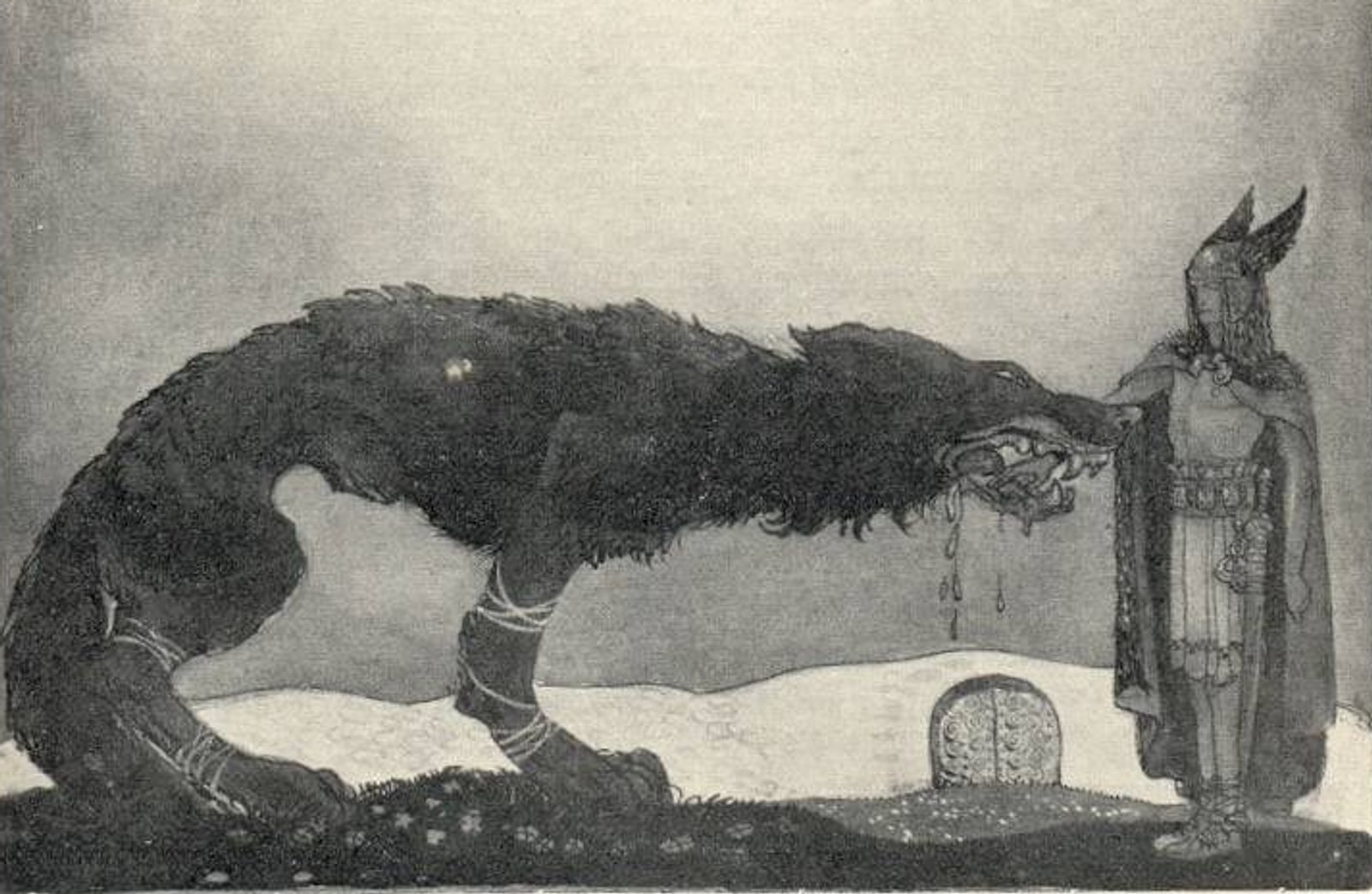
Fenrir allowed the ribbon to be fastened while Týr’s hand rested in his jaws, an act of profound trust extended to the one god who had actually earned it. When the wolf realized, despite all his straining, that he couldn’t break free - that Gleipnir held where Læðingr and Dromi had failed - he closed his jaws. Týr lost his hand.
That scene amounts to more than dramatic spectacle. It’s one of the clearest moral statements in the whole of Norse mythology about the cost of collective security. The Aesir as a group benefited from Fenrir’s binding, yet only one of them paid the immediate, physical price for it - and it was, of all people, the one god who least deserved to deceive the wolf. Scholars have long read Týr as a god associated with law, oaths, and formal agreements, and his sacrifice reads almost like a warning: institutions that act in the name of collective safety rarely distribute the cost fairly. More often than not, they pass the bill to whoever among them was honest enough to be trusted in the first place.
Ragnarök: The Wolf’s Revenge
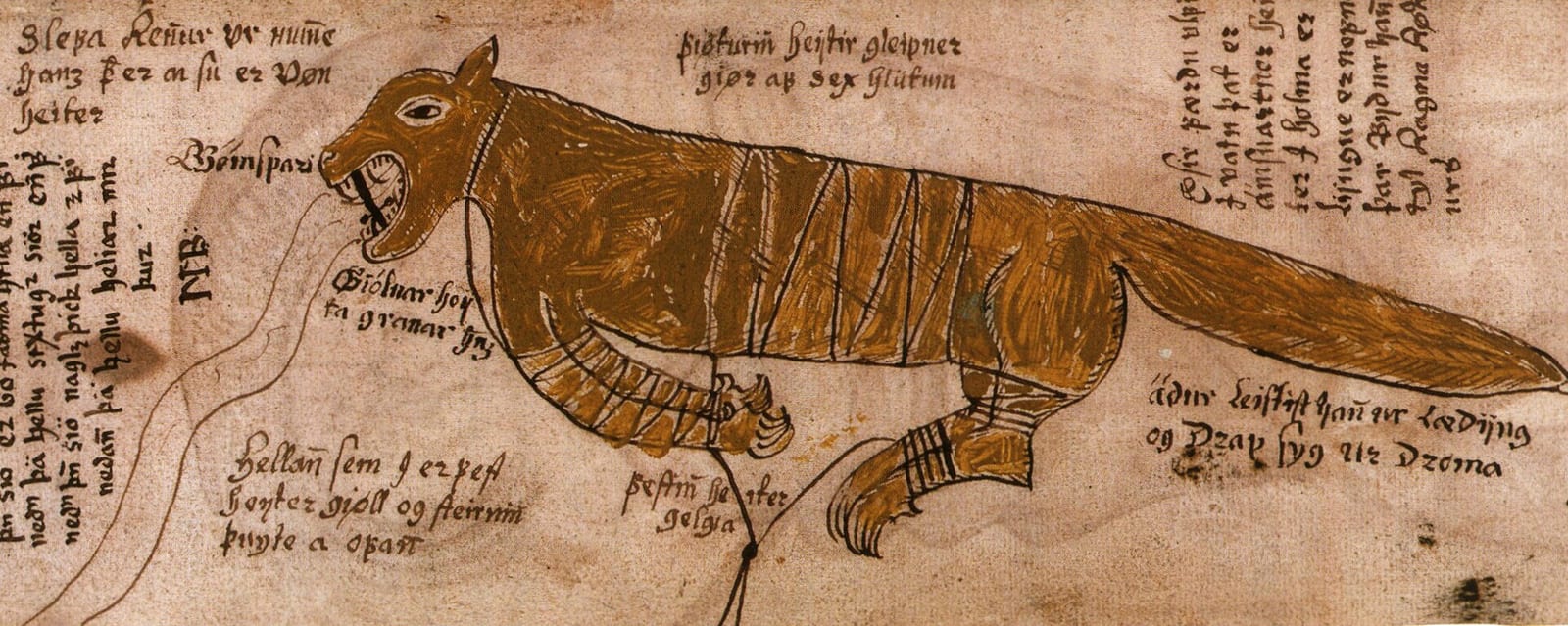
With Gleipnir secured, Fenrir was taken to a remote island called Lyngvi, in a lake named Amsvartnir, the binding fastened to a boulder driven deep into bedrock called Gjöll, a sword forced between his jaws to hold his mouth open. His saliva flowed continuously and, as Gylfaginning tells it, formed a river called Ván, meaning roughly “expectation” - a fitting image, since the binding wasn’t the end of the story, only a postponement of it.
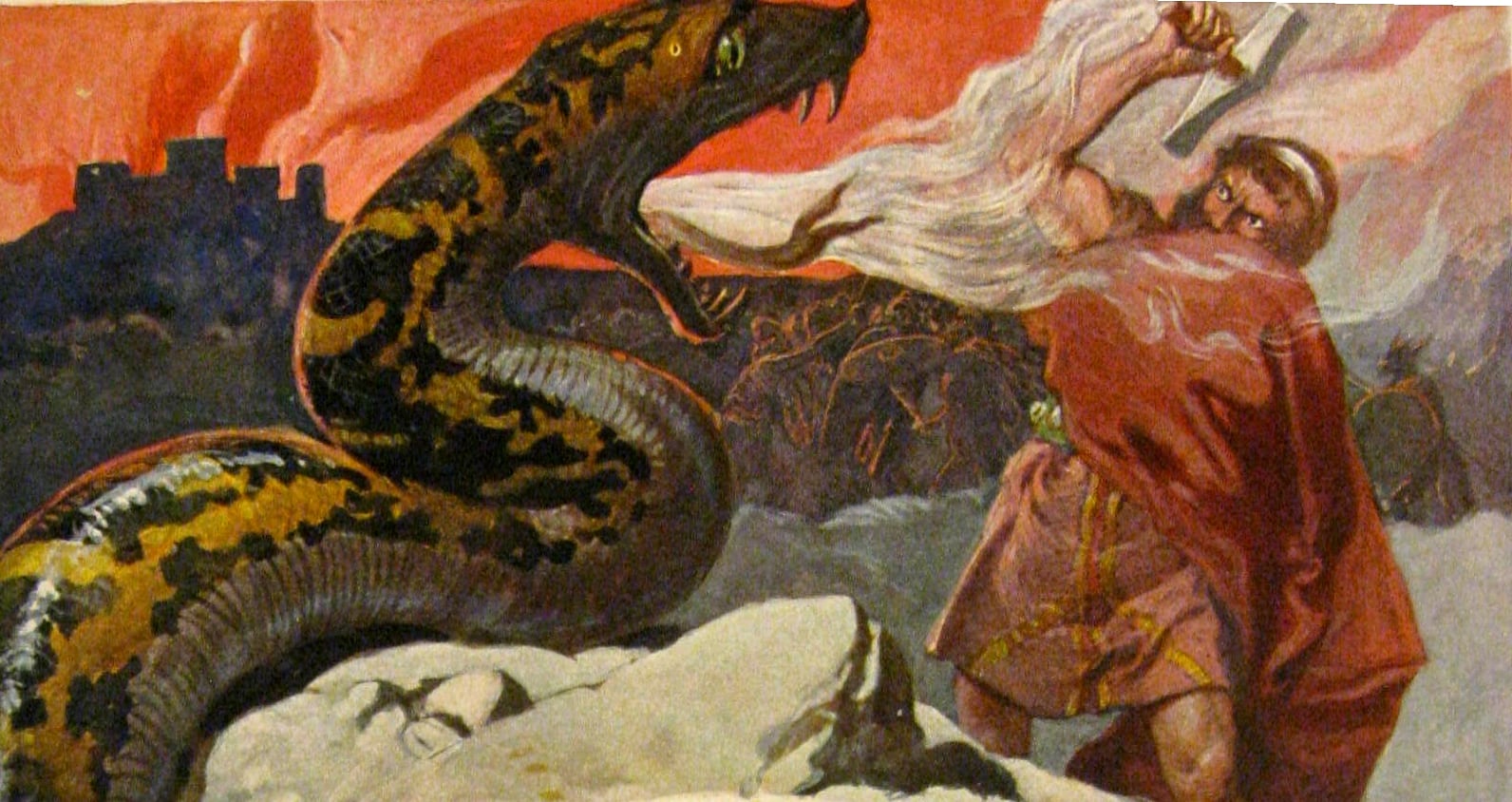
On the day of Ragnarök, when the entire order of the world comes apart, Fenrir finally tears free of his restraints. The Völuspá renders the moment in a handful of enormous images: the wolf runs with his jaws stretched wide, lower jaw dragging along the ground, upper jaw reaching the sky, fire blazing from his eyes and nostrils. He is no longer the chained creature from Lyngvi - he is the purest possible expression of unleashed, cosmic destruction. That idea, restraint as delay rather than resolution, ties Fenrir’s fate directly into the larger arc of Ragnarök, the final reckoning that the whole of Norse cosmology is inevitably building toward.
In that final battle comes the confrontation the prophecy foretold from the moment of Fenrir’s birth: the wolf faces Odin himself, the Allfather who once gave the order to have him bound. The sources are blunt here, with no softening: Fenrir kills Odin, devouring him outright. It’s the moment the entire myth has been building toward since the wolf’s earliest days - the fulfillment of the exact prophecy that pushed the Aesir to try binding him in the first place.
But the story doesn’t end with the wolf triumphant. Odin’s son Víðarr, known as “the silent god,” has spent ages wearing a special shoe made from the leftover scraps of leather that people discard while cobbling their own footwear - an accumulation, tradition says, that has been building across the ages for exactly this purpose. With that shoe, Víðarr pins Fenrir’s lower jaw to the ground and pulls the upper jaw upward with his hand, tearing the wolf apart, as Gylfaginning describes it - or, in an alternate version preserved in the Völuspá, drives a blade straight into his heart. The son avenges the father, but the vengeance arrives too late to undo the loss that came before it.
What the Myth Says About Norse Fatalism
It’s difficult to make full sense of Fenrir’s story without setting it against the broader framework of Norse fatalism. Unlike many other mythological traditions, where heroes can outwit fate through cleverness or courage, Norse cosmology runs on a different principle entirely: the inevitable can be delayed, sometimes for centuries, as the Gleipnir binding demonstrates, but it can’t be erased. Odin knows about Ragnarök long before it arrives - that’s a recurring thread throughout the Völuspá - and he acts anyway: gathering warriors in Valhalla, seeking out prophecy, trying to prepare, all while knowing that preparation ultimately won’t save him.
That, arguably, is the real distinguishing feature of Norse myth compared to many other pantheons: a kind of unflinching honesty about impermanence, extended even to the gods themselves. In that light, Fenrir isn’t simply a monster - he’s the personified consequence of every decision the Aesir made to secure their own power, starting with the choice to bring him to Asgard in the first place, continuing through the deception embedded in Gleipnir, and ending with the betrayal of Týr’s trust. Each of those decisions was individually defensible, maybe even necessary at the time, and yet together they add up to precisely the catastrophe they were meant to prevent. If Norse mythology offers a single lesson about power, it might be this: security built on deception and unevenly distributed sacrifice only ever buys time. It never buys lasting peace.
Fenrir has endured across the centuries better than almost any other figure in Norse mythology, surviving from medieval manuscripts into today’s popular culture. But the oldest version remains the most affecting one: a pup who trusted a single god, a binding made of things that don’t exist, and a hand sacrificed as the price of security. In the end, Fenrir remains exactly what he was from the beginning - not some random menace arriving from outside, but the direct consequence of decisions the gods themselves made, a fate the Aesir set in motion long before the wolf was strong enough to carry it out.
Image: Wikimedia Commons (Public domain), via Wikimedia Commons