Mythology
Thor: The Thunder God and His Hammer Mjölnir
Thor, the Norse god of thunder: how dwarves forged his hammer Mjölnir, how he went fishing for the World Serpent, and why he once dressed up as a bride.

Contents
- How We Know About Thor
- The Birth of the Hammer: How Mjölnir Was Forged
- The Theft Drama: Thor Dressed as a Bride
- The Fishing Trip: Thor Against the World Serpent
- Thor’s Gear: Belt, Gloves, and Goats
- Thor as Protector of Asgard and Midgard
- Thor’s Oak, Sacred Groves, and Thursday
- Why Thor Remains the Most Beloved God
A crack of thunder over the fjords, and Viking-age farmers knew at once: Thor, the Norse thunder god, was on the move. No other figure in Norse mythology was as present in everyday life as he was. While Odin ruled over kings and poets, Thor belonged to ordinary people - the farmer hoping for rain, the sailor riding out a storm. Behind the popular image of the bearded muscle-god, though, sits a far richer character, preserved in poems that are well over eight hundred years old.
We already introduced Thor briefly in our overview of the Norse gods. Here we go deeper: how was his hammer actually made? What adventures did he survive? And why did half of Scandinavia wear his symbol around its neck?
How We Know About Thor
As with most Norse myths, what we know about Thor comes chiefly from two Icelandic works of the 13th century: the Poetic Edda, a collection of anonymous poems preserved in the Codex Regius, and the Prose Edda of the scholar Snorri Sturluson, composed around 1220 as a handbook for aspiring poets.
Two poems of the Poetic Edda are devoted almost entirely to Thor: the Hymiskviða (“The Lay of Hymir”) and the Þrymskviða (“The Lay of Þrymr”). Unlike the darker, more solemn poems built around Odin, both have an almost comic tone. Thor is a hands-on, relatable god - clumsy, hungry, quick to anger, but reliable at his core. That is very likely why he was so beloved.
The Birth of the Hammer: How Mjölnir Was Forged
Few objects in Norse mythology are as famous as Mjölnir, Thor’s hammer. Few people, however, know its origin story - and it is full of irony.
Snorri tells it in the Skáldskaparmál, the second part of the Prose Edda: Loki, out of sheer mischief, had cut off the golden hair of Thor’s wife Sif. To save his own neck, he promised to fetch a replacement from the dwarves - and threw in more besides. He sought out the dwarf brothers Sindri and Brokkr and goaded them into forging three wonders that would outdo anything made by the sons of Ivaldi.
Brokkr worked the bellows while Sindri laid gold in the forge fire. Loki, fearing he had already lost the wager, turned himself into a fly and stung Brokkr’s hand to make him stop pumping. Brokkr held on regardless - but that brief flinch was enough to shorten the handle of the hammer taking shape in the fire. That is why Mjölnir ended up with an unusually short shaft, a flaw Snorri mentions explicitly.
Even so, the hammer proved the finest of the three gifts: it never missed its mark, always flew back to Thor’s hand after being thrown, and could even be tucked inside his tunic when needed. The gods judged unanimously that Mjölnir was the best gift of all, since nothing else would guard them so effectively against the giants, their greatest enemy. Loki, who had wagered his own head on the bet, barely escaped punishment - but that is a story for another day.
The Theft Drama: Thor Dressed as a Bride
Perhaps the most entertaining tale about the thunder god is told in the Þrymskviða. One morning Thor wakes to find Mjölnir gone. Panic breaks out - without his hammer, the Aesir are defenseless against the giants.
Loki borrows Freyja’s falcon cloak and flies to Jötunheim, the land of the giants. There the giant Þrymr freely admits it: he has buried the hammer eight leagues underground, and will only return it if the goddess Freyja is given to him as his bride.
When the gods put this to Freyja, she refuses so furiously that, as the poem puts it (paraphrased), “the hall of the Aesir shook beneath her.” So the crafty Heimdall proposes another plan: Thor himself should dress as the bride, veiled and draped in jewelry, and travel to the wedding in Jötunheim. Thor protests - the other gods will call him unmanly - but Loki convinces him that without the hammer, all of Asgard is doomed anyway.
At the wedding feast, the disguise nearly slips more than once. The “bride” devours an entire ox, eight salmon, and washes it down with three barrels of mead. Loki, disguised as a bridesmaid, must scramble for excuses each time - the bride, he claims, has fasted eight days out of longing for Jötunheim. When Þrymr finally tries to lift the veil for a kiss, he recoils from the “terrifyingly burning eyes” beneath it - again Loki saves the moment with a quick lie.
The climax comes when Mjölnir is laid on the bride’s lap to bless the marriage, as custom demanded. The instant Thor’s hand touches his hammer, he throws off the veil and slaughters Þrymr and the assembled giants. It is a rowdy, genuinely funny story - and proof that the Norse gods did not always take themselves entirely seriously.
The Fishing Trip: Thor Against the World Serpent
Things turn more serious in the Hymiskviða. Thor accompanies the giant Hymir on a fishing expedition, intent on hunting something far bigger than usual. As bait, he tears the head off the giant’s largest ox.
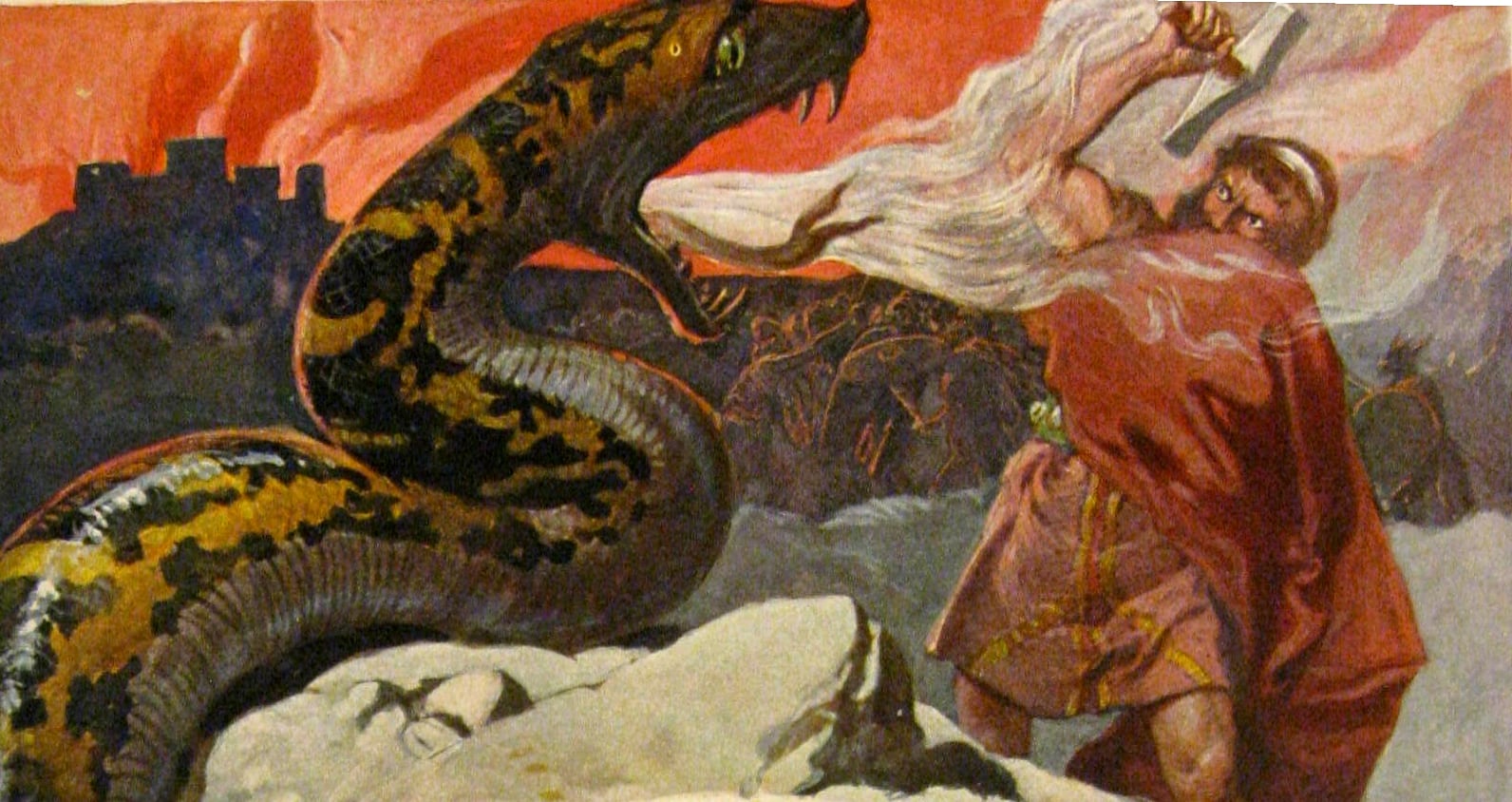
Out at sea, Thor casts his line - and what takes the hook is none other than Jörmungandr, the World Serpent, whose coils encircle the entire earth. Thor hauls with such force that his feet punch through the bottom of the boat and brace against the seabed itself. For one suspended moment, god and monster stare each other in the eye - Snorri describes venom spraying from the serpent’s jaws.
Thor raises his hammer for the killing blow. But the terrified Hymir, in a panic, cuts the fishing line, and Jörmungandr slips back into the deep. The myths agree that the two will only meet again at Ragnarök - this time with fatal results for both, as we describe in our article on Ragnarök.
Paraphrased from the Hymiskviða: Thor hauled the serpent up with such force that the earth itself trembled, while venom dripped from its gaping jaws.
Thor’s Gear: Belt, Gloves, and Goats
Mjölnir is only part of Thor’s power. Snorri names two further pieces of equipment without which the thunder god cannot bring his full strength to bear.
- Megingjörð, the “belt of strength,” doubles Thor’s bodily power the moment he fastens it on.
- Járngreipr, his iron gloves, are needed simply to grip the searing-hot hammer firmly - a direct consequence of its too-short handle.
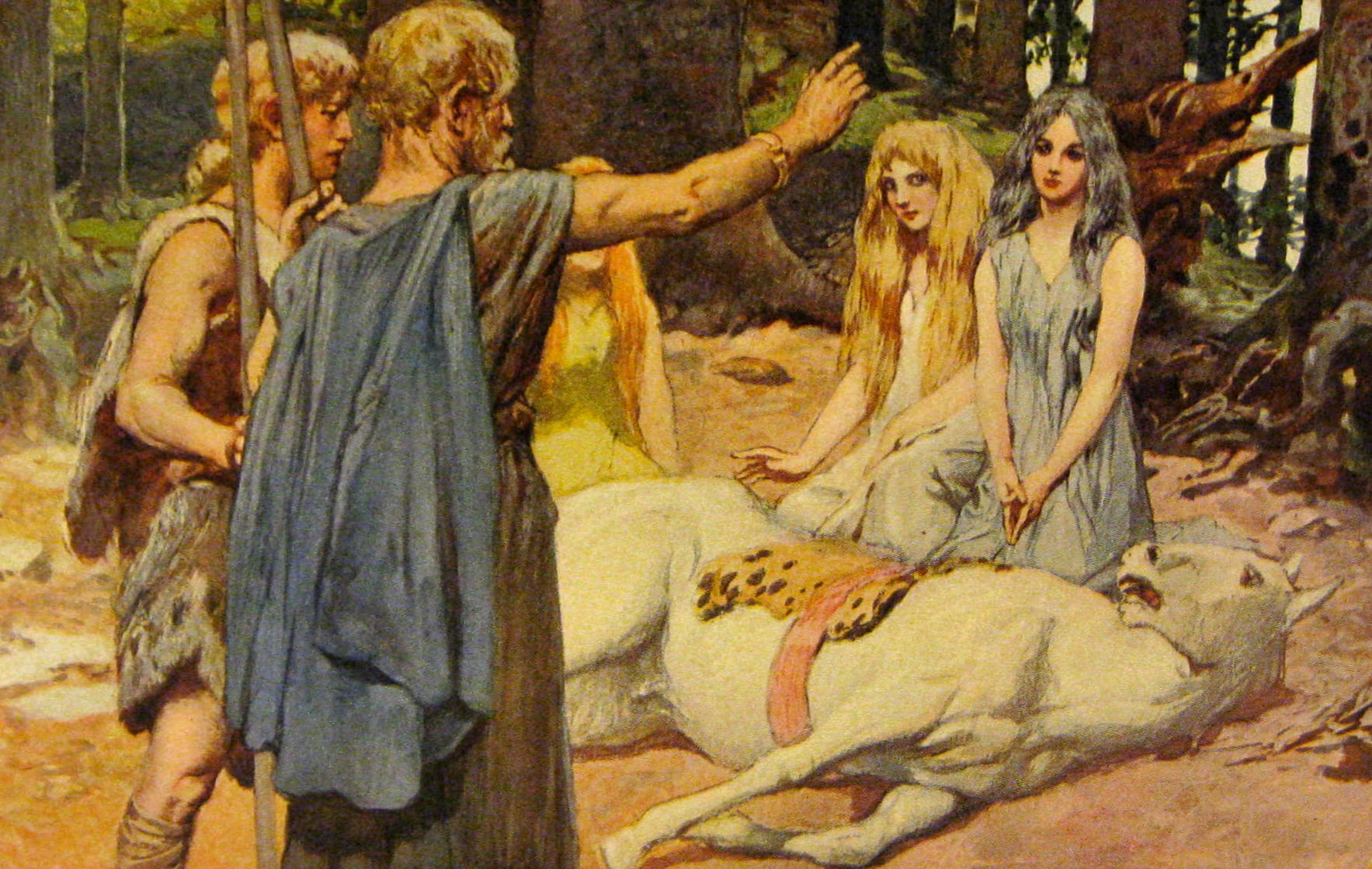
Then there are his unusual draft animals: the goats Tanngrisnir (“teeth-barer”) and Tanngnjóstr (“teeth-grinder”), who pull his chariot across the sky - an image that may well be the mythological explanation for thunder itself, the wheels rumbling over the clouds. What makes the goats remarkable is that Thor can slaughter them, eat their meat, and revive them the next morning with a touch of his hammer, provided their bones remain unbroken. Snorri tells a small, very human episode about this: while lodging with a farmer, Thor’s host’s son Þjálfi, driven by hunger, cracks open a thighbone to suck out the marrow. The next morning, when Thor revives the goats as usual, one of them limps on a hind leg. Thor immediately realizes what happened, and the terrified farmer must hand over his two children, Þjálfi and his sister Röskva, as servants in recompense. Þjálfi goes on to accompany Thor on many of his journeys, including a visit to the hall of the giant Útgarða-Loki, where he competes in a footrace against Thought itself - but that is a story of its own.
Thor as Protector of Asgard and Midgard
Behind all these adventures lies Thor’s real function: he is the border guard of the ordered world. The jötnar, the giants, embody the chaos that constantly presses against Asgard and Midgard in Norse mythology. Thor is the force that holds that border.
Nearly every surviving Thor story follows this pattern: a giant threatens the order of things, Thor sets out - usually with Mjölnir, sometimes relying on wit rather than muscle - and restores the balance. This protective role is even visible in the archaeological record: well over a thousand Thor’s hammer amulets, cast in silver and bronze, have been found across Scandinavia, from Norway to the lands of the Kievan Rus. Some craftsmen even made moulds that could cast either a hammer or a Christian cross, a small but telling sign of the uncertain transitional period when both faiths coexisted side by side.
Thor’s Oak, Sacred Groves, and Thursday
Thor’s importance reaches beyond myth into landscape and language. Several Scandinavian regions preserve place names recorded as Þórsáki, “Thor’s Oak” - sacred groves dedicated to the thunder god. The missionary Adam of Bremen, writing in the 11th century, described a statue of Thor at the temple of Uppsala holding a sceptre, believed to symbolize his power over weather and harvest.
And we still meet Thor every single week: the English Thursday is nothing other than “Thor’s day,” a direct translation of the Latin dies Iovis, the day of Jupiter, who - like Thor - was a god of thunder. Few other Norse gods have written themselves so quietly into our daily lives. Place names scattered across Scandinavia still whisper his former reach: settlements called Torshov, Thorslunde, or Torsåker - “Thor’s temple-yard,” “Thor’s grove,” “Thor’s field” - silent witnesses to a cult once as unremarkable as the weather itself.
Why Thor Remains the Most Beloved God
What makes this thunder god so enduring? Perhaps it is that he is never infallible. Thor loses contests to trickery, gets mocked, even has to dress as a bride to reach his goal - and yet he remains the rock that farmers and sailors could count on. He is powerful without being arrogant, hungry but loyal, quick-tempered but, in the end, always on the right side.
At Ragnarök, Thor finally slays the World Serpent Jörmungandr - but dies himself from its venom after staggering only nine steps. A fitting end for a god who never looked for the easy path, only the one that kept Asgard and Midgard safe. That, more than any of Odin’s wisdom, is what stayed with the Vikings across the centuries.
Image: Portable Antiquities Scheme from London, England (CC BY 2.0), via Wikimedia Commons