Daily Life & Culture
Daily Life of the Vikings: How They Really Lived
Viking daily life centered on farming, craft, and family, not raiding. What excavations at Birka, Hedeby, and Jorvik reveal about the era's true rhythm.

Contents
- The Longhouse at the Center of It All
- Farmers, Not Berserkers
- Food, Storage, and the Fight Against Winter
- Craft and Textile Work as the Backbone of Survival
- Hygiene: The Most Misunderstood Chapter
- Law, Disputes, and the Assembly of Free People
- Family, Children, and the Path to Adulthood
- A Daily Life That Outlasted the Stereotypes
Forget the unwashed barbarian in a horned helmet, lurking between raids in a soot-blackened hut. Viking daily life was, for well over ninety percent of the population, something far less cinematic: farming, herding, craftwork, raising children, and the relentless, unglamorous business of getting ready for the next winter. If you actually want to understand how people in Scandinavia lived between the eighth and eleventh centuries, you have to set the raiding aside almost entirely and look instead at the longhouse, the field, and the workbench. That’s where the lives of most Norse men and women actually played out, not at sea.
So why does the dirty-savage myth persist anyway? Probably because it’s a more satisfying story than the truth: a farmer who fussed over his fingernails because he could afford to own a personal comb.
The Longhouse at the Center of It All
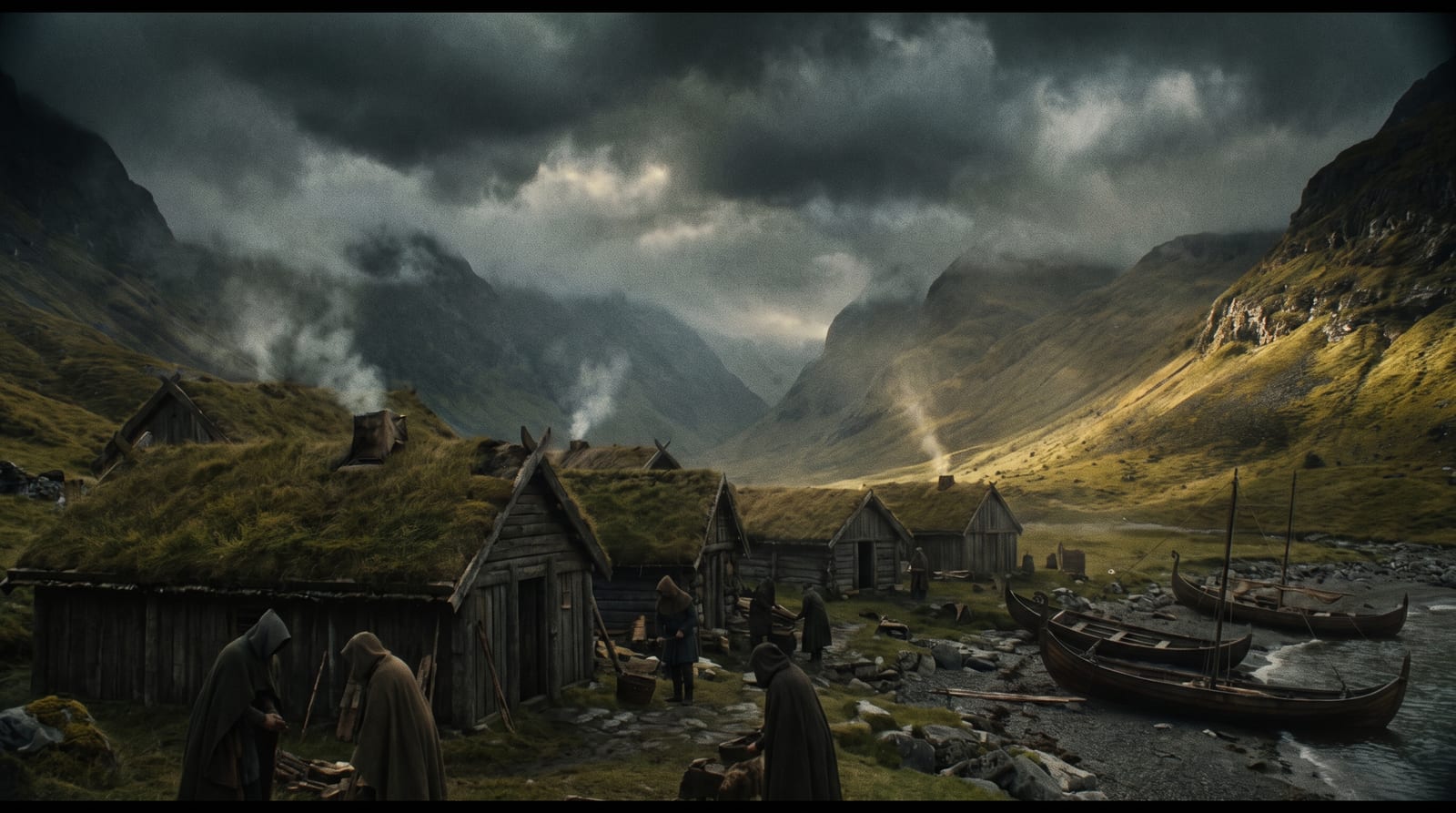
The basic unit of Viking Age life wasn’t the village but the farmstead, and its heart was the longhouse. Reconstructions at the Danish ring forts of Trelleborg and Fyrkat show what these buildings actually looked like: long timber structures with gently bowed walls, roofs of thatch, reed, or turf, and rows of interior posts bearing the weight of the roof above.
A typical longhouse sheltered far more than a nuclear family. Under one roof lived parents, children, often grandparents, in-laws, free farmhands, and - depending on the household’s wealth - enslaved workers known as thralls. In the cold months, livestock frequently moved indoors too, penned off at one end of the building. That wasn’t sloppiness; it was necessity. Animal bodies threw off heat, and in a winter with only a few hours of daylight, any heat source was worth its weight in silver.
A hearth fire burned at the center of the main room, kept alive continuously, since starting a new one from scratch with flint and tinder was slow, fiddly work. Around the fire ran raised wooden benches for sitting and sleeping, cushioned with furs and textiles. This is where people ate, worked, slept, told stories, and argued - the longhouse doubled as kitchen, workshop, bedroom, and living room all at once.
Archaeologists excavating Fyrkat and Trelleborg found not just the postholes marking where walls once stood, but traces of looms, cooking pits, and smithing debris right inside the living space - clear evidence of how tightly work and domestic life were woven together.
Farmers, Not Berserkers
Perhaps the single most important fact to grasp about Viking daily life: the overwhelming majority of the population never once left home for a raid. They were farmers, fishermen, and craftspeople, and their year followed the rhythm of planting, harvest, slaughter season, and the moods of Scandinavian weather.
Barley, rye, and oats were the staple crops, supplemented by peas and beans. Pastures held cattle, sheep, goats, and pigs, and nearly every farm kept chickens. Fishing - in the sea, in fjords, in rivers - filled out the diet substantially, especially through the long winter months when fresh vegetables ran out. Readers curious about the more martial side of this society might look into the Viking berserkers, though it’s worth remembering that even these feared warriors were the extreme exception, never the rule.
Labor on the farm was divided, but not arbitrarily. Men usually handled the heaviest field work, tool and building repair, and - where a household had the means - trade and seafaring. Women ran the household, a role that carried far more authority in this society than the word “housework” implies today: they managed the storerooms, wore the keys to the chests on their belts, and when the head of household traveled, full economic control of the farm rested in their hands. That standing had legal backing too, in codes such as the Gulating law and the Frostating law, two Norwegian legal traditions that spelled out inheritance and property rights in considerable detail.
Food, Storage, and the Fight Against Winter
A Scandinavian winter doesn’t forgive bad planning. The entire warm season amounted to one long preparation for the months when almost nothing grew. Meat and fish were smoked, salted, or air-dried; milk was churned into butter, cheese, and skyr; grain went into pits or storehouses kept carefully dry.
Meals were usually eaten from a shared pot, often a hearty stew of barley, vegetables, and whatever meat or fish was on hand, alongside coarse bread that, given the crude milling technology of the day, sometimes carried tiny fragments of grit from the millstones - one reason worn-down teeth turn up so often in skeletal remains from this period. Beer and mead were daily staples too, and not just for pleasure: in an age when clean water couldn’t be taken for granted, the brewing process produced a drink that was reliably safe.
Craft and Textile Work as the Backbone of Survival
Clothing, sailcloth, rope, tools, weapons - none of it came from outside the farm or the nearest market town. Textile production alone consumed a staggering amount of labor. Wool was sheared, washed, combed, spun, and finally woven on an upright warp-weighted loom, whose clay or stone loom weights turn up at nearly every Viking farmstead excavation. For smaller items like caps, mittens, or socks, people used naalbinding, a technique in which a single thread is looped and knotted with a bone needle into a dense, stretchy fabric - attested archaeologically at sites across Scandinavia and older than knitting as we know it today.
The trading towns of Birka in Sweden and Hedeby (also called Haithabu) on the Schleswig-Holstein coast provide the densest evidence for all this. At Birka, archaeologists have recovered tools for metalworking, comb-making, and bead production from imported glass and amber, along with evidence of trade contacts reaching all the way to Byzantium and the Abbasid Caliphate in Baghdad - Arab silver coins, known as dirhams, show up in large numbers in Scandinavian soil. Hedeby, for its part, functioned as a genuine craft-production hub: shoemakers, comb-carvers, smiths, and weavers worked and lived closely packed together, protected by an imposing semicircular rampart whose remains are still visible today.
Hygiene: The Most Misunderstood Chapter
Almost no aspect of Viking life gets misrepresented as persistently as personal grooming. The evidence tells an unambiguous story. Graves at Birka, Hedeby, and numerous other sites contain combs made of bone and antler, often finely decorated and kept in their own carrying cases, alongside tweezers, ear-cleaning tools, and small razors. These were standard kit, not rare luxuries.
Excavations at Jorvik - Viking Age York, in England - reinforce the picture. Alongside combs, the finds there point to routine personal grooming in a town that contemporary foreign chroniclers, writing from cultures hostile to the Norse, ironically described as relatively clean by the standards of the day. One frequently cited medieval account, by the Arab traveler Ahmad ibn Fadlan, describes some genuinely unhygienic practices among a particular trading group he encountered along the Volga - but it also notes, with visible distaste, how regularly these men washed their faces and hands, even if from a shared basin of water. Old Norse even had a dedicated word for Saturday that translates roughly to “washing day,” suggesting personal grooming was a fixed, recurring appointment in the weekly rhythm, not an occasional afterthought.
- Combs: made of antler or bone, often with a protective case, found in nearly every excavated cemetery
- Tweezers and ear spoons: standard components of grooming kits, frequently made of bronze
- Bathhouses and washing day: regular cleaning as a social occasion as much as a hygienic one
- Razors: for neatly kept beards and hairstyles, not unkempt wild growth
Law, Disputes, and the Assembly of Free People
A society often imagined as a chaotic mass of warriors actually ran on a remarkably sophisticated legal system. The Thing assemblies - regular gatherings of free men, and in certain cases free women - existed to settle disputes, pass laws, and hand down judgments. The surviving legal texts of the Gulating and Frostating from Norway describe a system that regulated theft, inheritance, dowries, divorce, and even assault with striking precision, complete with fixed fine schedules scaled to the severity of the offense.
Viking Age scholar Neil Price has argued repeatedly in his work that this legal culture, together with the daily grind of farming, formed the real backbone of Norse society, while raiding and conquest were the spectacular exception that later chroniclers, for obvious reasons, preferred writing about over yet another ordinary harvest day. That imbalance in the historical record is exactly why our modern image of the Vikings skews so far toward violence.
Family, Children, and the Path to Adulthood
Children were folded into farm labor early. By the age of five or six they were already handling small tasks like herding animals or gathering firewood, and as they grew older the responsibilities expanded toward fieldwork, craft, or - for girls - textile production and household management. Average life expectancy sat well below modern figures, but anyone who survived the dangerous early years could reasonably expect to reach fifty, sixty, or beyond, as skeletal analyses from multiple burial sites confirm.
Marriage functioned less as a romantic choice than as an economic and social alliance between families, typically with a negotiated dowry, though Icelandic sagas describe real cases of women successfully divorcing husbands who failed to meet their obligations. The belief system framing all of this daily activity was deeply rooted in the Norse gods, from Frigg as guardian of household and marriage to the ancestral spirits honored with offerings on particular days of the year.
A Daily Life That Outlasted the Stereotypes
Walk through the reconstructed longhouses at Trelleborg or Fyrkat today, or look at the combs, loom weights, and cooking pots pulled from the ground at Birka and Hedeby, and you get a picture that has almost nothing in common with the horned-helmet cliché. It’s the picture of an agrarian, craft-literate, legally organized society preoccupied, day in and day out, with harvest, family, and community - one that, incidentally, kept itself considerably better groomed than its own descendants ever gave it credit for.
Maybe that’s the real point here. It wasn’t the raiding that defined Viking life. It was the patient, disciplined work in between - work that has left its mark in the soil of Birka, Hedeby, and Jorvik to this day.
Image: No machine-readable author provided. ChickenFalls assumed (based on copyright claims). (Public domain), via Wikimedia Commons