Mythology
Heimdall: The Norse God Who Guards the Rainbow Bridge
Heimdall, the Norse god guarding Bifröst: what the Eddas, Snorri and the Húsdrápa really prove about the Gjallarhorn, his nine mothers and golden teeth.
Contents
- The White God: What the Prose Edda Says About Heimdall
- Heimdall, the Norse God on Watch: Himinbjörg and the Bridge
- Nine Mothers and a Pile of Names
- Seals, a Stolen Necklace, and a Final Duel
- Rígsþula: The Watchman as Ancestor of Humankind
- Myth Versus Fact: What Can Actually Be Proven
- Why Heimdall Remains the Strangest God in the North
Every other deity in the north does something. Odin hunts for knowledge, Thor kills giants, Loki breaks things for sport. Heimdall, the Norse god posted at the upper end of Bifröst, mostly stands still. His job is to watch the bridge between Midgard and Asgard and to notice anything coming, and the sources describe that job with a precision they rarely grant to anyone else. It sounds like the dullest assignment in the pantheon, and in the Lokasenna, Loki says exactly that to his face.
Look closer, though, and the watchman turns out to be the strangest figure in the entire Norse canon. He was born of nine mothers. His teeth are gold. He hears wool growing on a sheep’s back. He once fought Loki while both of them were seals. And the opening stanza of the Völuspá does not call humanity the children of Odin, but the sons of Heimdall. This article separates what the texts actually say from what Snorri Sturluson shaped them into, and marks the places where the tradition simply runs out.
The White God: What the Prose Edda Says About Heimdall
The fullest single portrait sits in the Gylfaginning, the mythological heart of the Prose Edda, written in Iceland around 1220. Snorri calls Heimdall the white god, great and holy, and says that nine maidens bore him, all of them sisters. He lists two bynames, Hallinskíði and Gullintanni, the second one explained on the spot: his teeth are made of gold. His horse is Gulltoppr, Golden-mane.
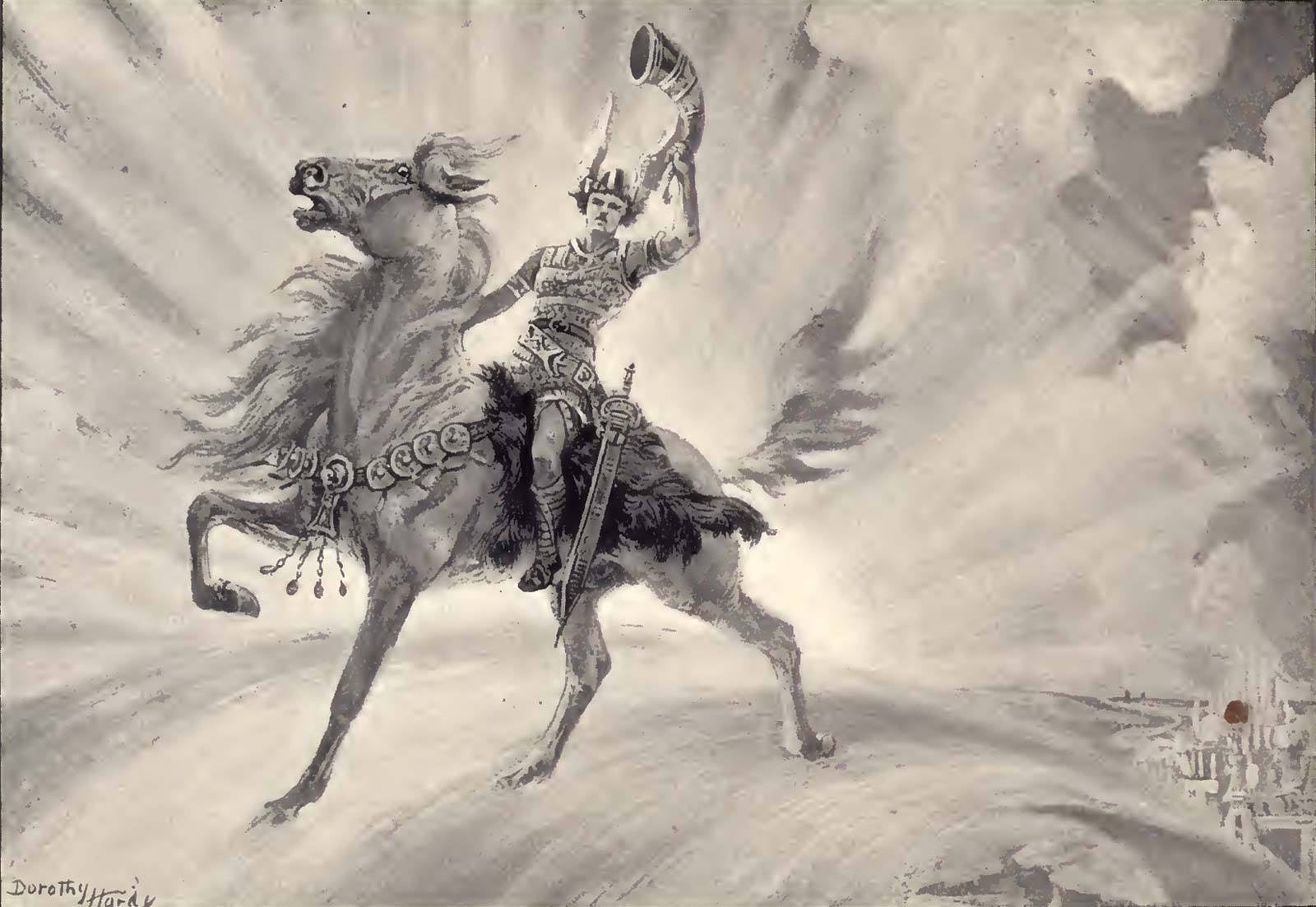
Then comes the catalogue that made him famous. He needs less sleep than a bird. He sees as well by night as by day, across a distance of a hundred leagues. He hears grass growing on the ground and wool growing on sheep, and anything louder than that. He owns the Gjallarhorn, and when he blows it the sound carries into every world.
Notice what kind of description this is. Snorri is not sketching a personality, he is specifying an instrument. Heimdall gets no love affair, no blunder, no quest of his own, and barely a line of dialogue anywhere in the corpus. What he gets is a job description, and it is the most detailed one any of the Aesir receives.
Heimdall, the Norse God on Watch: Himinbjörg and the Bridge
His posting is fixed. Stanza 13 of the Grímnismál names Himinbjörg, “heaven-cliffs”, as the eighth dwelling, and says the warden of the gods rules the holy places there and drinks good mead in the pleasant hall, content. Snorri picks this up and adds the geography: Himinbjörg stands at the end of heaven, at the point where the bridge meets the sky. Heimdall sits at the edge of the world and watches the road the mountain giants would have to take.
His account of the bridge itself is oddly engineering-minded. It has three colours, it was built with great skill, it is stronger than anything else, and people call it the rainbow. The red in it is burning fire, Snorri writes, which is what stops the frost giants and mountain giants from storming across. And then he adds one of the driest sentences in the whole Edda: nothing in this world is so strong that it can be relied upon. When the sons of Muspell ride over Bifröst, it will break.
That is the real shape of Heimdall’s duty. He guards a frontier the gods already know will fail. The Lokasenna shows how little status the post carried: Loki tells him a hateful life was laid out for him, that he must stand there as warden of the gods with a stiff back, and that his back is always wet. Nobody knows what the wet back means. Rain at an exposed outpost, sea spray, a hint at his origin in the water: translators part company at this line.
Put Heimdall on while you read the rest:
Nine Mothers and a Pile of Names
Heimdall carries more names than almost any other god, and nearly every one of them raises a question of its own. The table below keeps the attested from the inferred.
| Name | Meaning | Source | How certain |
|---|---|---|---|
| Heimdallr | unresolved, proposals link it to “home” and to a word for brightness | Eddic poems, Prose Edda | etymology open |
| Gullintanni | ”gold-toothed”, his teeth are of gold | Gylfaginning | explained in the text itself |
| Hallinskíði | unclear, the same word appears in Eddic name lists as a term for “ram” | Gylfaginning, Þulur | only the name is secure |
| Vindlér / Vindhlér | usually connected with wind or sea, the reading is disputed | Skáldskaparmál, Húsdrápa | only the name is secure |
| Rígr | ”king”, most likely borrowed from the Old Irish word for king | Rígsþula, prose preface | equation made only in the preface |
| Gulltoppr | ”golden-mane”, his horse | Gylfaginning | secure |
| Himinbjörg | ”heaven-cliffs”, his hall | Grímnismál 13, Gylfaginning | secure |
| Gjallarhorn | ”the resounding horn” | Völuspá 46, Gylfaginning | secure |
His origin is the oddest item of all. In the Skáldskaparmál Snorri quotes two lines from a poem that is otherwise lost, the Heimdallargaldr, in which the god speaks for himself:
“Nine mothers I have, nine sisters gave me birth.”
That is the entire surviving fragment. Snorri does not say who the nine women were. Scholars usually point to the Hyndluljóð, where stanzas 35 to 37 describe a being born at the edge of the earth to nine giantesses and strengthened by the might of the earth, the cold sea and sacrificial blood. The identification with Heimdall is very probably right, but the stanzas themselves never name him. Anyone who tells you the nine mothers were definitely the nine daughters of the sea giant Ægir is selling a reasonable guess as a textual fact.
Seals, a Stolen Necklace, and a Final Duel
The one story in which Heimdall acts rather than watches survives only in pieces. Around 985 the skald Úlfr Uggason performed his Húsdrápa at a wedding feast at Hjarðarholt in Iceland, describing the carved scenes on the walls of the hall. One of those scenes shows Heimdall and Loki in the shape of seals, fighting at a rock called Singasteinn over Freyja’s necklace, the Brísingamen.
Snorri quotes the verse in the Skáldskaparmál and records the poetic conventions that go with it: Heimdall may be called the visitor of Vágasker and Singasteinn and the enemy of Loki, while Loki may be called the thief of the Brísingamen. The myth is gone, in other words, but the shorthand for it survived. How Loki got hold of the necklace, why Heimdall of all gods went after it, and what made either of them take the form of a seal, no surviving text explains. That is not a gap in the storytelling, it is a straightforward loss of manuscript.
The account between the two is settled at the end of the world. In the Gylfaginning Snorri has Heimdall and Loki meet during Ragnarök and kill one another. The guardian of boundaries and the god who exists to cross them cancel each other out, and neither walks away.
Rígsþula: The Watchman as Ancestor of Humankind
One Eddic poem hands Heimdall a role you would expect to belong to Odin. The Rígsþula follows a god named Rígr as he walks along the shore and stops at three households in turn. At the poorest, the home of Ái and Edda, a child called Þræll is born nine months later, the thrall. At the farm of Afi and Amma comes Karl, the free farmer. At the hall of Faðir and Móðir comes Jarl, the nobleman, whose youngest son Konr ungr learns the runes and becomes king. The prose preface to the poem states flatly that this Rígr was Heimdall.
The famous first stanza of the Völuspá fits neatly alongside it. The seeress asks for silence and addresses the greater and lesser sons of Heimdall, meaning humanity as a whole. Two independent texts therefore make the watchman the ancestor of human society, and the poem that narrates the end of the world opens by calling the audience his descendants.
Caution is still in order. The identification of Rígr with Heimdall appears only in the prose preface, not in the verse, and that preface came from the scribe rather than the poet. More than one scholar has suggested the wandering god was originally Odin. The Völuspá line stands on its own, but it is a single line.
Myth Versus Fact: What Can Actually Be Proven
- Myth: Heimdall was a sun god or light god. Fact: Snorri calls him the white god and never explains the epithet. The light-deity reading is a modern assembly of white colour, gold teeth and a post in the sky, not a claim made by any source.
- Myth: Bifröst is the rainbow. Fact: That equation is Snorri’s. The Poetic Edda also calls the bridge Bilröst and nowhere describes it as a rainbow, which is why the Milky Way has been proposed as an alternative.
- Myth: Heimdall’s horn blast starts Ragnarök. Fact: In the Völuspá he raises the horn and blows once the collapse is already under way. It is an alarm, not a starting pistol. Stanza 27 also says that Heimdall’s hljóð lies hidden beneath the holy tree, and whether that word means his hearing or his horn is still argued over.
- Myth: Viking Age images of Heimdall exist. Fact: Not one securely identified. The figure with a horn on the 10th-century Gosforth Cross in Cumbria is the candidate most often named, but the cross carries no inscription and the reading remains a proposal.
- Myth: Heimdall had a significant cult. Fact: Unlike Thor, Odin or Freyr, he is almost entirely absent from place names and personal names. He is prominent in literature and close to invisible in the archaeological record.
That last point is, to the editorial team, the most revealing one. Heimdall is the best described and worst attested god in the north. His senses, his horse, his hall, his horn and his teeth are all set down with a sharpness the sources often deny Thor. What is missing is any sign that a farmer in the 9th or 10th century sacrificed to him, named a field after him or called a son by his name. We read that not as evidence of a late invention but as a sign that he was a narrative device from the beginning: the function a cosmos needs before it can tell stories about its own edges.
Why Heimdall Remains the Strangest God in the North
What is left is a figure assembled almost entirely from gaps. Nine mothers linked to him only by inference. A poem about his birth reduced to two lines. A fight between seals preserved only as a rule for poets. An ancestry resting on an editorial note.
And yet the pieces agree with each other remarkably well, which is our second observation about him. In every strand of the tradition, Heimdall turns up wherever two things meet: between Asgard and Midgard, between sea and shore in the body of a seal, between social ranks in the Rígsþula, between noise and silence. He is not the god of a thing. He is the god of the seam. A culture that organised its world through fences, assembly grounds and farm boundaries needed a divine specialist for exactly that, and this explains him far better than any light-god theory.
So anyone who files Heimdall away as Asgard’s doorman misses what the figure is doing. He does not merely guard a bridge. He marks every line the Norse world draws, and he knows how each of those lines ends: Bifröst will break, and he raises the horn anyway.
Image: Dorothy Hardy (1868 - 1937) (Public domain), via Wikimedia Commons