History
Gamla Uppsala Burial Mounds: Royal Graves and the Legendary Temple
The Gamla Uppsala burial mounds hold Vendel-era kings. What the digs really reveal, and why Adam of Bremen's golden temple is still debated by scholars.
Contents
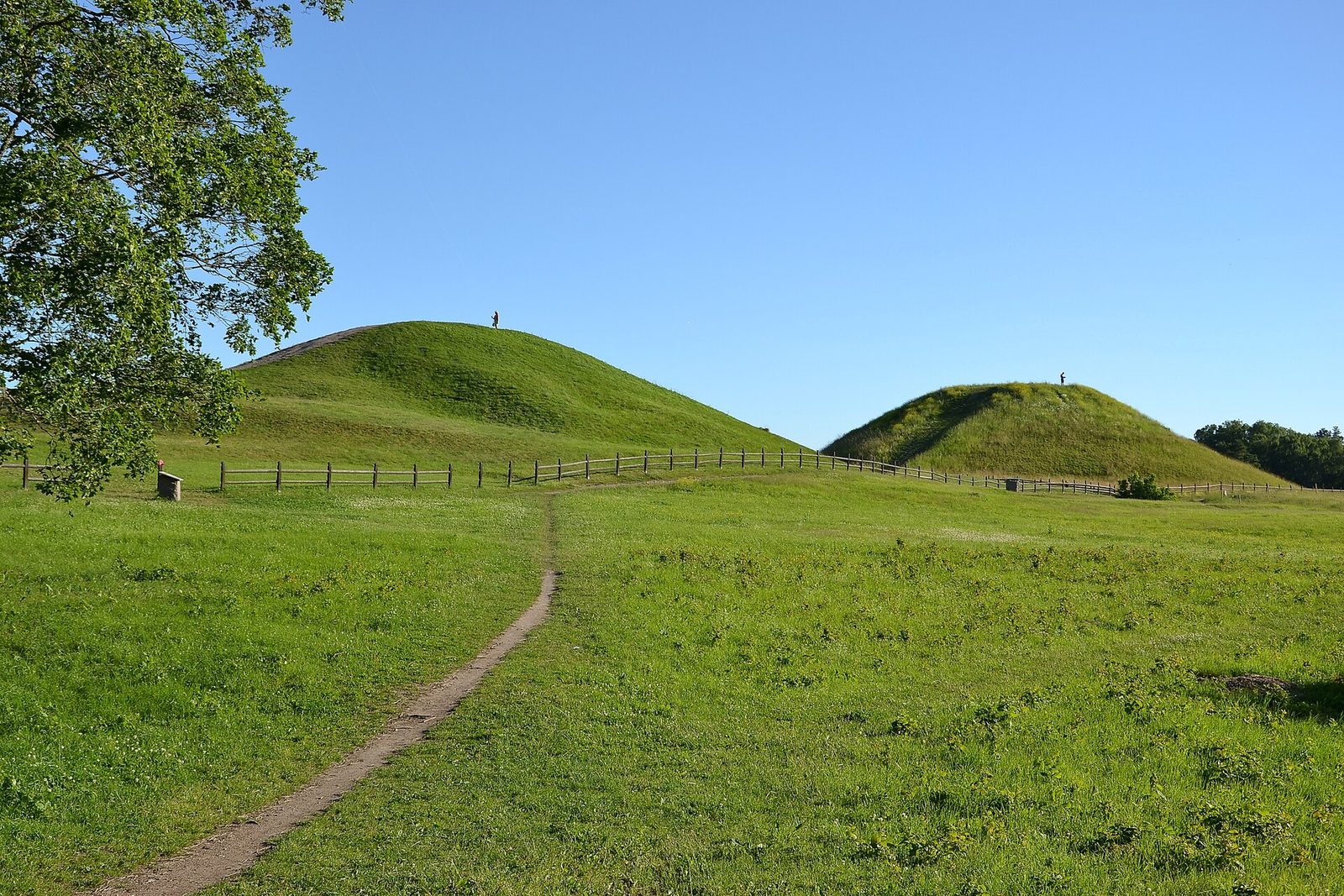
Three grass-covered domes rise out of an otherwise flat plain some five kilometres north of the Swedish university city of Uppsala. You can see them from a distance, and standing at their foot you understand at once that nobody piled up that much earth to hide the dead. The Gamla Uppsala burial mounds were built to be looked at. They count among the largest pre-Christian monuments in northern Europe, and they are older than most visitors assume: they went up before the Viking Age, not during it. Hanging over the same field is one of the most persistent stories in Norse religious history. Around 1070 a canon of Bremen cathedral described a temple here said to be covered entirely in gold, a sacred grove full of hanged offerings, and a festival that returned every ninth year. Between what a spade can recover and what a quill once wrote, Gamla Uppsala holds a gap that research has still not closed.
What the Gamla Uppsala Burial Mounds Actually Are
In Swedish the three great mounds are simply Kungshögarna, the Royal Mounds, distinguished by position as the East Mound, the Middle Mound and the West Mound. Each measures roughly fifty to seventy-five metres across and rises up to about ten metres above the surrounding ground. They look even more imposing than those figures suggest, and that is no accident: the mounds sit on a natural gravel ridge, a glacial esker running through the plain like a causeway. Anyone approaching from the south sees the domes already raised on a plinth that the last ice age delivered free of charge.
They belong to the Vendel Period, the stretch of centuries between the end of the Migration Period and the beginning of the Viking Age. Archaeological dating points to the sixth century, in part to the early seventh, and that detail matters more than popular accounts allow. By the time the raiders hit Lindisfarne and the Viking Age proper began, the mounds at Gamla Uppsala were already some two hundred years old. These are not Viking graves. They are the monuments of the generations out of whose world the Vikings eventually emerged.
The folk names Mound of Odin, Mound of Thor and Mound of Freyr sound ancient, and are not. They come out of seventeenth-century Swedish antiquarianism, when scholars matched the three mounds to the divine trio Adam of Bremen had described inside his temple. A sign bearing those names is therefore reading you a Baroque interpretation, not a Vendel Period tradition.
A little apart stands a fourth, much flatter mound with a levelled top, the Thing Mound. Medieval written sources describe it as an assembly place, a stage for law-speaking and for the acclamation of kings. Gamla Uppsala was never a mere cemetery. It was a place where burial, cult, market and politics were stacked into a single square kilometre.
Inside the Royal Mounds: Fire, Gold and Bear Claws
Two of the three great mounds have been opened. The East Mound was investigated in 1846 and 1847 under the direction of the Swedish state antiquarian Bror Emil Hildebrand; the West Mound followed in 1874. The Middle Mound remains essentially untouched, which modern archaeologists regard as luck. Whatever lies in there is waiting for methods nobody has invented yet.
Neither opened mound contained an inhumation. Both held cremations. The dead had been burnt on a pyre at very high temperatures together with their grave goods, and what survived the fire was gathered and deposited at the heart of the mound. What the excavators recovered was fused lumps of metal, splinters of calcined bone and vitrified residue. That any coherent picture emerged from such material at all is closer to forensic work than to treasure hunting.
The key finds can be summarised like this:
- Gold work with garnet inlay, cloisonné in the most demanding technique of the age, otherwise known only from elite graves across northern and central Europe
- Gaming pieces of bone and ivory, evidence of a board game and therefore of an aristocratic status symbol
- Bear claws, strongly suggesting the dead were cremated on bear pelts, a recurring feature of high-status Vendel Period burials
- Imported glass and fragments of fine vessels, proof of long-distance contact reaching into the Frankish and eastern Mediterranean worlds
- Weapon and armour fittings, badly damaged by fire, including mounts in the West Mound belonging to a richly decorated sword
Who actually lay there cannot be settled with certainty. For the West Mound most researchers accept a man. For the East Mound the osteological reading has swung back and forth for decades, with a woman and an additional younger individual both argued for. The honest summary is this: the mounds prove the rank of the people buried in them, not their names. Assigning any particular king of the Yngling dynasty to a particular mound is guesswork dressed as history.
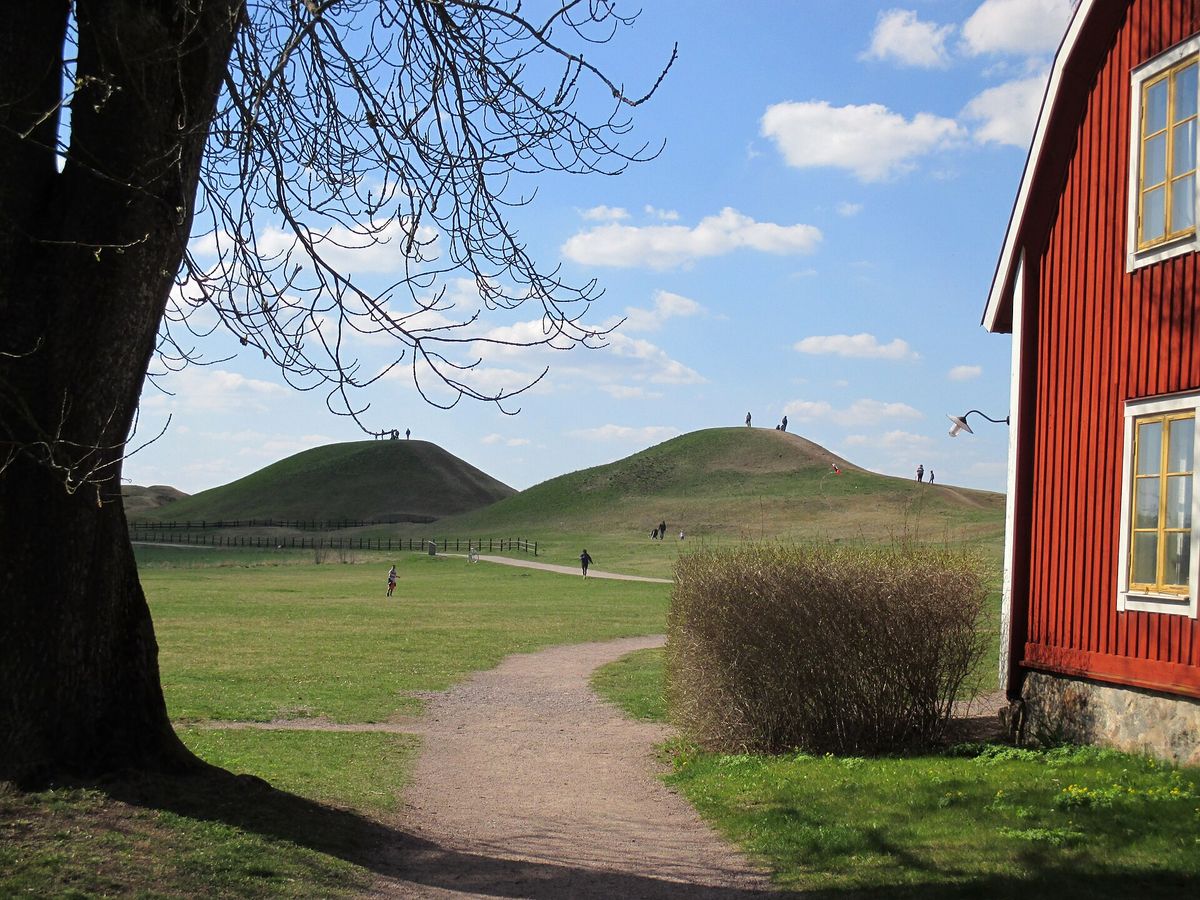 Image credit: Gunnar Creutz (CC BY-SA 4.0), via Wikimedia Commons
Adam of Bremen and the Temple Covered in Gold
The most famous text about this place was not written in Sweden. Adam of Bremen, cathedral canon and historian, composed his history of the archbishops of Hamburg around 1070. In the fourth book, a description of the northern lands, he turns to a site he calls Ubsola. There, he writes, stands a temple sheathed entirely in gold. Inside it the people worship three images: Thor in the centre, Wotan and Fricco at his sides. Thor governs thunder, weather and harvest, Wotan war, Fricco peace and bodily pleasure, and each god has his own priests. Every nine years, Adam continues, a common festival is held to which every province of the realm sends gifts. Nine males of every kind of living creature are sacrificed and their bodies hung in a sacred grove beside the temple. A marginal note in the manuscripts speaks of seventy-two hanging bodies, dogs and horses among the men. Adam also mentions an evergreen tree of unknown species and a spring in which people were drowned.
No other single text has shaped the popular picture of the heathen North so strongly, which is precisely why it deserves a cold eye. Adam never went to Uppsala. He wrote in Bremen and relied on informants, chief among them the Danish king Sweyn Estridsson, a Christian ruler with no reason to flatter the still-heathen Swedes. Nor is the work a travel report: it is an ecclesiastical history meant to underpin the missionary claim of the archbishopric of Hamburg-Bremen over the entire North. In that argumentative logic a gold-plated temple and a grove of corpses are not incidental colour; they are exhibits for the prosecution. On top of that, Thietmar of Merseburg had described a strikingly similar nine-year sacrifice at Lejre in Denmark decades earlier, which makes a travelling literary motif hard to rule out.
Our editorial view: writing Adam off as a liar would be as comfortable as it is wrong. That people feasted and sacrificed here on a grand scale across generations is difficult to deny given the site itself. But his numbers, his gold and his gallows deserve to be read for what they are, second-hand report sharpened for a clerical audience.
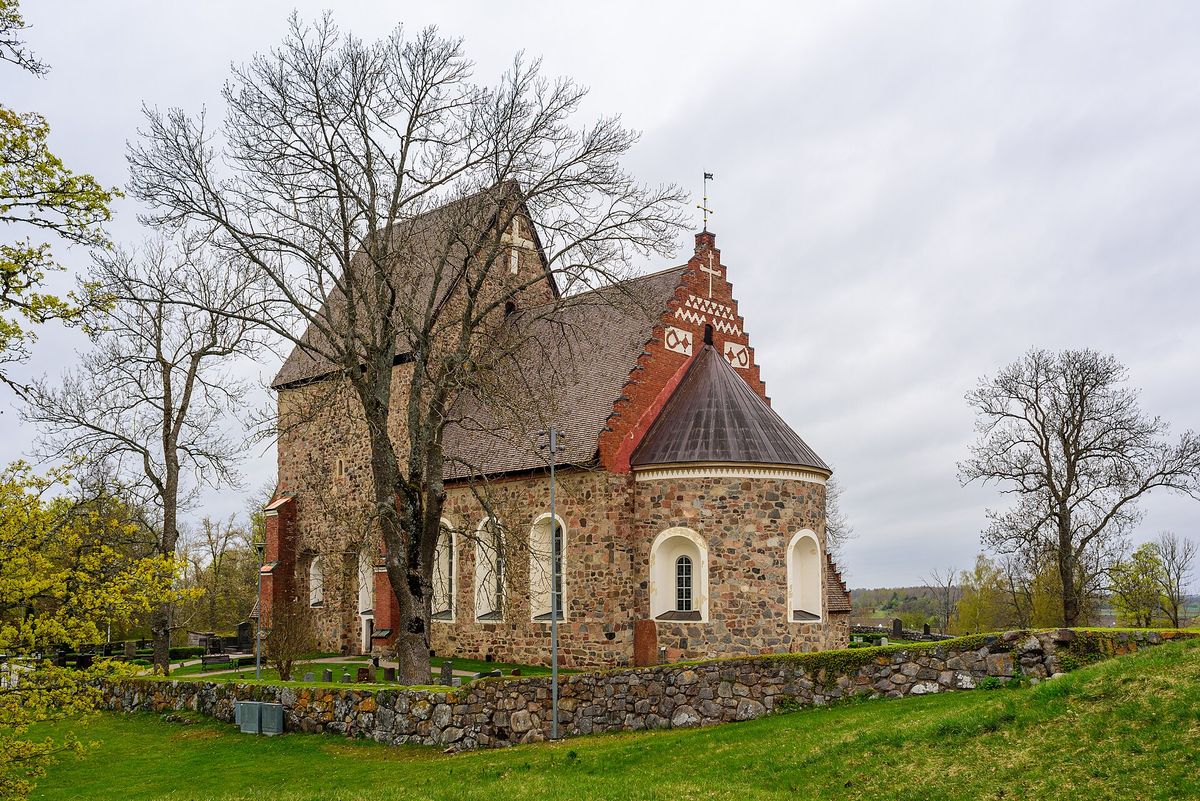 Image credit: ArildV (CC BY-SA 4.0), via Wikimedia Commons
Myth and Fact: What Is Actually Secure
| Claim | State of research |
|---|---|
| Three large mounds of the Vendel Period | Secure, dated archaeologically to the 6th and early 7th century |
| Cremation burials with elite grave goods | Secure, established by the digs of 1846/47 and 1874 |
| The mounds belong to Odin, Thor and Freyr | False, the names were coined in the 17th century |
| Gamla Uppsala was a centre of power and cult | Secure, shown by halls, post rows and grave fields |
| A temple sheathed entirely in gold | Unproven, the only source is Adam of Bremen |
| Nine-year sacrifices and a grove of hanged offerings | Disputed, a parallel literary pattern appears in Thietmar of Merseburg |
| The temple stood beneath today’s church | Open, the post holes found in 1926 allow several readings |
| Named Yngling kings lie in these mounds | Speculation, no find carries a name |
The Post Rows of 2012 and the Great Halls
The biggest surprise of recent research came not from the mounds but from the flat field beside them. During investigations in 2012 and 2013, prompted by construction work on the local transport infrastructure, Swedish archaeologists uncovered two near-parallel rows of enormous post pits. Each row runs for close to a kilometre across the landscape. The posts were heavy timbers, now surviving only as stains in the soil, dated to the fifth and sixth centuries, immediately before and during the mound-building phase.
What the structure was for cannot be proved, but the obvious reading is a compelling one: a monumental approach, a processional avenue that funnelled every arrival between two ranks of towering timber before the halls and the mounds came into view.
The hall terraces north of the present church fit the same picture. A building roughly fifty metres long has been identified there, a royal hall of the seventh century that eventually burned down. Taken together they read as a designed ensemble: approach, hall, mound, assembly ground. Gamla Uppsala was a political stage set, and stayed one for centuries. The contrast with its neighbour is instructive. While Birka out in Lake Mälaren served as the economic hub of Svealand, Gamla Uppsala was its ritual and dynastic heart.
The temple itself, however, stays maddeningly out of reach. In 1926 the archaeologist Sune Lindqvist exposed post holes beneath the church floor and read them as the remains of the very building Adam described. Later generations of researchers read the same features differently, as traces of an older wooden church or of a hall. The question has never been settled, and the only responsible thing is to say so plainly.
Timeline: From Royal Hall to Archbishop’s Seat
- 5th to 6th century: the monumental post rows are erected and the first large halls appear on the terraces
- 6th to early 7th century: the three royal mounds are raised over elite cremation burials
- 7th century: a hall of around fifty metres stands north of the later churchyard and later burns down
- Around 1070: Adam of Bremen describes Ubsola with its temple, grove and nine-year sacrifice
- 12th century: the present stone church is built on the old centre
- 1164: Gamla Uppsala becomes the seat of Sweden’s first archbishop
- 1273: the archbishop’s seat moves to Östra Aros, today’s Uppsala
- 1846/47 and 1874: excavation of the East and West Mounds
- 2012/13: discovery of the kilometre-long post rows
The jump from 1164 to 1273 is the telling one. Gamla Uppsala was not abandoned when Christianity arrived; it was absorbed and reused, and only then overtaken. The site lost out not to a new religion but to logistics: Östra Aros sat on navigable water, and water meant trade.
Visiting Gamla Uppsala Today
The mounds are open to anyone. A path crosses the meadow, climbing is permitted, and a few seconds on the crest explain the choice of site: the view runs far across the plain, and the plain looks back. Beside them stands the church, whose present form is only a fragment of the larger medieval building, and an on-site museum displays finds, reconstructions and the history of the excavations. For a closer look at how a high-status cremation of this kind may have unfolded, see our article on the Viking ship burial.
One thread reaches the present day: the Disting market, still held in Uppsala every February, descends from a market and assembly tradition documented in the Middle Ages. Fifteen centuries on, the slot in the calendar has proved remarkably stubborn.
In the end the Gamla Uppsala burial mounds fascinate because they set two kinds of knowledge against each other. The ground yields hard, awkward facts: burnt bone, melted gold, post holes in gravel. The manuscript yields a grand, golden, bloody story at second hand. Both belong to the site. Only by keeping them apart do you see Gamla Uppsala for what it really was, not a backdrop but the command centre of a kingdom whose history survives only in fragments.
Hero image credit: Pudelek (CC BY-SA 4.0), via Wikimedia Commons