Daily Life & Culture
Viking Burials: Ship Graves and the Road to the Afterlife
Viking burial ship traditions explained: Oseberg, Gokstad, Ibn Fadlan's eyewitness account, and grave goods - what archaeology proves about Norse death.
Contents
- 1. The Ship Grave: Oseberg and Gokstad, Scandinavia’s Most Famous Burials
- 2. Ibn Fadlan’s Eyewitness Account: A Rus Ship Burial on the Volga
- 3. Cremation Versus Inhumation: Two Roads to the Afterlife
- 4. Chamber Graves: The Underground Version of the Status Burial
- 5. Stone Ship Settings: Lindholm Høje and the Symbol Without the Ship
- 6. What Grave Goods Actually Tell Us About Norse Beliefs
- 7. Why Viking Burial Customs Still Fascinate Us
A Viking burial was never a quiet business of putting someone in the ground. It was a statement, aimed at the living as much as at the gods. Mention Viking death rites and most people picture a warrior laid out in his longship, ringed by weapons and treasure, sealed under a mound of earth. That image isn’t wrong, exactly, but the ship grave was the most spectacular option available, not the most common one. Somewhere between cremation, chamber graves, mound burials, and the stone ship settings of Denmark, a far more layered picture emerges - one that has less in common with a burning drakkar drifting out to sea than most people assume.
This piece walks through the main burial types of the Viking Age one by one, with actual sites, actual dates, and a clear line between what the archaeology proves and what later storytelling added on top. On the subject of death specifically, that line matters more than usual.
1. The Ship Grave: Oseberg and Gokstad, Scandinavia’s Most Famous Burials
No single find shaped the modern image of the Viking burial ship more than the Oseberg ship, unearthed in a burial mound near Tønsberg, Norway, in 1904 and dated to roughly 834 CE. The oak vessel, just over 21 meters long, was heavily ornamented - so much so that later analysis concluded it had been built primarily as a ceremonial ship rather than a seaworthy warship. Inside it lay two women: an older individual, likely of high status, and a younger companion or attendant whose exact relationship to her is still debated among archaeologists.
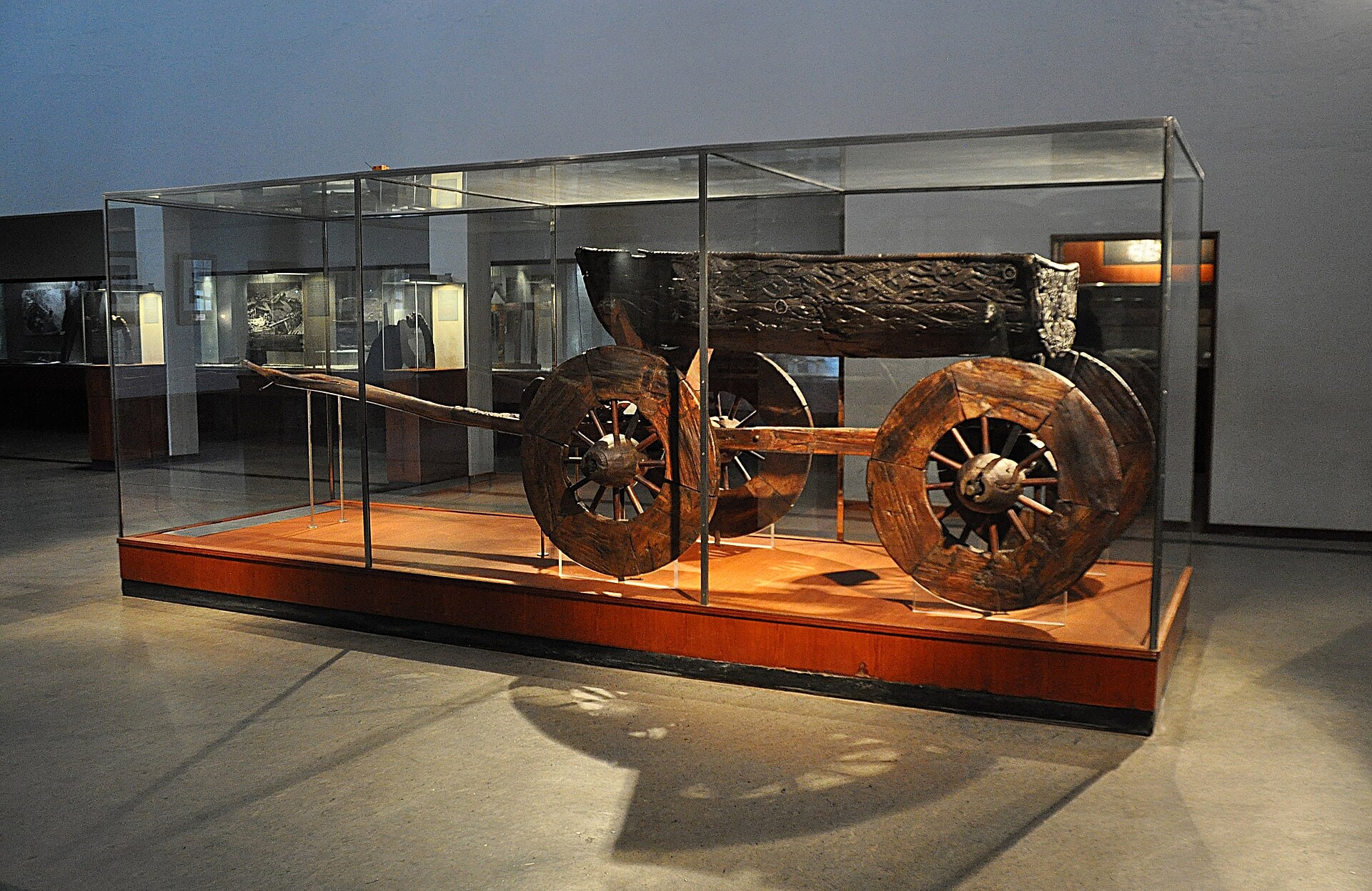
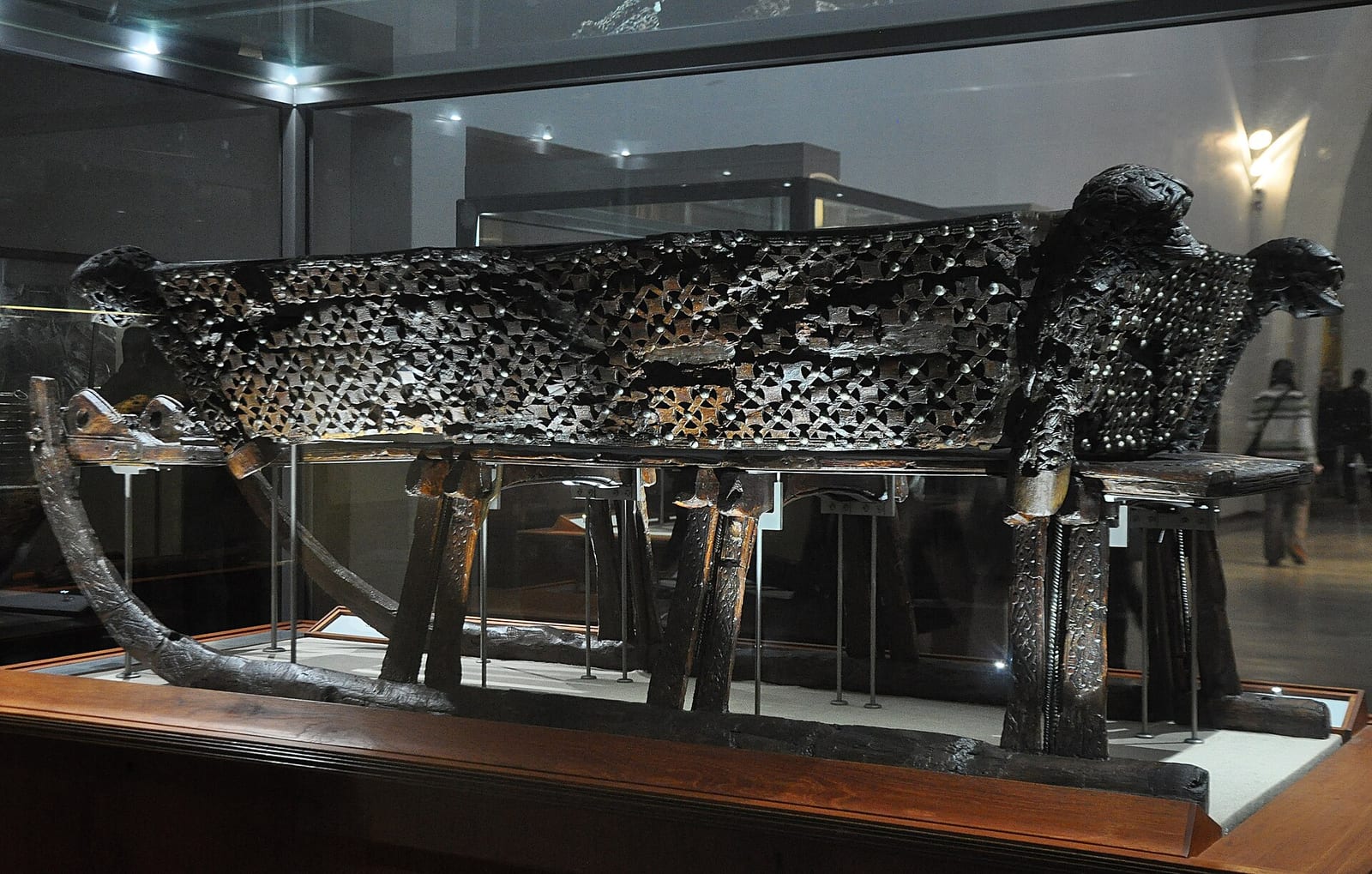
The grave goods rank among the richest ever recovered from the Viking Age: an elaborately carved cart, several sledges, looms, kitchen equipment, wooden chests, and an ornate bronze vessel known as the “Buddha bucket,” whose origins trace far outside Scandinavia and speak to just how far Norse trade networks reached. Animal sacrifice was part of the burial too - several horses and dogs were interred alongside the women. Notably, the mound had already been broken into and partially looted at some point during the Viking Age itself, a detail that says something uncomfortable but true: even contemporary Norse raiders weren’t above robbing someone else’s grave.
A few kilometers away, also in the Vestfold region, the Gokstad ship was excavated in 1880 and dated to around 900 CE. Unlike the largely ceremonial Oseberg vessel, the Gokstad ship was fully seaworthy - a working warship and trading vessel nearly 24 meters long, built to carry 32 oarsmen, and a genuine showcase for how capable the Viking longship actually was as a design. The man buried inside was middle-aged, likely a chieftain or regional lord of some standing, and his skeleton shows signs of injuries consistent with combat.
His grave goods included three smaller boats, hunting gear, board games, and - again - a substantial animal sacrifice: twelve horses, six dogs, and even a peacock, an exotic bird that underlines just how far-reaching Norse trade contacts had become. As with Oseberg, the Gokstad mound had been disturbed before modern excavators ever got to it, almost certainly by grave robbers after precious metal, who left behind the organic material that now makes the find so scientifically valuable.
Listen to Daudi while you read on - this exact story, set to music:
2. Ibn Fadlan’s Eyewitness Account: A Rus Ship Burial on the Volga
The single most vivid account of a Viking-style burial doesn’t come from Scandinavia at all - it comes from an Arab diplomat. Ibn Fadlan, an envoy of the Caliph of Baghdad, personally witnessed and recorded the funeral of a high-ranking Rus leader - Scandinavian-descended traders and warriors - on the banks of the Volga around 922 CE. His account is unusually detailed, and unusually blunt. The dead man was first laid in a temporary grave for ten days while new clothing was prepared for him. His ship was then hauled onto land and loaded with grave goods, sacrificed animals - dogs, horses, cows, chickens - and valuable textiles.
The centerpiece of Ibn Fadlan’s account is the ritual killing of an enslaved girl who had volunteered to accompany her master into the afterlife. He describes several days of ritual, drinking, and sexual activity leading up to her death, which finally took place in front of the assembled community. The ship, along with the body and all its goods, was then set alight, and a mound was raised over the remains. However unsettling this reads today, it remains one of the only sources describing a burial of this kind from a firsthand witness rather than through archaeological inference alone. One caveat matters here: Ibn Fadlan was describing the Rus, a Scandinavian-rooted group that had already absorbed Slavic and other influences through generations of contact along the trade routes - his account shouldn’t be read as a direct snapshot of burial customs back in Scandinavia itself.
3. Cremation Versus Inhumation: Two Roads to the Afterlife
Alongside the headline-grabbing ship graves, cremation was actually the more common burial method across much of Scandinavia for much of the Viking Age, particularly in Sweden. The body was burned on a pyre, and the remains were then either placed in an urn or scattered directly within a mound, frequently alongside burned grave goods and animal remains. It was only over the course of the 10th century, as Christianity spread, that inhumation (burial without cremation) became increasingly common - a shift that shows up clearly in the archaeological record as a gradual religious transition, well before Scandinavia was officially Christian.
Both practices shared the same underlying logic: the dead needed to be equipped for whatever came next, whether that meant weapons, jewelry, tools, or food. The real dividing line wasn’t ideological so much as regional and chronological. Both methods also appear across a huge range of wealth levels, from a modest pit of ashes to a richly furnished burial mound.
4. Chamber Graves: The Underground Version of the Status Burial
A third, less famous but archaeologically significant form is the chamber grave - a wooden, sometimes furnished burial chamber dug into the earth, where the body was laid out or seated, fully dressed, and surrounded by personal belongings. Some of the richest chamber graves have turned up at Birka, the major Swedish trading center, including the well-known “warrior grave Bj 581,” whose weapon-laden burial was confirmed through genetic analysis in 2017 to belong to a woman - a finding that reignited debate over the actual role women played in Viking Age warfare.
Chamber graves differ from ship burials in one obvious way: there’s no vessel involved. The chamber itself served as a kind of symbolic living space for the deceased in the afterlife, sometimes fitted out with beds, chairs, or other furniture. This form of burial shows up more often among the urban trading elite than in rural areas, which hints at a real economic gap between chamber burial and the simpler mound grave.
5. Stone Ship Settings: Lindholm Høje and the Symbol Without the Ship
Not every “ship grave” actually contained a ship. In Denmark, most impressively at the cemetery of Lindholm Høje near Aalborg, hundreds of graves are outlined by upright stones arranged in the shape of a ship - so-called stone ship settings. The site was in continuous use for centuries, from the late Iron Age well into the Viking Age, and contains several hundred graves, a substantial number of which carry this distinctive stone outline.
These stone settings suggest that the symbolism of the ship as a vehicle to the afterlife was far more widespread than actual ship ownership at death, which tied up enormous resources. Sacrificing or burying a genuine ship was a privilege reserved for the elite; outlining a grave in stone in the shape of one let less wealthy families express the same religious idea without the expense of the real thing. It’s a pattern that recurs across cultures - symbolic substitution standing in for a status object most people simply couldn’t afford.
6. What Grave Goods Actually Tell Us About Norse Beliefs
Before getting into interpretation, it’s worth laying the types side by side. The table below makes a point that often gets lost in popular retellings: the Viking burial wasn’t a single uniform ritual. It was a graded system that reflected status, wealth, and regional tradition just as much as it reflected any specific belief about the afterlife.
| Burial Type | Typical Finds | What It Signaled |
|---|---|---|
| Ship grave (Oseberg, Gokstad) | Actual ship, rich grave goods, animal sacrifice | Highest status, usually elite or royal |
| Rus ship cremation (Ibn Fadlan) | Ship, grave goods, human sacrifice, fire | Elite status among traders, combined with ritual sacrifice |
| Chamber grave (Birka) | Furnished earthen chamber, personal items | Urban wealth, trading elite |
| Mound burial with cremation | Urn, burned grave goods, animal remains | Common across most social classes |
| Stone ship setting (Lindholm Høje) | Stones arranged as a ship, usually no real vessel | Religious symbol, accessible to less wealthy families |
This is worth being precise about, because it’s where solid evidence and popular myth genuinely part ways. The fact that grave goods - weapons, jewelry, tools, animals, and in rare, documented cases, people - appear consistently across Viking Age burials is archaeologically beyond dispute, and it points to an obvious conclusion: the Norse believed in some form of continued existence after death, one in which a person still needed possessions, status, and even a retinue. That lines up with the later literary picture of Valhalla and Hel, though it’s worth remembering those concepts were only written down systematically much later, mostly through Icelandic saga literature and the Eddas, long after most of these graves had already been dug.
What tends to get overstated is the idea that every burial was a spectacular ship funeral, blazing away on open water - an image that owes more to later novels, film, and a fairly loose reading of Ibn Fadlan’s account than to the archaeological record as a whole. In reality, the overwhelming majority of burials were far more modest: a simple grave in the earth or a cremation without any ship at all, often with only a handful of grave goods. The true ship burial was the exception, reserved for a tiny elite who could afford to permanently surrender a fully functional ship - one of the single most expensive objects of the entire Viking Age - to the earth or to fire.
Picture a Viking burial as nothing but a blazing dragon ship on open water, and you’ve mistaken a rare, highly symbolic outlier for how most Norse people were actually laid to rest - more plainly, but no less meaningfully.
7. Why Viking Burial Customs Still Fascinate Us
The sheer range of burial types - from the lavish ship grave to the simple cremation urn to the symbolic stone outline - points to a culture that treated death not as an ending but as a transition requiring real preparation. That care is exactly what makes these archaeological finds so revealing today: every grave is essentially a snapshot of what a society believed the dead would need on the road ahead, filtered through what the survivors could actually afford and were willing to give up.
Anyone who visits the Oseberg or Gokstad ships at the Viking Ship Museum in Oslo today is standing in front of objects that make this exact tension visible - between belief, status, and limited resources. It’s little wonder these graves still tell us so much about a culture that left behind almost no written record of its own religious beliefs, and instead let its dead do the talking.
Image: Bochum1805 (CC BY-SA 2.0), via Wikimedia Commons