History
Viking Trade Routes: From Baghdad to Newfoundland
Viking trade routes stretched from Baghdad to Newfoundland. Follow the silver dirhams, furs and silk along the rivers, portages and Atlantic crossings.
Contents
- Not Roads, but a Chain of Water and Portage
- The Eastern Way: Volga, Bulgar and the Road to Baghdad
- From the Varangians to the Greeks
- What Actually Moved Along the Viking Trade Routes
- Silver by Weight: Scales, Hacksilver and Test Nicks
- The Western Way: Iceland, Greenland and the Leap to Newfoundland
- Why the Silver Stopped, and What We Make of It
Say “Viking” and most people picture a longship on a beach with a monastery burning behind it. Open the finds catalogue of any Scandinavian museum and a different picture appears: silver coins with Arabic legends, strips of silk in a Norwegian ship burial, basalt millstones quarried in the Rhineland, three butternuts preserved in Newfoundland peat. For roughly two centuries the Viking trade routes connected the Abbasid Caliphate with the coast of North America, and economically they mattered far more to the North than any single raid. What follows traces the three axes of that network, shows through specific finds what moved along them, and explains why the system collapsed within a few generations.
Not Roads, but a Chain of Water and Portage
The word “route” is misleading here. There was no highway, no itinerary, no schedule, only a chain of rivers, drag-over points, seasonal fairs and local middlemen, and most Scandinavian merchants worked just one segment of it themselves. Old Norse has two directional terms that capture the shape of the thing: Austrvegr, the eastern way through the Baltic and up the rivers of eastern Europe, and Vestrvegr, the western way across the islands of the North Atlantic. Between them ran a third, frequently underrated axis: the short north-south traffic linking Scandinavia to the Frankish realm and the British Isles.
This trade did not begin with the raid on Lindisfarne in 793, and it did not end with a battle either.
| Date | Event |
|---|---|
| c. 750 | Staraya Ladoga founded on the Volkhov, earliest known Norse foothold in the east |
| c. 840 to 880 | Ibn Khordadbeh describes Rus merchants carrying furs to the Caspian and Baghdad |
| 870s | Settlement of Iceland, the North Atlantic link becomes permanent |
| 907 and 911 | Rus-Byzantine treaties set the terms of trade at Constantinople |
| 921 to 922 | Ibn Fadlan meets Rus traders on the Volga and records their customs |
| c. 950 | Constantine VII lists the Dnieper rapids with their Norse names |
| c. 985 | Erik the Red settles Greenland |
| 1021 | Scientifically dated Norse presence at L’Anse aux Meadows, Newfoundland |
| c. 1000 to 1015 | Islamic silver stops flowing into Scandinavia |
The Eastern Way: Volga, Bulgar and the Road to Baghdad
The eastern axis was the profitable one and the best documented. From the Baltic it ran through the Gulf of Finland to Lake Ladoga, up the Volkhov, then across a series of portages into the Volga system. The destination was Bulgar on the middle Volga, the great market of the Volga Bulgars and the hinge between the Norse and Islamic worlds. Beyond it lay the Caspian, and beyond that a camel caravan to Baghdad.
We know this from Arabic sources rather than Norse ones. Ibn Khordadbeh, a postmaster in Abbasid service, wrote in his Book of Roads and Kingdoms about Rus traders bringing beaver and fox pelts and swords down to the Caspian, paying their tithe there, and sometimes continuing by camel to the capital. Some eighty years later Ibn Fadlan, envoy of Caliph al-Muqtadir to the Volga Bulgars, recorded in 922 a camp of those same Rus: offerings laid before wooden posts with a blunt request for wealthy customers, and the cremation of a chieftain inside a ship. It is the closest thing to an eyewitness account of Norse merchants at work.
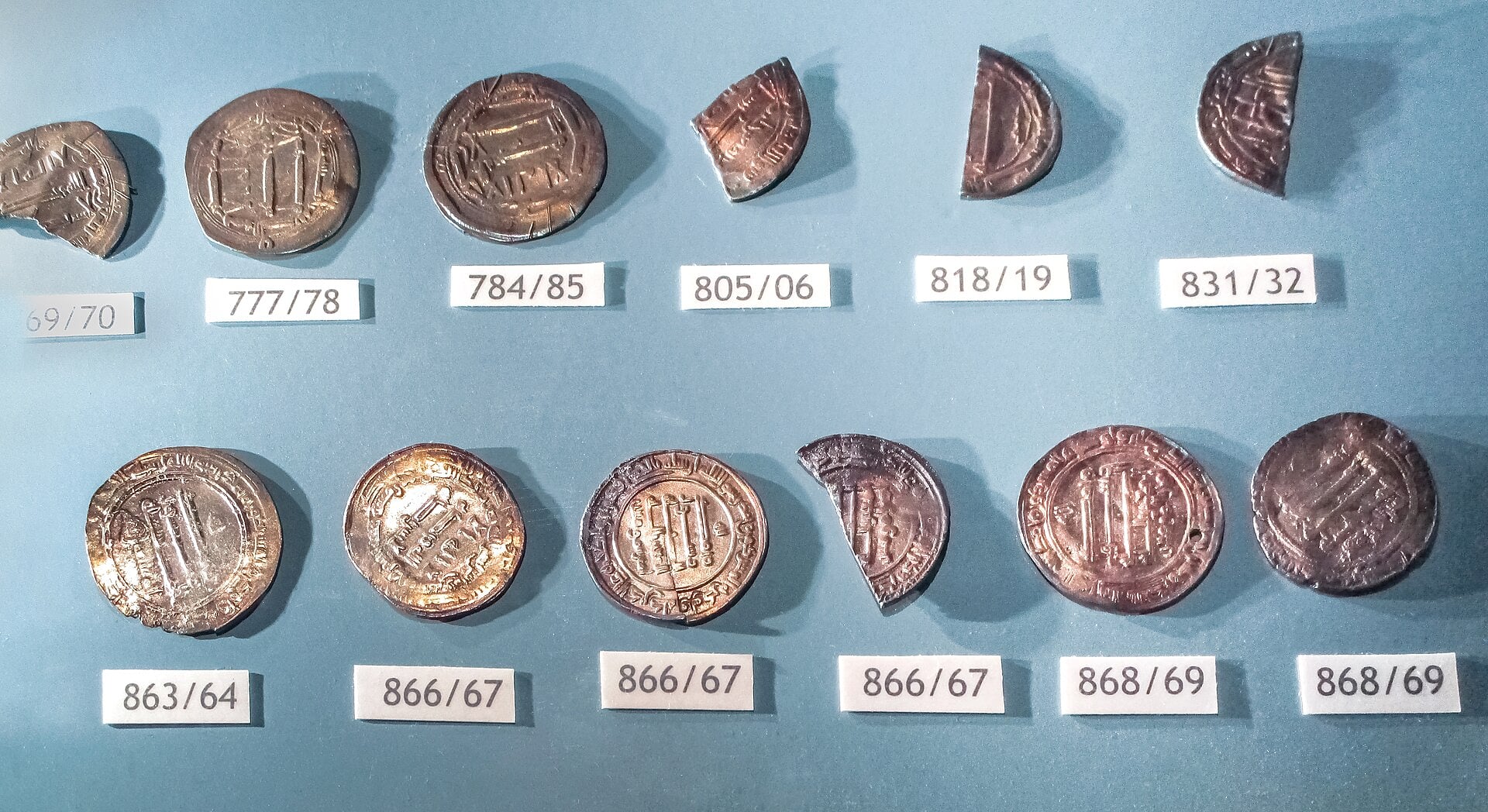
What came back up the rivers was, above all, silver. The Samanid mints at Samarkand and al-Shash struck dirhams in enormous quantities, and a startling share ended up in Scandinavian soil. Gotland alone has produced roughly 700 silver hoards, more than any comparable region in Europe, and trading towns such as Birka sat at the northern end of that chain.
From the Varangians to the Greeks
The second eastern route left the Volga aside and followed the Dnieper to the Black Sea. The Primary Chronicle of the Rus calls it the way “from the Varangians to the Greeks,” and its destination was Constantinople, Miklagarðr in the sagas, the richest market anyone in the North had heard of.
The dangerous part came long before the open sea. Below Kyiv a run of seven rapids forced crews to unload and haul cargo, sometimes the boats themselves, overland past the white water, exposed and within reach of Pecheneg raiders. Around 950 the Byzantine emperor Constantine VII Porphyrogenitus catalogued those rapids in “De administrando imperio,” and did something unusual: he gave each name twice, once in Slavic and once in what he explicitly calls the language of the Rus. Names such as Gelandri, which he glosses himself as the noise of the water, resolve without strain into Old Norse.
Under the treaties of 907 and 911 the Rus could enter Constantinople only in small parties, unarmed, through one designated gate. They were housed outside the walls at the suburb of St Mamas, issued provisions, and granted free use of the baths.
Those conditions cut both ways: Byzantium badly wanted the trade and plainly did not trust the traders. The same milieu later supplied the Varangian Guard, the emperor’s own bodyguard. In the east, merchant and mercenary were never separate careers, only two possible outcomes of the same voyage.
What Actually Moved Along the Viking Trade Routes
The North had very little the South was short of, with one exception: raw materials from the cold and the wilderness. That single advantage was the whole business model, and the table below sets out what the record supports.
| Commodity | Direction | Evidence or find spot |
|---|---|---|
| Sable, marten, fox and beaver furs | north to south | Ibn Khordadbeh, Ibn Fadlan |
| Walrus ivory and narwhal tusk | Arctic and Greenland to Europe | workshop waste, Dublin and Trondheim |
| Amber | Baltic coast southwards | Hedeby, Birka |
| Whetstones, soapstone, iron blooms | Norway and Sweden westwards | Eidsborg whetstones at Hedeby |
| Enslaved people | eastern and western Europe southwards | Arabic accounts, Rus-Byzantine treaties |
| Silver dirhams | Caliphate to Scandinavia | c. 700 hoards on Gotland |
| Silk | Byzantium and Central Asia northwards | Oseberg ship, 100 plus fragments |
| Glass beads, Rhenish pottery, basalt querns | Frankish realm northwards | Hedeby, Birka, Kaupang |
| Frankish sword blades | Frankish realm northwards | swords with Ulfberht inscriptions |
One line in that table should not be glossed over. The slave trade was no sideline but a load-bearing pillar of the system. Arabic writers and Byzantine treaty clauses treat enslaved people as ordinary merchandise, and part of the silver in Gotlandic hoards arrived by exactly that route.
The return traffic is just as tangible. The Oseberg ship, buried in 834, held more than a hundred fragments of silk patterned in ways that point to Byzantine or Central Asian workshops: a farm in Vestfold wearing cloth that had travelled several thousand kilometres.
Silver by Weight: Scales, Hacksilver and Test Nicks
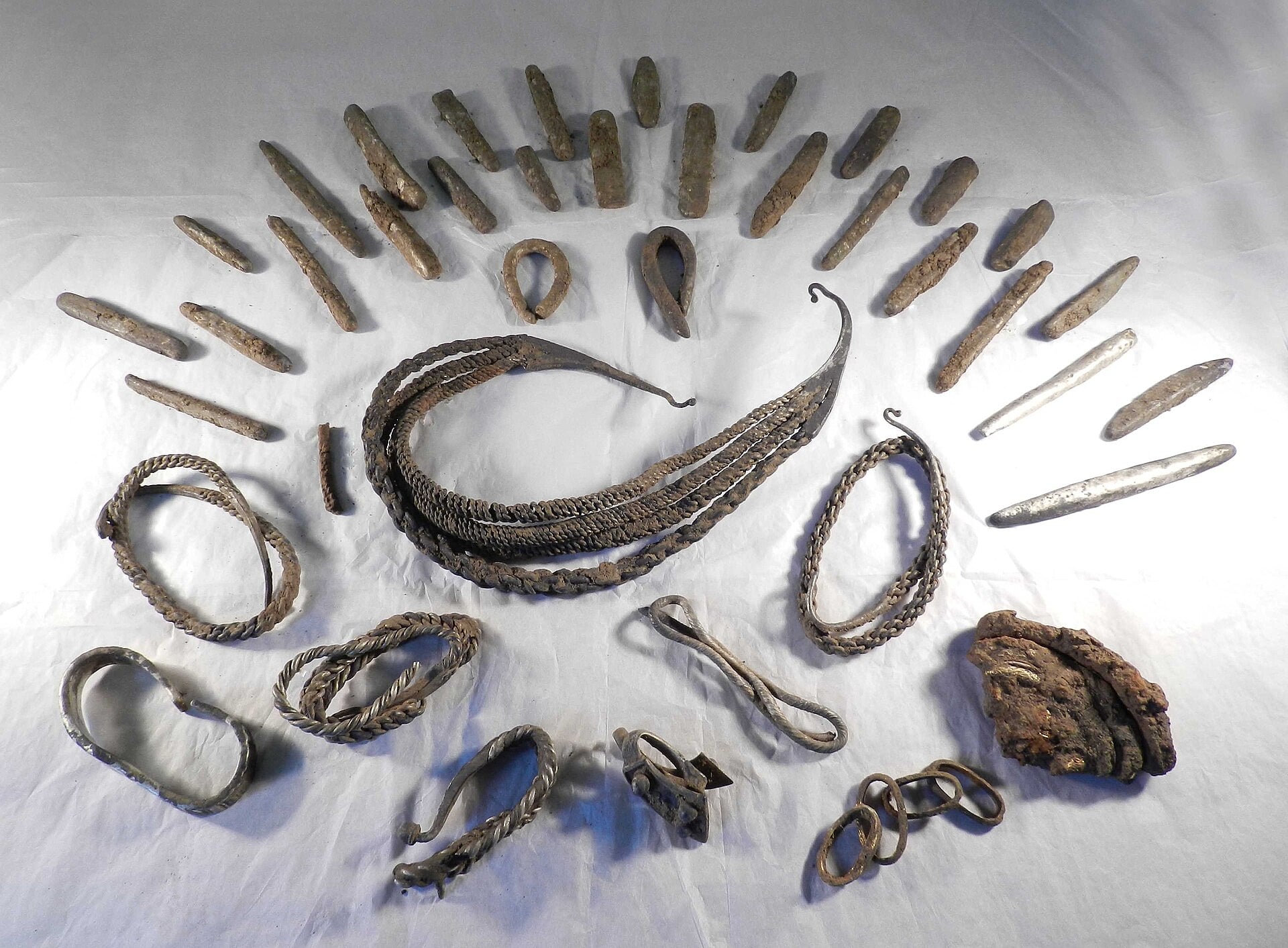
For most of the Viking Age Scandinavia had no coin economy in the modern sense. It ran a bullion economy: what counted was not who struck a coin but how much the metal weighed and how pure it was. Dirhams were cut up, arm rings chopped apart and ingots divided until the weight came right. Archaeologists call the result hacksilver, and in hoards it sits beside intact coins.
A merchant’s kit therefore included a folding balance and a set of weights. Graves at Birka and Kaupang have produced standardised cubo-octahedral weights on an Islamic system. Just as characteristic are the small nicks along coin edges, peck marks left by testing whether copper hid under a thin skin of silver. Distrust was built into the price.
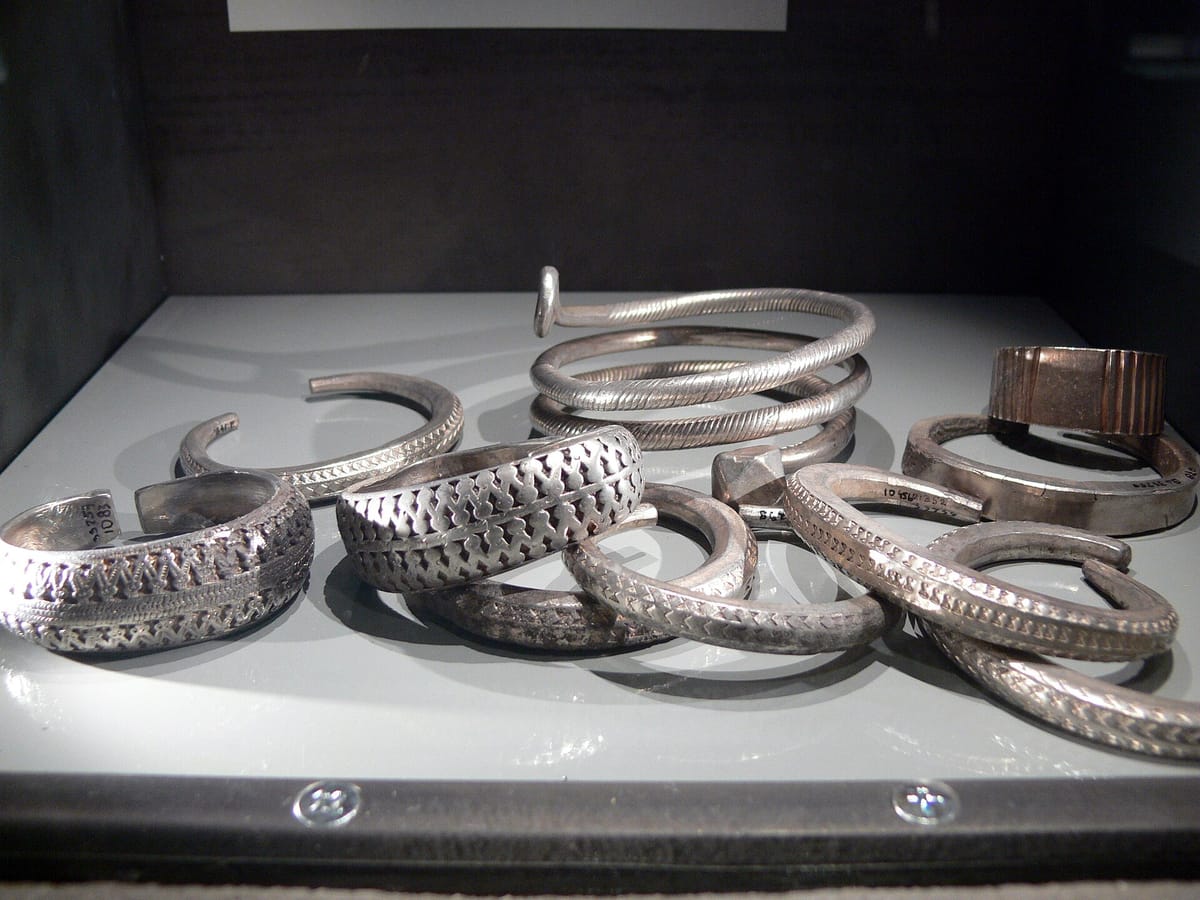 Image source: Wolfgang Sauber (CC BY-SA 3.0), via Wikimedia Commons
The scale these fortunes could reach is best shown by the Spillings hoard, found in 1999 in Othem parish on Gotland. It holds roughly 67 kilograms of silver in two deposits, plus a separate bronze hoard, making it the largest known Viking Age silver find anywhere. Over fourteen thousand coins belong to it, overwhelmingly Islamic dirhams, the youngest struck in 870 or 871. A single Baltic farmstead was sitting on Central Asian silver in quantities that outstripped the yield of entire districts.
The Western Way: Iceland, Greenland and the Leap to Newfoundland
The western axis obeyed different rules. No middlemen, no markets, no silver, only open ocean. From Norway it ran by way of Shetland, Orkney and the Faroes to Iceland, settled from the 870s, on to Greenland around 985, and finally to North America.
None of it worked without a specialised hull. The workhorse of long-distance trade was not the sleek longship but the broad-beamed knarr: shorter, deeper, with an open cargo hold amidships and built to cover distance under sail rather than oars. The Skuldelev ships in Roskilde show the difference in the original timber, from ocean-going freighter down to small Baltic coaster.
The far end of that road lies in Canada. L’Anse aux Meadows, on the northern tip of Newfoundland, was identified in 1960 by Helge Ingstad and the archaeologist Anne Stine Ingstad and excavated over the following years: eight turf buildings, a smithy with bog-iron slag, a Norse ring-headed pin. It has been a UNESCO World Heritage Site since 1978. In 2021 a research team anchored a date to the cosmic radiation event of 993 visible in tree rings, arriving at 1021 for wood felled and worked on the site.
The most revealing find there is not a building but three butternuts. Butternut does not grow on Newfoundland; its nearest natural range lies well to the southwest, around the Gulf of St Lawrence. The Norse must therefore have sailed further than the settlement itself, which was probably less a colony than a base camp and repair yard. For the people behind those voyages, see our article on Leif Erikson. Commercially the west stayed a one-way street: Greenland shipped walrus ivory to Europe, confirmed by genetic work on walrus skulls from medieval workshops, and Vinland supplied timber. Neither ever supplied silver.
Why the Silver Stopped, and What We Make of It
Between roughly 965 and 1015 the eastern supply failed. The cause lay in Central Asia, not the North: production at the Samanid mines went into crisis, the silver content of the dirham fell, and the long journey stopped paying. Scandinavian hoards record the switch like a ledger entry. Arabic coins vanish, German Otto-Adelheid pennies and English silver pennies take their place, many of the latter arriving as the tribute payments remembered as Danegeld.
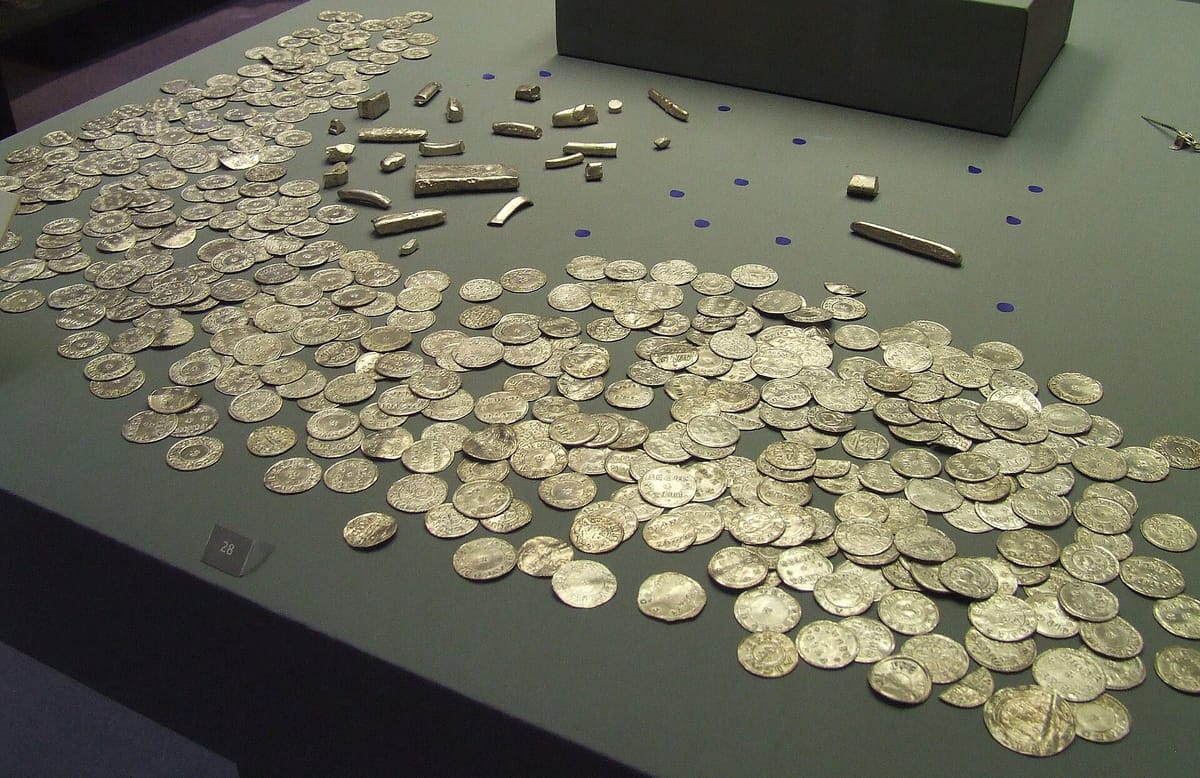 Image source: JMiall (CC BY-SA 3.0), via Wikimedia Commons
The hubs shifted with the metal. Birka was abandoned around 975 and Sigtuna took over; Hedeby was finished off in 1066 and Schleswig replaced it. The network did not tear so much as get retied, with different towns, different coinage and eventually the Baltic merchants who became the Hanseatic League.
Two points strike us as central. First, the Viking trade routes read better as an economic structure than as a feat of exploration. The North exported raw materials and human beings and received a metal it could not produce itself. That is the profile of a commodity supplier, and it explains the fragility: when the buyer vanished, the model collapsed although nothing in Scandinavia had changed. Second, the tidy line we draw between trader and warrior is not in the sources. The crew selling pelts at Bulgar could raid on the way home, and the men bargaining in Constantinople might return with an axe in the emperor’s service. The Viking Age only makes sense if you hold both together.
Image source: W.carter (CC BY-SA 4.0), via Wikimedia Commons