History
Viking Silver Hoards: Why They Buried Their Silver
Viking silver hoard finds explained: Cuerdale, Spillings and Galloway, what was actually buried, why the Norse hid silver, and why so much was never reclaimed.
Contents
On 15 May 1840, labourers repairing an embankment on the River Ribble near Preston in Lancashire drove their spades into the remains of a lead chest. Inside lay roughly 8,600 silver objects, about 7,000 of them coins, along with ingots, chopped-up arm-rings and brooch fragments: some 40 kilograms of bullion in total. The Cuerdale find is still the largest Viking silver hoard ever recovered in Britain, and it poses the question that every hoard of this kind poses. Why would anyone bury a fortune in the ground and then never come back for it?
The honest answer is that there is no single answer. Silver was put into the earth across the Norse world for very different reasons, and a portion of it was probably never meant to come out again. What now sits in cases in London, Edinburgh and Visby is therefore less a collection of treasure than an archive of decisions taken more than a thousand years ago, under pressure, under threat, or out of belief.
What a Viking Silver Hoard Actually Contains
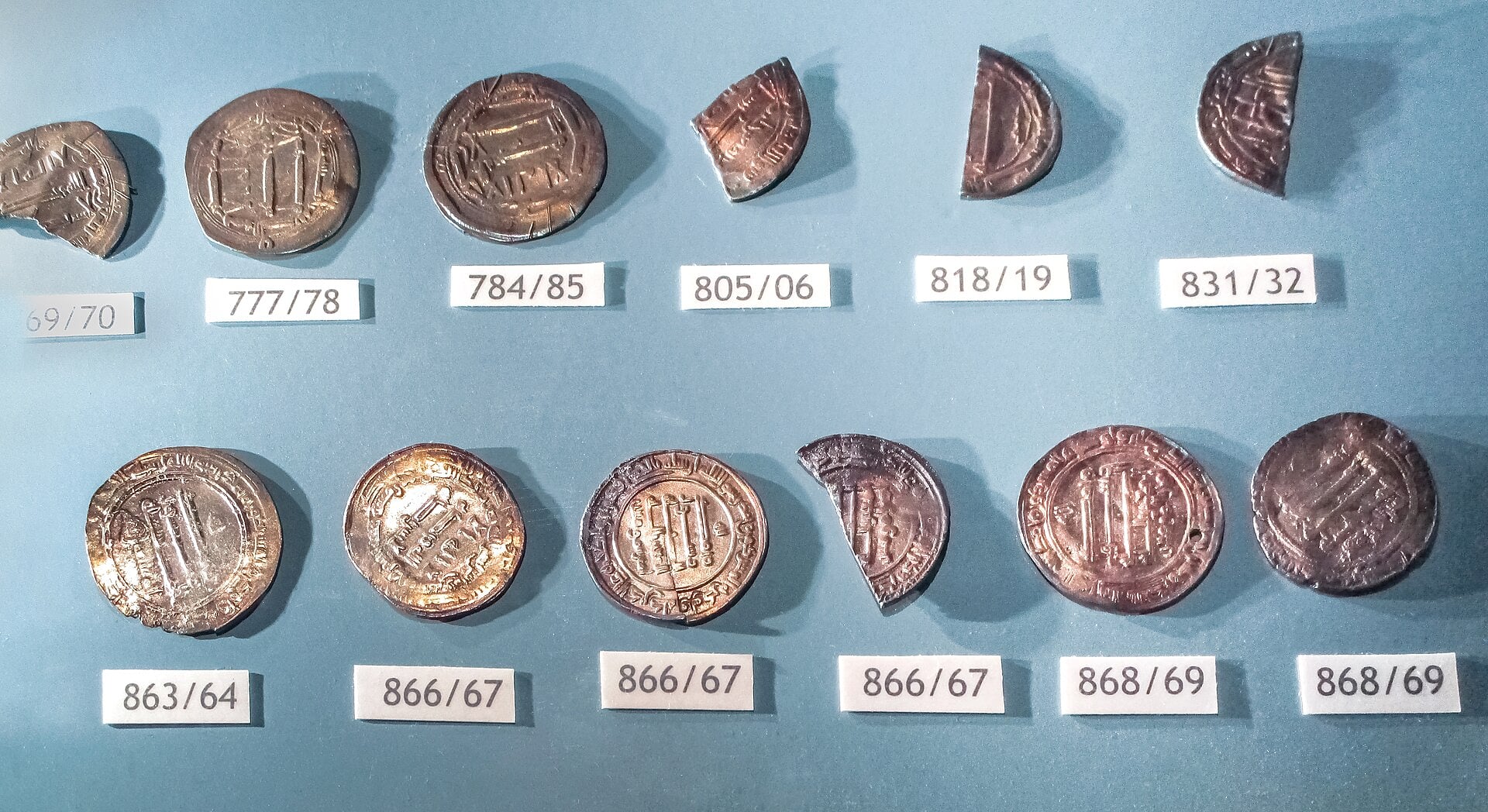
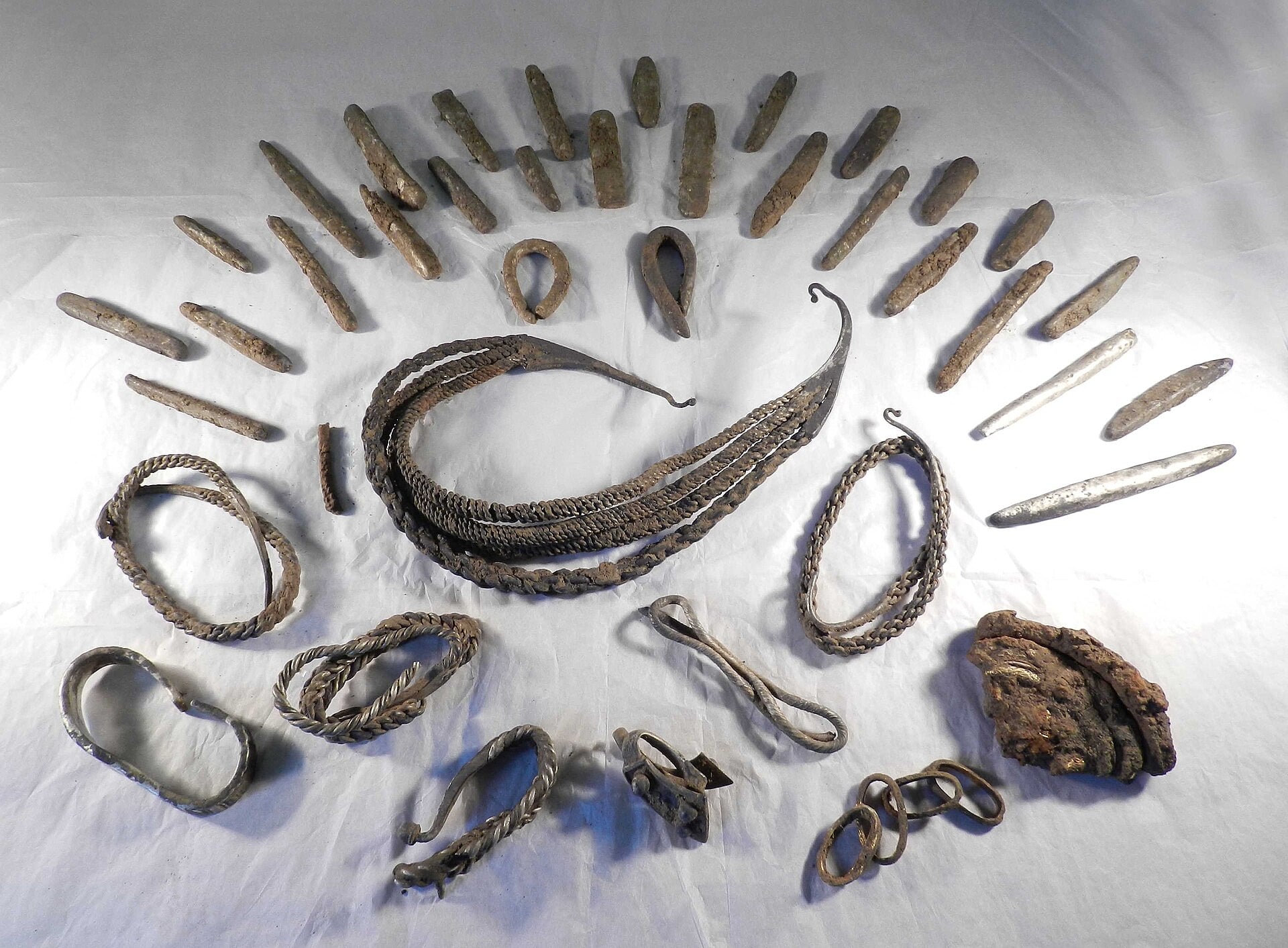
Anyone picturing chests of neatly matched coins will be disappointed by the real finds. A typical Viking Age hoard is a jumble of four material classes. First, coins, and rarely native ones: Arabic dirhams struck in the mints of the Abbasid and Samanid realms, Frankish deniers, Anglo-Saxon pennies and, from the late tenth century onwards, a rising tide of German pfennigs. Second, jewellery, above all arm-rings and neck-rings, frequently stamped or plaited. Third, ingots, meaning cast bullion in convenient bars. Fourth, what archaeologists call hacksilver: deliberately cut or chopped fragments of ornaments and vessels.
It is the hacksilver that tells you the most. A chopped arm-ring is not damaged jewellery, it is a unit of payment. Across much of the Norse world silver counted by weight and purity rather than face value, so a buyer cut off as much as the price demanded. That makes a hoard less a jewel box than a stock of raw material, and plenty of them look exactly like that.
The origin of the coins reveals how far the trade networks stretched. Tens of thousands of Islamic silver coins are documented from Scandinavian finds alone, struck in workshops from Baghdad to Samarkand and carried north along the river routes of eastern Europe. The trading town of Birka in Sweden’s Lake Mälaren shows what that traffic looked like on the ground, with the same dirhams turning up in its graves and occupation layers.
The Great Hoards Compared
The quickest way to get a feel for the scale involved is to set the best-known finds side by side:
| Hoard | Location | Found | Deposited around | Size and notable feature |
|---|---|---|---|---|
| Cuerdale | Lancashire, England | 1840 | 905 to 910 | c. 8,600 objects, c. 40 kg, of which some 7,000 coins |
| Spillings | Gotland, Sweden | 1999 | after 870/871 | c. 67 kg of silver, over 14,000 coins, the largest known Viking Age hoard |
| Vale of York | North Yorkshire, England | 2007 | c. 927/928 | 617 coins and 65 objects, packed inside a gilded silver vessel |
| Galloway | Dumfries and Galloway, Scotland | 2014 | c. 900 | around 100 objects in four layers, arm-rings carrying runic inscriptions |
| Silverdale | Lancashire, England | 2011 | 900 to 910 | 201 objects in a lead container, a coin naming the ruler Airdeconut |
Two things jump out of that list. One is the clustering in time: four of the five hoards fall within a few decades either side of the year 900, precisely when northern England and the Irish Sea were being fought over. The other is the geography. Gotland alone has produced more than 700 Viking Age silver hoards, more than any comparable region in northern Europe. The island was the clearing house of Baltic trade, and its farmers were sitting quite literally on the silver flowing through their harbours.
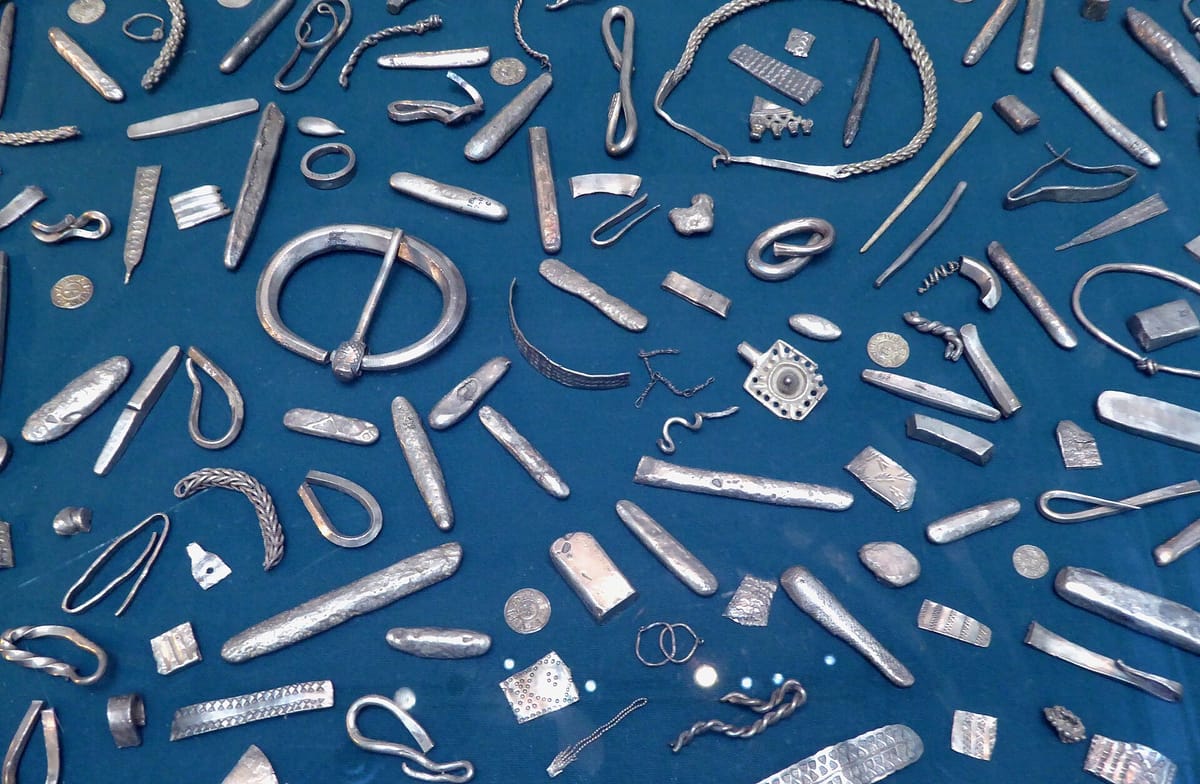 Image credit: Ethan Doyle White (CC BY-SA 4.0), via Wikimedia Commons
Listen to Víkingr while you read on:
Why the Norse Buried a Viking Silver Hoard
Four explanations compete in the literature, and the most defensible position is that they are not mutually exclusive.
The emergency cache. The obvious reading. If you expect an army, you get your movable wealth out of the house. It fits the clustering of the English hoards around 900, when the Norse kingdom of York was fighting for survival and Scandinavian warbands expelled from Dublin in 902 were looking for new footholds along the Irish Sea. Cuerdale sits exactly on that fault line, at a river crossing on the route between York and the coast.
Banking without a bank. In a society with no vaults, no enforceable paper debt and no bailiffs, a hole in the ground is a rational financial product. It costs nothing, it attracts no attention, and only one person knows where it is. The drawback is identical to the advantage: if that person dies unexpectedly, the silver stays put. A substantial share of surviving hoards probably exists for no better reason than that the owner never made it back.
The offering. Some deposits lie in places where recovery would have been awkward or impossible, in bogs, in water, or at conspicuous boundary points in the landscape. Here there is a strong case that the metal was deliberately taken out of circulation as a gift to powers rather than parked as savings.
The deposit for the afterlife. The most dramatic explanation, and the one with an actual written basis, which is where the sources come in.
Odin’s Law and Egil’s Chests: What the Sources Say
In Ynglinga saga, the opening section of his Heimskringla, Snorri Sturluson describes the laws Odin is said to have laid down. Every dead man, he writes, should come to Valhalla with whatever property he had with him on the pyre, and should likewise enjoy whatever he had himself buried in the earth. That is the plainest statement about hoarding wealth to survive anywhere in the Old Norse written record.
It needs handling with care. Snorri was writing in the thirteenth century, a couple of centuries after Iceland’s conversion, and he was tidying pagan practice into a system after the fact. The passage still matters, though, because it shows that burying silver was remembered in the medieval north as a religiously meaningful act and not merely a security measure.
Egil’s saga supplies the literary counterpart. The old and nearly blind Egill Skallagrímsson takes his two chests of English silver, rides off into the night with two thralls, hides the silver and comes back alone. Whether the episode ever happened is unanswerable. As evidence of how people centuries later imagined a hoard being laid down, it is hard to beat: in secret, after dark, and with no surviving witnesses.
Lay all three strands of evidence next to each other and the same pattern appears. Silver in the north was never only money. It was rank, obligation and gift at the same time, and where it disappeared, it rarely disappeared out of pure calculation.
The language carries the same message. Skaldic poetry praises kings as ring-breakers and ring-givers because they cut up precious arm-rings and handed the pieces to their followers. The Arab envoy Ibn Fadlan, who encountered the Rus on the Volga in 922, recorded the custom of a man having a neck-ring made for his wife for every ten thousand dirhams he owned. Wearable wealth was a public statement of standing, not just a reserve.
Paying by Weight: Hacksilver, Scales and Peck Marks
How a transaction actually worked can be read off the finds. Among the most common grave goods of Viking Age traders are small folding balances and sets of standardised weights, usually cube-shaped with bevelled corners or flattened spheres. They appear from the late ninth century across the Norse world in strikingly similar forms, which points to a broadly shared system of weight.
The test marks are just as revealing. A great many coins and ingots from the hoards carry fine nicks and notches along their edges, made with knife points to check whether a cheap core of copper or lead lurked beneath a silver skin. A hoard full of pecked pieces is therefore also a record of forgery and mistrust, of a market where nobody took a stranger’s lump of metal on trust.
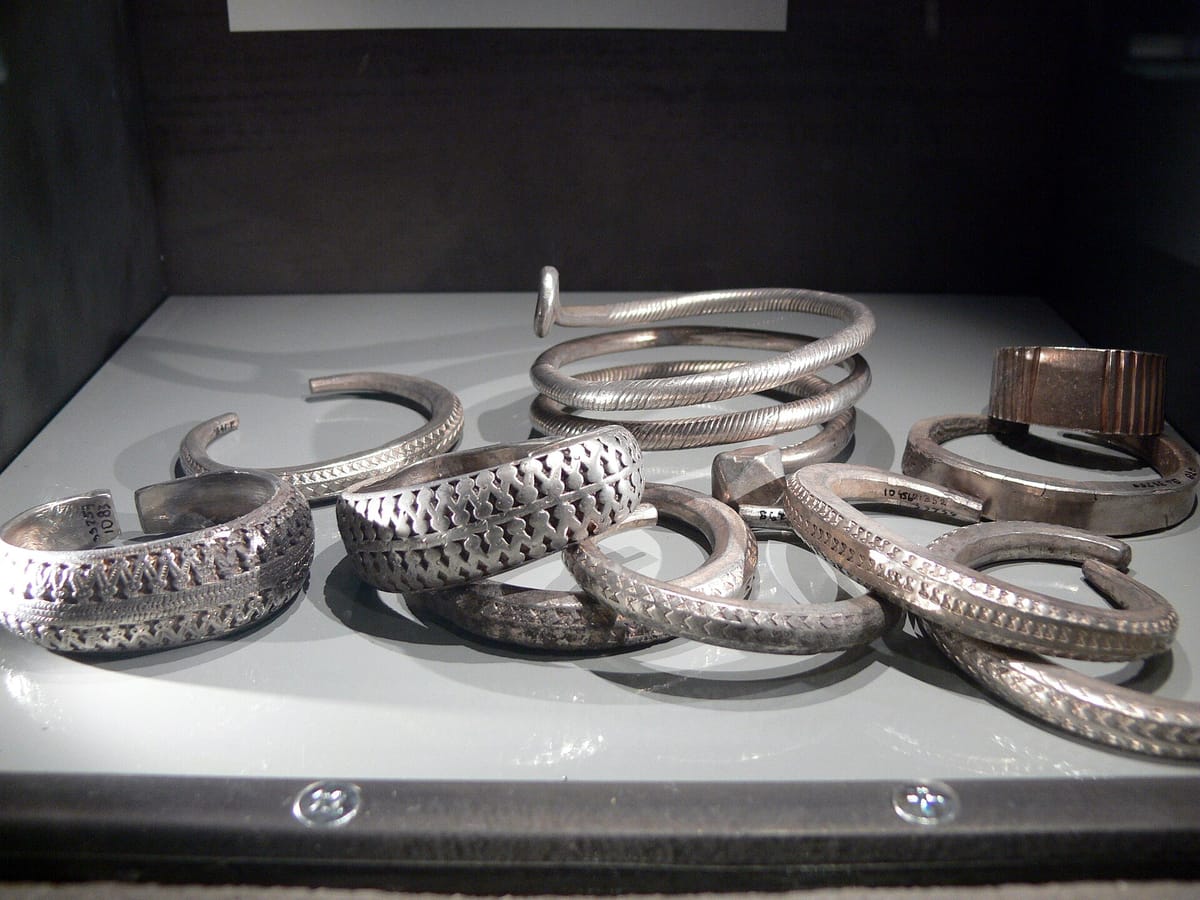 Image credit: Wolfgang Sauber (CC BY-SA 3.0), via Wikimedia Commons
Out of this bullion economy grew regional hybrids. In the Scottish isles of the tenth and eleventh centuries, arm-rings circulated at remarkably consistent weights, a phenomenon scholars call ring-money: ornament that doubled as a predictable unit of payment. Where a strong kingship minted its own coin and enforced its circulation, hacksilver gradually faded out. The story of Danegeld, in which England handed over minted silver to Norse armies on an industrial scale, marks exactly that transition.
Myth Versus Evidence
Popular accounts and the archaeological record diverge unusually widely on this subject. Four common assumptions, tested:
- Myth: Viking hoards are mostly gold. Fact: the overwhelming majority of finds are silver. Gold was known and prized in the north but scarce. Silver was the mass medium of value.
- Myth: the treasure came almost entirely from raiding. Fact: a large share of the metal arrived through trade, tribute and mercenary pay, much of it along the eastern route. Plunder was one source among several, not the only one.
- Myth: a hoard always belonged to one person. Fact: several arm-rings in the Galloway Hoard carry runic inscriptions with different names, which suggests multiple owners or a jointly deposited communal fund.
- Myth: burial spots were chosen at random. Fact: many deposits lie at fords, boundaries, prominent stones or high points, places you can find again or that carried religious weight.
One point strikes us as badly underrated in most retellings. The hoards we know about are, by definition, the failures. Every Viking silver hoard that was buried successfully and later dug up again is invisible to archaeology, because it went straight back into circulation. What survives is not the practice but its casualties. Concluding from the finds that the Norse were forever losing silver out of fear or piety mistakes the sample for the population. It is far more likely that burying wealth was an ordinary and usually effective way of handling it, and that only the misfires reached us.
Anyone who stumbles on such a find in northern Europe today has a legal duty to report it. In England and Wales the Treasure Act 1996 sets out the procedure, in Denmark the old principle of danefæ applies, and Swedish and Norwegian heritage law requires precious metal finds to be offered to the state. That route is how National Museums Scotland acquired the Galloway Hoard in 2017 for 1.98 million pounds. Unauthorised digging, by contrast, destroys the very thing that gives a find its scientific value: its context in the ground.
Conclusion: Silver That Outlived Its Owner
A Viking silver hoard is not a fairy-tale motif but a snapshot. It shows how far a Gotland farmer’s trading connections reached, how jittery northern England felt around the year 900, how people saved without banks, and how they imagined an afterlife with a reserve fund attached. Above all it shows that silver in the north did several jobs at once: currency, status marker, gift and, quite possibly, offering.
Cuerdale, where this article started, remains the clearest case. Forty kilograms of silver, carefully sorted, packed into a lead chest and buried at a river crossing, speaks of a deliberate act by someone who fully intended to return. That nobody did is the only reason we can look inside it at all. That irony sits at the bottom of almost every hoard of the Viking Age.
Hero image credit: Portable Antiquities Scheme from London, England (CC BY 2.0), via Wikimedia Commons