History
Leif Erikson: The Viking Who Found America
Leif Erikson reached America around 1000 CE, roughly 500 years before Columbus. What the Vinland sagas claim, and what L'Anse aux Meadows actually proves.
Contents
Almost five hundred years before three Spanish ships crossed the Atlantic, a man from Greenland pointed his ships west and found a continent nobody in Europe knew existed. Leif Erikson, son of the notorious outlaw Erik the Red, is now recognized as the first European known to have set foot on North American soil. This isn’t legend dressed up as history - it’s a genuine chapter of exploration that took centuries to be believed.
So why does every schoolchild know Columbus, while Leif Erikson barely rates a footnote? The answer has less to do with the scale of the achievement than with how it was recorded - and that record is worth examining closely.
The Son of an Exile
To understand Leif Erikson, you have to start with his father. Erik the Red was an Icelander banished from his homeland for manslaughter - a family pattern, it turns out, that repeats more than once. He used his exile to explore an unfamiliar landmass further west, gave it the deliberately appealing name “Greenland” to lure settlers, and around 985 CE founded the first Norse colonies there.
Leif grew up on this rough edge of the Viking world, at the furthest frontier Norse settlers had reached at the time. Life in Greenland meant knowing the nearest known coastline lay days away by sea. That comfort with long, uncertain voyages would turn out to matter enormously.
The Sagas as Sources - and Their Problem
Almost everything we know about Leif Erikson’s voyage to America comes from two Icelandic sagas: the Grœnlendinga saga (“Saga of the Greenlanders”) and the Eiríks saga rauða (“Saga of Erik the Red”). Both were written down in the 13th century - a good two hundred years after the events they describe, following generations of oral transmission.
That’s not a minor caveat; it’s the heart of the problem. Oral tradition drifts. Names shift, sequences blur, individual feats migrate from one figure to another. The two sagas genuinely disagree on important points - including who actually sighted the new land first.
The Grœnlendinga saga tells us the merchant Bjarni Herjólfsson was blown off course around 986, glimpsed unfamiliar, forested coastlines from his ship - but never went ashore. Only years later, the saga says, did Leif buy Bjarni’s ship and set out deliberately to find and actually land on that country. In the Eiríks saga rauða, Bjarni is absent entirely; there, it’s Leif himself who gets blown off course sailing home from Norway and stumbles on the new land more or less by accident.
Which version is correct? Probably neither, exactly. Most historians today suspect Bjarni’s sighting and Leif’s later, deliberate landing were genuinely separate events - and that the sagas, as oral traditions tend to do, later fused them into a tidier single story.
How Leif Erikson Reached America
What the sources agree on: Leif Erikson set out with a crew of roughly 35 men and reached, in sequence, three distinct stretches of coast, each of which he named:
- Helluland (“Land of Flat Stones”) - likely parts of Baffin Island in modern Canada, barren and rocky
- Markland (“Forest Land”) - probably the coast of Labrador, densely wooded
- Vinland (“Land of Wine” or “Pastureland” - the exact meaning is still debated) - where the crew wintered over
The sagas describe Vinland as mild and fertile, with salmon “larger than any seen before” and wild grapes said to have given the land its name. None of this would have been possible without the right ship for the job - the shallow-draft, remarkably seaworthy Viking longship, equally at home on open ocean and coastal rivers.
The Grœnlendinga saga reports, in paraphrase, that Leif named the land after its three most notable resources - stone, timber, and wine - and sailed home to Greenland with a hold full of lumber and grapes, since usable timber was chronically scarce there.
None of these details should be taken as verbatim fact. But the broad shape of the story - a voyage along a wooded, fish-rich coastline far west of Greenland - lines up remarkably well with what archaeologists would later actually dig up.
L’Anse aux Meadows: Proof in the Ground
For centuries, Vinland remained pure saga geography, a place historians argued over without evidence. That changed in 1960, when the Norwegian husband-and-wife team Helge Ingstad and archaeologist Anne Stine Ingstad followed local knowledge to grass-covered ridges at the northern tip of Newfoundland - features known to residents for generations but never formally excavated.
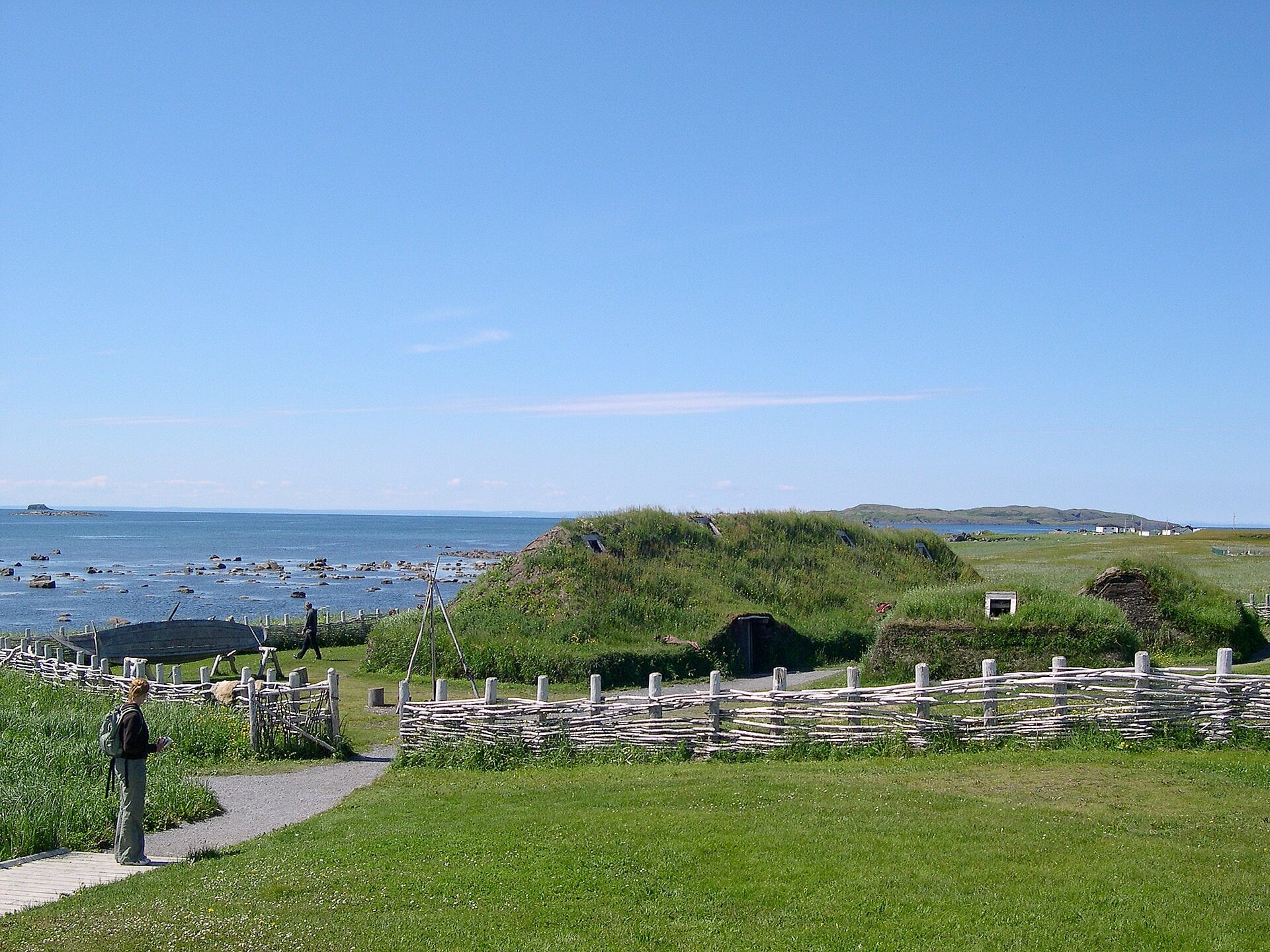
The dig at this site, L’Anse aux Meadows, uncovered the foundations of several longhouses, a smithy, iron slag, a boat shed, and worked timber - all built in a distinctly Norse, non-Indigenous style, radiocarbon-dated to around 1000 CE. It remains the first - and to date the only - unambiguously confirmed evidence of a Norse presence on the North American mainland before Columbus. A 2021 study using a solar-storm signature preserved in the wood’s tree rings even pinned down a date with startling precision: the year 1021 CE.
L’Anse aux Meadows itself was probably not the legendary Vinland of the sagas, but more likely a base camp or staging point for expeditions further south, toward the milder climate and wild grapevines the sagas describe. Either way, the site proved something unshakeable: the core claim of the sagas - that Norse sailors reached America around the year 1000 - is not legend. It’s history.
Where Legend Ends and History Begins
This is really the crux of the Leif Erikson story. The sagas blend verifiable fact with narrative embellishment - omens, prophecies, and dramatic dialogue no chronicler could plausibly have recorded word for word. Details like exact conversations or the precise number of grapes in the ship’s hold belong squarely to storytelling, not history.
But the skeleton of the account - a Greenland-based expedition under Leif Erikson that reached new land to the west around the year 1000 and settled there temporarily - is backed by archaeology. That’s rare in medieval historiography: a saga whose core claim can literally be excavated.
The Siblings Who Tried Again
According to the sagas, Leif himself never returned to Vinland - after his father’s death he took over leadership of the Greenland settlement and stayed there. But his family wasn’t done with the new land. His brother Thorvald Eiriksson is said to have sailed west again a few years later using Leif’s ship, wintered at the same camp, and died in a violent clash with the local population. His sister Freydís Eiríksdóttir is also credited, in both sagas, with her own - considerably bloodier - Vinland expedition.
The most ambitious attempt came from an Icelander named Thorfinn Karlsefni, who led a much larger expedition with livestock and settlers, explicitly intending to stay for good. That voyage produced one of the most touching footnotes in the whole tradition: Karlsefni’s wife Gudrid is said to have given birth to a son named Snorri in Vinland - by current understanding, the first child of European descent born on American soil. This attempt, too, ultimately foundered on the same problems: the distance from Greenland was too great, and conflict with the people the sagas call the Skrælingar proved too costly to sustain.
Why the Vikings Didn’t Stay
If the Norse reached America around 1000 CE, why isn’t there a lasting Norse colony in New England? The sagas offer a plain answer: repeated conflict with the Indigenous population, combined with the sheer distance to the nearest supply base in Greenland, made permanent settlement too risky and too expensive. Greenland itself was already stretched thin; its population likely never exceeded a few thousand people, leaving no surplus to sustain a distant overseas colony.
What remained were isolated, time-limited expeditions - enough to leave physical traces in Newfoundland’s soil, not enough to build a lasting colony. It would take another five centuries, a different set of tools, and an entirely different political landscape before another sailor would forge a connection between the continents that actually endured.
Leif the Lucky
The Eiríks saga rauða gives Leif Erikson a nickname that points beyond the discovery itself: Leif hinn heppni, “Leif the Lucky.” According to the saga, the name originally had nothing to do with Vinland - it referred to an earlier episode in which Leif rescued shipwrecked sailors at sea on his voyage home from Norway, before ever sailing west.
The religious context the sagas place him in is worth noting too. Leif is credited with accepting Christianity from King Olaf Tryggvason of Norway and later bringing the new faith to Greenland, at a moment when the wider Norse world was shifting away from the old gods. Whether that attribution is historically precise, or a later, Christian-tinted flourish, can’t be settled with certainty. What is notable is that both Vinland sagas were composed after Iceland had already converted, and both consistently portray Leif as a level-headed, exemplary leader - not a raider, but an explorer and go-between.
A Date We Still Celebrate
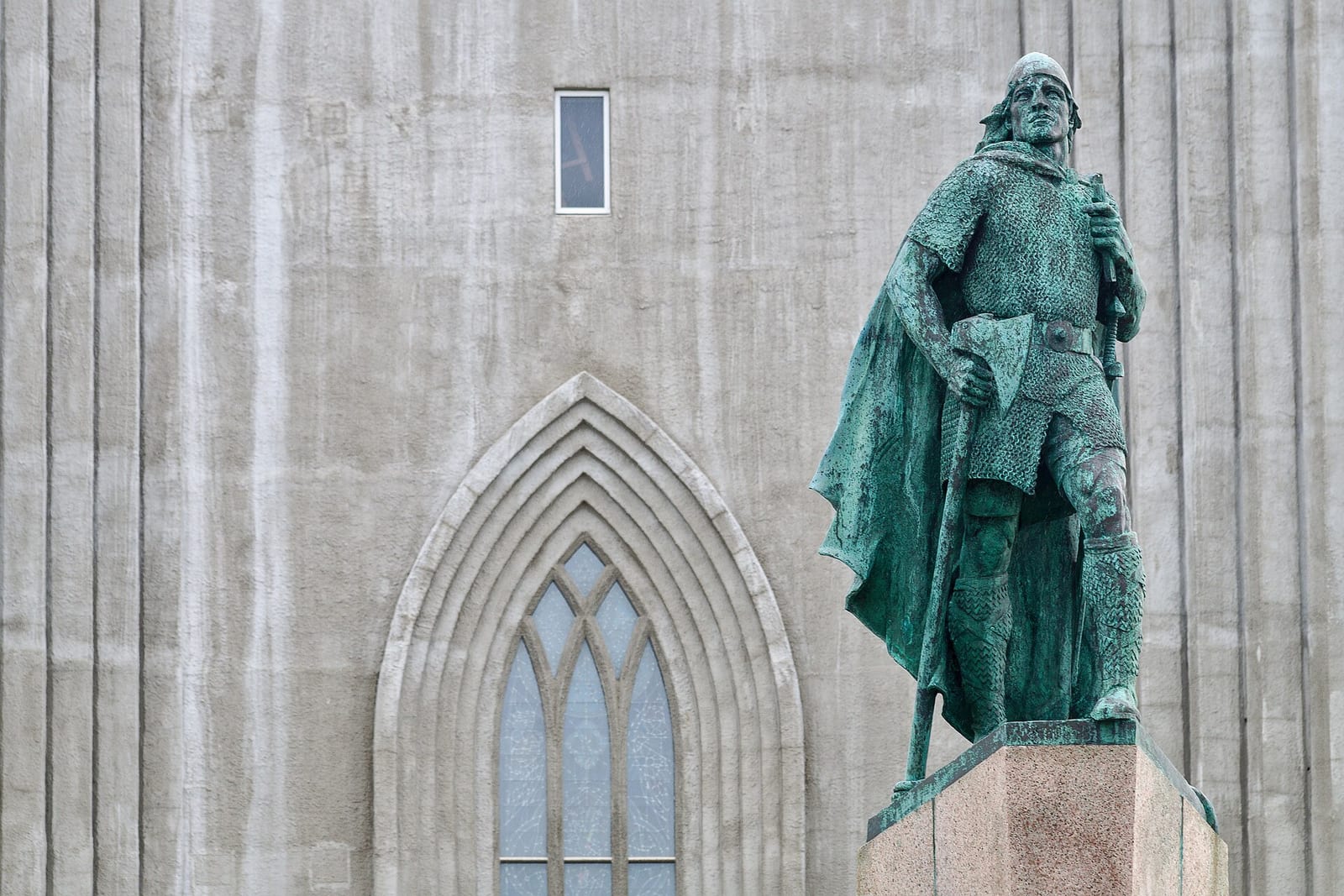
Recognition came slowly, but it came: since 1964, the United States has marked Leif Erikson Day every October 9th, and across Scandinavia and among descendants of Scandinavian emigrants, the day serves as a tribute to the actual first European discoverers of America. Statues of Leif Erikson now stand in Reykjavík, Boston, Seattle, and several other North American cities - monuments to a voyage dismissed as legend for centuries, until the soil of Newfoundland proved it true.
Maybe that’s the real lesson in Leif Erikson’s story: sometimes a centuries-old tale that sounds like exaggeration turns out to have a true core, waiting patiently to be dug up.
Image: Rob Oo from NL (CC BY 2.0), via Wikimedia Commons