Recipes
Viking Nettle Soup Recipe: The Spring Dish of the Norsemen
Viking nettle soup recipe: the Norse spring dish of wild nettles, barley and butter. What the archaeology really proves, and how to cook it in under an hour.
Contents
Every farming culture has a hungry season, and in the North it landed in March. The storage pit had been scraped out, the salted meat had long since stopped being interesting, and the barley harvest was still half a year away. Then, right on cue, the nettles came up. This Viking nettle soup recipe is not a piece of costume-drama cooking. It is what you make when the year is at its thinnest and the only reliable green thing in sight is the weed growing against the byre wall: a cauldron, a knob of butter, a handful of barley, and two fistfuls of stinging leaves.
The interesting part is how much of that we can actually prove, and how much is wishful thinking dressed as history. So let us sort that out before the pot goes on the heat.
The Hungry Gap: Why Nettles Mattered in a Norse Spring
Scandinavian farming in the Viking Age ran on barley, dairy and whatever the sea and the woods provided. Barley came in at the end of summer and had to stretch. Cows only started giving milk again after spring calving. Slaughtering livestock in March was a bad trade, because every animal that survived the winter meant a whole summer of milk, butter and cheese. For a few brutal weeks, the household lived on the edges of its own supplies.
Nettles walk straight into that gap. They push up as soon as the ground thaws, they grow faster than anything a gardener plants deliberately, and they come in absurd quantities. Best of all, they grow exactly where people already are. Nettles love nitrogen-rich, disturbed ground, which is a botanist’s way of saying middens, byres, footpaths and farmyard edges. The plant follows human settlement the way smoke follows fire. Nobody in a Norse farmstead had to go foraging for nettles. They had to stop them taking over.
The sting is a harvesting problem, not an eating problem. Nettle hairs are tiny glass needles that snap on contact and inject an irritant cocktail into the skin. Heat and crushing destroy that structure completely. Blanched or simmered nettles do not sting at all. One pair of gloves is the entire safety kit.
What the Digs Actually Say About Nettles
This is where the evidence gets both generous and slippery. Nettle seeds turn up routinely in waterlogged settlement layers across the Viking world. That proves the plant was there. It does not prove anybody ate it, because nettles would have grown thickly around those settlements whether or not a single leaf reached a bowl. Good archaeobotany keeps presence and intent firmly apart.
| Find | Date | What it shows |
|---|---|---|
| Lusehøj barrow, Voldtofte, Denmark | Bronze Age, around 800 BC | A textile wrapping cremated bone, woven from nettle fibre. Isotope work points to an Alpine origin for the material |
| Settlement deposits at trading towns such as Hedeby and York | 9th to 11th century | Rich waterlogged plant assemblages from waste and cesspit layers, with nettle among the regular settlement weeds |
| Oseberg ship burial, Norway | Buried 834 | An iron cauldron with a tripod, wooden troughs and a hand quern: the full kit for exactly this kind of pot cooking |
| Norwegian soapstone vessels | Viking Age | Soft-stone cooking pots, widely traded, ideal for slow simmering over an open fire |
Myth: There is a surviving Viking recipe for nettle soup. Fact: There is no surviving Viking recipe for anything. Not one cookbook comes down to us from the Viking Age. The oldest known Nordic cookery manuscript, the Danish Libellus de arte coquinaria, was written around 1300, roughly three centuries after the period ended. Anything sold as an “authentic Viking recipe” is a reconstruction. That is perfectly honest work, as long as somebody says so out loud.
What we can document is the nettle as a useful and medicinal plant across the wider Norse orbit. In tenth-century Anglo-Saxon England it appears in medical compilations such as Bald’s Leechbook, and it holds a fixed place in the Old Danish herbals associated with the physician Henrik Harpestreng, who died in 1244. Its fibre had been spun for millennia before that. A plant people weave, spin and dose themselves with is not a plant they overlook at dinner.
Building a Viking Nettle Soup Recipe That Holds Up
Our honest editorial take: nettle soup is the most defensible “Viking dish” we have ever cooked. Not because a saga names it, but because every single component is independently documented. Barley as the staple grain, butter and soured milk from a dairy-heavy economy, onion and leek as garden crops, and the cauldron over the hearth as the cooking method. Nothing has to be invented. It only has to be assembled.
That also means leaving things out. Potatoes crossed the Atlantic centuries later and have no business here. Carton cream becomes soured cream or skyr, because that is what a Norse household actually had. The body comes from barley rather than wheat flour. Black pepper is a modern reflex; caraway, thyme and a spoonful of something sour sit far closer to the period, as we set out in our guide to Viking herbs and seasonings.
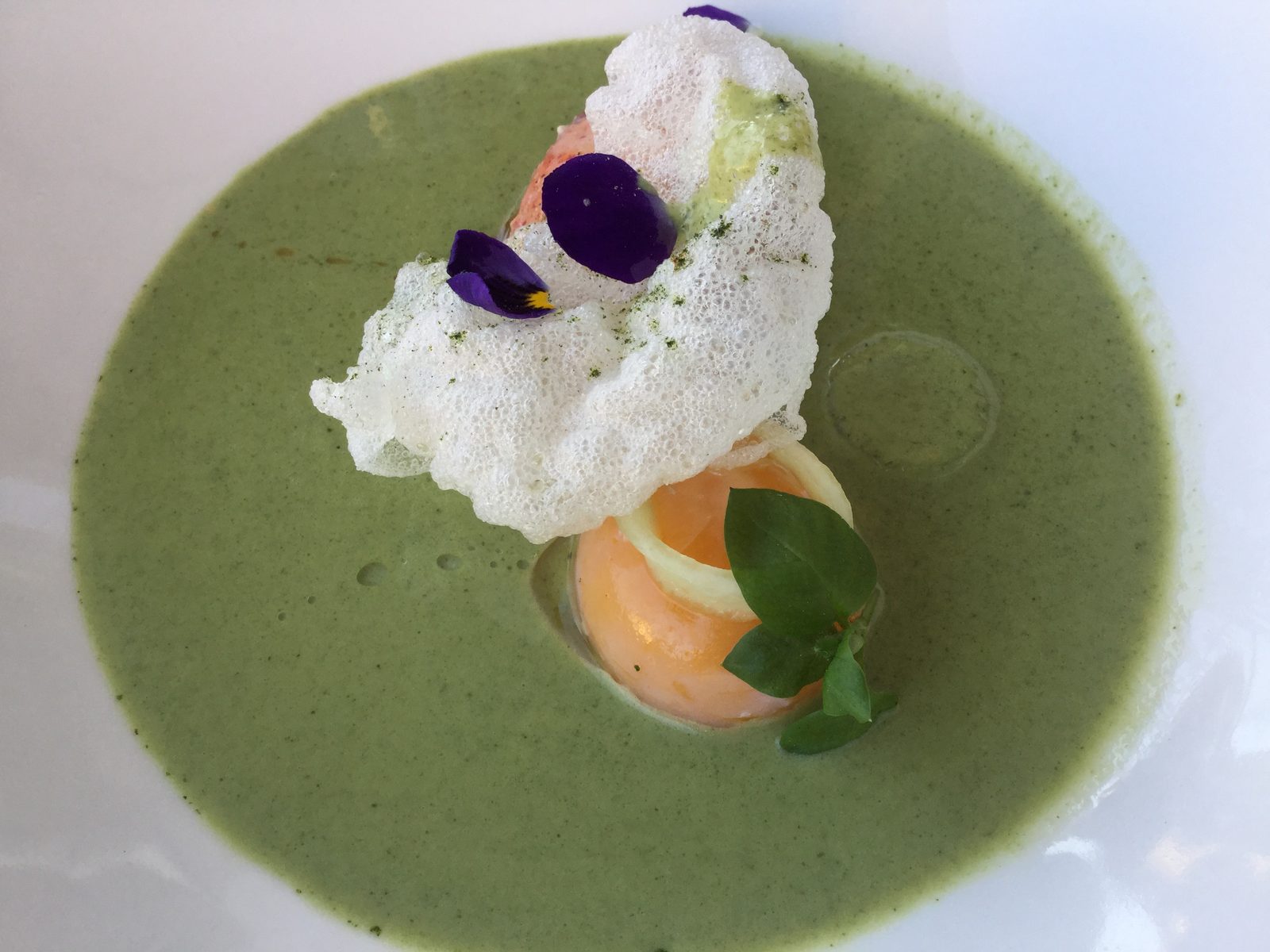
The one technique that matters: cook the nettles briefly, then stop. Two to three minutes is plenty. Simmer them for twenty and you get a grey-brown, bitter broth instead of that electric green. The colour is not decoration here. It is the warning light for flavour.
The other non-negotiable is fat. Nettle tastes green, mineral and faintly austere, somewhere between spinach and young cabbage. Butter rounds that edge off and turns a survival dish into something you would happily order twice. That part is period-accurate too: butter was everyday food in the North, not a luxury, and it was used with a heavy hand.
Ingredients
Serves 4:
- 300 g young nettle tops (about 2 large handfuls, picked before flowering)
- 1 large onion or 1 leek
- 3 tbsp butter
- 60 g pearl barley (or 2 tbsp barley flour to thicken)
- 1.2 l well-flavoured stock (meat or vegetable)
- 150 g soured cream, crème fraîche or skyr
- 1 tsp salt
- 1/2 tsp whole caraway seeds
- Freshly ground pepper
- Optional: 2 hard-boiled eggs, halved, to serve
Instructions
- Prepare the nettles. Wearing gloves, pick only the top four to six tender leaves and strip out thick stems. Wash thoroughly in cold water and drain.
- Start the barley. Add the pearl barley to the stock and simmer over medium heat for 25 to 30 minutes until tender. It gives the soup both body and a gentle nutty base note.
- Sweat the onion. Finely dice the onion or leek and soften it in 2 tbsp butter without letting it colour. Season with the salt and caraway.
- Blanch the nettles. Drop the washed leaves into the simmering stock and cook for just 2 to 3 minutes. The moment they collapse and turn deep green, they are done.
- Blend. Add the buttery onion and blitz smooth with a stick blender. For a rustic version, blend only half and leave the rest as texture.
- Finish. Take the pot off the heat, stir in the soured cream or skyr, and swirl in the last knob of butter. Do not let it boil again or the dairy will split.
- Serve. Season with pepper, set half a boiled egg in each bowl and serve hot, ideally with warm Viking flatbread.
Tips & Variations
- When to pick: from the first shoots until just before flowering, roughly March to May depending on where you live. After that the leaves turn tough and stringy. Cut plants back in summer and you get a second flush.
- Where to pick: away from roadsides, dog-walking routes and fertilised field margins. Woodland edges, stream banks and neglected old gardens are the better addresses.
- The lean version: skip the cream, thicken with a spoonful of barley flour and simmer a piece of bacon in the pot. This is about as close to a tenth-century weekday as a modern kitchen gets.
- The feast version: a quenelle of skyr, toasted hazelnuts and a poached egg on top. The survival dish becomes a course you would put in front of guests.
- Mix your greens: ground elder, wild garlic, sorrel and young dandelion all belong. Sorrel adds acidity and makes the dairy almost unnecessary.
- Freeze ahead: blanch, squeeze dry and freeze in portions. Then you can have this soup in November too.
This recipe is only a taste of what is coming: our cookbook “Viking Feast” holds 141 Nordic recipes, from cauldron dishes and feast-day roasts to bread, mead and wild-greens cooking. See the cookbook
What Stays on the Spoon
Sagas tell you about kings and battles, but nobody survived March on silver. They survived it on what grew against the fence. The nettle was never a delicacy in the North; it was insurance, and it was free. That is precisely why this soup tastes so convincingly northern: short on ingredients, long on flavour, and built entirely from what happens to be there. Cook it once from leaves you picked yourself and you will understand Viking food better than any chapter about roaring mead halls ever taught you.
Image credit: Sinikka Halme (CC BY-SA 4.0), via Wikimedia Commons